An away rotation at an ACGME site is not universally essential for DO applicants—but for competitive specialties and academic programs, skipping one can absolutely tank your chances.
Let me be blunt: the people who tell you “away rotations don’t really matter anymore” are usually either
- applying to less competitive fields, or
- looking back with survivor bias.
You need a more precise answer than that. So here it is.
1. The Real Question: “Essential” For What?
You can’t answer “Is an ACGME away essential?” in a vacuum. You have to specify what target you’re aiming at.
Break it down into four buckets.
| Target Programs/Specialties | How Critical Is an ACGME Away? | Notes |
|---|---|---|
| Highly competitive (Derm, Ortho, ENT, PRS, etc.) | Virtually essential | Often 1–2 aways expected |
| Mid-competitive academic (EM, Anes, Rad, Neuro) | Very important / functionally required | Especially for university programs |
| Community IM, FM, Psych (non-elite) | Helpful, not required | Strong app can match without away |
| Rural/community-heavy DO-friendly programs | Usually optional | Fit and interest matter more |
So, ask the right question:
For Derm, Ortho, ENT, Neurosurgery, PRS and similar:
An ACGME away at a target program (or at least a similar-level ACGME place) is basically table stakes now.
You’re not technically disqualified without one, but you’re realistically behind.For Emergency Medicine, Anesthesiology, Radiology, Neurology, PM&R, OB/GYN:
An ACGME away is strongly recommended, especially if:- Your home institution doesn’t have that specialty
- Your home core rotation was at a smaller community site
- You want an academic program or big city
For Internal Medicine, Family Medicine, Psychiatry at non-elite, non-ivory-tower programs:
An away at an ACGME site is a plus, not a requirement.For very DO-friendly, community-heavy programs (especially in the Midwest/South with a history of taking DOs):
Many applicants match there with no ACGME away, just solid performance and good letters.
So no, it’s not “essential” across the board.
But for certain paths, not doing one is like trying to run a marathon with one shoe.
2. Why ACGME Aways Matter So Much More for DOs
ACGME aways aren’t just about “extra experience.” They solve three specific DO problems in the residency selection world.
Problem 1: Bias and Unknown Schools
Some PDs don’t know your DO school. Or worse, they have outdated opinions.
An ACGME away lets you:
- Prove you can work at the same level as MD students
- Show you understand ACGME culture and expectations
- Put your performance in a context PDs trust (“they did great on rotation at X well-known program”)
I’ve seen this play out: a DO student from a smaller school rotates at a big-name academic center, outworks the MD students, and suddenly that PD is vouching for them up and down the rank list. Without that month, they’re just another unknown DO applicant in the ERAS stack.
Problem 2: Letters of Recommendation (LORs) from Known Names
Right or wrong, a letter from:
- “John Smith, MD – Chair of Orthopedic Surgery, Big State University”
carries more weight than:
- “Assistant Clinical Professor at small community site nobody’s heard of”
Even if both say you’re amazing.
A strong ACGME away gets you:
- A letter on academic letterhead
- From someone who regularly writes for MD applicants
- Who speaks the program’s language (“top 5% of students I’ve worked with in 10 years”)
For a DO applicant, this can be the difference between “let’s interview them just to see” and “auto-reject.”
Problem 3: The “Audition” for Competitive Spots
In competitive fields, the away rotation is the interview before the interview.
Programs use aways to:
- See if you fit their culture
- Watch you handle call, consults, stress
- Decide whether you’re worth spending an interview spot on
For DOs, where there may already be skepticism, this is your chance to remove doubt in 4 weeks instead of trying to convince them in one 20-minute Zoom interview.
3. When an ACGME Away Is Functionally Required
If you’re in any of these situations, I’d treat an ACGME away as mandatory, not optional.
Situation A: No Home Program in Your Specialty
Example: You’re a DO at a school without an in-house Dermatology, Ortho, or EM residency.
Then an ACGME away rotation:
- Shows you’ve actually seen the specialty in a residency environment
- Gives you a specialty-specific LOR (huge)
- Signals seriousness to PDs
Without that, your whole application screams: “I think I like this specialty based on shadowing and vibes.”
Situation B: Highly Competitive Specialty + DO Applicant
Let’s be specific. If you’re applying as a DO to:
- Dermatology
- Orthopedic Surgery
- Neurosurgery
- ENT
- Plastic Surgery
- Urology
- Interventional Radiology
- Sometimes EM at very academic places
Not doing at least one ACGME away is playing on hard mode.
Most matched DOs in these fields:
- Did 1–3 away rotations, often all ACGME
- Targeted programs known to take DOs
- Got at least 1 major letter from an ACGME academic sponsor
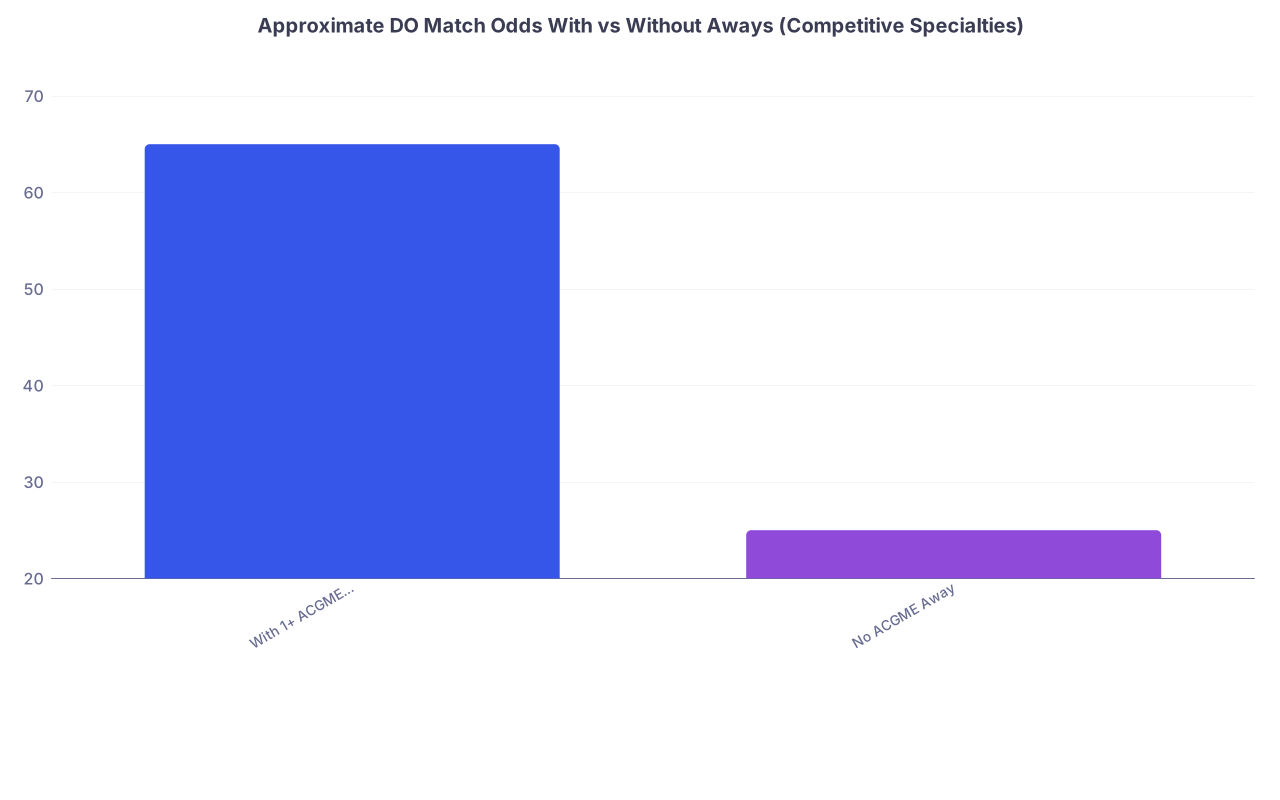
| Category | Value |
|---|---|
| With 1+ ACGME Away | 65 |
| No ACGME Away | 25 |
The exact percentages vary by year and specialty, but the pattern is consistent: aways dramatically improve your odds.
Situation C: Weak Institutional Name + Ambitious Target
If you’re from:
- A newer DO school
- A school without a strong local academic hospital
- A region that’s unfamiliar to your target programs
Then an ACGME away at a more recognizable site reassures programs:
- You’ve handled higher acuity
- You’ve worked with complex cases
- You understand teaching-hospital expectations
4. When an ACGME Away Is Helpful but Not Required
Now let’s talk about where you can breathe.
Scenario 1: Community-Focused FM, IM, Psych
For DOs aiming at:
- Typical community Family Medicine
- Non-university Internal Medicine
- Community Psychiatry
You can absolutely match without an ACGME away if you have:
- Solid COMLEX/USMLE scores
- Consistent clinical performance
- Reasonable geographic strategy
- Decent letters from your core sites
Here, aways are more about:
- Geography (showing you’re serious about a region)
- Fit (seeing if you like the vibe)
- Networking (making sure they remember you at rank time)
They’re nice. They’re not life-or-death.
Scenario 2: You Already Have Strong ACGME Exposure
Example:
- Your core rotations are all at a big ACGME academic center
- You’ve already got strong letters there
- Your specialty is mid-competitive (like IM or FM with no subspecialty ambitions yet)
In that case, using an elective for research or a different subspecialty might be smarter than chasing an away just for the logo.
5. How Many ACGME Aways Should a DO Applicant Do?
You don’t need to live on the road MS4 year. Target strategically.
Here’s a reasonable framework:
| Target Level | Suggested # of ACGME Aways |
|---|---|
| Hyper-competitive specialties | 2–3 |
| Mid-competitive academic programs | 1–2 |
| Community-focused FM/IM/Psych | 0–1 |
| Rural/community DO-friendly programs | 0 |
Rule of thumb:
If your specialty is audition-heavy (ortho, EM, neurosurg, etc.):
2–3 well-chosen away rotations.If your specialty is audition-light (FM, typical IM, most Psych):
0–1 away is plenty, if any.
Don’t forget:
Each away is:
- 4 weeks of performance pressure
- Travel, housing costs, lost income from side work
- A chance to either help or hurt your application depending on how you show up
Spamming aways you can’t crush is not a good strategy.
6. How to Prioritize If You Can Only Afford 1 Away
A lot of DO students don’t have unlimited money or flexibility. So if you can realistically only do one ACGME away, here’s how to pick.

| Step | Description |
|---|---|
| Step 1 | Need to Pick 1 Away |
| Step 2 | List DO-Friendly Academic Programs |
| Step 3 | Identify Desired Region |
| Step 4 | Apply to Those First |
| Step 5 | Pick Strongest Program With Recent DO Matches |
| Step 6 | Choose ACGME Program in Target Region |
| Step 7 | Maximize Chance of Strong Letter |
| Step 8 | Competitive Specialty? |
| Step 9 | Any Program Already Takes DOs? |
Simplified priority list:
Programs that:
- Already take DOs
- Have DOs in current resident classes
- Are in a region you’d genuinely live in
Programs where:
- You can get real responsibility (not just shadowing)
- You’ll work closely with PDs/chairs who write letters
- The rotation timing lets your letter be in before ERAS deadlines
Avoid:
- Programs that historically don’t touch DOs at all
- Late-year aways that won’t impact interviews
- Places infamous for chewing through rotators without ever ranking them
7. If You Can’t Do an ACGME Away as a DO
Sometimes it’s not feasible. Family, health, money, school policies, whatever. You’re not doomed. But you need a compensation plan.
Here’s what you do instead:
Max out your home rotation performance
Honors, great evaluations, strong shelf performance.Secure the best possible letters from what you do have
- Rotate with the PD or chair at your home/affiliate site
- Ask explicitly for “a strong letter for X specialty”
Use research to break into academic circles
- Remote projects with an ACGME institution
- Case reports or QI work with someone who has a recognizable name
Be extremely strategic where you apply
- Prioritize DO-friendly programs
- Look at current resident lists for DOs
- Don’t waste money on places with 0 DOs in 5+ years
Explain constraints if needed
If you had a real barrier (caregiving, major financial issue, visa restriction), you can briefly mention it in your personal statement or signaling conversation. Not as an excuse—just context.
8. Answering the Core Question Directly
Let me answer the original question in one sentence:
For a DO applicant, an away rotation at an ACGME site is essential if you’re shooting for competitive or academic programs, and optional but beneficial if you’re primarily targeting community, DO-friendly residencies.
Not everyone needs one.
But if you’re a DO aiming high, acting like “aways don’t matter anymore” is self-sabotage.
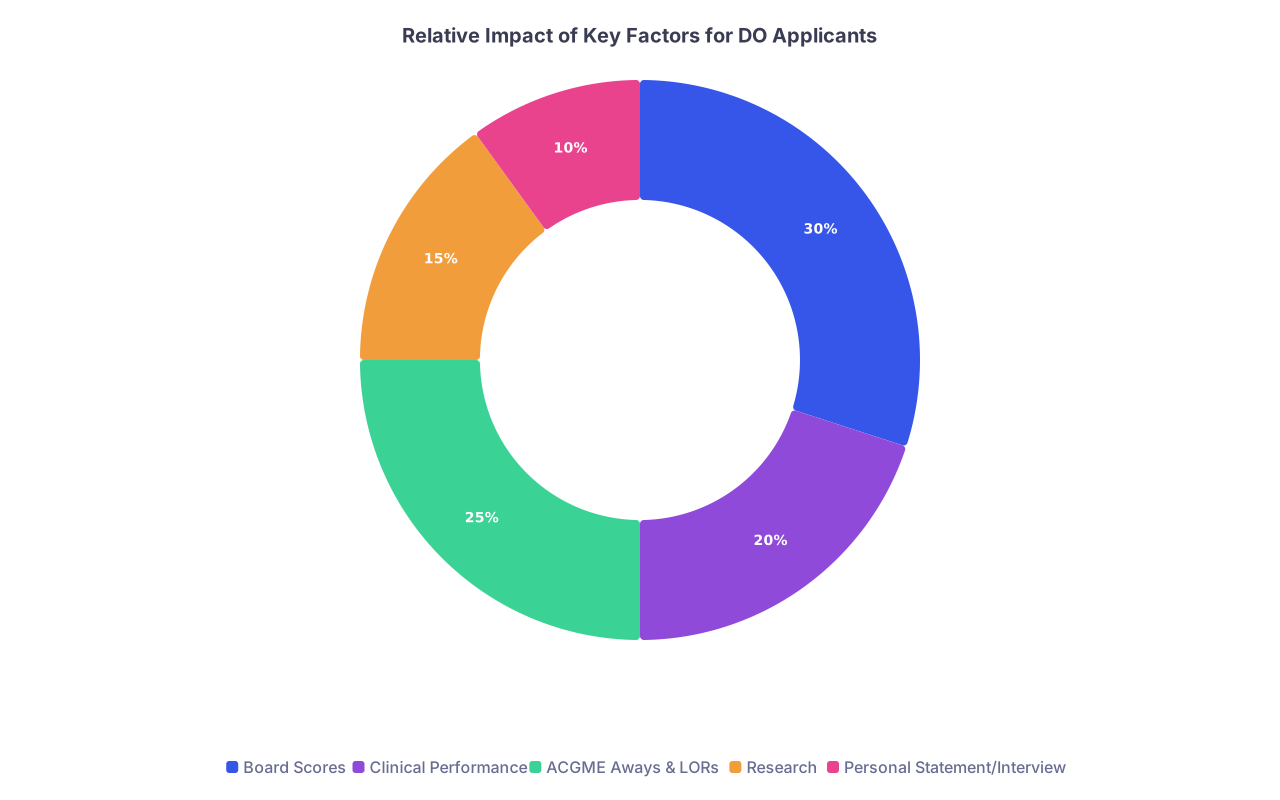
| Category | Value |
|---|---|
| Board Scores | 30 |
| Clinical Performance | 20 |
| ACGME Aways & LORs | 25 |
| Research | 15 |
| Personal Statement/Interview | 10 |
Aways and the letters they generate are not everything. But they’re a big enough slice of the pie that ignoring them is not smart.
FAQ (Exactly 6 Questions)
1. Is an ACGME away rotation absolutely required for DOs to match any residency?
No. Plenty of DOs match every year without an ACGME away, especially into Family Medicine, Internal Medicine, and Psychiatry at community or DO-friendly programs. It becomes “functionally required” when you’re aiming at competitive specialties or academic university programs that lean heavily on aways to choose interviewees.
2. If I can only do one away, should I prioritize an ACGME site over a strong osteopathic site?
If you’re targeting competitive or academic programs, yes—prioritize an ACGME site that already has a history of accepting DOs. That said, a powerful letter from a well-known DO academic at a strong osteopathic site can still carry real weight, especially in DO-friendly programs. But if you want to break into MD-heavy or historically MD-dominant spaces, the ACGME away wins.
3. Do ACGME away rotations help DOs even if my school already has an affiliated ACGME teaching hospital?
Yes, but the marginal benefit is smaller. If your core training is already at a solid ACGME academic center, one carefully chosen away can expand your network and open doors at a different institution or region. But stacking multiple aways may not be as high-yield as doing research, leadership, or sub-specialty experiences, depending on your goals.
4. Can I substitute research at an ACGME institution for an away rotation?
Research helps, especially if it’s with faculty in your target specialty at an ACGME institution, but it’s not a full substitute. Aways show how you function on the wards, in the OR, or in clinic. Research shows academic curiosity and follow-through. The ideal combination for a DO in a competitive field is both: one strong ACGME away plus visible research output or ongoing projects.
5. How late is too late to do an away rotation for it to help my DO application?
If your away is so late that letters won’t be ready by the time programs review ERAS (usually early–mid October), its impact on interviews goes way down. For DOs trying to leverage an away for LORs and interview invites, aim for rotations between roughly July and September of your application year. Anything starting after October is mainly for experience and maybe rank-list nudging, not interview generation.
6. What’s worse: no ACGME away, or a mediocre performance on an ACGME away?
A bad or lukewarm away can hurt more than having no away at all, especially in small programs where everyone talks. If you’re going to do an ACGME away, treat it like a live audition: show up early, know your patients cold, read at night, and be aggressively reliable. If you’re not in a position to perform at that level—for health, burnout, or life reasons—it might be smarter to skip the away and double down on places already friendly to DOs.
Two key takeaways:
- As a DO, you don’t always need an ACGME away—but if you’re aiming up the ladder (competitive or academic), you probably do.
- If you do it, do it right: pick the right program, at the right time, and treat those four weeks like the most high-stakes job interview you’ve ever had.