
Is It Better for DOs to Get LORs from MDs or DOs for ACGME Applications?
What actually matters more for a DO applicant: a glowing letter from an MD at a big-name academic center, or a strong LOR from a DO who knows you well and is in your chosen specialty?
Here’s the short answer you’re looking for:
For most ACGME programs, the writer’s specialty, seniority, and how well they know you matters more than MD vs DO.
But for osteopathic-focused programs or when you’re a DO applying to a historically MD-heavy specialty, having at least one strong DO letter in your field is smart—and sometimes expected.
Let’s break this down so you stop guessing and start planning.
The Real Priority List for LORs (MD vs DO Is Not #1)
If you remember nothing else, remember this hierarchy.
When program directors scan your letters, they care about these things, roughly in this order:
- How strong and specific the letter is
- Does the writer know you well clinically?
- Is the writer in your chosen specialty?
- Is the writer senior / respected (program director, associate PD, chair, core faculty)?
- Is the writer from an ACGME-affiliated institution / recognized hospital?
- Then, way down the list: MD vs DO
So if you’re choosing between:
- A generic MD letter from someone who barely remembers you
vs - A detailed DO letter from a core faculty in your target specialty who supervised you closely
You pick the second one. Every time.
Where it gets tricky is in a few specific situations, which we’ll get into.
When a DO Letter Is Better (or Safest)
There are scenarios where a DO letter is either preferred or quietly expected.
1. You’re applying to ACGME programs that are historically osteopathic-friendly
Many former AOA/osteopathic programs that merged into ACGME still care about:
- Demonstrated interest in osteopathic medicine
- Commitment to the DO identity
- Sometimes osteopathic principles and manipulative treatment (in certain fields)
In those programs, having at least one DO LOR (ideally in your specialty) is a plus and occasionally a soft requirement.
Examples where DO letters can help:
- Community FM, IM, EM, psych programs that previously took mostly DOs
- Osteopathic-recognized tracks (e.g., IM with an osteopathic focus)
In these settings, a DO letter signals:
“This student is one of us, understands osteopathic training, and someone in our world is willing to vouch for them.”
2. Your application “story” is heavily osteopathic
If your personal statement, activities, and school are very DO-centric—OMM fellowship, osteopathic student government, OMT clinics—then zero DO letters can look slightly off. Not fatal, but odd.
One DO LOR from:
- Your school’s OMM/Osteopathic principles faculty
- A DO in your chosen field
- A DO PD or core faculty from an audition rotation
…ties the story together.
3. You’re applying DO to a competitive specialty that’s wary of DOs
This is where you stop being casual and start being strategic.
Specialties like:
- Dermatology
- Orthopedic surgery
- ENT
- Ophthalmology
- Neurosurgery
- Some highly competitive anesthesiology, radiology, EM programs
Some of these programs are still figuring out their comfort level with DO applicants. In that environment, a strong DO letter from a well-known DO in the specialty can be gold.
For example:
- A DO ortho attending at a major academic or high-volume ortho site
- A DO dermatologist with strong ties to academic programs
- A DO EM faculty at an ACGME Level I trauma center
If that DO is known in the specialty or is a PD/APD, that helps more than their degree letters.
When an MD Letter Makes More Sense
Let’s not pretend there’s no bias out there. There is.
There are times where an MD letter is more strategic—or at least equally important.
1. You’re applying to highly academic, traditionally MD-dominant programs
Think:
- Big-name university programs (Harvard, UCSF, Duke, etc.)
- Research-heavy residencies
- Historically MD-heavy specialties (derm, ENT, ortho, etc.)
These programs are used to reading MD letters from:
- Chairs
- Division chiefs
- Well-published attendings
- PDs and APDs
If you do a sub-I or away rotation at one of these places, and:
- The faculty is MD
- The environment is MD-dominant
Then a strong MD letter from that setting carries a lot of practical weight. Not because they’re MD, but because:
- They’re “inside” that academic ecosystem
- They may be personally known to other PDs
- Their letter feels more comparable to what they see from MD applicants
2. You rotated at a big academic center and impressed them
If you did an away at a strong ACGME program, and they offer a letter, you do not say “Actually, I’m a DO, I’d prefer a DO letter.”
You take the letter.
If that MD faculty is:
- A PD or APD
- Core faculty in your exact specialty
- Known in the field
That letter probably outranks almost any other letter you could get, MD or DO.
3. Your DO letters are weak and your MD letters are strong
You don’t force DO representation if the content is clearly inferior.
A short, lukewarm DO letter will hurt you more than having no DO writer at all. Programs are not awarding diversity points for token DO letter-writers.
You want:
- Clear statements about your clinical ability
- Direct comparison to peers (“top 10%” / “top student in 5 years”)
- Evidence-based praise: cases you handled, initiative, reliability
- Professionalism and work ethic described in detail
If your MD letters do that and your DO letters don’t, you lean on the MD ones.
Strategy by Specialty: MD vs DO LOR Mix
Let me give you a practical, not-perfect, but useful breakdown.
| Specialty Type | Recommended Mix (3 LORs) |
|---|---|
| Primary Care (FM, IM, Peds) | 1–2 DO, 1–2 MD |
| EM (moderate competitiveness) | 1 DO, 2 MD or 2 DO, 1 MD |
| Psych, Neuro, PM&R | 1 DO, 2 MD or 2 DO, 1 MD |
| Surgical (Gen Surg, OB/GYN) | 1 DO, 2 MD |
| Highly Competitive (Ortho, Derm, ENT, etc.) | 1 strong DO in specialty + 2 strong MDs or vice versa, prioritize strength over degree |
Notice the pattern:
- Mix is usually best if you can get equally strong MD and DO letters
- Primary care and EM are the most tolerant of more DO-heavy letters
- Competitive specialties: focus on writer prestige + strength + specialty first
How Many DO Letters Do You Actually Need?
Most ACGME programs do not have a stated “DO letter requirement.”
The usual expectations:
- 3 letters total (some allow 4 in ERAS, but many programs only read 3 carefully)
- Often 2 in your specialty + 1 from something else (IM, surgery, dean’s/MSPE, etc.)
Here’s a reasonable target as a DO:
- Minimum: 0 required for many programs, but this is not ideal for osteopathic-leaning programs
- Safe middle ground: 1 strong DO letter in your target specialty
- Very osteopathic-focused path (e.g., applying mostly to former AOA programs): 2 DO letters can be fine, especially if they’re from core faculty or PDs
What you never do: sacrifice letter strength just to manipulate your MD:DO ratio.
What Program Directors Actually Complain About
I’ve heard versions of this in PD meetings and faculty lounges:
- “I can’t tell who this student is from this letter.”
- “This is clearly a template. They changed the name and sent it.”
- “Three letters from non-specialists. Not one from our field.”
- “No one compares them to peers. I don’t know if ‘hard-working’ means average or amazing.”
Notice what’s missing?
“Ugh, this letter is from a DO.”
That’s not a serious complaint in 2026 at most ACGME sites. What is a problem:
- Generic language
- No direct supervision
- No specific examples
- No ranking or comparison
- All letters from the same small home institution with no outside perspective (especially for competitive specialties)
Your move: worry more about content and context than letters after the name.
Step-by-Step: How to Decide Between Two Potential Letter Writers
If you’re stuck choosing, run this quick internal checklist.
You’re choosing between Dr. A (MD) and Dr. B (DO).
Ask yourself:
- Who supervised me more closely?
- Who is in my target specialty?
- Who saw me on my best days, not just average ones?
- Who has a title that looks good on paper (PD, APD, core faculty, chief)?
- Who would actually remember specific patients or stories with me involved?
- Who writes more enthusiastically about students, based on what I’ve seen/been told?
If Dr. B (DO) wins 4 out of 6 but Dr. A is at a bigger name place, you still usually pick Dr. B.
The only major exception: if Dr. A is a PD or big name at a highly desirable program in your specialty and you did very well with them, that carries huge weight.
Timeline: When to Lock in MD vs DO Letters
Stop waiting until September to figure this out.
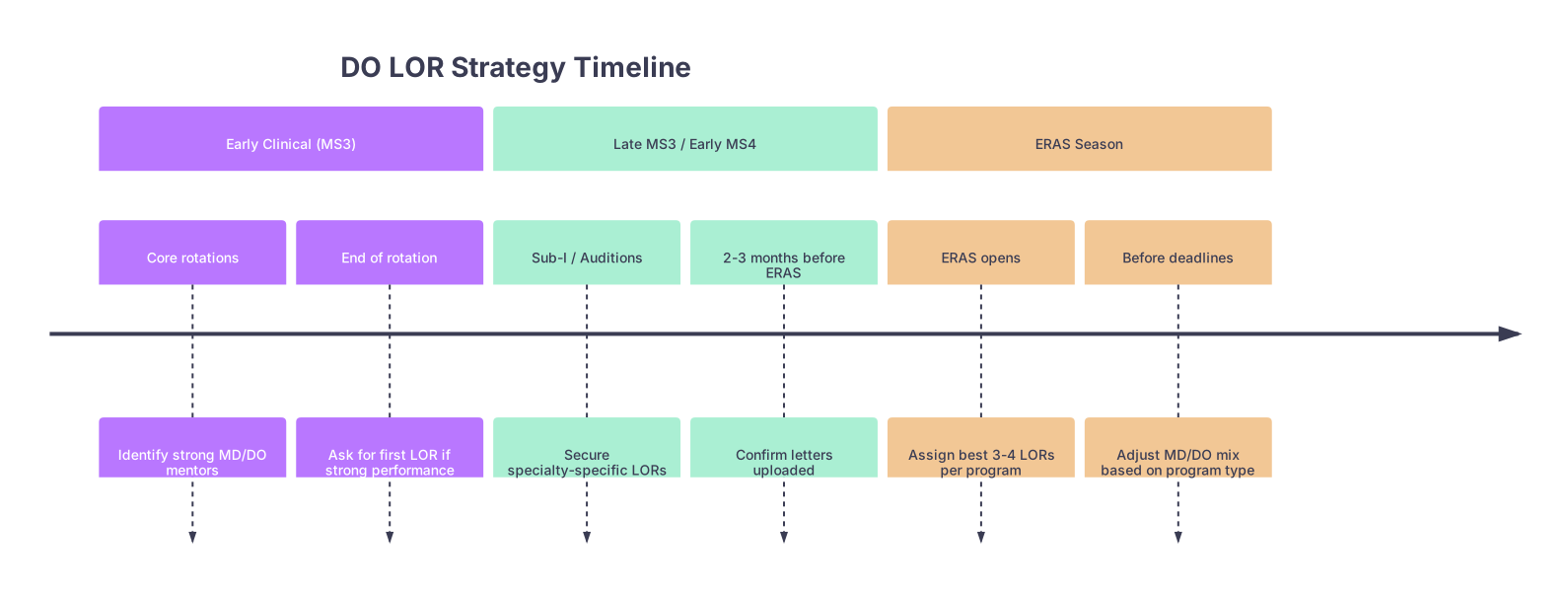
| Period | Event |
|---|---|
| Early Clinical (MS3) - Core rotations | Identify strong MD/DO mentors |
| Early Clinical (MS3) - End of rotation | Ask for first LOR if strong performance |
| Late MS3 / Early MS4 - Sub-I / Auditions | Secure specialty-specific LORs |
| Late MS3 / Early MS4 - 2-3 months before ERAS | Confirm letters uploaded |
| ERAS Season - ERAS opens | Assign best 3-4 LORs per program |
| ERAS Season - Before deadlines | Adjust MD/DO mix based on program type |
Rough plan:
MS3 core rotations:
Aim for at least 1 strong medicine/surgery/primary care letter (MD or DO)Early MS4 / sub-Is / auditions:
Get 1–2 letters in your chosen specialty (ideally one DO somewhere in the mix)Before ERAS opens:
You should already know your pool: maybe 4–5 letters total, a mix of MD/DO, then you assign strategically per program.
Visual: Typical LOR Mix for DO Applicants
Here’s what I usually see among successful DO applicants:
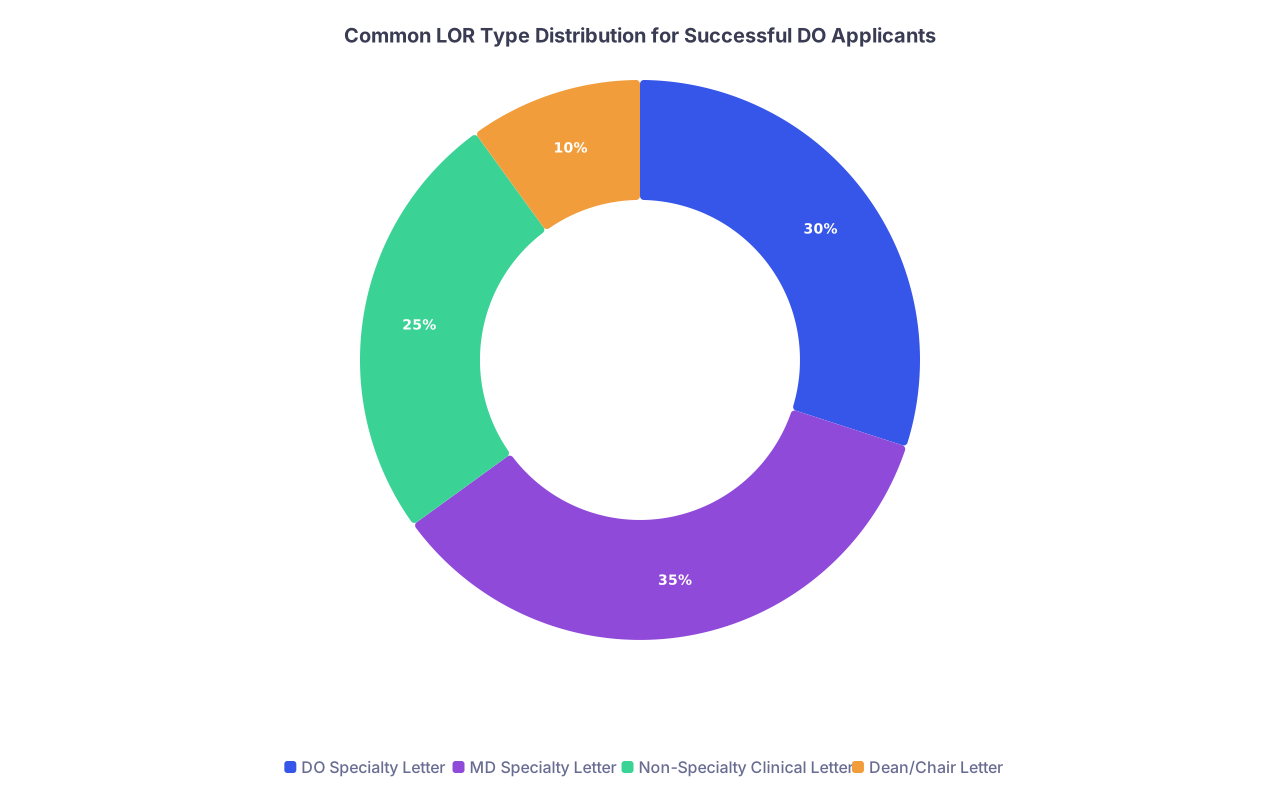
| Category | Value |
|---|---|
| DO Specialty Letter | 30 |
| MD Specialty Letter | 35 |
| Non-Specialty Clinical Letter | 25 |
| Dean/Chair Letter | 10 |
You’re not trying to game some perfect ratio. You’re trying to build a coherent, convincing picture of you as a capable resident.
Common Mistakes DO Applicants Make with LORs
Let me be blunt about the big ones.
Chasing a famous MD’s lukewarm letter instead of a strong DO’s detailed letter.
Name recognition does not save a weak letter.All letters from your home DO school; no external validation.
Especially bad for competitive specialties. At least one outside ACGME letter helps.No specialty-specific letter.
Trying to match EM with zero EM letters? That’s almost self-sabotage.Waiting too long to ask.
Faculty forget details, and you get vague fluff instead of sharp descriptions.Overvaluing degree, undervaluing narrative.
Programs decide whether they can trust you on call at 3 a.m. The letter that best shows that is the one you want, MD or DO.
Putting It All Together: A Simple Rule Set
You’re a DO applying ACGME. Use this as your quick rule book:
- You do not “need” all DO letters.
- You should try to have at least one strong DO letter somewhere, ideally in your specialty or from core osteopathic faculty.
- For competitive or academic-heavy specialties, mix DO and MD letters and lean slightly toward the most senior, respected, specialty-specific writers.
- Always prioritize: strength, specificity, and relationship → over MD vs DO.
- Don’t be cute. Don’t chase optics at the expense of substance.
If you can check those boxes, you’re doing this part right.

FAQ: LORs for DOs Applying to ACGME Programs
1. Do ACGME programs prefer MD letters over DO letters?
Most do not explicitly prefer MD over DO. They prefer:
- Strong, specific, detailed letters
- From people in your specialty
- Who are known educators or faculty
If a DO faculty member fits that better than an MD, their letter will carry more weight for you.
2. Is it bad if all my letters are from DOs?
Not inherently. Many DO-heavy or community-based programs won’t care.
It becomes more of an issue if:
- You’re aiming at very academic MD-heavy programs, and
- You have no letters from ACGME university hospitals or well-known centers
The real red flag is “insular” letters, not DO vs MD by itself.
3. As a DO, should I have at least one DO letter in my chosen specialty?
If possible, yes. Particularly if:
- You’re applying to osteopathic-friendly or former AOA programs
- You’ve had meaningful clinical exposure with DO attendings in that specialty
It’s not mandatory everywhere, but it’s a smart move when you can do it without sacrificing letter strength.
4. For EM, should I prioritize SLOEs from MD or DO attendings?
For EM, SLOEs (Standardized Letters of Evaluation) outrank everything.
Whether they’re signed by MD or DO matters far less than:
- They’re true SLOEs (not “regular” letters)
- They come from ACGME EM programs or well-recognized EM sites
- They reflect strong clinical performance
EM cares much more about the SLOE format and content than MD vs DO.
5. If I have a famous MD willing to write a short generic letter, should I use it?
Usually no. A short, generic letter from a big name is weaker than a detailed, enthusiastic letter from a less-famous DO or MD who actually knows you.
Use the famous name only if they can genuinely speak to your work and potential.
6. Can I assign different LOR combinations to different programs?
Yes, and you should. ERAS lets you upload more letters than you assign to any single program.
You can:
- Use more DO-heavy combos for osteopathic-leaning or community programs
- Use more MD/academic combos for university programs
- Keep at least one strong specialty-specific letter in every combination
7. What if my only strong letter option in my specialty is from a DO at a small hospital?
Use it. A strong, specific DO specialty letter from a smaller site is better than no specialty letter or a generic MD letter. You can then balance it with other letters from larger or more academic settings if available.
Key takeaways:
- MD vs DO is secondary; strength, specificity, and specialty match matter more.
- As a DO, aim for at least one strong DO letter, but don’t force it if it weakens your overall LOR set.
- For competitive or academic programs, a balanced MD/DO mix with at least one big-name or specialty leader letter is ideal—if and only if they can write you a genuinely strong letter.