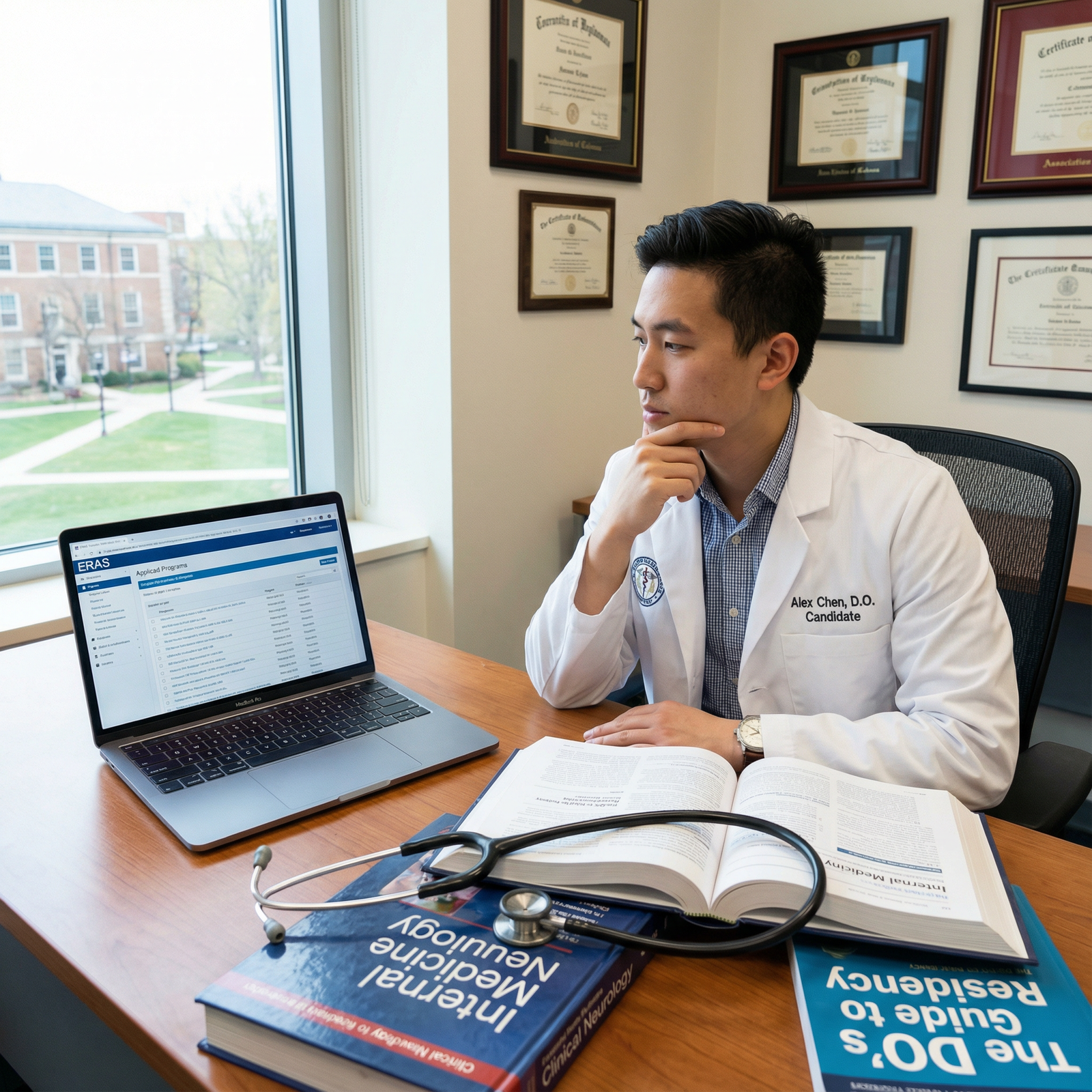
You’re an OMS‑3 or early OMS‑4, sitting in a call room between patients, scrolling Reddit threads and SDN posts. You keep seeing the same message: “You must have research to match derm, ortho, rads, anesthesia, or any competitive ACGME specialty—especially as a DO.”
You look at your CV. Solid clinical evals. Some leadership. Maybe decent COMLEX and/or Step. But under “Research”? Nothing. Or one half-baked project that never went anywhere.
Here’s the blunt question you’re asking:
Can a DO match a competitive ACGME specialty without research experience?
Let me answer that clearly, then we’ll unpack it.
The Short Answer: Yes, But Only In Very Specific Situations
You can match a competitive ACGME specialty as a DO without meaningful research. I’ve seen it happen.
However:
- It’s rare at highly academic programs.
- The more competitive the specialty, the more your other metrics must be exceptional.
- You’ll be locked out of a big chunk of university and top-tier programs.
- You must be strategic as hell about where and how you apply.
If you’re aiming for something like anesthesiology, PM&R, EM (where still competitive but more forgiving), it’s more doable.
If you’re talking about derm, ortho, neurosurgery, plastics, ENT, rad onc, or IR — having no research is a major handicap. Not a death sentence, but a handicap.
Let’s talk specifics.
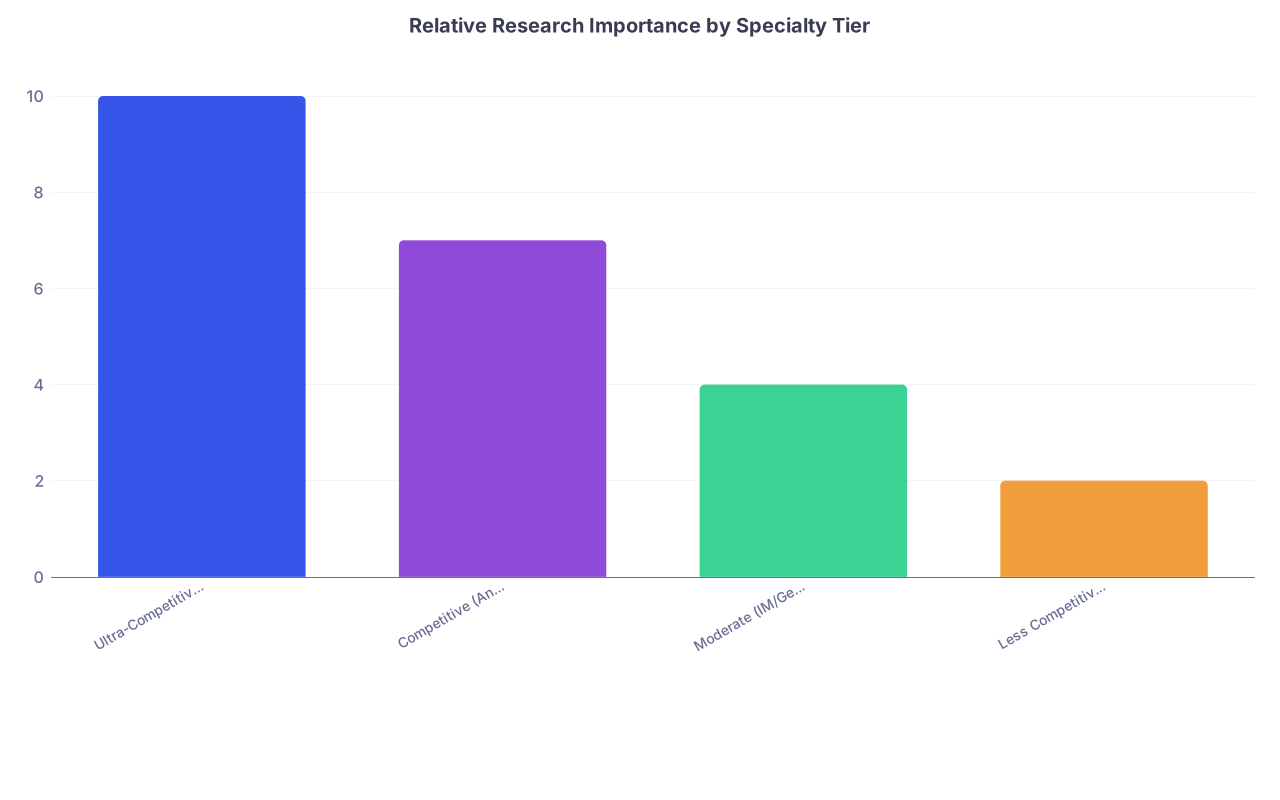
| Category | Value |
|---|---|
| Ultra-Competitive (Derm/Ortho/Neurosurg) | 10 |
| Competitive (Anes/Rads/EM) | 7 |
| Moderate (IM/Gen Surg/OBGYN) | 4 |
| Less Competitive (FM/Peds/PM&R) | 2 |
What “Competitive” Actually Means For a DO
People throw “competitive” around loosely. For DOs, competitiveness is not just about fill rates. It’s about how willing ACGME programs are to consider osteopathic grads at all.
Here’s a rough reality check:
| Specialty | DO-Friendliness | Typical Research Expectation (MD world) |
|---|---|---|
| Dermatology | Very Low | High |
| Orthopedic Surg | Low | High |
| Neurosurgery | Very Low | Very High |
| Radiology (Dx) | Moderate | Moderate |
| Anesthesiology | Moderate-High | Low-Moderate |
| EM | Moderate-High | Low-Moderate |
| General Surgery | Moderate | Moderate |
If your target is:
Derm / Ortho / Neurosurgery / ENT / Plastics / IR / Rad Onc
→ No research as a DO is a big problem.Anesthesia / EM / Radiology / General Surgery (mid-tier)
→ No research can sometimes be offset by strong scores, great clinical performance, and strategic rotations.IM / FM / Peds / PM&R
→ Research helps, but you absolutely can match ACGME programs without it, even fairly strong ones.
Now let’s go deeper into the “how.”
What DOs Actually Need To Offset No Research
If you’re going into this with basically zero research, then at least one of these must be true (and ideally several):
Strong scores for your target specialty
- For competitive fields, think:
- COMLEX Level 2: ≥ 620–650+
- USMLE Step 2 (if taken): ≥ 245–250+
- For moderately competitive fields, a bit lower is fine, but “average” scores plus no research is a weak combo.
- For competitive fields, think:
Outstanding clinical performance on away rotations
- Honors-level performance, stellar narrative evaluations.
- Faculty explicitly saying: “This student is in my top 5–10 rotators of the last few years.”
- Ideally, a home or away rotation where attendings routinely send people into that specialty.
Very strong letters of recommendation
- Letters that sound like:
- “I would rank this student at the very top of our list.”
- “They performed at or above the level of our interns.”
- Bonus: Letters from well-known people in the specialty (this matters more than people want to admit).
- Letters that sound like:
Clear specialty-specific commitment
- Electives in that field.
- Specialty-specific leadership, clinics, volunteer work, teaching.
- For example: ortho interest group officer, sports coverage, fracture clinics, etc.
-
- Mix of community and academic programs.
- Identify programs with a track record of taking DOs and of not being obsessed with research.
If you don’t have research and you’re average in the list above, that’s where the wheels come off.

| Step | Description |
|---|---|
| Step 1 | DO without research |
| Step 2 | You need research or a backup plan |
| Step 3 | Focus on scores, letters, and fit |
| Step 4 | Apply broadly to DO-friendly programs |
| Step 5 | Increase scores, consider less competitive specialty |
| Step 6 | Specialty Type? |
| Step 7 | Scores & Rotations Strong? |
Specialty-by-Specialty Reality Check For DOs Without Research
Derm, Ortho, Neurosurgery, ENT, Plastics, IR, Rad Onc
Here’s the reality: for a DO with zero research:
- You’re fighting uphill against:
- MDs with multiple publications.
- People who took dedicated research years.
- Applicants from top schools with big-name mentors.
Can it still happen for a DO with no research? Very rarely. Situations where I’ve seen it:
- The DO student had:
- Step 2 in the 260s / COMLEX 700+ range.
- Incredible away rotator reputation at a DO-friendly program.
- A PD who said, “I don’t care about research; I care about who I want on my team at 2 a.m.”
If you’re dead-set on one of these fields and truly have no meaningful research:
- You should assume:
- Your odds are significantly lower.
- You’ll need to apply extremely broadly.
- You should have a realistic parallel plan (e.g., prelim gen surg, anesthesia, IM).
Anesthesiology, Diagnostic Radiology, EM, General Surgery
This is where a DO can realistically match without research—with the right profile.
For DOs, here’s what I’ve seen work:
Anesthesia:
- Step 2: mid-240s+ or COMLEX 620+.
- Strong anesthesia rotations and letters.
- Programs: often community or hybrid community-academic; DO-friendly.
Diagnostic Radiology:
- Scores really matter here. Step 2 high 240s / low 250s or COMLEX 650+ makes research less critical, especially at DO-friendly programs.
- Strong quantitative mindset, good narrative in your personal statement about why rads.
- Research is common, but some community-heavy or less academic programs care much more about scores and letters.
EM:
- SLOEs (Standardized Letters) matter more than research.
- Strong EM rotations will beat a weak research CV.
- Some academic EM programs do like research, but lack of it won’t sink a DO with great SLOEs and solid scores.
General Surgery (non-elite programs):
- Community and some hybrid programs: they mainly want workhorses who show up early, stay late, and own the floor.
- Research helps for academic gen surg, but for many community programs, it’s optional.
IM, FM, Peds, OB/GYN, PM&R
Here it’s straightforward:
- You can absolutely match these as a DO with no research.
- Where it starts to matter:
- Big-name IM programs (e.g., UMich, Duke, UCSF-style).
- Academic OBGYN.
- University-based PM&R with strong fellowship pipelines.
But if your goal is “solid ACGME program where I’ll be trained well,” not “top-10 academic powerhouse,” then:
- Strong Step/COMLEX
- Good clerkship performance
- Thoughtful personal statement
- Good letters
…will take you far even without research.
How Programs Actually Think About Research For DOs
Here’s the part you rarely see written plainly.
For many ACGME programs—especially academic ones—research isn’t just about “science.” It’s a filter for:
- Does this person understand how academia works?
- Will they help our department’s publication count?
- Have they worked with faculty closely enough to get strong, specific letters?
- Do they look like everyone else our department has historically taken?
For DOs, the bar is often higher. Not officially. But functionally.
So when a PD looks at a DO application for a competitive specialty and sees:
- No publications
- No posters
- No abstracts
- No ongoing projects
…they’re often going to assume:
- You’ll be behind your peers when it comes to scholarly activity.
- You’re less “plug-and-play” for their academic machine.
- You might have had less mentorship or fewer opportunities.
They’re not always right. But that’s how the mental shortcut tends to work.
That’s why:
- Community / DO-friendly programs: more flexible on research.
- Older PDs who trained with DOs or in community settings: more interested in your work ethic than your PubMed ID.
- Big university programs with huge NIH funding: often locked into a research-heavy culture, especially for competitive specialties.
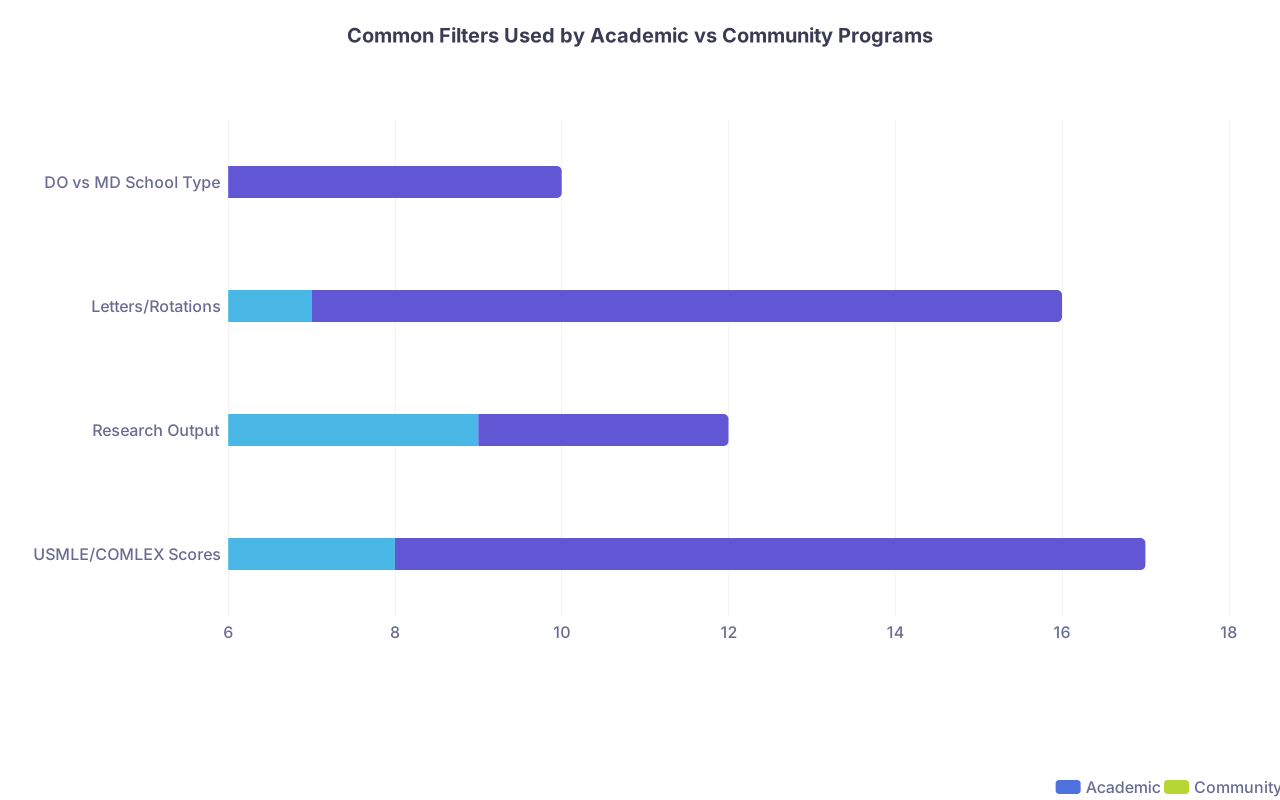
| Category | Academic | Community |
|---|---|---|
| USMLE/COMLEX Scores | 8 | 9 |
| Research Output | 9 | 3 |
| Letters/Rotations | 7 | 9 |
| DO vs MD School Type | 6 | 4 |
If You’re Already OMS‑3/OMS‑4 With No Research: What Now?
Let’s be practical. You’re not going to invent a 3-year research portfolio in 4 months. Stop fantasizing about that.
Here’s what you can do that actually moves the needle.
1. Get Hyper-Serious About Step 2 / COMLEX 2
If these exams are still ahead of you, they’re your biggest lever:
- For competitive specialties:
- Aim for Step 2: 245–250+
- COMLEX Level 2: 620–650+ or higher
A DO with no research but a 252 Step 2 and great rotations is in better shape than a DO with mediocre scores and a half-hearted poster.
2. Crush Your Away Rotations
This matters more than your CV in a lot of programs.
During aways:
- Be early, prepared, and low-maintenance.
- Know the bread-and-butter cases cold for that specialty.
- Ask for feedback mid-rotation and fix what they tell you.
- Leave each rotation with at least one faculty member who wants to write you a strong letter.
3. Find “Fast-Track” Scholarly Activity If You Still Have Time
You don’t need a bench research empire. You just need something that shows engagement.
Possible options:
- Case report with a motivated attending
- Retrospective chart review with a clear, limited scope
- Quality improvement project that turns into a poster at a regional or national meeting
Even one poster or local presentation is way better than a totally blank line.

4. Target Programs Where Research Is Not King
You need a smart list, not a prestige-chasing list.
Focus on:
- Community and community-academic hybrid programs.
- Programs with multiple DO residents visible on their website.
- Regions that are historically more DO-friendly (Midwest, South, some Northeast community systems).
- Programs whose residents’ CVs (if posted) don’t all show mountains of research.
Don’t waste 30 applications on research-heavy academic powerhouses that barely take DOs.
5. Use Your Personal Statement and Interview To Show Maturity
If you lack research, your story should make it clear you weren’t just coasting.
Strong angles:
- You focused on clinical excellence, teaching, leadership, or working to support yourself/family.
- You articulate clearly why this specialty, why you’re a fit, and what you bring day one as an intern.
- You don’t sound defensive about not having research. You sound intentional and grounded.
When You Should Seriously Consider Adding Research Anyway
Let me be blunt. If all of this applies to you:
- You are OMS‑1 or OMS‑2
- You’re thinking about derm/ortho/neurosurg/ENT/plastics/rad onc
- You have zero research yet
…then yes, you should get yourself into research. Yesterday.
Not because every resident in those fields is a research addict. Many aren’t. But because:
- The application filters for those specialties are brutal.
- Many programs auto-screen for research.
- You’re already “non-traditional” in many PDs’ eyes as a DO.
You do not need basic science at a top-5 institution. But you should aim for:
- Some kind of ongoing project.
- At least one abstract/poster.
- Preferably at least one publication (even low-impact, even case report).
That buys you entry into more doors.

| Step | Description |
|---|---|
| Step 1 | OMS-1/2 DO interested in competitive specialty |
| Step 2 | Join faculty research or QI project |
| Step 3 | Secure ongoing involvement over 1-2 years |
| Step 4 | Present poster/abstract at conference |
| Step 5 | Use mentor for strong letter, build narrative |
Bottom Line: Can You Do It? Yes. Should You Rely On That? No.
Summing it up:
- A DO can match a competitive ACGME specialty without research.
- The more competitive the specialty, the less wise it is to gamble on that.
- For ultra-competitive fields, no research as a DO is a major self-imposed handicap.
- For anesthesia, EM, rads, mid-tier gen surg, and most core specialties, you can absolutely match with:
- Strong scores
- Great clinical performance
- Strong letters
- Smart program selection
If you’re already deep into clinical years with no research, your best play is:
- Maximize Step 2 / COMLEX 2.
- Be undeniable on rotations.
- Add any quick, meaningful scholarly activity you still can.
- Aim for programs that have actually welcomed DOs like you before.
If you’re early in school and want a competitive field? Don’t be stubborn. Get involved in research now. It is by far the easiest time in your career to do it.
FAQ (Exactly 6 Questions)
1. I’m a DO applying anesthesia with no research but a 248 Step 2 and 640 COMLEX 2. Do I need to panic?
No. Those are strong scores. You’re very much in the game, especially for DO-friendly and community-heavy ACGME programs. Your priority now is excellent anesthesia rotations, strong specialty-specific letters, and a broad, smart program list. You won’t be the most academic applicant, but you’re absolutely viable.
2. I want ortho as a DO and I have no research. Should I still try?
You can try, but you need to be brutally honest with yourself. Without research, you’re competing against MDs and some DOs with multiple ortho projects, away rotations, and big-name mentors. If your scores are elite and you’re willing to apply extremely broadly and accept a high risk of not matching, go for it—but you must build a parallel plan (prelim surgery, anesthesia, etc.). Blindly applying ortho-only with no research is reckless.
3. Does a single case report or poster really help, or is it just CV decoration?
For you as a DO, yes, it helps. Not because it makes you a scientist overnight, but because it signals: “I engaged. I can see a project through. I understand the basics of scholarly work.” One case report plus good letters is better than a completely empty research section, especially for borderline academic programs.
4. If I have to choose, should I focus on research or Step 2/COMLEX 2 studying?
If you’re late in third year and still haven’t taken Step 2/Level 2, choose the exam first. A 10–15 point jump in Step 2 is usually worth more than a rushed, weak research line. For OMS‑1/2 or early OMS‑3, you can do both: prioritize a strong board foundation and add slow, consistent research involvement in the background.
5. Are there specific programs that truly do not care about research?
Yes—many community and smaller hybrid programs. Often in the Midwest, South, and some non-coastal regions. They may mention “scholarly activity” in their descriptions, but in practice they care more about: “Will this resident work hard, be teachable, and get along with the team?” Look for programs with multiple DO residents and where residents’ bios don’t all scream heavy research.
6. What’s one thing I can do this week if I’m a DO with no research and worried about my chances?
Two options, depending on where you are:
- If exams are coming: build a concrete Step 2/COMLEX 2 study plan and set a score target that will compensate for your lack of research.
- If you have a little breathing room: email 2–3 attendings in your target specialty at your school or rotation site and say, “Do you have any small project, case report, or QI idea I can help with? I’m specifically trying to strengthen my application this year.” Keep the ask small and specific.
Open your current specialty list right now and circle the one you’d be willing to do even if your long-shot dream didn’t work out. Then decide: are you going to keep gambling with zero research, or are you going to either (1) build at least one real scholarly activity, or (2) commit hard to a realistic target specialty and design everything else—scores, rotations, letters—around that?