
The average DO student either ranks too few programs or too many random ones. Both are mistakes.
You do not need 100+ programs on your list. But you also cannot “shoot your shot” with 8 ranks in a competitive specialty and expect the Match to be kind. The real answer sits in the middle—and it depends heavily on your profile and your specialty.
Let me give you numbers.
The Short Answer: Typical Ranges by Risk Level
Here’s the blunt, working rule:
- Low‑risk DO applicant in a less competitive specialty:
10–15 programs ranked is usually enough. - Average‑risk DO applicant in a moderately competitive specialty:
15–25 programs is the realistic target. - Higher‑risk DO applicant and/or more competitive specialty:
25–40+ ranked programs is often what it takes to sleep at night.
If you’re applying to ultra‑competitive fields (derm, ortho, ENT, plastics, etc.) as a DO, the honest answer is: the number of ranks alone won’t save you. You need a strategy, not just a long list.
Let’s anchor this with data and then carve it up by scenario.
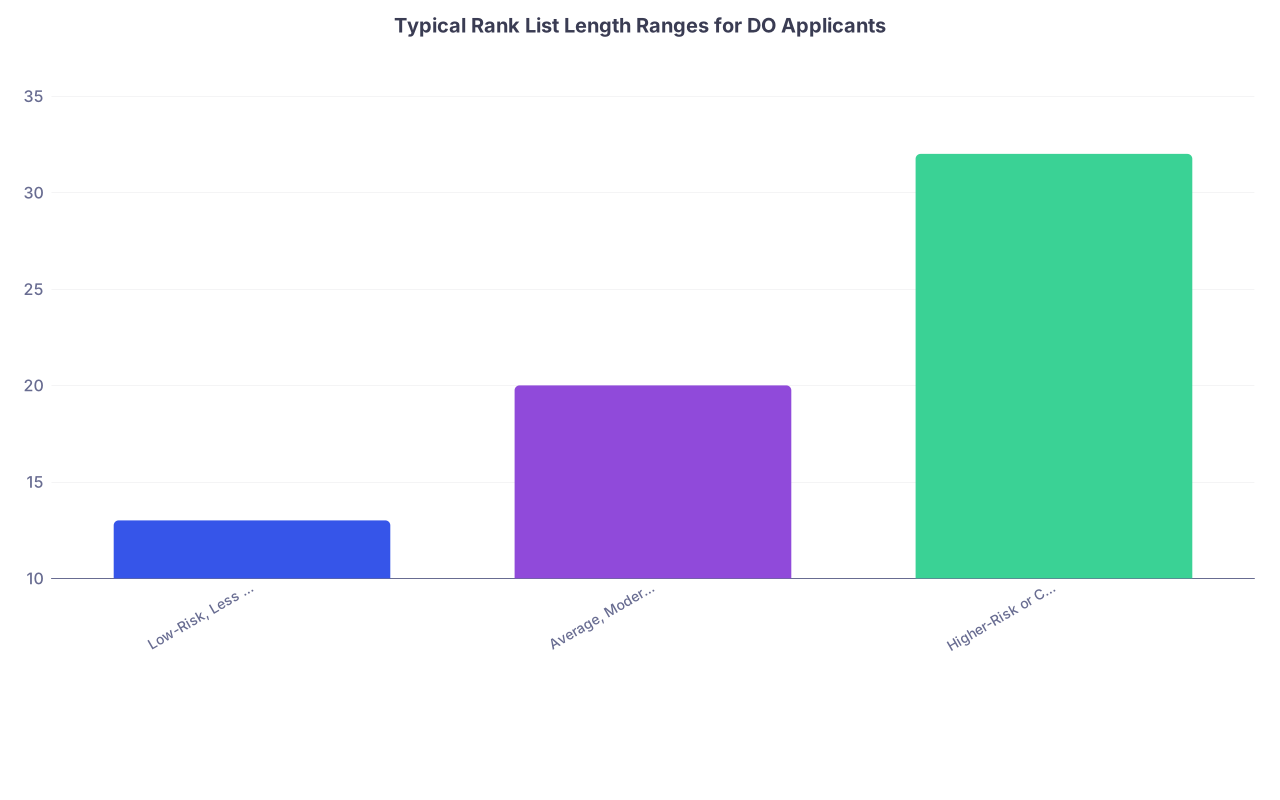
| Category | Value |
|---|---|
| Low-Risk, Less Competitive | 13 |
| Average, Moderate | 20 |
| Higher-Risk or Competitive | 32 |
What the NRMP Data Actually Shows (And How It Applies to DOs)
NRMP publishes match data by number of ranks. You’ll see charts showing that for U.S. grads in core specialties, match rates plateau around 12–15 ranks. But DO applicants often face:
- Less DO representation in some ACGME programs
- Hidden bias in more competitive specialties and academic centers
- Variable comfort with COMLEX vs USMLE scores
So DO applicants generally need to overshoot the MD numbers a bit.
Here’s a realistic translation for a “typical” DO applicant who is applying smart (not wildly):
| Competitiveness Level | Example Specialties | Ranks Where Match Rate Mostly Plateaus* |
|---|---|---|
| Less Competitive | FM, IM (non-academic), Psych, Peds | ~12–15 |
| Moderate | EM, OB/GYN, Neurology, Anesthesiology | ~15–20 |
| More Competitive | General Surgery, PM&R (strong), Academic IM | ~20–25+ |
*Plateaus = additional ranks beyond this give only small gains, assuming the programs are realistic.
For DOs, I usually tell people to aim 2–5 programs above what you see MD graphs using as their “safe” plateau point, because of the DO factor.
Step 1: Know Which Bucket You’re In
You cannot pick a smart number until you classify yourself—honestly.
1. Less Competitive Specialties (More DO-Friendly)
Think:
Family Medicine, Community Internal Medicine, Pediatrics, Psychiatry, many Community PM&R, some Community EM.
If this is you, ask:
Are you a solid applicant?
- COMLEX Level 1/2: comfortably above mean
- If you took USMLE: scores roughly aligned with MD averages
- Passed everything on first attempt
- Adequate clinical grades, solid letters, decent interview skills
Then: 10–15 ranked programs is generally reasonable if:
- You’d be happy at most of them
- They actually interview and match DOs
Are you a borderline or somewhat weaker applicant?
- Scores near or below national mean
- A fail or big red flag
- Weak or late clinical experiences
Then: you’re in the 18–25 range.
I’ve watched DO applicants with 8–10 ranks in FM or Psych panic on Match Week. It wasn’t necessary—they didn’t rank enough realistic options.
2. Moderate Competitiveness Specialties
Think:
Emergency Medicine (post-merger it’s in flux but still selective), OB/GYN, Anesthesiology, Neurology, better PM&R programs, more academic-leaning community IM.
For a typical DO applicant here (one or two minor dings, decent but not stellar scores):
- Target: 15–25 ranked programs
- Below ~12 ranks, your risk of not matching jumps quickly.
- Beyond ~25, your returns diminish if the added programs are lower on your true preference list and truly realistic.
For a strong DO in this group (good scores, strong SLOEs/letters, maybe some research):
- 12–18 ranks often suffices.
But there’s almost no penalty for having 20+ if you interviewed there and would truly go.
3. More Competitive Specialties
Think (for DOs):
Categorical General Surgery, some IM with heavy research/academic lean, strong PM&R, and the classic “impossibly competitive” fields: Derm, Ortho, ENT, Urology, Plastics, Radiation Oncology.
Reality check:
- For derm/ortho/ENT/urology/plastics as a DO, the main problem isn’t your number of ranks.
It’s your interview count and the willingness of programs to rank DOs at all.
But if you are in the game:
- 1–5 interviews? You should be ranking all of them.
- 6–10 interviews? I’d say: rank every single one unless there is a truly catastrophic reason not to.
- For DOs in Gen Surg / strong PM&R / academic IM:
- 20–30 ranks is common.
- 25+ is reasonable if you want to be aggressive about avoiding SOAP.
Bottom line: as a DO in a competitive field, your rank list should be basically “all programs that interviewed me and are not truly unsafe for me personally.”
Step 2: Tie Your Rank Length to Your Interview Count
The rank list is downstream of interviews. No interview = no rank.
Here’s a simple framework that works well for most DO applicants:
| Total Interviews | Typical Rank Target (If DO) |
|---|---|
| 3–5 | Rank all (3–5) |
| 6–8 | 6–8 (no trimming) |
| 9–12 | 9–12 (maybe 1–2 cuts max) |
| 13–20 | 12–18 (trim only if truly necessary) |
| 20+ | 18–30 (depends on field and true preferences) |
Most DOs do not need to “cap” their list for strategic reasons. The algorithm does not punish longer lists. It only helps you.
You only cut programs if:
- You genuinely would not go there (safety, family, or ethical reasons).
- Or your specialty advisor, who knows your field well, tells you a program is extremely toxic or unstable.
Step 3: Adjust for Your Risk Factors
Let’s talk about applicant risk. Because two DOs both applying to Internal Medicine might need very different rank lengths.
You should increase your target rank count if you:
- Failed or barely passed a COMLEX/USMLE exam
- Needed a leave of absence unrelated to something clearly resolved
- Have low or inconsistent clinical evaluations
- Are switching specialties after applying to another field
- Are couples matching
- Limited your geography strongly (e.g., “Northeast only” or “within 3 hours of Dallas”)
Each major risk factor? Add ~3–5 more realistic ranks if you can.
So a typical DO applying to community IM with some red flags might move from 12–15 to more like 18–22.

Step 4: Be Honest About Geography and Prestige
I see the same mistake over and over:
“I have 18 ranks.”
Then I look at the list. Twelve of them are academic IM programs in big coastal cities that have never or rarely taken a DO.
That is not 18 realistic ranks. That’s more like 6–8.
So when you decide “how many” you need, filter this way:
- Has this program matched DOs in the last 3–5 years?
- Did I feel I was treated as a genuine candidate, or did it feel like a courtesy interview?
- Does my profile fit what they usually take? (scores, research, region, school type)
If the answer to #1 is “no” across most of your list, your rank count is lying to you. You either:
- Need more community‑oriented, DO‑friendly programs on your list, or
- Need to be willing to move beyond your favorite city cluster.
More ranks of the same unrealistic type do not help you. You want a mix.
Step 5: When You Can Safely Stop Adding Programs
You do not have to keep tossing on programs indefinitely “just in case.” Here’s how you know your list is long enough that adding more isn’t logically helping much:
For less competitive specialties (FM, Psych, Peds, community IM) as a solid DO:
- If you have 12–15 programs that:
- routinely match DOs
- are in locations you would attend
- treat you seriously
you’re usually in a safe zone.
For moderate specialties (EM, OB/GYN, Anesthesia, Neuro):
- Around 15–20 realistic ranks is where you often see diminishing returns, assuming they are a mix of strong and mid-tier programs that actually like DOs.
For more competitive fields or higher‑risk profiles:
- You generally do not hit a “true plateau” as easily.
If you can realistically add up to 25–30 programs you’d actually attend, it’s often worth it.
If your advisor who knows your full picture says, “You’re fine with these 15,” listen. They know how your school’s graduates do year to year.

| Step | Description |
|---|---|
| Step 1 | Get Interview Invites |
| Step 2 | Classify Programs as DO-Friendly or Not |
| Step 3 | Filter by Places Youd Actually Attend |
| Step 4 | Assess Personal Risk Factors |
| Step 5 | Aim for 10-15 Realistic Ranks |
| Step 6 | Aim for 15-25 Realistic Ranks |
| Step 7 | Aim for 25-40+ Realistic Ranks |
| Step 8 | Finalize Rank Order by Preference |
| Step 9 | Submit Rank List |
| Step 10 | Less, Moderate, or More Competitive Specialty? |
Quick Specialty-Specific Reality Checks for DOs
I’m going to be brief and a bit blunt.
Family Medicine / Community IM / Psych / Peds
Many DO‑friendly programs. If you’re average‑ish and open geographically, 10–15 ranks usually works. If risky or geographically rigid, push to 18–22+.Emergency Medicine
Post‑merger, DOs got squeezed harder at some academic shops. Aim for 15–25 if possible; rank every interview that feels remotely reasonable.OB/GYN
DOs match but bias definitely exists in some places. 15–25 ranks is a realistic target, especially if you’re not at the very top of the applicant pool.Anesthesiology
Similar story: 15–25 ranks; more if your scores are mid/low or geography is tight.PM&R
Very DO‑friendly overall, but top programs can be competitive. Solid DO: 12–18 ranks. Risk factors or mostly big‑name centers: 20–25+.General Surgery
Tougher for DOs than most people admit. If you’re serious: 20–30+ realistic ranks is common. You want a heavy community mix, not just big academic names.Derm / Ortho / ENT / Plastics / Urology / Rad Onc
If you’re in striking distance, you already know you’re an outlier DO with research, strong scores, mentors. The right question is “How many interviews can I get?” not “How many should I rank?”
Rank every place that is not morally or personally unacceptable. Period.
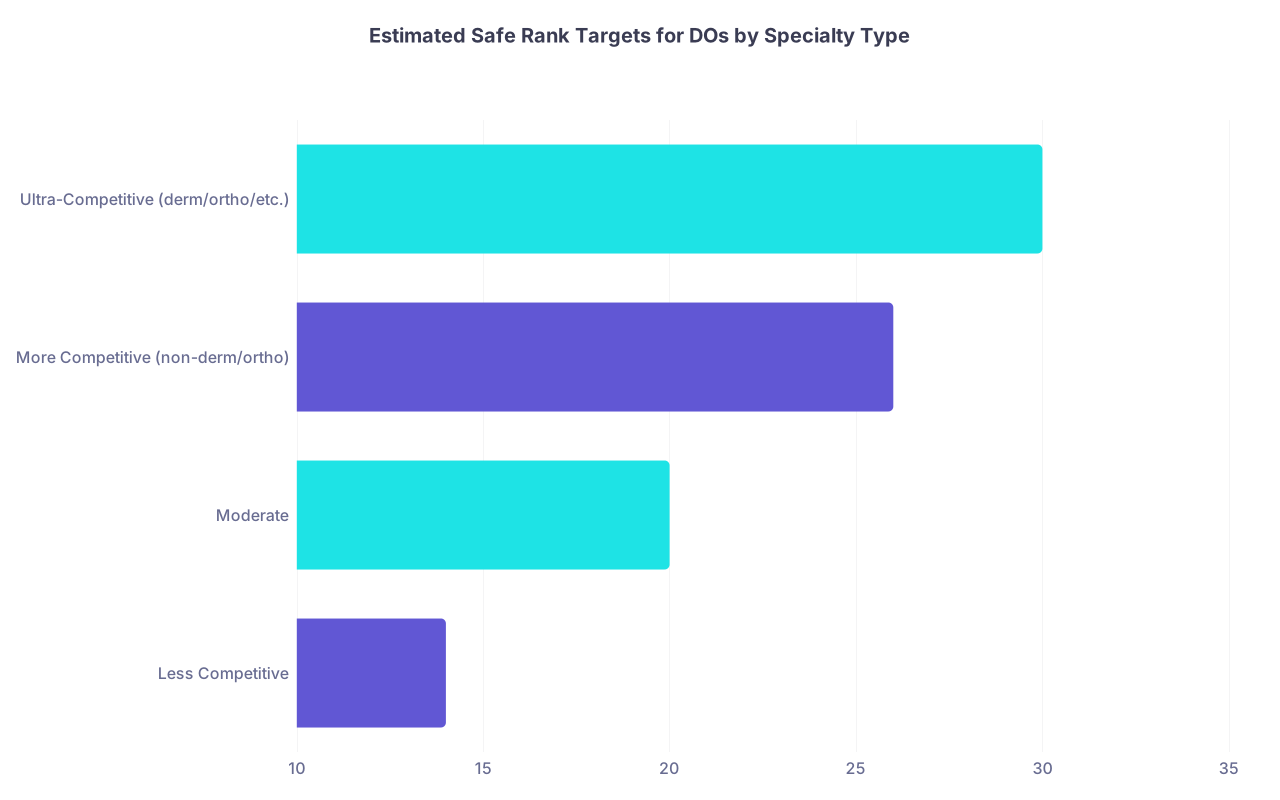
| Category | Value |
|---|---|
| Less Competitive | 14 |
| Moderate | 20 |
| More Competitive (non-derm/ortho) | 26 |
| Ultra-Competitive (derm/ortho/etc.) | 30 |
Practical Rules You Can Actually Use
Let me boil it down into usable rules:
You do not get extra points for leaving programs off your rank list “to look confident.” The algorithm does not see your list until after programs rank you.
-
- where you interviewed
- that you’d be willing to attend
unless a program is truly unsafe or toxic for you.
If you’re DO, average applicant, and:
- In FM/IM/Psych/Peds and open geographically → shoot for 10–15
- In EM/OB/GYN/Anesthesia/Neuro/PM&R → shoot for 15–25
- In Gen Surg or more competitive settings → 20–30+
If you’re clearly higher risk: add 3–5 more realistic programs above those baselines.
If you have fewer than ~8 total interviews in any specialty as a DO, your priority is not “how many to rank” but “should I have had a backup specialty?”

FAQ: DO Applicants and ACGME Rank Lists
1. I’m a DO applying to Family Medicine with 12 interviews. How many should I rank?
Rank all 12 unless there’s a program you’d genuinely refuse to attend (safety, family, ethics). For a typical DO in FM, 10–15 realistic ranks is very reasonable, and your 12 fits that window nicely.
2. I’m a DO with one COMLEX failure applying to Internal Medicine. How many ACGME programs should I realistically rank?
You’re higher risk. If you have the interviews, aim for around 18–25 ranks, all at places that commonly accept DOs and are not hyper‑academic. Do not over‑concentrate on big‑name university programs; you need a strong mix of community and mid‑tier university affiliates.
3. Does adding more programs to my rank list ever hurt me?
No. The NRMP algorithm cannot “downgrade” you for having a longer list. The only harm is psychological (you feel more anxious) or practical (you overvalue toxic places). If you would actually go there, ranking it can only help, not hurt.
4. I only got 5 interviews in a moderately competitive specialty. Is there any point obsessing about my rank length?
No. Your ceiling is 5. Rank all 5 in true order of preference. At that point your odds are driven by how those programs feel about you, not list length. Your energy should shift to SOAP planning and contingency thinking, not micromanaging order #3 vs #4.
5. Should I rank programs that seemed lukewarm about DOs, just to have more on my list?
If you sensed real DO bias or they’ve basically never had a DO resident, those are low‑yield ranks. If you still would attend if it’s your only option, go ahead and rank them—but do not count them as “safe” when you decide how many total you need. They’re bonus lottery tickets, not your safety net.
6. I’m couples matching as a DO with an MD partner. How does that change how many I should rank?
Couples matching always needs longer lists, because the algorithm has to match pairs of spots. A typical DO/MD couple should usually be aiming for the upper end of the ranges I gave—often 25–40 combined pair options, depending on competitiveness and geography. Work with your advisor closely; couples matching is more complex and unforgiving of short lists.
Key points:
Most “typical” DOs in less or moderately competitive specialties land in the 15–25 rank range when they’re being realistic and safe. The rank list cannot magically rescue a weak application, but it absolutely can sink a decent one if it is too short or full of unrealistic programs. Rank every place you’d actually attend, and build your number around your interviews, your risk factors, and how DO‑friendly your specialty really is.