
Does skipping USMLE actually leave your ACGME interview chances untouched, or is that one of those comforting myths med students repeat because the alternative is expensive, annoying, and stressful?
Here's my answer: the claim that "COMLEX-only is basically equivalent for ACGME invites" is too clean, too confident, and not supported by how residency screening actually works. Not across specialties. Not across programs. Not across years.
That doesn't mean every DO needs to dual-test. That's the other lazy myth. What it means is simpler and less comforting: test strategy changes how legible your application looks to the people screening it. And legibility matters. A lot.
I'm going to stay disciplined here. Not vibes. Not forum folklore. Just what the public data can reasonably support, what it can't, and what I've seen happen when applications hit the real-world machinery of ACGME review.
Myth #1: "COMLEX-Only Makes No Difference for ACGME Invites." Reality: The Signal Is Context-Dependent
This myth survives because people confuse official policy with actual behavior.
Plenty of programs will say they accept COMLEX. Fine. I believe them. That's not the same as saying COMLEX-only is processed identically at the screening stage, by every coordinator, faculty reviewer, spreadsheet filter, or committee member. It isn't.
The real question isn't, "Will they take COMLEX?" The real question is, "Does COMLEX-only create any friction in the path to an interview?"
Sometimes no. Sometimes absolutely yes.
Why the variation? Three big reasons:
- Specialty culture differs. Some specialties are comfortable with DO applicants and routinely interpret COMLEX without drama. Others still anchor on USMLE because that's the benchmark they've used for years.
- Program workflow differs. A faculty champion for DO applicants can offset ambiguity. A coordinator using old internal score cutoffs can amplify it.
- Applicant pool changes every year. In a crowded cycle, anything that makes your file slower to interpret can hurt.
And here's the irritating part: public invite data is incomplete. Programs don't consistently publish interview rates by COMLEX-only vs dual-tested DOs. Even when surveys exist, they're tangled with confounders, class rank, clerkship grades, specialty choice, research, geography, signaling, audition rotations, letters, school reputation. A student with strong COMLEX and no USMLE may still do great because the rest of the application screams "easy invite." That doesn't prove testing didn't matter. It means residency selection is messy.
Still, don't overcomplicate the basic truth: scores are often used as screening signals even when programs preach holistic review.
I've seen this exact scenario. A program director says in an open house, "We review applicants holistically." Then the application spreadsheet gets sorted by familiar score fields because 1,200 applications arrived and nobody has time for philosophy. That's not hypocrisy. It's throughput.
So no, COMLEX-only is not "neutral" in some universal sense. It's context-dependent. In DO-friendly programs and specialties, the difference may be tiny. In programs that rely on familiar USMLE benchmarks, the difference can be real.

Myth #2: "Dual-Testing Is Purely Redundant." Reality: It's About Mapping Across Two Score Interpretations
This is where people get sentimental. "But COMLEX is a valid licensing exam." Correct. Clinically, professionally, structurally, yes. That's not the issue.
The issue is interpretation.
A score isn't just a measure. It's a signal that has to be decoded by different people in a rushed system. And USMLE remains more legible to many ACGME workflows. That's not a moral victory for USMLE. It's just the current operating environment.
Different audiences inside a program use scores differently:
- Program coordinators or staff may rely on familiar benchmarks to triage volume.
- Faculty reviewers may be more nuanced, especially if they regularly work with DO residents.
- Selection committees often discuss "risk," and unfamiliar score interpretation can get mislabeled as risk.
- Automation or internal rubrics may still be built around USMLE-style expectations, even if nobody says that out loud.
That's why dual-testing isn't automatically redundant. It can function as a translation layer.
A strong or solid USMLE score doesn't magically make you a better future resident. What it can do is reduce uncertainty for reviewers who already know how to place that score mentally. That matters more than people want to admit.
Here's the likely mechanism: dual-testing lowers mismatch risk. If your COMLEX score is strong but a reviewer doesn't confidently know how to benchmark it, a USMLE result can anchor interpretation. If both are decent, your file may move faster. If one score fits a program's internal screening expectations especially well, you've made the invite decision easier.
Easier is good. Easier gets interviews.
Now, don't misread me. Dual-testing is not an automatic advantage in every case. A mediocre USMLE can create score discordance. A late exam can wreck timing. A distracted student can trade away honors, letters, and sanity for a test that adds little. That's bad strategy.
But the blanket line that USMLE is "just redundant" for DOs applying ACGME? No. That's fiction. In many settings, it's not redundancy. It's interpretive alignment.
What the Data Actually Supports: Outcomes, Benchmarks, and Where Evidence Ends
Here's the disciplined read of the evidence.
What we can reasonably infer:
- Board performance correlates with interview selection in many settings. Programs use academic metrics as risk filters. This is not controversial.
- USMLE often remains the more familiar benchmark inside ACGME environments. That gives dual-testers a potential interpretive advantage.
- That advantage is not the same thing as proven causality. Public data rarely isolates dual-testing itself as the sole driver of more invites.
That distinction matters. A lot of people overclaim.
The honest position is this: dual-testing likely helps most when it reduces uncertainty.
That tends to happen in a few "sweet spots":
- Your COMLEX is solid, but a USMLE score would make your application easier to benchmark.
- You're applying to specialties or regions where USMLE familiarity is stronger.
- You need to reassure programs about academic readiness quickly and clearly.
And here are the failure modes:
- Your overall application is already elite; the marginal benefit may be small.
- Your USMLE score underperforms and muddies the message.
- You spend so much energy on dual-testing that your letters, Sub-I performance, or specialty narrative get weaker.
That's the part students hate hearing. There is no score-based cheat code. Testing can sharpen your signal. It can't rescue a thin application or incoherent story.
Practical Decision DOs: If You're COMLEX-Only, Optimize What Programs Can See
Let's say you're staying COMLEX-only. Fine. That can absolutely be defensible. But don't pretend "no USMLE" means "nothing to manage." You need to reduce ambiguity everywhere else.
Start with timing. A late retake or delayed score release can do more damage than students realize. Programs don't evaluate the application you meant to submit. They evaluate the one that exists when screening starts. Brutal but true.
Then think about your score story. Not spin. Story. If your COMLEX performance is your primary testing signal, the rest of the application should reinforce readiness rather than ask reviewers to guess.
That means:
- Apply with specialty coherence. Random electives and weak narratives create doubt.
- Get letters from people who can actually compare you to residents and students. Generic praise is useless.
- Use clinical experiences strategically. Auditions, Sub-Is, away rotations, where relevant, can replace uncertainty with direct evidence.
- Be smart about program targeting. Don't spray applications blindly and call it strategy.
- Address readiness through the whole file. Transcript trend, clerkship performance, MSPE comments, specialty-specific engagement.
I've watched COMLEX-only applicants do very well when the application was clean, timely, and easy to believe. Strong board performance. Good letters. Clear specialty fit. No weird gaps. No vague "I'm passionate about everything" nonsense.
The goal is not to cosplay as a USMLE applicant. That's dumb. The goal is to make your application high-signal and low-friction.
If a reviewer has to do extra interpretive labor on your scores, then don't also make them do extra labor on your commitment, your specialty fit, or your clinical maturity.
That's how COMLEX-only works best: clarity, consistency, and zero unnecessary mystery.
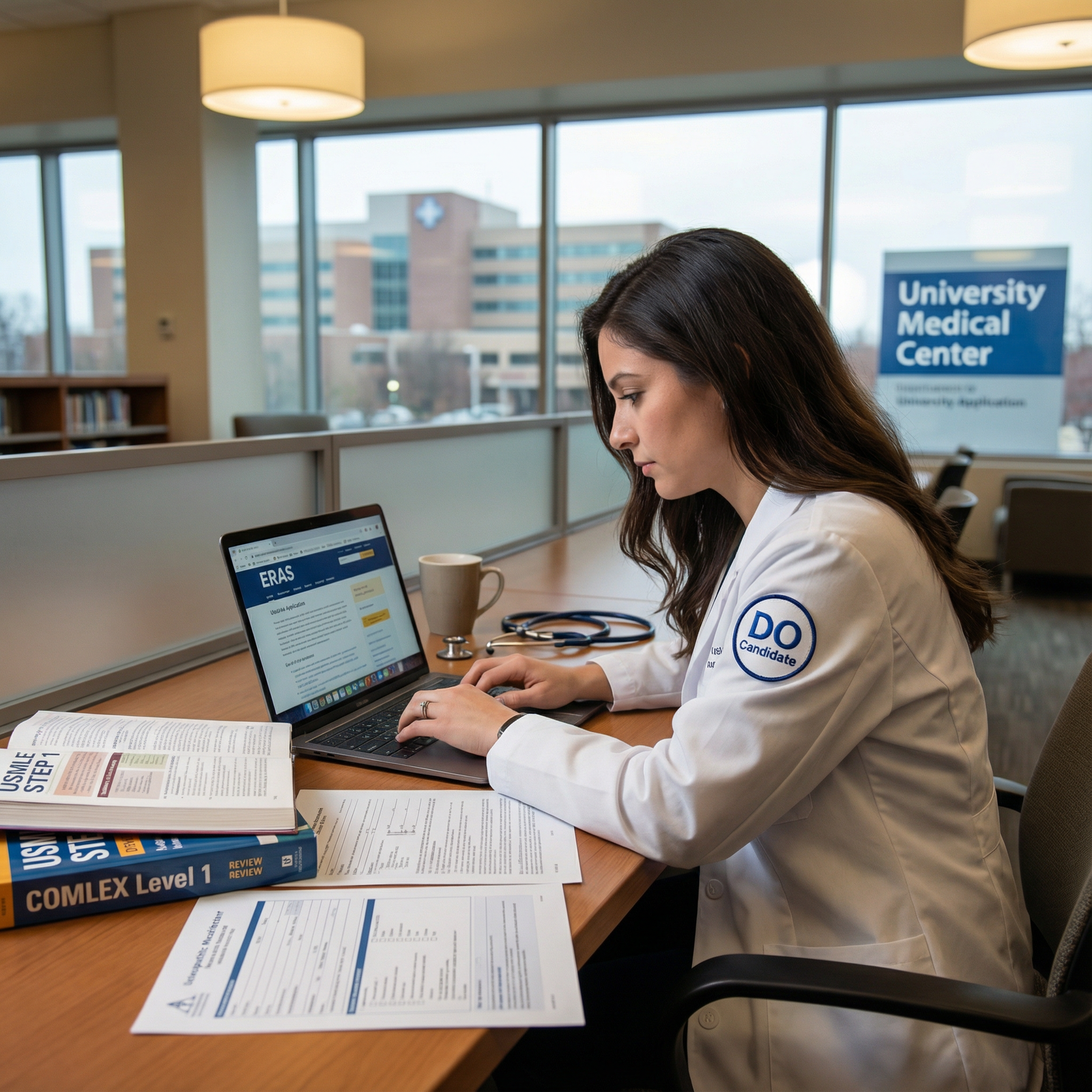
Dual-Tester DOs vs Dual-Tester Pitfalls: How to Use USMLE Strategically, Not Religiously
Now the other camp.
If you're going to dual-test, do it with a purpose. Not because Reddit panicked you. Not because someone one year above you said, "I just did it to be safe." Safety without a plan is how people end up with mediocre scores and fried fourth years.
Before taking USMLE, answer three questions:
- What specialty am I targeting?
- What score range would actually help me?
- Can I take it early enough that it improves, not delays, my application?
If you can't answer those, you're not making a strategy decision. You're buying anxiety at retail price.
The biggest pitfall is discordance. If your COMLEX is excellent and your USMLE comes in flat or weak, you may have added noise instead of clarity. Another pitfall is overinvestment, sacrificing clerkship performance, networking, research output, or Sub-I prep just to chase a marginal score improvement in a lower-yield context.
I've seen students do this. They spend months trying to optimize one extra exam while their letters stay average and their specialty story remains mush. Then they wonder why invites didn't flood in. Because programs aren't ranking your suffering. They're screening your application.
Use USMLE strategically if it's likely to produce a clear, timely, interpretable advantage. Skip it if the expected gain is low and the opportunity cost is high.
That's the contrarian point people miss: dual-testing may improve interpretability, but it does not substitute for being a compelling applicant.
Not even close.
The takeaway is sharper than the usual advising fluff.
There's no honest way to say COMLEX-only is guaranteed neutral for ACGME invites. It isn't. Screening systems use signals unevenly, and those signals are interpreted through specialty culture, program habits, and plain old familiarity.
But dual-testing isn't some sacred ritual either. It helps when it reduces uncertainty. It hurts when it adds noise, delay, or distraction.
So step back and be ruthless with your own strategy. Not ideological. Not defensive. Not performative. Just honest.
Because this whole debate isn't really about exam loyalty. It's about something much less romantic: how quickly a stranger can look at your file and feel confident saying yes to an interview.
That's the game. The myth is pretending otherwise.