The idea that DOs are “locked out” of competitive ACGME specialties is lazy, outdated, and only half-true. Which makes it dangerous.
There is real bias. There are real structural barriers. But the fatalistic story many premeds and med students tell each other—“If you go DO, forget derm, ortho, ENT, plastics, or top academic programs”—is not what the data actually show in the post–single accreditation world.
You are not locked out. You are on hard mode.
Let’s separate urban legend from the numbers.
The Single Accreditation Myth: “Now It’s All Equal”
The biggest myth in this entire conversation is that the AOA–ACGME single accreditation magically “fixed” DO–MD differences.
It did one thing very well: it brought former AOA programs into the ACGME system and let DOs and MDs apply through the same Match infrastructure. That’s integration.
Equality is something else.
Here’s what actually changed:
- Before 2020, DOs had a parallel AOA Match plus access to some ACGME programs.
- After 2020, everything (AOA + ACGME) became ACGME-accredited and moved under NRMP.
What did not automatically change:
- Program director attitudes toward COMLEX vs USMLE
- Historic DO underrepresentation in ultra-competitive fields
- Institutional bias at some elite academic centers
- The basic math of supply (spots) vs demand (applicants)
So when a school recruiter waves their hands and says “Single accreditation means it doesn’t matter anymore,” that’s incomplete at best, dishonest at worst.
There are DOs matching derm, ortho, neurosurgery, ENT, plastics, and top internal medicine programs. More than a decade ago? Yes. But the bar is higher and narrower.
What the Match Data Actually Show for DOs
You cannot answer this question honestly without looking at numbers, especially NRMP’s “Charting Outcomes in the Match” and annual “Results and Data” reports.
Let’s look at the big picture first.
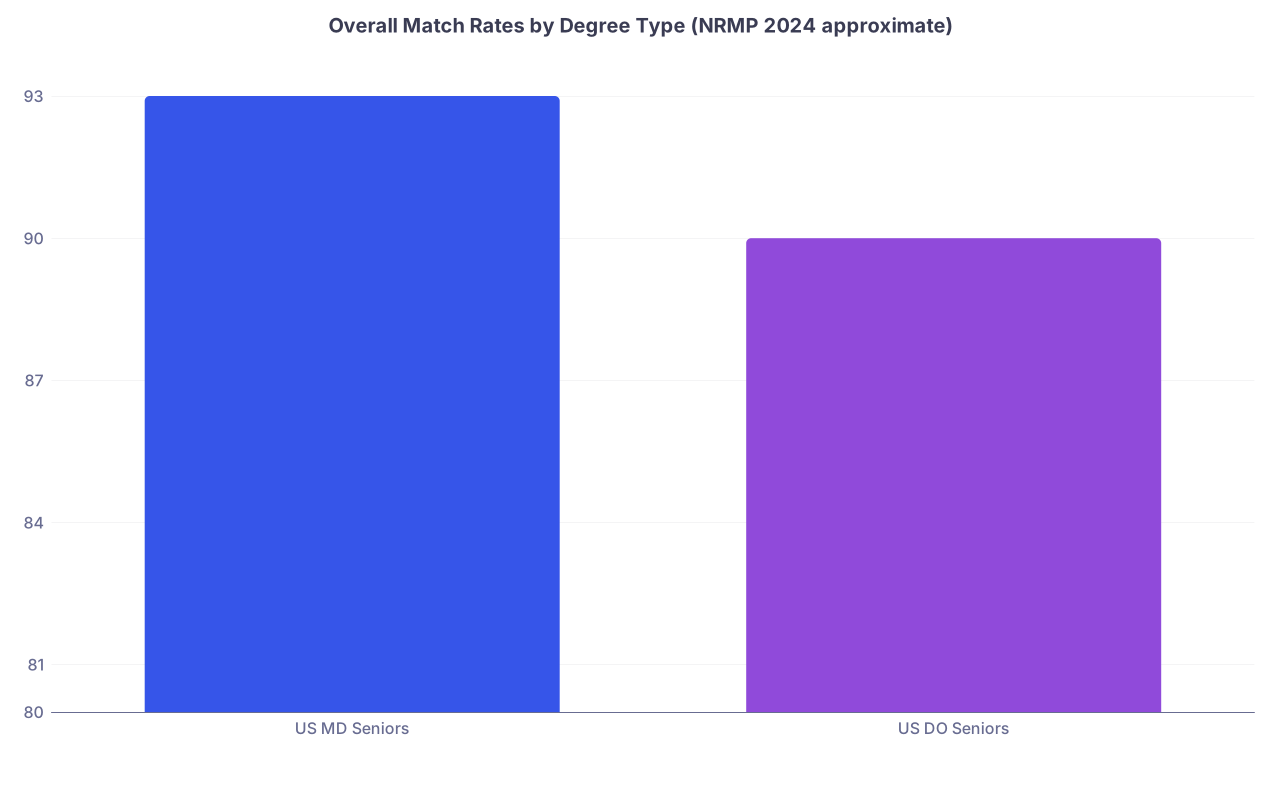
| Category | Value |
|---|---|
| US MD Seniors | 93 |
| US DO Seniors | 90 |
Roughly speaking:
- US MD seniors: low 90s% match rate
- US DO seniors: high 80s to ~90% match rate (depends on year, but comparable)
So globally, DOs are not being shut out of residency. The gap is small.
The problem is not the overall match rate. It’s the distribution across specialties and programs.
In competitive specialties, the disparities are real. For example (numbers rounded/illustrative but pattern is consistent with NRMP reports):
| Specialty | US MD Senior Match Rate | US DO Senior Match Rate |
|---|---|---|
| Dermatology | ~75–80% | ~35–45% |
| Orthopedic Surg | ~75–80% | ~45–55% |
| ENT (Otolaryng) | ~70–80% | ~35–45% |
| Neurosurgery | ~70–80% | ~30–40% |
| Plastic Surgery | ~65–75% | Very small N, lower |
The exact percentages change year to year and DO applicant numbers are smaller, but the pattern is stable:
- DOs match these specialties every year.
- Their success rate is substantially lower than MDs’.
So the honest statement is:
- Are DOs locked out? No.
- Are DOs disadvantaged in competitive ACGME specialties? Yes, significantly.
If you want “any residency,” DO vs MD is a small difference.
If you want “derm at a top-20 academic center,” it’s a different universe.
The Three Real Gatekeepers: USMLE, Program Type, and School Reputation
Most students obsess over the wrong variables: “Is my personal statement strong enough?” “Do I need more shadowing?” That’s nice, but for DOs chasing competitive specialties, three things matter a lot more.
1. USMLE vs COMLEX: The Non-Debatable Reality
You will occasionally see a DO dean say, “Programs are getting better about accepting COMLEX alone.” Some are. Many are not.
Here’s what program directors say, in their own data.
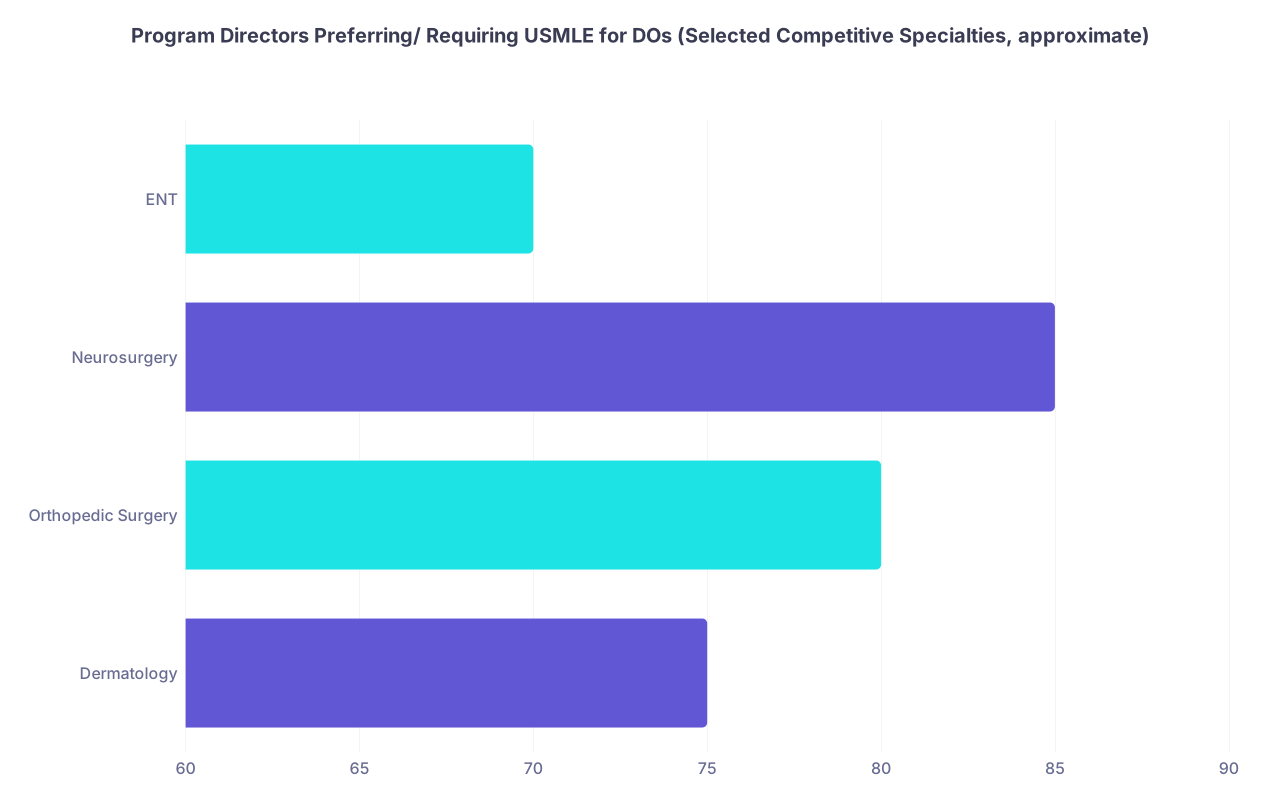
| Category | Value |
|---|---|
| Dermatology | 75 |
| Orthopedic Surgery | 80 |
| Neurosurgery | 85 |
| ENT | 70 |
For many competitive academic ACGME programs:
- USMLE Step 1 (even now pass/fail) and Step 2 CK numeric scores are the primary filter.
- Some will not even review a DO applicant without USMLE, regardless of COMLEX performance.
- Others “accept COMLEX” but clearly do not know how to interpret it, so a high COMLEX does not carry the same weight as a high Step 2 CK.
If you are a DO and refuse to take USMLE, you’re not just making it harder.
You are essentially self-selecting out of a large chunk of derm/ortho/ENT/neurosurgery/plastics/academic IM programs.
I’ve heard DOs say, “But the NBOME says COMLEX is equivalent; PDs will adjust.” No. They won’t. They have thousands of applications and a deeply ingrained USMLE-based mental model. They’re not retooling that for you.
So:
- Want a competitive ACGME specialty as a DO? Plan on taking USMLE Step 2 CK.
- Want an academic or coastal program? Same answer.
Do not let anyone sugarcoat this.
2. Program Type: Former AOA vs “Legacy” ACGME
After the single accreditation, there are essentially three buckets of programs:
- Historically ACGME (mostly MD-dominant, higher academic profile)
- Historically AOA but now ACGME (more DO-friendly, sometimes community-based)
- Newer programs or expansions (vary widely)
Many of the “easier access” spots for DOs in competitive fields live in bucket 2: former osteopathic programs now under ACGME. These are where you see DO-heavy ortho, neurosurgery, or ENT rosters.
This matters for your expectations.
If you’re a DO thinking dermatology, it’s not “derm or bust.” It’s:
- Derm at a historically ACGME, top-tier academic program (very uphill, not impossible)
- Derm at a former AOA or DO-friendly program (still hard, but lane exists)
Same goes for ortho and ENT. You’ll see entire programs with mostly DO residents. Those are your highest-yield targets.
Does that mean you can’t match at a historically allopathic academic giant? No. There are DOs at places like Mayo, Cleveland Clinic, MGH, etc. But those are statistical outliers, not baseline expectations.
3. School Reputation and Clinical Environment
People hate this part, but it’s true: not all DO schools are equal in PDs’ eyes.
A DO from a school with:
- Strong USMLE culture
- High Step 2 CK averages
- Robust research infrastructure
- Rotations at big-name academic hospitals
…will be treated very differently from a DO school with:
- Minimal USMLE support
- Little research
- Primarily small community rotations far from major centers
You’ll never see this on a brochure, but PDs absolutely look at school names and known pipelines.
Specialty-by-Specialty: Where DOs Truly Stand
Let’s crush a few specific myths.
Dermatology
Myth: “DOs basically can’t match derm anymore.”
Reality: DOs match derm every single year. The numbers are small, but not zero. Patterns I see over and over in successful DO derm applicants:
- USMLE Step 2 CK in the top decile
- Multiple derm publications, often starting M1–M2
- Away rotations at derm programs that already train DOs
- Strong home-institution mentorship and realistic targeting of DO-friendly programs
You are not trying to be “average derm applicant.” You’re trying to be a top derm applicant with a nontraditional degree in a PD’s eyes.
Orthopedic Surgery
Myth: “Ortho is off-limits for DOs now that AOA ortho is gone.”
Reality: No. Many former AOA ortho programs are now ACGME and still heavily DO.
Several DO schools maintain quasi-pipeline relationships with these ortho residencies. You’ll see ortho programs where half or more of the residents are DOs. Those did not evaporate in 2020.
What changed is that everyone is in one pool, and Step 2 CK matters a lot more. But DOs with:
- Strong scores (USMLE + COMLEX)
- Early ortho research
- Real letters from ortho attendings at the target programs
- Rotation time at those programs
…still match ortho at decent rates. The MD vs DO gap is there, but the door is not shut.
ENT, Neurosurgery, Plastics
These are less DO-heavy but not DO-free.
Successful DOs in these fields usually have some combination of:
- USMLE CK in the 250s+ range
- Year(s) of dedicated research (often gap years)
- Repeated away/audition rotations
- Mentors who are already trusted by PDs in those fields
If you want one of these as a DO, you’re signing up for a long war. It’s not “work harder than your classmates.” It’s “be in the top few percent of all US graduates aiming at that specialty.”
That’s not impossible. But it’s wildly different from, say, matching FM, psych, or IM.
Where DOs Are Absolutely Not Locked Out
Let’s be fair. There are large swaths of medicine where the DO/MD distinction is practically background noise once you meet baseline metrics.
Fields where DOs do very well:
- Family medicine
- Internal medicine (non-elite academic programs)
- Pediatrics
- Psychiatry
- PM&R (still very DO-friendly)
- EM (more complicated after the EM crash, but historically very DO-heavy)
- Neurology
- Anesthesiology (many DOs, especially in community and mid-tier academic)
In these specialties, what matters most is:
- Board scores (USMLE + COMLEX if you have them)
- Clinical evaluations and letters
- Whether you are normal and coachable on interview day
If your dream is to be a solid clinician in one of these areas, DO is essentially equivalent in outcome for most applicants.
Strategy: How a DO Actually Breaks Into Competitive ACGME Spots
Let’s talk practical strategy, not vibes.

| Step | Description |
|---|---|
| Step 1 | Start DO School |
| Step 2 | Standard Match Strategy |
| Step 3 | Plan USMLE Step 2 CK |
| Step 4 | Secure Early Mentors |
| Step 5 | Research and Publications |
| Step 6 | Target DO-Friendly Programs |
| Step 7 | Away Rotations |
| Step 8 | Interview and Match |
| Step 9 | Competitive Specialty? |
A realistic path for a DO targeting, say, ortho or derm:
- Decide early. By early M2 at the latest, preferably M1. Late epiphanies are rough in competitive fields.
- Take USMLE seriously. Not as an afterthought to COMLEX. Build your entire preclinical study schedule around crushing Step 2 CK.
- Get plugged into research early. This usually means emailing faculty, asking classmates who’s doing what, and accepting grunt work upfront. You need pubs, not just “interest.”
- Stack your deck with DO-friendly/DO-heavy programs. Look up resident rosters. If a program has zero DOs in its last 5 years, that’s not your first target.
- Rotate where you want to match. Audition rotations still matter massively in procedural and competitive specialties. Be a workhorse, be teachable, be pleasant.
- Accept that your application needs to look “MD-top-10%-level” on paper. Because you’re fighting both the numbers and the bias.
Will this guarantee you match derm at UCSF or ortho at HSS? No. Those are moonshots even for MDs with immaculate CVs.
But this strategy is how DOs continue to match derm, ortho, ENT, neurosurgery, and plastics every cycle.
The Subtle Bias That Never Makes the Brochures
One more thing people rarely admit out loud.
There are programs—and sometimes entire specialties at certain institutions—where leadership still quietly view DO as lower-tier. They will couch it in language like “holistic review” or “best fit,” but the rank lists and resident rosters tell you everything.
You are not hallucinating if you notice:
- Zero DO residents in the last 10–15 years
- Only interviewing DOs from one or two specific “brand name” DO schools
- An unofficial need for DOs to be “exceptional” just to get a look
You will not talk your way out of this. You will not “explain osteopathic philosophy” on interview day and change decades of culture.
Your job is to:
- Identify these red-flag programs early
- Decide whether they’re worth a lottery ticket application
- Focus your real energy where DOs historically get a fair shot
That’s not defeatist. That’s playing the game that actually exists, not the one people wish existed.
FAQ (Exactly 4 Questions)
1. If I’m a DO student who doesn’t take USMLE, am I doomed to low-tier specialties?
No, but you’re severely limiting options in competitive and academic programs. For family medicine, community IM, peds, psych, and several others, COMLEX alone can absolutely be enough, especially at DO-friendly programs. But for derm, ortho, ENT, neurosurgery, plastics, and many top academic IM/Anes/EM programs, skipping USMLE Step 2 CK is basically opting out.
2. Are DOs still matching into top internal medicine programs (think MGH, Hopkins, UCSF)?
Yes, but it’s rare. You’ll find individual DOs at big-name places, usually with stellar Step scores, serious research portfolios, and strong letters from known faculty. The default path for DOs is more often solid mid-tier academic or community IM. Aiming for truly elite IM as a DO is possible but should be treated like a stretch goal, not a baseline expectation.
3. Do former AOA programs still “prefer” DOs now that everything is ACGME?
Many of them clearly do, based on resident rosters. You’ll see ortho, neurosurgery, ENT, and other competitive fields where the majority of residents are DOs, even after the transition. These programs may list “MD/DO welcome,” but their actual match lists show they remain very DO-friendly. Those are prime targets if you’re a DO chasing a competitive specialty.
4. If I want a competitive specialty but I’m not sure which yet, should I still plan to take USMLE?
Yes. If there is any real chance you’ll want derm, ortho, ENT, neurosurgery, plastics, or a high-end academic path, assume you will need a strong USMLE Step 2 CK. You can always choose not to apply competitively later. You cannot go back and retroactively sit for USMLE once applications are open. Keeping that door open costs extra work now but saves you from having your future decided by a decision you made with incomplete information.
Key points: DOs are not locked out of competitive ACGME specialties, but they are disadvantaged and judged by a harsher bar. USMLE Step 2 CK, DO-friendly program targeting, and early research/mentorship are non-negotiable if you want to be in the game. Stop listening to fairy tales—good or bad—and start planning based on how the Match actually works today.