The absolutist “USMLE-or-you’re-doomed” advice for DO students is wrong.
Not outdated. Not incomplete. Just wrong.
Let me be blunt: there are programs where skipping USMLE will absolutely hurt you. But there are also very real, very competitive lanes where COMLEX alone is not just “fine” — it’s perfectly sufficient and sometimes strategically smarter.
The problem is that most of the loud voices online never talk about those lanes. They just scream: “TAKE USMLE OR YOU WON’T MATCH.” Lazy, fear-based advice.
You want the truth? You have to separate:
- What used to be true in the pre–single accreditation era
- What’s still true for certain specialties and programs
- What’s actually changing in your favor if you know how to play it
Let’s dismantle the myth and then draw actual lines: when COMLEX alone is enough, when it’s risky-but-defensible, and when skipping USMLE is self-sabotage.
The Myth: “If You Don’t Take USMLE, You Won’t Match Well as a DO”
That line gets thrown around in every DO group chat, Reddit thread, and hallway whisper. Usually by:
- Anxious M2s who haven’t read a single NRMP report
- MD students who have no idea how COMLEX is perceived
- Older DO grads whose entire experience was pre–single accreditation
Here’s the hard reality:
- DOs without USMLE match every year into solid programs
- Some specialties and regions are now explicitly COMLEX-friendly
- A decent COMLEX-only app can beat a weak USMLE + COMLEX app
Notice I didn’t say “everywhere” or “in anything you want.” This is where nuance lives.
The better question isn’t “Do I need USMLE?”
It’s: “Given my specialty target, geography, and numbers, is USMLE a good trade?”
Because that’s what it is: a trade of time, risk, and money for potentially more doors.
What the Data Actually Shows (Not Forum Panic)
Let’s pull away from the anecdotes and talk numbers.
No, you don’t have exact side‑by‑side COMLEX vs USMLE equivalence baked into every dataset, but you have enough to see patterns: NRMP Program Director Survey, Charting Outcomes, ACGME and NBOME reports, and what programs publicly post.
Here’s a simplified reality check for DOs:
| Specialty / Setting | COMLEX-Only Viability | USMLE Strongly Recommended? |
|---|---|---|
| Community Internal Medicine | High | No |
| Community Family Medicine | Very High | No |
| Community Pediatrics | High | Rarely |
| Community Psych | High | Often optional |
| ACGME EM (non-elite, regional) | Moderate | Often Yes |
| Competitive Surgical (Ortho, NSG) | Very Low | Essentially Required |
Does that mean you can’t match EM or even a surgical field with COMLEX-only? Not necessarily. But you’ll be swimming upstream in most settings.
Now, look at the bigger trend: program directors being pushed (by ACGME, NBOME, and recent policy shifts) to actually understand and accept COMLEX as a legitimate licensing exam. A lot of them are adapting. Slowly. Imperfectly. But it’s happening.
And with USMLE Step 1 now pass/fail, the “Step 1 or bust” mentality has already cracked. Some PDs are now, very bluntly, saying:
- “We accept COMLEX alone. Just tell us your percentile.”
- “We’ll convert COMLEX to our internal scale.”
- “USMLE is preferred but not mandatory.”
Those aren’t unicorns. I’ve seen that exact wording on multiple EM, IM, and FM program websites.
When COMLEX Alone Is Truly Enough
Let’s cut to what you actually want: where can you reasonably skip USMLE and still sleep at night?
1. Bread‑and‑Butter Primary Care (Especially in DO‑Friendly Regions)
If your realistic target is something like:
- Community Internal Medicine
- Community Family Medicine
- Outpatient‑heavy Pediatrics
- Rural‑focused programs in the Midwest, South, or Mountain West
COMLEX alone is not just “okay” — it’s often the norm.
Programs that are:
- Historically osteopathic (former AOA programs)
- Located in regions saturated with DO schools (Michigan, Ohio, Pennsylvania, Missouri, Texas, etc.)
- Clinically heavy and less obsessed with prestige metrics
These places know COMLEX. Their faculty are DOs. Some PDs only ever took COMLEX themselves. They’re not sitting around bitter that you didn’t take USMLE Step 1.
What they actually care about:
- Did you pass on the first attempt?
- Are your scores clearly above “bare minimum” (roughly >50th percentile)?
- Do your clinical evaluations and letters show you can function on a busy service?
For a lot of these programs, a COMLEX Level 1 and 2 with decent percentiles plus solid rotations = more than enough.
2. DO‑Friendly OPS: Osteopathic Primary Specialties
There are entire pockets of programs that exist primarily to train DOs:
- Osteopathic‑heritage Internal Medicine and FM programs
- Programs with “osteopathic recognition”
- Systems where most attendings are DOs
In those ecosystems, COMLEX is the native currency.
USMLE there? Nice, but irrelevant. They care far more about:
- Your performance on core rotations in their hospital or network
- Whether you showed up on audition rotations and did real work
- Fit with their culture and long‑term retention
If you’re aiming for this ecosystem, spending hundreds of hours studying for USMLE just to end up at a program that doesn’t even filter by it is a terrible use of your time.
3. You Have Strong COMLEX and Weak Bandwidth
Here’s the part almost nobody says out loud:
For some DO students, chasing USMLE is net negative.
Example I’ve seen more than once:
- M2 crushes COMLEX-style material, NBMEs are mediocre
- They burn another 8–10 weeks trying to “convert” their prep to USMLE focus
- Score a marginal pass on Step 1, then have less time to secure research, audition rotations, and clinical letters
End result: a “meh” USMLE that adds no real value, plus weaker clinical experiences. Programs that might have been impressed with a strong COMLEX percentile and great letters now see an average USMLE and wonder what happened.
If:
- You’re clearly tracking to be above average on COMLEX
- You’re aiming for non‑hyper‑competitive specialties
- And you would have to cannibalize rotation performance, research, or quality of life to squeeze in USMLE
Then yes — going COMLEX-only can be the smarter, more rational, data‑consistent move.
When Skipping USMLE Really Does Hurt You
Now let’s flip the coin. There are cases where “COMLEX only” is like showing up to a gunfight with a butter knife.
1. Competitive Surgical and Procedure‑Heavy Specialties
If your heart is set on:
- Orthopedic Surgery
- Neurosurgery
- Integrated Plastics
- ENT
- Dermatology
- Even some Anesthesia and Radiology programs
Then pretending COMLEX-only is “just as good” is self‑deception.
Plenty of those programs still:
- Auto‑filter applicants based on USMLE
- Have zero internal understanding of COMLEX percentiles
- Historically match very few DOs to begin with
Does a unicorn DO occasionally slip into ortho or derm COMLEX-only? Yes. But building your entire career strategy around statistical outliers is not smart.
For these lanes:
- You need to assume USMLE Step 2 CK is basically mandatory now that Step 1 is P/F
- You should treat a competitive numeric Step 2 as a major part of your application armor
2. Big‑Name Academic Places Obsessed with Standardization
Think major academic centers with name recognition:
- “Top 20” university programs
- Research powerhouses
- Places stuffing their websites with NIH and R01 grants
A subset of these programs still prefer the simplicity of one yardstick: USMLE. They don’t want to mentally convert COMLEX. They don’t want to open the NBOME PDF explaining score distributions. They want a number in a familiar format.
Even in fields like IM or Psych, some of these programs will:
- Mark “USMLE required” or “USMLE strongly preferred”
- Quietly de‑prioritize COMLEX-only apps in the pile
- Use USMLE thresholds for interview selection
Could things change in 5–10 years? Maybe. Today? If you want a real shot at those institutions, USMLE is still extremely helpful.
A Simple, Honest Decision Framework
Let’s get practical. Here’s how I’d walk a DO student through the decision in real life.
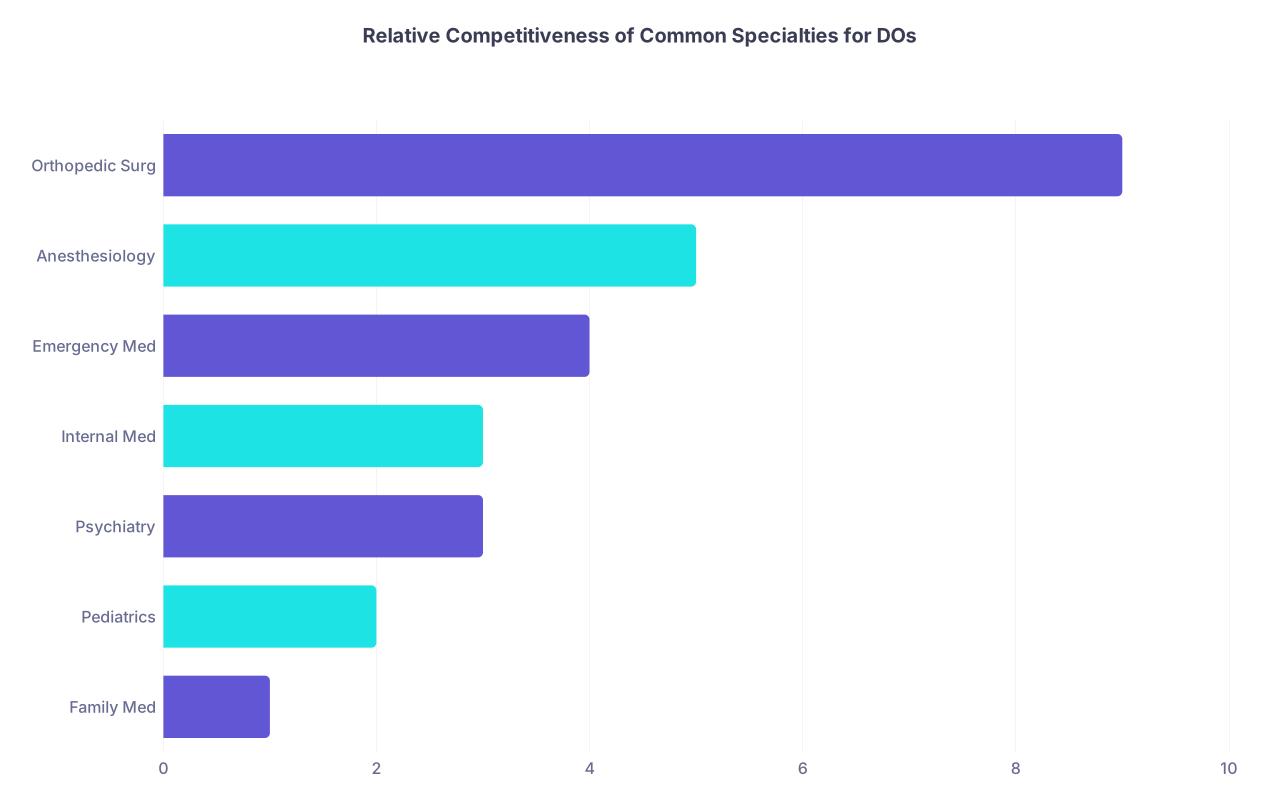
Step 1: Be brutally honest about specialty competitiveness.
| Category | Value |
|---|---|
| Family Med | 1 |
| Pediatrics | 2 |
| Psychiatry | 3 |
| Internal Med | 3 |
| Emergency Med | 4 |
| Anesthesiology | 5 |
| Orthopedic Surg | 9 |
Scale 1–10, where 1 is “almost everyone matches somewhere” and 9–10 is “bloodbath.”
If your target is:
- 1–3: COMLEX-only is often safe if the rest of your app is coherent
- 4–6: COMLEX-only is possible, but USMLE gives you more safety and range
- 7–10: Skipping USMLE is a major handicap unless you’re okay with a very narrow set of programs
Step 2: Map your geography and program type.
Write down:
- 5–10 actual programs you’d be happy to match at
- Check their websites for: “USMLE required,” “USMLE preferred,” or “COMLEX accepted”
You’ll be surprised how clear the pattern gets. On paper. Not in your imagination.
Step 3: Be realistic about your test‑taking profile.
If your COMSAEs and school exams are:
- Consistently strong → USMLE may be a good upside play
- All over the place, with marginal safety on COMLEX alone → prioritizing a strong COMLEX and clinical performance may be smarter than tossing in a mediocre USMLE
USMLE is not a magical door opener if the score is weak. It’s just another number programs can use to say no.
How to Make COMLEX-Only Actually Work for You
If you’re going COMLEX-only, you do not get to be average everywhere else. You win by tightening the rest of your application.
Crush the Percentile, Not Just the Pass
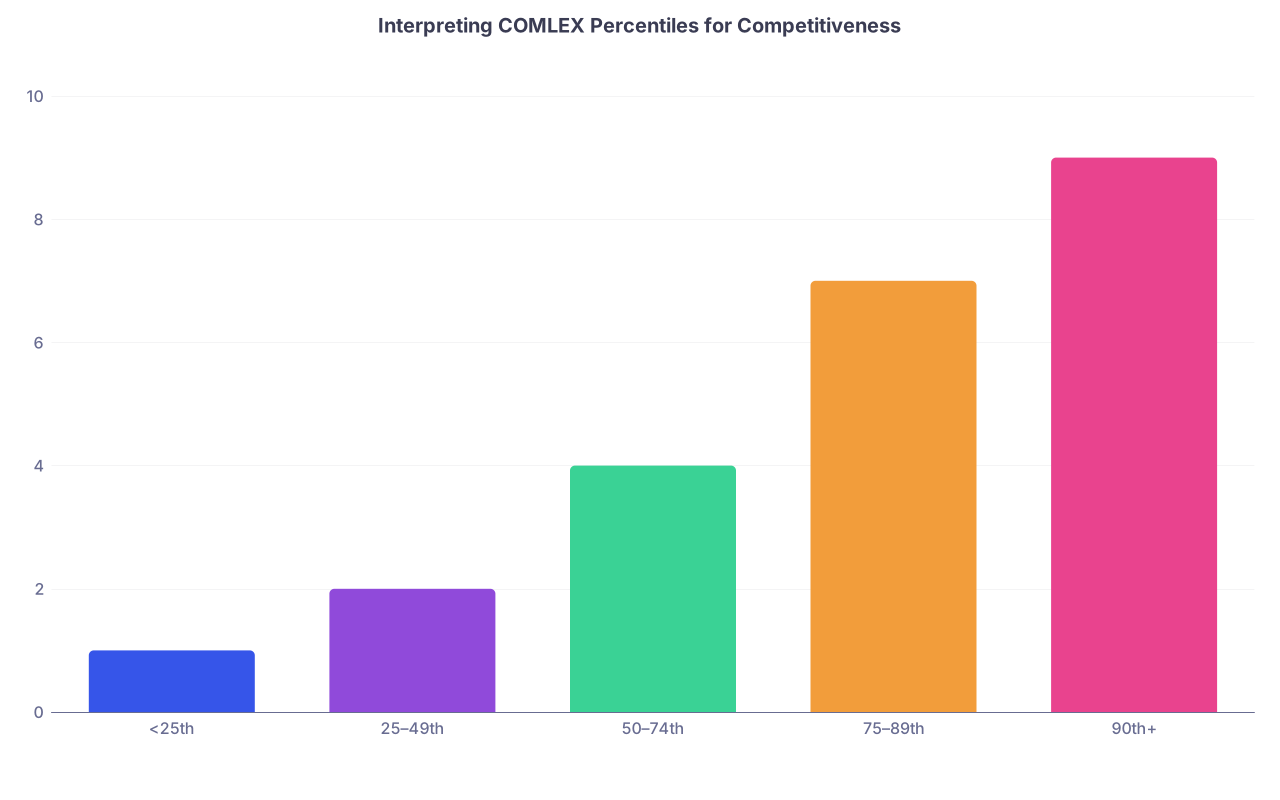
Programs won’t always know what a “610” means. They do understand “top 15–20%.”
So you should be thinking in percentiles, not just raw score.
| Category | Value |
|---|---|
| <25th | 1 |
| 25–49th | 2 |
| 50–74th | 4 |
| 75–89th | 7 |
| 90th+ | 9 |
Rough translation (for bread‑and‑butter specialties):
- Below 25th: You’re in damage control. Target highly DO‑friendly, lower‑tier programs, consider backup specialties.
- 25–49th: You can match, but your list needs to be wide and realistic.
- 50–74th: You’re competitive for most community programs if the rest of your app isn’t a mess.
- 75th+: You’re strong. Pair that with good letters and you’re fine in most COMLEX-friendly lanes.
Rotate Where COMLEX Is the Norm
Set up audition rotations and sub‑Is at:
- Former AOA programs
- Hospitals with DO-heavy leadership
- Systems affiliated with your COM or other osteopathic schools
These places will:
- Already know exactly how to interpret COMLEX
- See your performance in person, which trumps any score debate
- Sometimes explicitly prefer DOs because of retention and culture fit

| Step | Description |
|---|---|
| Step 1 | Define specialty + region |
| Step 2 | Identify target programs |
| Step 3 | Reconsider USMLE or adjust list |
| Step 4 | Schedule rotations at DO-friendly sites |
| Step 5 | Crush rotations + secure strong letters |
| Step 6 | Emphasize COMLEX percentile in ERAS |
| Step 7 | USMLE required? |
Spell It Out in Your App
Do not assume PDs will dig for COMLEX interpretation.
In your ERAS experiences or, if appropriate, in your personal statement (a short line, not a manifesto), you can:
- Briefly state your COMLEX percentile
- Reassure on test-taking ability if you have strong Level 2 as well
- Anchor your scores to performance: “COMLEX Level 2 (x percentile) in line with clinical honors in IM, FM, and EM.”
It saves them the guesswork. Many will be grateful you did the conversion work for them.
The Biggest Myth: That There’s One Right Answer for Every DO
The loudest mistake in DO advising culture right now is trying to turn this into a binary religion:
- Group A: “Everyone must take USMLE. No exceptions.”
- Group B: “COMLEX-only is just as good. USMLE is MD gatekeeping.”
Both are wrong. Dogma is easy. Strategy is messy.
Here’s the reality:
- There are scenarios where COMLEX-only is totally rational, defensible, and supported by outcome data.
- There are scenarios where skipping USMLE is basically choosing to accept much narrower, less competitive options.
- And in a lot of grey-zone cases, it’s a judgment call based on your numbers, your goals, and your bandwidth.
If you’re looking for a one-liner rule like “always take USMLE” or “never bother,” you’re asking the wrong question.
The smarter question is: “Given who I am, what I want, and the programs that actually exist, where does USMLE meaningfully move the needle?”
Answer that honestly, and the path is usually obvious.
Years from now, you won’t be thinking about whether you did or did not sit in a Prometric center for eight more hours; you’ll be thinking about whether you built a career that actually fits you. The exam is just one tool — not the entire story.