The belief that an away rotation “guarantees” a spot in an ACGME residency is wrong—especially for DOs—and hanging onto that myth will cost you interviews, money, and sanity.
You’ve probably heard some version of this in group chats or on SDN: “If you get an away in that program, you’re basically in.” Or, “For DOs, the only way to match university programs is to rotate there.” Sounds comforting. It’s also lazy thinking and only half-true on a good day.
Let’s tear it apart and replace it with what actually happens to DO applicants in ACGME programs.
What Programs Actually Do With Away Rotators
Program directors are not sitting there thinking, “Anyone who rotates here gets ranked.” They’re doing something much more boring and much more ruthless: risk evaluation.
They use aways as an extended interview. That’s it. An away rotation:
- Gives them a 4-week sample of how you work.
- Gives you a chance to prove your Step/COMLEX score doesn’t define you.
- Gives them more data—not a moral obligation—to rank you.
For DOs, aways can help. Sometimes a lot. But they aren’t magic. Here’s a more accurate translation of how aways function for most ACGME programs.
| Program Type | How They Use Aways for DOs |
|---|---|
| Community IM/FM | Nice but not essential |
| Mid-tier university IM | Helpful, small to moderate bump |
| Competitive surgical | Often expected, screens for fit/work ethic |
| Derm/Ortho/ENT/Urology | Functionally required, not sufficient |
| EM (mid to high tier) | Strong weight on SLOEs, not auto-accept |
The reality: for highly competitive fields, aways are sometimes close to necessary for DOs to be seriously considered. But “necessary” is not remotely the same as “guarantee.”
What the Data Actually Shows for DOs
Let’s look at the bigger picture first.
The NRMP’s Charting Outcomes and Program Director Surveys (combined MD+DO now) show the same pattern over and over:
- Home institution students and rotators are more likely to match at a program than total outsiders.
- But a huge fraction of rotators still do not end up there.
- For DOs, the gap between “rotated here” and “actually matched here” is big enough to be painful.
You never see glossy marketing numbers like “80% of our away rotators match our program.” Because the real numbers are lower and less flattering.
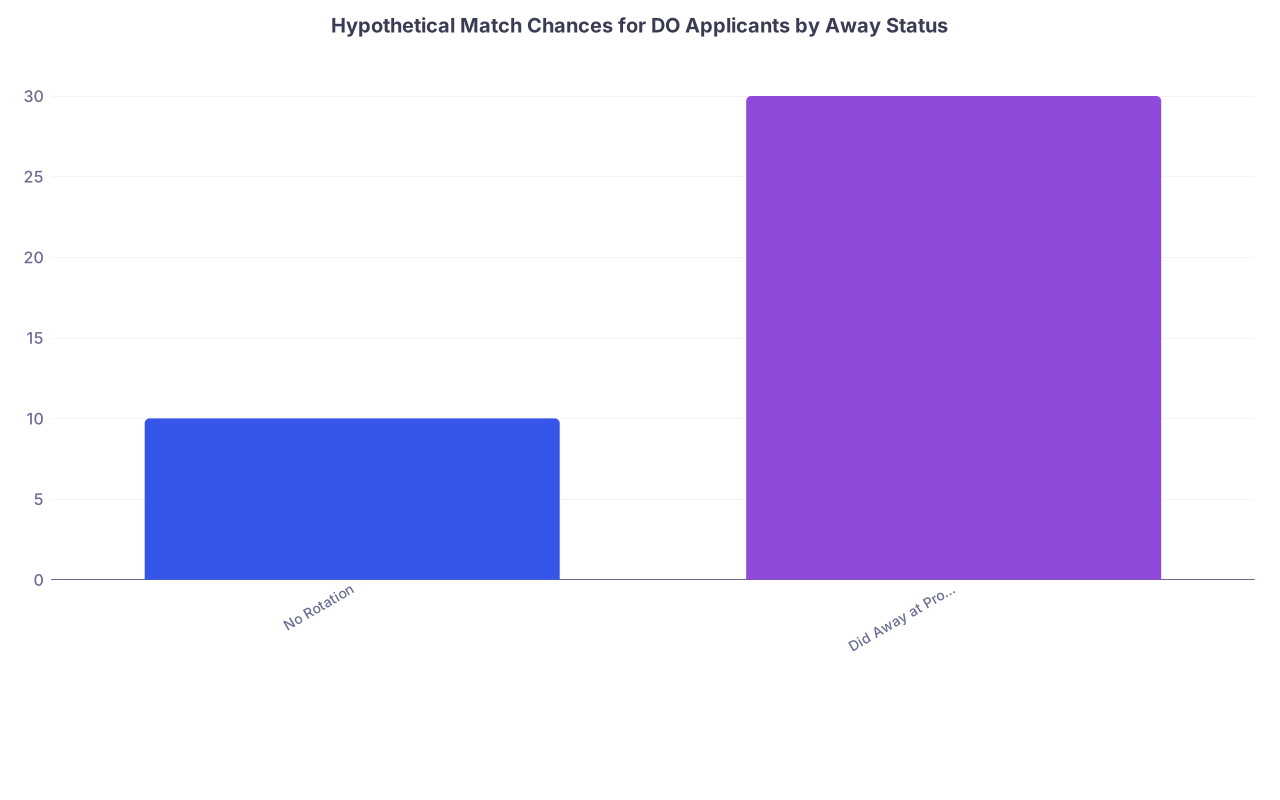
For many specialties, what aways really do is change the probability a bit, not the outcome category. Think more like this:
| Category | Value |
|---|---|
| No Rotation | 10 |
| Did Away at Program | 30 |
Those are made-up numbers, but that ratio (3x better odds, still low in absolute terms) is very close to what I’ve seen informally in EM, ortho, and some surgical subspecialties for DOs.
Yes, your odds improve if you do an away. No, you’re not “basically in.”
Why DOs Cling So Hard to the Away Rotation Myth
I get why this myth won’t die. The deck is stacked, and students want a lever to pull.
Here’s what DO students are up against in ACGME programs:
- Fewer home university academic departments with built-in pipelines.
- Program directors who still quietly prefer MDs (even if they won’t say it out loud).
- Extra scrutiny on Step 1/2 or COMLEX equivalents.
- Less built-in research, especially in surgical and academic internal medicine programs.
So the story becomes: “If I can just get them to see me, I’ll win them over.”
Sometimes that’s true. Sometimes you are better in person than you look on paper. I’ve watched a DO student with a 225-ish Step 2 win over a mid-tier academic IM program by being the hardest-working, most clinically sharp sub-I on the team. She matched there.
I’ve also watched a DO student with a 250+ Step 2, strong letters, and a “dream” away in ortho get nothing more than a polite rejection. Why? Because they had 15 rotators and 4 spots, and three of those slots were basically already spoken for (home students and a prior rotator they loved).
The myth survives because people remember the success anecdotes and ignore the denominator: all the rotators who never post their outcome.
Where Aways Actually Matter (and Where They Don’t)
Let’s be specific, because hand-wavy advice is useless.
Surgical and Surgical-Adjacent (Ortho, ENT, Urology, Neurosurgery, Plastics)
For a DO trying to break into these in ACGME programs:
- Aways are almost required.
- Multiple aways are often expected.
- Your letters from these rotations can be worth more than your entire preclinical GPA.
But they still do not guarantee you anything. Programs often bring in:
- Their own home students
- 2–3 rotators they adored
- 1–2 high-stat outsiders with connections or research
If you’re the DO rotator who was “fine” but not outstanding, you’re gone. If you were good but they already had three internal candidates? Also gone.
EM
EM used to be the poster child for “crush the away, get a SLOE, you’re in.” That fairy tale is dead in the current EM climate.
Now:
- SLOEs from aways are necessary for a competitive EM DO application.
- But tons of DOs with decent SLOEs and solid performance are not matching, even having done 2–3 aways.
Aways get you the SLOE. The SLOE gets you considered. The market right now is still oversaturated.
Internal Medicine / Family Med / Peds
If you are a DO applying to community or lower-mid academic programs:
- Aways are useful but not mandatory.
- They can be strategically valuable at a single target program you really want.
But don’t kid yourself that doing an away at a solid but not hyper-competitive academic IM program “locks it in.” If your scores are weak or your clinical performance is average, the away might just save you from being filtered out—not elevate you into “guaranteed” territory.
Extremely Competitive University Programs
For big-name academic IM, anesthesia, radiology, etc.:
- Aways as a DO can sometimes open a door that would otherwise be shut.
- But you’re competing against MDs with institutional connections, publications in that department, and home program advocates.
Plenty of DOs rotate at “dream” big-name programs and end up matching nicely—but somewhere completely different.
What Aways Actually Signal to Programs
Let me flip the question: what do programs actually learn about you from an away?
They’re looking for:
- Can you function like a PGY-1 without being dangerous?
- Do residents like working with you, or do they sigh when they see your name on the list?
- Do you take feedback once…or need the same correction three times?
- Are you the DO who’s “just happy to be here,” or do you act like part of the team?
They’re not thinking, “Well, they spent thousands of dollars and came all this way, we owe them a spot.”
They also see:
- Your raw test-taking ability (Step/COMLEX scores) hasn’t changed.
- Your research output hasn’t magically appeared in PubMed.
- Their already small number of DO interview slots may be partially pre-allocated to DOs from schools they know well.
If you rotate and blend into the background, you’ve gained very little. The rotation doesn’t guarantee anything; your targeted impact during that month is what moves the needle.
The Hidden Risks: How Aways Can Backfire for DOs
The myth doesn’t just give false hope. It actively harms DO applicants by misallocating their limited shots.
I’ve watched DO students:
- Burn two prime away slots on hyper-competitive university programs where they were never going to be ranked high, based on prior DO match patterns.
- Skip a smart, realistic away at a mid-tier academic program that actually likes DOs, to chase a prestige logo.
- Over-rotate in one geographic area and then have a thin, geographically unbalanced application.
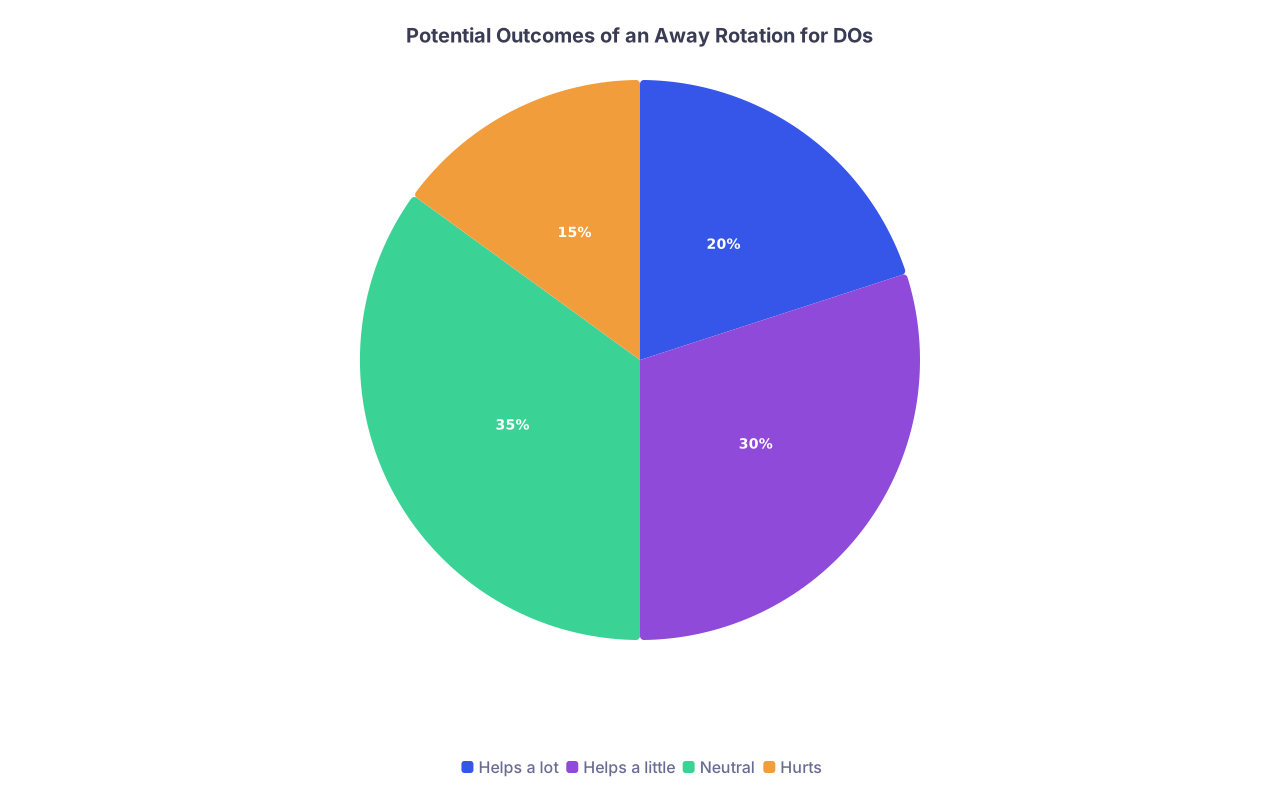
Here’s the ugly reality: a bad or even mediocre away can hurt you more than no away.
Residents talk. Attendings write damning-with-faint-praise narratives. Program directors remember the DO student who “seemed disengaged” or “was fine but not standout.”
You don’t get points just for showing up. You get judged.
| Category | Value |
|---|---|
| Helps a lot | 20 |
| Helps a little | 30 |
| Neutral | 35 |
| Hurts | 15 |
Again, those numbers are illustrative, but that distribution is very close to the pattern I’ve seen: only a slice of rotators truly stand out in a way that changes their rank list slot.
How to Use Aways Strategically as a DO (Without Believing the Myth)
The smart DO applicant does not treat aways like lottery tickets. They treat them like high-risk, high-yield investments.
A few principles that actually hold up:
Know the program’s DO track record.
If a university program has taken zero DOs in the last 5 years and has a massive MD home school, your away is a Hail Mary. You might still do it, but don’t call it a “pathway.”Use at least one away on a realistic, DO-friendly target.
That means a place that has:- Recent DO grads
- Faculty or leadership with DO backgrounds
- Notoriously fair treatment of DOs (talk to older students and PGY-1s, not just their website)
Aim to be known, not just present.
On your away, you need at least 1–2 attendings and several residents who could, if asked, describe you in detail: how you work, how you think, how you treat patients and staff. If they can’t, you failed the month.Don’t overspend on long-shot prestige.
If money and time are finite (they are), tossing both at a big-name institution that rarely ranks DOs is more ego than strategy.Have an application that can stand without the away.
Too many DOs think, “My scores are mediocre, but I’ll just crush the away and it’ll balance out.” No. The away is a tie-breaker and a differentiator among already viable candidates. It’s not a rescue boat for a sinking file.
The Timeline Reality Check
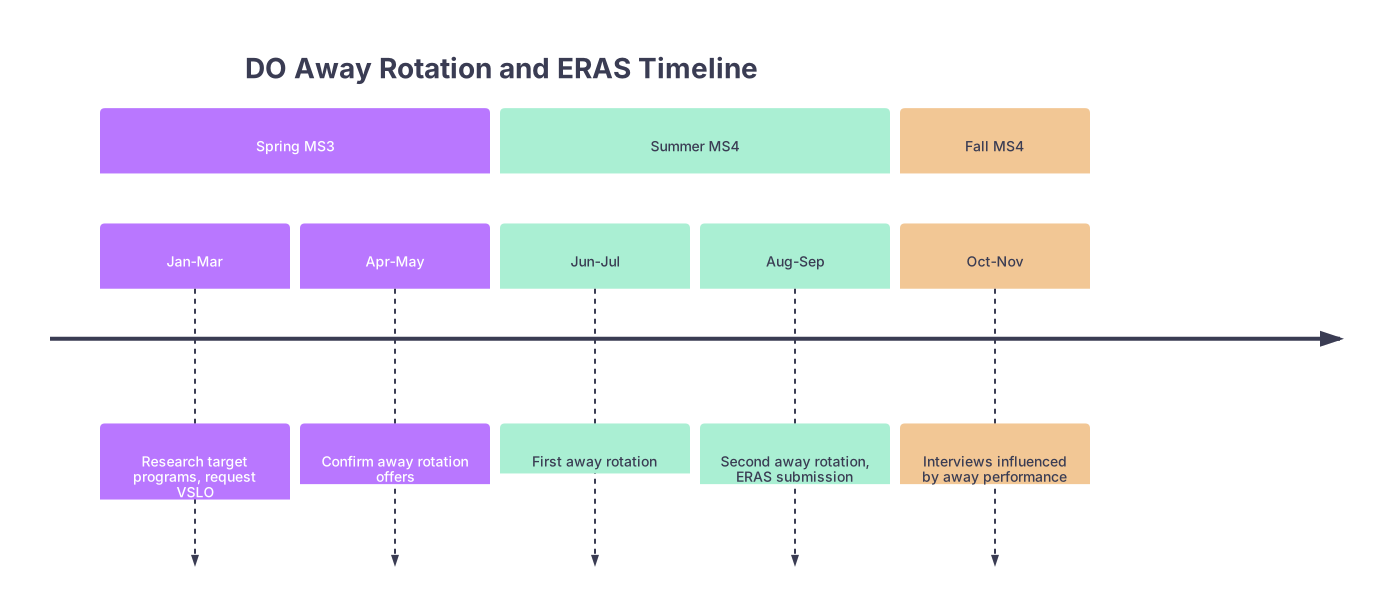
Aways also introduce timing problems that DOs tend to ignore.
| Period | Event |
|---|---|
| Spring MS3 - Jan-Mar | Research target programs, request VSLO |
| Spring MS3 - Apr-May | Confirm away rotation offers |
| Summer MS4 - Jun-Jul | First away rotation |
| Summer MS4 - Aug-Sep | Second away rotation, ERAS submission |
| Fall MS4 - Oct-Nov | Interviews influenced by away performance |
If your critical away is in August–September:
- Your letters may not be in before ERAS submission.
- Programs may pre-screen you based on scores and school before seeing your shiny SLOE or letter.
- One bad early impression from an away can poison multiple programs in that region if word spreads.
So even if the myth were true, the mechanics make “guarantee” impossible. The timing doesn’t line up cleanly enough.
What You Should Actually Believe Instead
Here’s a more accurate, less magical way to think about away rotations as a DO in ACGME-land:
An away rotation is an audition, not a contract.
It can:
- Bump you from “unlikely” to “credible contender.”
- Convert a borderline file into an interview.
- Push you up a rank list if you genuinely impressed the people who have a vote.
It cannot:
- Erase fundamental weaknesses without any objective evidence to support your growth.
- Overcome a program’s ingrained bias against DOs if they basically never rank them.
- Turn 4 weeks of being “fine” into a guaranteed match.
If you plan like it’s an audition and not a guarantee, you’ll make smarter choices. You’ll pick programs strategically, prepare harder, and treat every day like it matters—because it does.
If you cling to the guarantee myth, you’re setting yourself up for one of the worst feelings in this whole process: standing there on Match Day realizing that your “golden ticket” away did exactly nothing for you.
The Bottom Line
Three things I want you to walk away with:
- Aways help DOs in ACGME programs by giving more data and face time—not by guaranteeing anything. They’re an audition, not a promise.
- For competitive fields, aways are often necessary prerequisites, but plenty of DO rotators still do not match at their away sites; believing otherwise leads to bad risk-taking.
- The DOs who win with aways are the ones who choose DO-friendly programs strategically, perform at a PGY-1 level every day, and build an application that could still stand without that rotation.