The blanket claim that “all ACGME programs prefer MDs over DOs” is wrong. Not exaggerated. Wrong.
There are programs and specialties where DOs are still at a disadvantage. Some of that is bias, some of it is pipeline, and some of it is self‑selection. But if you look at what the Match data actually show—NRMP, AAMC, AACOM—you get a much more nuanced picture:
- Many ACGME programs do not care whether you’re MD or DO if you’ve hit their objective filters.
- Some programs quietly prefer MDs.
- A smaller group actively recruits DOs.
Lumping all of that into “ACGME hates DOs” is lazy thinking that hurts applicants more than it helps them.
Let’s pull this apart.
What the Match Data Actually Say About DO vs MD
First, numbers, not vibes.
Every year the NRMP publishes the Charting Outcomes in the Match and Results and Data reports. They break out U.S. MD seniors and U.S. DO seniors separately. If you do not read those documents and you’re giving advice about DO competitiveness, you’re guessing.
Here’s a simplified snapshot (recent cycles, rounded; patterns are stable year to year):
| Applicant Type | Overall Match Rate |
|---|---|
| U.S. MD Seniors | ~92–94% |
| U.S. DO Seniors | ~90–92% |
| U.S. IMGs (US Citizens) | ~60–65% |
| Non‑US IMGs | ~55–60% |
The two big points:
- DO seniors now match at rates very close to MD seniors.
- Both are far above any IMG group.
So if all ACGME programs “preferred MDs” in some categorical way, you wouldn’t see DOs basically matching at the same rate. You’d see a cliff.
But you don’t live in the “overall” match. You live in one specialty, one tier of competitiveness, one applicant pool. That’s where it gets more interesting.
Specialty Matters More Than the Letters After Your Name
The idea that every ACGME program favors MDs equally is like saying every restaurant in a city is equally expensive. Obviously false. Some are McDonald’s. Some are French Laundry.
Residency is the same. There are:
- DO‑friendly specialties and programs
- Truly neutral ones
- MD‑heavy, MD‑protective islands
Let’s group them in reality‑based terms.
1. Historically DO‑friendly specialties
FM, IM (excluding super‑elite academic tracks), peds, psych, EM (non‑top tier), PM&R, anesthesia at many community sites.
Look at NRMP data and you see:
- High DO match rates
- Large numbers of DOs in training
- Many programs with DO PDs or core faculty
In these fields, once you clear basic hurdles (Step/COMLEX, no major red flags, decent LORs), DO vs MD is rarely the decisive factor.
2. Truly mixed/neutral specialties
OB/GYN, pathology, neurology, general surgery (community), transitional year, prelim IM.
These often have:
- A meaningful DO presence but still MD‑majority
- Program‑to‑program variability—one OB program has 40% DOs, the one across town has none
Here, your individual application (scores, letters, school reputation, audition performance) overwhelms the degree type at most places. But some programs in these specialties are still quietly “MD‑preferring.”
3. High‑end, MD‑heavy specialties
Derm, plastics, ENT, ortho, neurosurgery, urology, radiation oncology, some IR pathways, and the prestige academic IM programs that pipeline to cards/GI/heme‑onc at the “name” places.
Here the pattern is consistent:
- DO match rates are lower.
- Many programs have no DOs on their roster, ever.
- Some PDs still say things like, “We haven’t really worked with DOs before,” which is a polite way of saying “we haven’t bothered.”
But pay attention to what that doesn’t mean: it doesn’t mean all programs in these specialties prefer MDs. Several of the more competitive specialties now have clearly DO‑friendly sites that routinely match DOs who’ve done the work—Step 2 CK, research, away rotations.
Blanket narrative: “Derm is impossible for DOs.” Reality: “Derm is brutally hard for everyone, and harder for DOs. But not zero. And some programs deliberately keep a slot or two DO‑accessible.”
Do Programs Formally Prefer MDs? What’s in Black and White
If you want to separate myth from reality, you don’t ask what people say on Reddit. You look at:
- Program websites / FREIDA entries
- Historical resident rosters
- PD surveys (NRMP Program Director Survey)
Many programs spell this out, if you’re willing to read instead of catastrophize.
You’ll see things like:
- “Accepts: US MD, US DO, IMGs” (neutral phrasing; often truly don’t care)
- “We accept applications from US MD and DO graduates only” (IMG‑exclusive, not DO‑exclusive)
- “We have historically matched primarily US MD seniors” (that’s a flag)
- Or the quieter signal: a roster of 30 residents, 0 current or former DOs in the last decade
Here’s where the myth breaks: a huge number of ACGME programs explicitly list DOs as fully welcome and have DOs in house. Some older attendings may still grumble about osteopathic schools, but the system itself is not designed to weed you out just for being DO.
Where there is a difference:
- Programs that require USMLE (but technically accept DOs)
- Programs that only accept COMLEX (very rare, usually smaller DO‑heavy places)
- Programs that don’t understand how to interpret COMLEX and therefore subconsciously favor MDs with clean USMLE numbers
That’s not quite “we prefer MDs because we hate DOs.” It’s “we prefer an exam we understand and a pipeline we know.” Still a problem. Just a different one.
COMLEX vs USMLE: The Bias Nobody Likes to Call Bias
The most toxic oversimplification in the DO world is: “You don’t need USMLE anymore; the Match is single, everything is equal now.”
Nonsense.
If every ACGME program truly treated MD and DO applicants identically, then COMLEX‑only should be fine in all fields. But the real patterns:
- A ton of programs screen by USMLE score only, because that’s how their filters are built.
- Many coordinators still don’t know how to normalize COMLEX Level 1/2 to Step 1/2 CK.
- Some PDs admit privately: “If they don’t have Step 2 CK, I don’t know where to place them in the pile.”
So you get structural bias against COMLEX‑only DOs in some specialties. Not openly malicious. Just lazy.
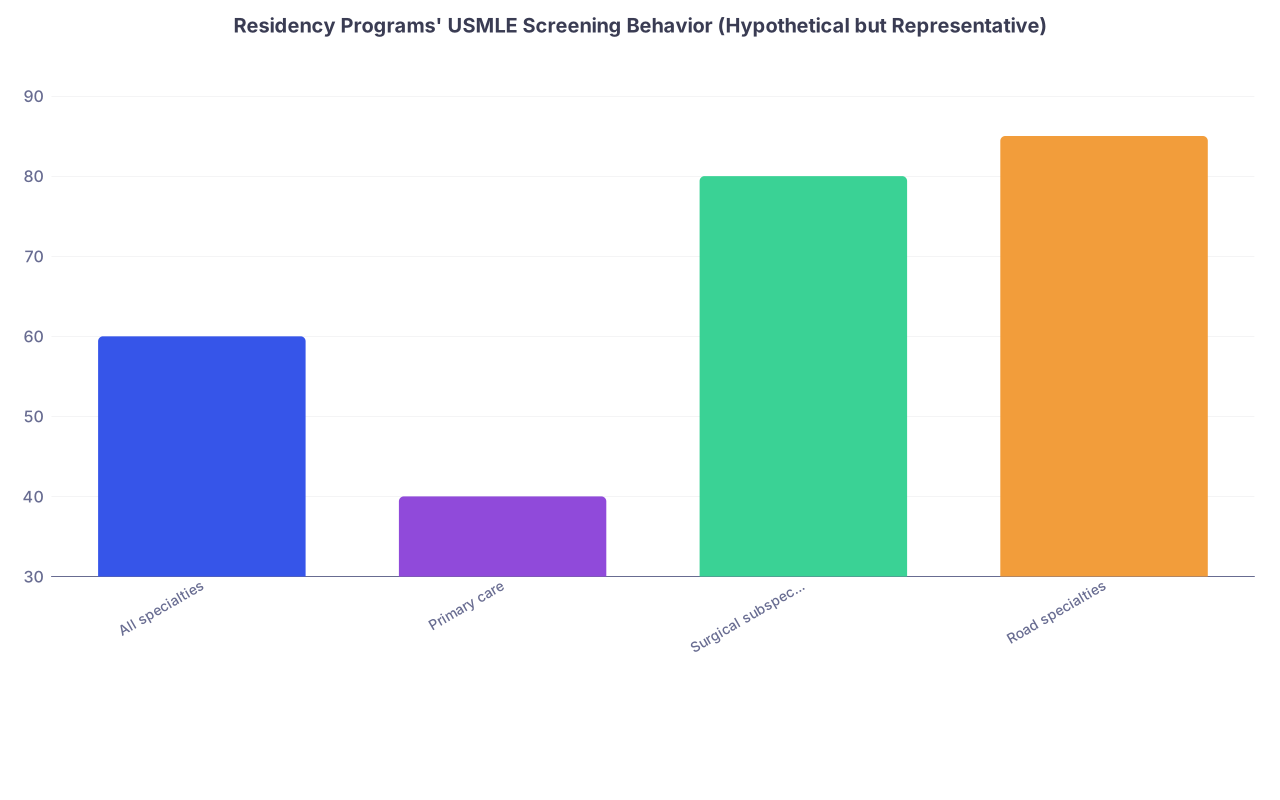
| Category | Value |
|---|---|
| All specialties | 60 |
| Primary care | 40 |
| Surgical subspecialties | 80 |
| Road specialties | 85 |
That chart is approximate, but the trend matches PD survey data: as competitiveness goes up, reliance on standardized scores (and specifically USMLE) goes up.
So when people say, “Programs prefer MDs,” half the time what they really mean is:
“Programs prefer applicants with USMLE scores, and most MDs have them by default.”
For a DO student eyeing anything beyond the easiest buckets, the pragmatic approach is:
- Take Step 2 CK unless there’s a very specific, strong reason not to.
- Assume COMLEX‑only will quietly close doors you never even knew existed, especially in surgical and ROAD fields.
- Realize that what looks like “MD preference” is often “USMLE familiarity + applicant pool inertia.”
The Historical Baggage: Why Some Programs Skew MD‑Heavy
You cannot understand current DO vs MD dynamics without remembering that:
- ACGME (MD) and AOA (DO) residencies were separate until the recent single accreditation.
- Many academic departments grew up in an MD‑only ecosystem. Their chair, vice‑chair, PD, and faculty are all MD, trained in MD‑only programs.
Change in medicine is slow. Institutions have memory.
So some MD‑heavy programs aren’t sitting around saying, “We hate DOs.” They’re saying:
“We’ve always gotten more than enough MD applicants from top schools; we don’t see a reason to change our pattern.”
Is that functionally a preference for MDs? Yes.
Is it a universal ACGME policy? No.
Does it mean you should write off the entire specialty? Also no.
I’ve seen this play out in specific examples:
- A top‑20 academic IM program that had never matched a DO suddenly took a strong DO applicant with a 260+ Step 2, two publications with their faculty, and a stellar sub‑I performance. The next year, they interviewed more DOs.
- A midwestern ortho program that used to be AOA‑only now has a 50–50 MD/DO mix after the merger, and explicitly touts that as a strength.
The pipelines are shifting. Just not uniformly, and not at Reddit speed.
Where DOs Are Clearly Not Second‑Class: Reality Checks
If the “ACGME prefers MDs” myth were fully true, you’d expect DOs to be chronically underrepresented across the board. That’s not what’s happening.
Areas where DOs are clearly thriving:
Primary care (FM, IM, peds)
Many programs have DO majorities. Several PDs are DOs. Some big systems explicitly recruit DO‑heavy classes because they want clinicians, not paper scores.Psychiatry and EM (outside the hyper‑prestige tier)
Tons of DOs. In some regions, DOs dominate EM and psych rosters at community and mid‑academic centers.Leadership
Plenty of PDs, APDs, and chairs are DOs now, especially in community‑based programs and former AOA residencies that migrated into ACGME.
These folks are not “preferring MDs.” They’re often giving DOs the first shot, consciously or not, because they know the pathway and trust the training.
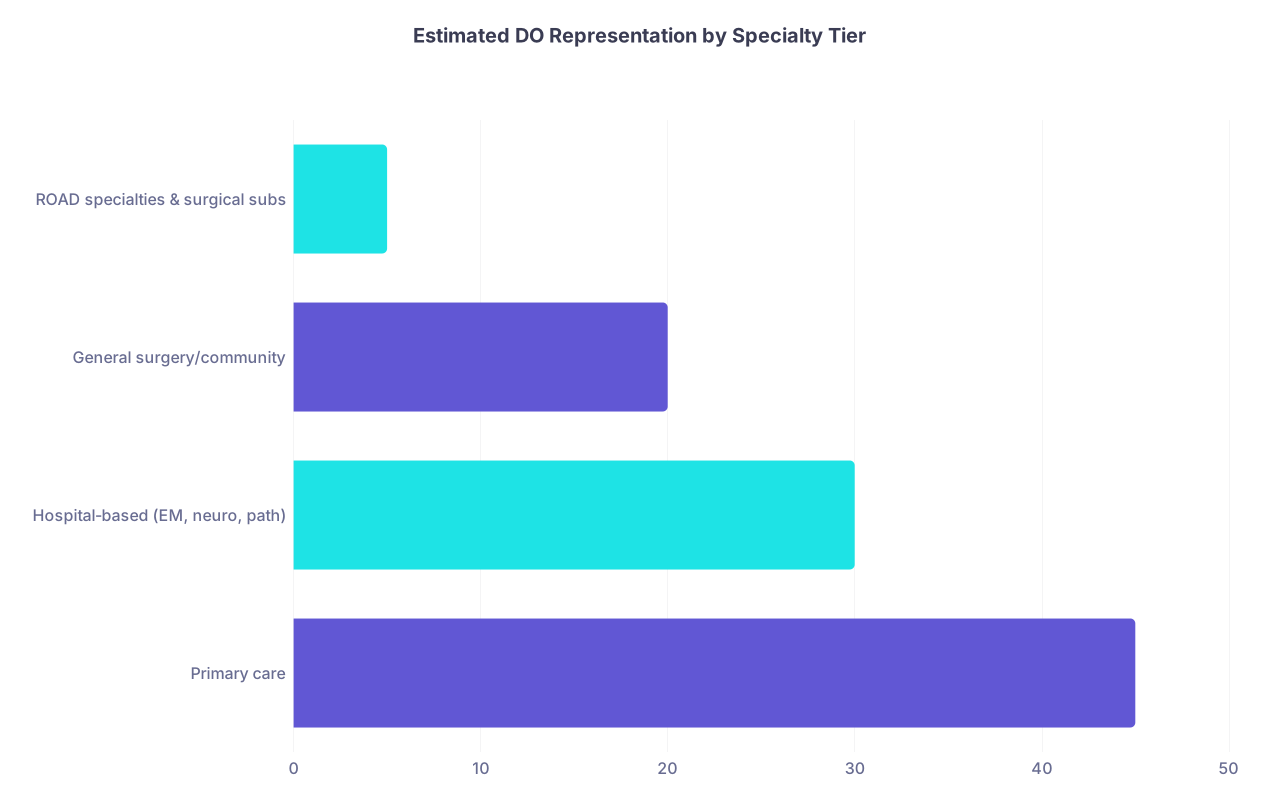
| Category | Value |
|---|---|
| Primary care | 45 |
| Hospital‑based (EM, neuro, path) | 30 |
| General surgery/community | 20 |
| ROAD specialties & surgical subs | 5 |
Again, approximate, but the pattern is the point: DOs are common where the workforce needs are high and gatekeeping is lower. They’re scarcer where prestige obsession is highest. That’s not unique to DO vs MD; it’s how gatekeeping works everywhere.
The Part No One Likes: Self‑Selection and Application Strategy
Another ugly truth: some of the “MD vs DO” gap isn’t external bias. It’s self‑selection and bad strategy.
Patterns I’ve seen up close:
- DO students avoiding Step 2 CK because someone told them “you don’t need it anymore,” then being filtered out of competitive programs that would’ve otherwise liked them.
- DO applicants aiming only at the most elite programs in elite specialties, then complaining the system is rigged against them—after sending 10 applications where an MD in the same situation would have sent 60 and done 3 aways.
- Advisors (including some DO faculty) giving genuinely outdated guidance based on the AOA era, not the current single‑accreditation reality.
Flip side: I’ve watched DOs match ortho, ENT, derm, IR, and cards in solid programs by being brutally realistic:
- They took Step 2 CK and crushed it.
- They did research with people who actually publish, not just “I shadowed Dr. X in his office.”
- They targeted DO‑friendly and DO‑proven programs instead of playing “Top 10 or bust.”
- They did aways where they could plausibly match, not just vacation at brand‑name campuses.
Did a similarly strong MD applicant have an easier path? Usually, yes.
Did the letters DO vs MD decide their fate? No. Their strategy did.
How to Read “MD Preference” as a DO Applicant
Here’s a practical translation guide. When you see or hear:
“Our residents are mostly MDs.”
→ They haven’t built a DO pipeline yet. You’ll need to be stronger than their usual MD applicant to break in.“We accept DOs with USMLE scores.”
→ COMLEX‑only DOs are not truly considered. With CK, you’re competing on similar footing.“We’re a former AOA program now ACGME‑accredited.”
→ Often very DO‑friendly; MDs are the newcomers here.Roster includes multiple DOs from a variety of schools.
→ Real DO‑friendly. They aren’t just taking DOs from one “favorite” school.Zero DOs on the roster and no mention of DOs on the website.
→ Assume a de facto MD preference unless you have exceptional stats + a strong connection.
The Bottom Line: What the Data Actually Show
Strip away the noise and you get three clear truths:
ACGME as a system does not automatically prefer MDs over DOs.
At the macro level, DO seniors now match at rates similar to MD seniors. Many programs are genuinely degree‑neutral if you meet their objective thresholds.Degree‑type bias is real but concentrated.
The further you move into hyper‑competitive, prestige‑driven specialties and programs, the more you see implicit MD preference—driven by history, pipeline, and USMLE‑centric screening, not any official rule.Your exam choices and strategy matter more than the two letters.
As a DO, taking Step 2 CK, targeting DO‑friendly programs, and backing your application with real performance (scores, clinical evaluations, research where needed) has far more impact than arguing about “ACGME bias” on social media.
You can’t change the letters on your diploma. You can change how intelligently you play the game those letters drop you into.