38% of DO seniors going into the 2024 Match failed to secure a PGY-1 position in their first-choice specialty. Most of those misses did not happen at big-name academic powerhouses. They happened at “safe” community ACGME programs applicants assumed would be DO‑friendly.
So no, “community ACGME is easier for DOs” is not a reliable rule. It is a half-truth that gets a lot of people burned.
Let’s pull this apart with actual data and what programs are doing on the ground—not forum mythology.
The Comfortable Myth: “Just Apply Community ACGME, You’ll Be Fine”
You’ve heard this one a hundred times:
- “Academics love MDs and Step 1 > 250. Community just wants warm bodies.”
- “If you’re a DO, target community IM/FM/psych—those are basically DO pipelines.”
- “They don’t care about research, they just want someone who will work.”
Some of that has a grain of truth. But a lot of DOs have discovered the hard way that:
- Many community ACGME programs are more selective than applicants think.
- Some are quietly filtering DOs by school, by board pattern, or by whether you took USMLE.
- The supposed “safety” of community programs has eroded as the applicant pool gets more crowded and more MDs chase “lifestyle” or “backup” specialties.
Let me show you the structural reasons why this myth used to be more true—and why it is breaking down.
What the National Data Actually Shows About DOs in ACGME Programs
First, broad strokes. We’ll keep it concrete.
From the 2024 NRMP Main Residency Match data (MD + DO in single accreditation):
- Overall PGY‑1 match rate for DO seniors: ~89–91% (varies slightly by year)
- But that hides specialty and setting differences:
- DOs are heavily clustered in community and regional programs.
- Academic, university-based programs in competitive specialties still have disproportionately fewer DOs.
Where it gets messy is that NRMP doesn’t publish a clean “community vs academic” breakdown by degree. You have to triangulate:
- Look at program type (university, university-affiliated, community, community with university affiliation).
- Look at program websites and current residents.
- Look at applicant self-report (Charting Outcomes, NRMP Program Director Survey, plus the unglamorous “stalking the residents page”).
Patterns are obvious.
The Resident Roster Reality Check
I’ve done this exercise with students: pull 10 programs in IM, EM, and psych—mix of university and community—and count the DOs.
Typical pattern in many regions:
- Big-name university IM programs: 0–2 DOs per class, often from a handful of “known” DO schools.
- Mid‑tier community IM affiliated with a university: 3–6 DOs per class.
- Standalone community IM: very often majority DO.
But here’s the catch: the majority-DO community programs are not “easier” anymore. They’re just more willing to rank DOs highly. They still filter aggressively by:
- Board failures
- USMLE vs COMLEX
- Visa status
- School reputation
So for DOs, “community ACGME” often means “more DO representation,” not automatic “lower bar.”
Where Community Really Is More Accessible for DOs
Let’s be fair. There are real advantages for DOs in many community settings.
1. Historical Osteopathic Ties
A lot of current ACGME community programs were:
- Former AOA programs that converted
- Historically DO‑heavy training sites
- Systems with significant DO faculty leadership (esp. FM, IM, EM, psych)
Those programs tend to:
- Understand COMLEX scoring and pass/fail patterns.
- Be more tolerant of a modest board hiccup if the rest of the application is strong.
- Have residents/faculty who openly advocate for strong DO candidates.
In those programs, being a DO is neutral or even slightly positive—because they’ve seen plenty of excellent DO grads.
2. Less Irrational Prestige Chasing
Some (not all) community programs care a lot more about:
- Will you show up?
- Are you going to quit, transfer, or fail Step 3?
- Are you teachable and not malignant?
That can benefit a DO with:
- Solid local rotations
- Strong letters from community attendings
- Average‑plus scores but a clear record of reliability and work ethic
But again—this is not the same as “lower standards.” It’s “different weighting of criteria.” Many of these places will still screen out:
- COMLEX < 430 or USMLE < ~215–220 for core specialties
- Any Step/Level failure (especially if unexplained)
- No USMLE taken when the PD clearly said “USMLE preferred”
Where the Myth Breaks: Community ≠ Automatic DO Safety Net
Here’s where people get burned.
1. Community Programs That Behave Like Mini-Academic Centers
Not all community programs are created equal.
- Some are in wealthy suburbs or high-demand cities.
- Some are affiliated with big university departments.
- Some are highly sought‑after for lifestyle/location (think coastal, big metro, or near major cities).
These programs often:
- Draw hundreds to thousands of applications.
- Fill with high‑stat MDs and high‑performing DOs.
- Quietly apply the same or stricter filters than mid-tier university programs.
I’ve watched DO applicants with COMLEX 550 / USMLE 230 and solid rotations get 0 interviews from these “community” programs because:
- They don’t take COMLEX alone.
- They hard‑filter for USMLE ≥ 235–240.
- They soft‑prefer MDs when sifting through 3,000+ apps.
But on paper? They look like “community ACGME IM in a mid-sized city, should be safe.” Wrong.
2. The COMLEX-Only Trap
A huge, underappreciated issue.
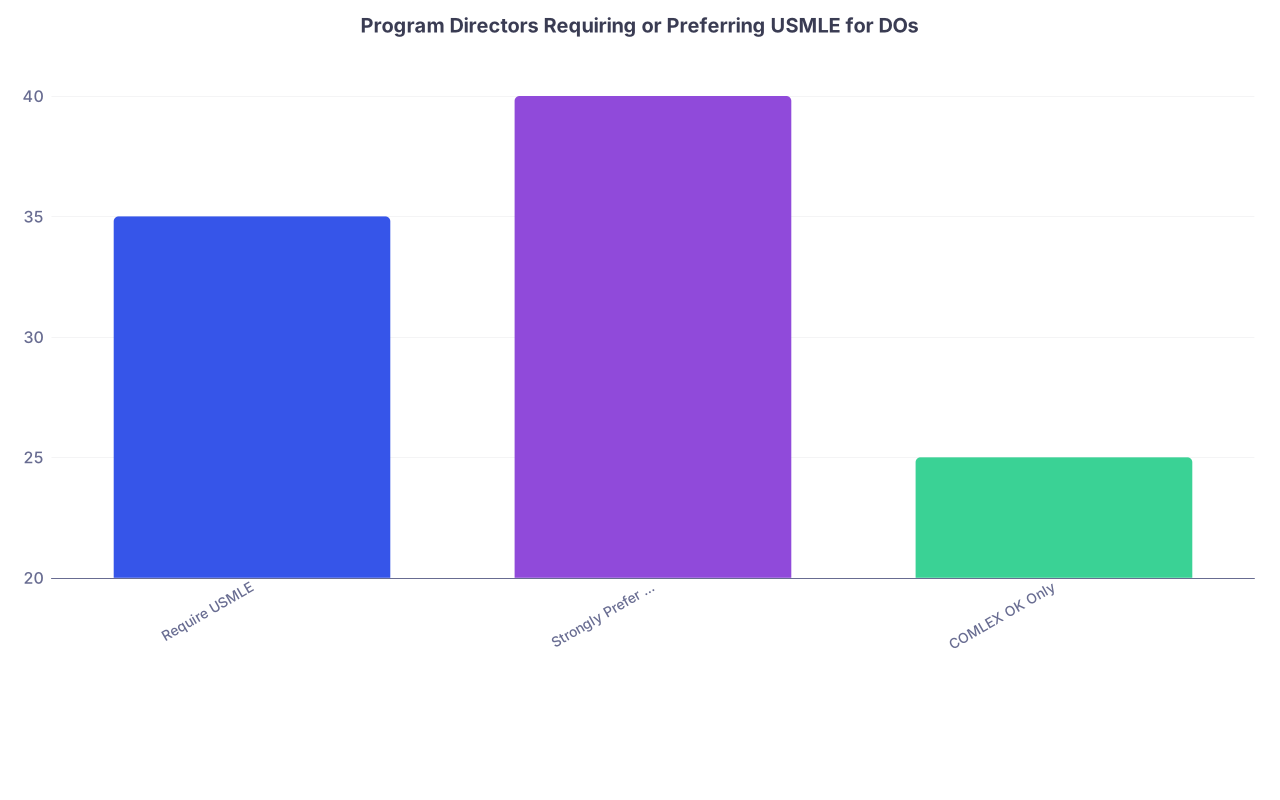
PD Surveys over the last few cycles keep saying a version of the same thing:
- A sizeable chunk of programs do not know what to do with COMLEX alone, or dislike converting.
- Many programs simply filter by USMLE Step 1 / Step 2 CK scores.
| Category | Value |
|---|---|
| Require USMLE | 35 |
| Strongly Prefer USMLE | 40 |
| COMLEX OK Only | 25 |
Those percentages vary by specialty, but the theme is consistent: a majority of PDs either require or strongly prefer USMLE from DOs.
So a DO with only COMLEX applying predominantly to community programs that quietly:
- Don’t read COMLEX well, or
- Automatically sort by USMLE
…will see a fraction of the interview invites they expected. Not because they’re “too good” or “too bad,” but because they never made it past the first filter.
The myth says: “Community programs don’t care, they just need bodies.” Reality: many use the same lazy filters as everyone else.
3. More MDs Are Crowding “Community Backup” Spots
This is the post‑USMLE Step 1 pass/fail world.
MD students from mid‑tier schools who:
- Don’t want to fight for academic spots
- Care more about location than “brand”
- Want a sane call schedule and better lifestyle
…are now applying heavily to the same community IM/FM/psych spots DOs traditionally relied on as safer.
You’re not competing against an imaginary “weaker” pool. You’re competing against MDs who:
- Have USMLE only (easy to screen)
- Often have home‑institution letters
- Show up early in the app cycle
Community PDs are not dumb. They know when they can fill a class with strong candidates and raise the bar.
Real Patterns: Which DOs Actually Match Well at Community ACGME?
Let’s stop speaking in generalities. Here are the DO profiles I’ve repeatedly seen do well at community ACGME programs in core specialties (IM, FM, psych, peds, EM where still open).
| Profile Label | Stats & Features | Typical Community Outcome |
|---|---|---|
| Local Workhorse | Mid 220s USMLE / 500s COMLEX, strong local rotations, PD knows them | Multiple interviews, likely match locally |
| Stats-Only DO | 240+ USMLE, 600+ COMLEX, no local ties | Interviews at mid/high-demand community but not all |
| COMLEX-Only Solid | 520–550 COMLEX, no USMLE | Good shot at DO-heavy or former AOA sites, ignored by many others |
| Borderline Boards | Step fail or COMLEX < 430 | Very limited interviews unless exceptional backstory + strong advocacy |
| Non-Competitive Rebrand | Switching from failed competitive attempt (e.g., ortho to IM) | Mixed; some community programs wary without clear narrative |
The key theme: fit and visibility matter more than the lazy “community = easier” rule.
Strong DOs who:
- Rotate at those hospitals (especially audition rotations)
- Get letters from their attendings
- Show up early in the cycle
- Have at least one pass on USMLE Step 2 CK (if they took it)
…tend to match very well. Even at “desirable” community sites.
DOs who simply carpet-bomb “community IM in big cities” with late, generic applications and COMLEX-only scores? Much more variable.
Program Perspective: What Community PDs Actually Worry About
Talk to community PDs and APDs off the record. They’ll tell you what keeps them from ranking someone, DO or MD.
It’s not the initials after your name. It’s:
- Higher risk of board failure during residency (they hate remediation and losing accreditation points).
- Residents who can’t function independently early enough.
- People who will quit or transfer and leave them scrambling.
So when they look at DO applicants, the real questions are:
- Did your school historically produce residents who passed Step 3/Level 3?
- Did you take USMLE and at least hit a respectable passing cushion?
- Did you complete solid medicine/surgery rotations in real hospital environments (not just community clinics and low-acuity)?
This is why some community programs are pickier with DOs even if they “like DOs” in principle. They’ve had a few bad experiences from certain schools or profiles and now quietly filter.
How to Use This Reality Instead of Getting Crushed by It
Let’s translate this into actionable strategy, because you’re not reading for philosophy.
1. Stop Thinking in “Community vs Academic.” Think in “DO Track Record.”
You want programs with a visible history of:
- Multiple DOs per class
- DOs from schools like yours (or similar tier)
- Faculty who are DOs, or leadership with osteopathic background
If you pull up a “community” program website and see:
- 1 DO in the last 3 years
- All residents from the same 3 MD schools
- Leadership all MD from the same university department
…you are not looking at a “DO-friendly community program.” You’re looking at an off‑site university satellite with different branding.
2. Track Your Risk Honestly
DO + COMLEX-only + no local ties + average scores = you cannot rely on generic community ACGME to save you.
You need to:
- Prioritize former AOA programs and DO-heavy sites.
- Apply more broadly in less competitive locations/regions.
- Seriously consider taking USMLE Step 2 CK if not already done and you’re early enough.
If you’re a DO with USMLE 240+ and solid clinicals, your life looks different. You can:
- Mix university and community, including “desirable” areas.
- Still prioritize DO-heavy programs for safety, but you no longer depend on them.
 or COMLEX < 430](https://cdn.residencyadvisor.com/images/articles_svg/chart-approximate-do-match-risk-by-board-profile-core-sp-9005.svg "Approximate DO Match Risk by Board Profile (Core Specialties)")
| Category | Value |
|---|---|
| USMLE 240+ + COMLEX 600+ | 10 |
| USMLE 225–239 or COMLEX 520–599 | 20 |
| COMLEX-only 520–550 | 35 |
| [Any Step/Level Failure](https://residencyadvisor.com/resources/do-residency-applications/unspoken-acgme-red-flags-that-make-pds-pass-on-strong-do-candidates) or COMLEX < 430 | 60 |
(Values are rough estimated “risk of not matching desired specialty” percentages based on patterns, not official NRMP data—but they align disturbingly well with what advisors see.)
3. Use Rotations and Networking to Make Community Programs Truly “Easier”
Where community can actually be easier for DOs is when you convert yourself from “random name on ERAS” to “known quantity on the ward.”
Rotating at a target community site (sub‑I, audition) and then:
- Getting a strong letter from a respected attending there.
- Showing reliability with notes, presentations, follow‑through.
- Making it clear you’d rank them highly if offered.
…often cuts through a lot of DO/USMLE/COMLEX noise. I’ve seen DOs with very average boards beat objectively stronger MDs just because the PD trusted them based on a month of work.
This is the one advantage that has not eroded with time: community programs still care a lot about fit with their culture and team, and they’ll stretch a bit for someone they know fits.
Quick Reality Check Against the Myth
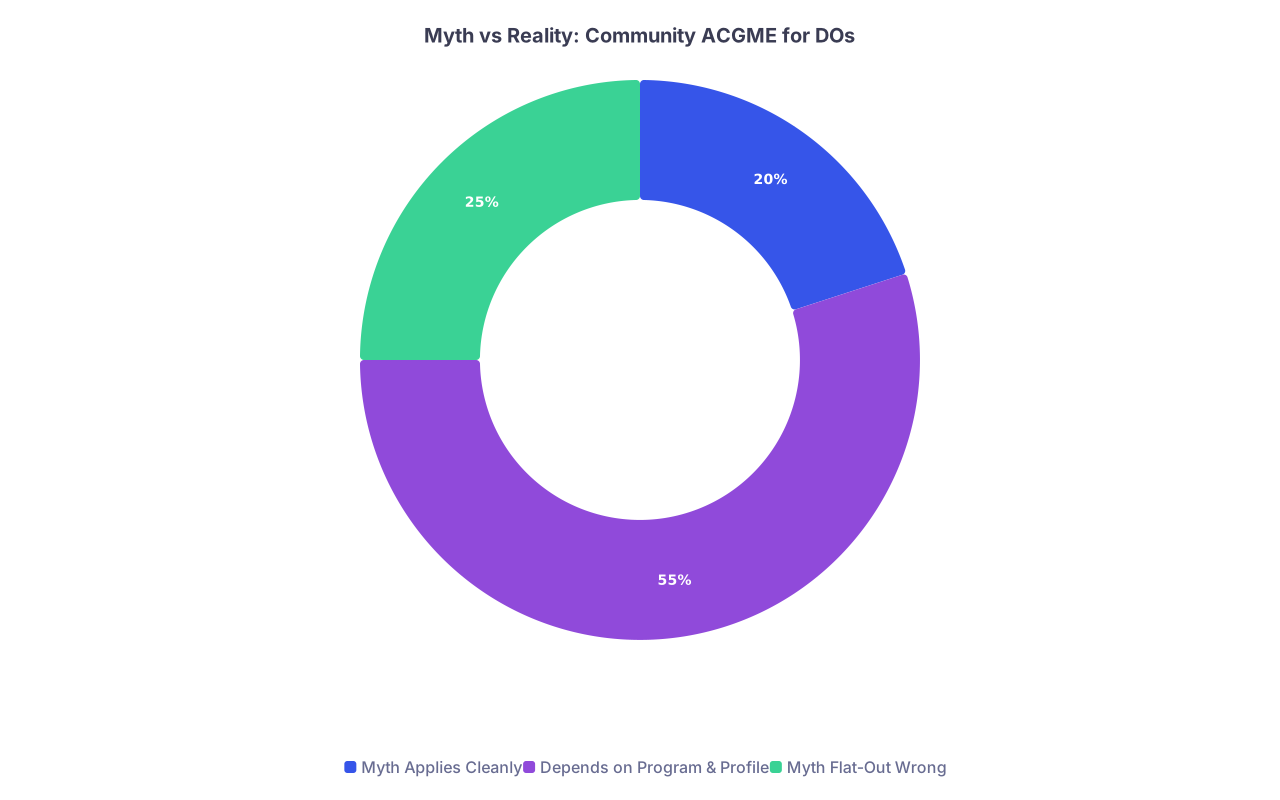
Let me line it up clearly.
| Category | Value |
|---|---|
| Myth Applies Cleanly | 20 |
| Depends on Program & Profile | 55 |
| Myth Flat-Out Wrong | 25 |
Where the myth is partly true:
- Former AOA/DO-heavy community programs
- Rural or less desirable locations
- Programs with DO leadership and long DO track records
Where it breaks down or flips:
- Popular metro/suburban community programs
- “Community” programs effectively run as university satellites
- Programs that hard-filter for USMLE and barely look at COMLEX
- Settings where MDs are flooding the same “backup” spots
Bottom Line: What You Should Actually Remember
“Community ACGME is easier for DOs” is not a rule. It’s a conditional statement that depends on the specific program’s DO history, board filters, and applicant volume.
A community program with no DOs in recent classes is not a DO safety net. It’s often just an informal academic satellite with different signage.
Your best leverage as a DO isn’t “community vs academic.” It’s:
- Choosing programs with proven DO track records.
- Taking USMLE when strategically valuable.
- Using rotations and relationships to be a known, trusted entity—not just “another DO app” in someone’s inbox.