The idea that DOs are automatically weaker applicants in ACGME programs is lazy, outdated, and mostly wrong.
Not entirely wrong. There are real structural disadvantages. But the blanket claim—“DO = weaker applicant” —does not survive contact with the data or with how PDs actually think when they’re staring at a stack of ERAS files at midnight.
Let’s separate superstition from signal.
Myth vs Reality: Where the “DO = weaker” idea actually came from
Historically, DOs were disadvantaged in the ACGME world. But the reasons were structural, not genetic.
Before single accreditation (pre-2020), there were:
- Separate AOA and ACGME accreditation systems
- Some ACGME programs that simply did not accept COMLEX
- Old-school attendings who literally didn’t know what a DO was, or thought DO still meant “couldn’t get into MD”
So what happened? Many DO students self-selected out of the most competitive ACGME programs and specialties. That created a feedback loop:
Fewer DOs applied → Programs saw fewer DO residents → Faculty assumed “we never see DOs here, so they must not be competitive.”
Notice what’s not in that loop: actual performance data showing DOs are weaker.
Post–single accreditation, the landscape is different:
- DOs and MDs now train in the same ACGME-accredited residencies
- DO grads are everywhere in EM, FM, IM, anesthesia, psych, PM&R, even derm and ortho
- Many program directors trained with DO co-residents and don’t see DO as some alien pathway
But the stereotype lags behind reality by about 10 years. Happens in every profession.
What the data actually shows about DO match outcomes
Let’s look at NRMP and match data, because feelings do not equal facts.
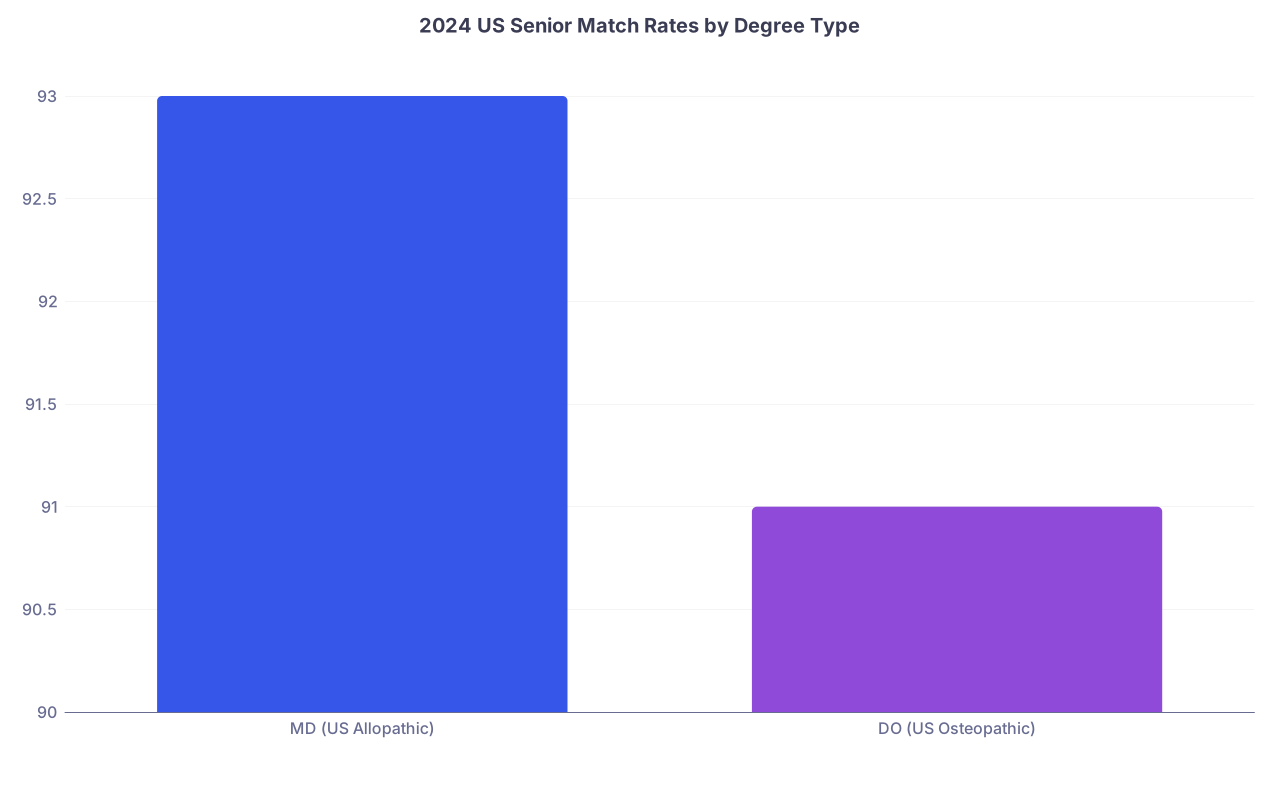
Match rates: the “weaker applicant” narrative starts to crack
| Category | Value |
|---|---|
| MD (US Allopathic) | 93 |
| DO (US Osteopathic) | 91 |
The exact percentages wiggle each year, but the pattern is consistent:
- US MD seniors match at a slightly higher rate than US DO seniors
- But we’re talking a couple of percentage points, not some giant canyon
Does that look like “automatic weaker applicant” territory? No. It looks like “marginal disadvantage that might be structural and specialty-specific.”
And when you break it down by specialty, you see the real story: the gap isn’t uniform.
| Specialty | US MD Match Rate | US DO Match Rate |
|---|---|---|
| Family Med | Very high (90%+) | Very high (85–90%+) |
| Internal Med | Very high | High–very high |
| Psych | High–very high | High |
| Anesthesia | High | Lower but solid |
| EM (post-2023) | Dropped for both | Dropped for both |
| Ortho | Competitive | Very competitive |
In core fields (FM, IM, psych), DOs match extremely well. Where DOs struggle more is in the prestige-obsessed, Step-score-worshipping, “we only interview from 20 schools” specialties and programs.
That’s not about your degree letters making you weak. That’s about gatekeeping.
What program directors actually care about (hint: not your diploma font)
I’ve sat in rooms where PDs and faculty go through applications. Nobody says, “This is an amazing application, but they’re a DO, so no.”
What actually happens sounds like:
- “COMLEX only. Harder to compare, but their scores are strong.”
- “They’re DO but took Step 2 and crushed it.”
- “From a school we’ve had good experiences with.”
- “Research is light; for derm that’s going to hurt them.”
Translation: the DO vs MD distinction becomes one variable among many, and usually not the deciding one.
Here’s what PDs reliably care about more:
- Board performance they can interpret
- Whether your clinical performance matches your scores
- Signals you actually care about their specialty and their program
- Whether you’re going to be a problem resident (red flags, professionalism, vibes)
The “DO label” mainly creates friction at step 1.
The COMLEX / USMLE problem: the biggest real disadvantage
The single biggest reason DOs feel weaker in the ACGME pool isn’t intelligence or training. It’s translation.
Many (not all) ACGME programs still think in USMLE terms. Even now.
So when you apply with:
- COMLEX Level 1 and 2 only
- No USMLE scores
- And a PD who’s busy and not very familiar with COMLEX percentiles
Your file is simply harder to parse. Harder to rank. Harder to compare.
Lazy programs convert COMLEX to USMLE-equivalent with some nonsense formula they found on Reddit. Better programs look at COMLEX percentiles. But nobody has as much calibration for COMLEX as they do for USMLE, because they’ve been staring at USMLE reports for decades.
This is where reality hurts a bit: in competitive ACGME programs, DOs without USMLE are often at a disadvantage. Not because they’re weaker, but because their metrics are opaque to decision-makers.
Flip it around, though, and the “automatic weaker” idea collapses quickly.
A DO with:
- Strong COMLEX scores
- A solid Step 2 CK (260+ in competitive fields, >245 in many mid-tier programs)
- Strong clinical grades and letters from recognizable attendings
…becomes extremely competitive. I’ve watched MDs lose spots to DOs with that profile. Repeatedly.
Specialty-specific: where the DO bias is real vs mostly imagined
Let’s stop pretending all specialties treat DOs the same.
More DO-friendly (or at least neutral in practice)
- Family medicine
- Internal medicine (especially community and many university-affiliated but non-elite programs)
- Pediatrics
- Psychiatry
- PM&R
- Pathology
- Neurology
- Transitional / prelim medicine in many places
In these, the “weaker applicant” label is garbage. DOs match extremely well and often make up a huge percentage of residents. Walk into a random community IM program and DOs may be half or more of the house staff.
Mixed but doable with a strong file
- Anesthesia
- Emergency medicine
- OB/GYN
- General surgery
- Radiology
Here the story is program-dependent. Some university programs are DO-friendly with multiple DO faculty and residents. Others quietly (or openly) prefer MDs. You can’t treat the entire specialty as one organism.
Truly uphill for DOs
- Dermatology
- Orthopedic surgery
- Plastic surgery
- Neurosurgery
- ENT
- Some top-10 academic IM programs and subspecialty pipelines (e.g., “we send 4 a year to cardiology at Big Name Hospital”)
Here, yes, being DO starts as a handicap. Denying that is dishonest. But even here “automatic weaker” is false. There are DO derms. DO neurosurgeons. DO plastics. Their path was just steeper, required more strategy, and usually involved:
- High USMLE scores
- Research at known institutions
- Networking, away rotations, and very strong letters
The myth usually dies the moment a program has one standout DO resident who crushes boards and fellowship placement. Suddenly the “we don’t really take DOs” dogma morphs into “oh, we’re open to DOs if they’re like that.”
Where DOs are statistically weaker: not what you think
Let’s be blunt: there are patterns that hurt DO applicants on average. But cause and effect get twisted.
Common issues I actually see in DO ERAS files:
- No USMLE, applying heavily to programs that quietly screen by Step 2
- Late decisions on specialty → weak specialty-specific experiences
- Over-application without targeted strategy (“100+ applications and hope”)
- Personal statements that are vague and generic, especially in competitive fields
- Underestimating how much letters from certain institutions or known faculty matter
Notice what’s missing: “They’re not as smart.” “They can’t handle the work.” “Their training is inferior.”
The weakest DO applications usually lose on strategy and signaling, not raw talent.
Program-level bias: old guard vs new reality
I’ll be very clear: some ACGME programs still discriminate, formally or informally, against DOs.
Examples I’ve actually heard:
- “We don’t consider DOs unless they rotated here.”
- “We’ve never taken a DO.” (Said with pride, like it’s a brand.)
- “If they’re DO with no Step, they’re out.”
These are often:
- Top-heavy, prestige-chasing university programs
- Departments where the leadership is old-school and never worked with DOs
- Places obsessed with reputation more than resident outcomes
On the flip side, I’ve also heard:
- “Our best resident is a DO; I don’t care about the letters.”
- “We’ve had great DOs from X school; let’s interview more from there.”
- “If the numbers and letters are good, DO vs MD is irrelevant.”
What you’re seeing is generational turnover. The older the PD / department chair, the more likely the DO stereotype is to linger. The younger, the more likely they trained with DO co-residents and care far more about who will survive night float without imploding.
How a DO stops looking “weaker” and starts looking like a top-tier applicant
You can’t control prejudiced PDs. You can control whether you give neutral or DO-friendly programs something they can clearly recognize as strong.
Here’s what that looks like, concretely.
1. Make your metrics legible
If you’re aiming at ACGME-heavy or competitive programs and you can safely do well on Step 2 → take it.
COMLEX alone is fine if:
- You’re applying primarily to DO-heavy or explicitly COMLEX-accepting programs
- Your scores are genuinely strong and you’re realistic about specialty/program targeting
But if you’re chasing:
- University anesthesia
- Competitive EM
- Mid–high tier academic IM
- Any surgical subspecialty
…not taking Step 2 CK is basically handicapping your own file.
2. Overcompensate where stereotypes live
The lazy stereotype: DO = weaker test-taker, less rigorous school, “soft” applicant.
You kill that with:
- A strong Step 2 CK (if you take it) and/or high COMLEX percentiles
- Honors in core rotations, especially in the specialty you’re applying to
- Strong, specific letters: “Top 5% of students I’ve worked with in 15 years,” not “pleasant to work with”
You don’t argue with these programs. You out-perform their expectations and let the data embarrass them.
3. Signal commitment like you mean it
I see this mistake all the time with DOs applying into competitive ACGME fields: the file looks half-hearted. One paper, vague PS, no clear story connecting prior experiences to the specialty.
What makes you look strong:
- Away rotations at realistic but solid ACGME programs, not reach-only
- Specialty-specific research or at least a meaningful project
- Specificity in your personal statement and interviews: “Here is exactly why this specialty, and what I’ve already done that aligns with it.”
Programs are not hunting for “perfect.” They’re hunting for “will this person actually stay, work hard, and not quit halfway through PGY-2.”
Where assumptions still bite DOs (and how to not walk into the trap)
There are two big unspoken assumptions that hurt DOs:
- “If they were really strong, they’d have gone MD.”
- “If they’re DO, they probably didn’t have the metrics for MD.”
You’ll never fix this mindset fully. But you can make it obviously wrong for you:
- Your board scores are as high or higher than many MDs in the pile
- Your clinical comments read like a future colleague, not a marginal student
- Your behavior during interviews shows maturity, self-awareness, and work ethic
The truth is, once you’re in residency, nobody cares. People care if you can staff a busy night shift, write a decent note, and not scare the nurses. I’ve watched MD attendings recommend DO co-residents for fellowships over MDs without blinking.
The whole “weaker applicant” thing is a pre-residency obsession that melts away once the real work starts.
Bottom line: DO is not a weakness. Sloppy strategy is.
The narrative that DOs are automatically weaker ACGME applicants is mostly an excuse—used by programs that don’t want to examine their own biases and by applicants who don’t want to examine their own strategy.
Here’s what the evidence and real-world behavior actually say:
- DOs match extremely well in many core specialties
- The match gap between MD and DO seniors is modest and heavily specialty-driven
- The biggest real disadvantage is not intelligence or training; it’s metric translation (COMLEX vs USMLE) and a residue of institutional bias
- A well-prepared DO with strong scores, letters, and a coherent specialty story is more competitive than a mediocre MD trying to coast on the letters “M” and “D”
Years from now, nobody in your hospital will introduce you as “the weaker applicant who somehow matched.” They’ll introduce you as “our resident” or “our attending,” and they’ll remember whether you showed up, did the work, and owned your role—letters after your name or not.