
The obsession with “apply to 100+ programs” is one of the worst pieces of advice DO students get about ACGME residencies. It is lazy, fear-based, and increasingly wrong.
If you’re osteopathic and aiming for ACGME programs, you’re not doomed to carpet-bomb the entire country with applications. The data does not support it. The people pushing that narrative usually haven’t looked at an NRMP chart book in a decade—or they’re trying to justify their own panic-clicking spree.
Let’s dismantle this properly.
The Origin of the “Apply to 100+” Panic
This myth came from three places:
- The old pre-merger era, when many ACGME programs quietly filtered out DOs.
- Anecdotes from a few weaker applicants who matched after applying to 120+ programs.
- Commercial incentives—advisors and “consultants” who get more business when students are terrified.
What actually changed:
- The single accreditation system forced a lot of programs to confront their DO bias in writing and reporting.
- NRMP and AAMC started publishing applicant behavior vs. match rates very clearly.
- Program directors have become more open (sometimes painfully blunt) about what they will and will not seriously consider.
The result: the signal-to-noise ratio matters more than raw number of applications. And DOs who understand that win.
What the Data Actually Shows for DO Applicants
Let’s ground this in numbers, not vibes.
From recent NRMP Charting Outcomes and Program Director Survey data (patterns are consistent year to year):
- DO match rates into many ACGME specialties are comparable to MDs when:
- They have competitive board scores (COMLEX and/or USMLE).
- They target programs that historically interview DOs.
- They do not waste all their interview capital on long-shot “prestige” programs.
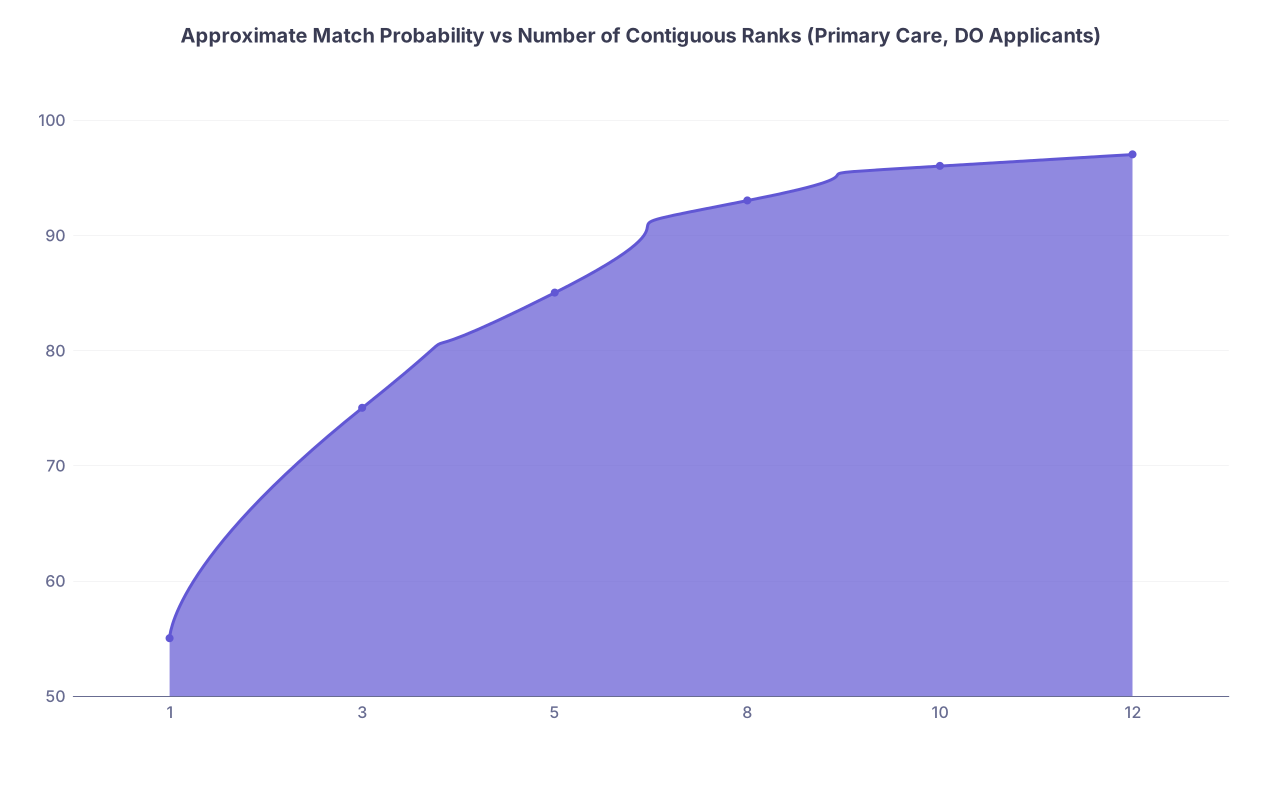
The key relationship is between number of ranks and probability of matching, not “how many programs you panic-applied to.”
| Category | Value |
|---|---|
| 1 | 55 |
| 3 | 75 |
| 5 | 85 |
| 8 | 93 |
| 10 | 96 |
| 12 | 97 |
Notice what’s not on that graph: “programs applied to.” Because the number that matters is how many realistic programs end up on your rank list.
Here’s what I see over and over:
- DO applicant applies to 120 ACGME IM programs.
- Automatic filters kill 40–60 of those apps instantly (USMLE required, no DOs historically, hidden Step 1 cutoffs).
- Another 30 were totally unrealistic (research-powerhouse university programs with no DO residents).
- They get 8–12 interviews—from the 30–40 programs that were actually in play.
- They could’ve applied to 60 intelligently and gotten almost identical results.
You are not buying more safety by going from 60 to 120. You’re buying more chaos and credit card debt.
Why 100+ Applications Is Often a Terrible Strategy for DOs
I’ve watched DO students burn themselves out every cycle with the same pattern:
- Borrow money for ERAS.
- Apply broad and blind—“just in case.”
- Then drown in secondary requests, surveys, signals, and interview scheduling.
The problem is not just cost. It’s that spreading yourself that thin wastes your limited time, energy, and signaling power.
Let’s be concrete.
| Scenario | Programs Applied | Interview Invites | Interviews Attended | Final Rank List Length |
|---|---|---|---|---|
| Targeted | 60 | 12 | 10 | 10 |
| Panic | 120 | 14 | 10 | 10 |
I’ve seen numbers almost exactly like this in real advisees’ dashboards. The “panic” group spent literally double on ERAS, wrote twice the emails, spammed twice as many programs—and ended up with the same 10 interviews on their rank list.
Because interviews—not raw apps—are the bottleneck.
And here’s the kicker for DOs: if half the programs you applied to never seriously consider DOs or quietly auto-screen COMLEX-only applicants, your effective application count is already cut in half.
You’re playing a game with biased referees, and instead of changing the venue, you’re just buying more tickets to the same broken stadium.
Where High Application Numbers Do Make Sense (And Where They Don’t)
There are specialties where DOs sometimes benefit from broad application strategies. But “broad” still doesn’t always mean “100+”.
Let’s map this out based on typical DO competitiveness and ACGME attitudes:
| Specialty Type | Examples | Typical DO Strategy |
|---|---|---|
| Friendly / Neutral | FM, IM, Peds, Psych, Neurology | 40–80 well-chosen programs |
| Mixed / Moderate Bias | OB/GYN, Gen Surg, EM, Anesthesia | 60–100 targeted programs, watch DO history closely |
| Hostile / Hyper-Competitive | Derm, Ortho, ENT, Plastics, Urology | 80–120 may still be needed, plus parallel plan |
Notice what’s missing: “Every DO should apply to 100+ ACGME programs.” That’s lazy, context-free advice.
If you’re a DO applying to Family Medicine with decent scores and solid clinicals, applying to 100+ ACGME FM programs isn’t just unnecessary, it’s almost irresponsible. You could use that time to actually prepare for interviews or improve letters.
If you’re chasing ortho as a DO? Sure, 80–120 applications might be rational. But that’s because the structural bias is intense and the denominator (programs that even consider you) is small. That’s a separate reality—not a universal rule.
The Hidden Cost: How 100+ Applications Hurts Your Actual Chances
There’s a nasty irony here: overapplying can lower your effective competitiveness.
Here’s how it plays out:
- You spray 110 applications.
- You get flooded with:
- Program “preference” forms
- “Signal” requests
- Oddball essays
- Interview scheduling chaos
- You rush everything.
- Your communication with programs becomes generic. Boring. Obviously copy-pasted.
- You show up to interviews under-prepared for each individual program because you’re doing 10 in two weeks.
Program directors notice this. I’ve heard them say things like:
- “She clearly didn’t know anything about our program.”
- “His answers were generic, like he was reading off a script.”
- “I could tell we were one of 40 interviews that month.”
If you apply to 50–70 correct programs, you can:
- Actually read their websites.
- Understand their DO history.
- Tailor a paragraph in your supplemental or email.
- Prepare for interviews like you care.
Depth beats breadth after a point. Especially for DOs, who already need to overcome mild to moderate skepticism at some programs.
How to Right-Size Your Application List as a DO
Let’s talk practical strategy instead of fear-mongering.
Step 1: Reality-check your competitiveness
You need to look at yourself the way a program director would:
- COMLEX Level 1/2, and whether you took USMLE.
- Class rank or quartiles.
- Red flags (repeats, leaves, professionalism issues).
- Research and letters in the specialty.
- Rotations at ACGME programs in that field.
If you’re a DO with:
- Solid COMLEX (and optionally decent USMLE),
- No serious red flags,
- At least one ACGME rotation in your specialty,
you don’t need 120 IM or FM programs. You probably sit in that 40–80 range, depending on geography flexibility.
If you’re weaker on scores or have a red flag, then yes, you might inch up the numbers—but still intelligently.
Step 2: Filter ruthlessly for DO-friendliness
This is where most DOs fail and why they feel forced into 100+ apps. They don’t filter. They just add.
Go through programs and look for:
- Do they have current or recent DO residents?
- Does their website list “USMLE required” with no COMLEX alternative?
- Does FREIDA show any DO percentage in the resident pool?
- Are they in regions historically hostile vs welcoming to DOs?
You can literally create three columns in a spreadsheet:
- Tier A: DOs clearly welcome (current DO residents, no anti-DO language)
- Tier B: Mixed history or unknown
- Tier C: Almost certainly DO-hostile (no DOs ever, explicit USMLE-only + no COMLEX talk)
Then ask yourself: Why on earth are you wasting money on Tier C?
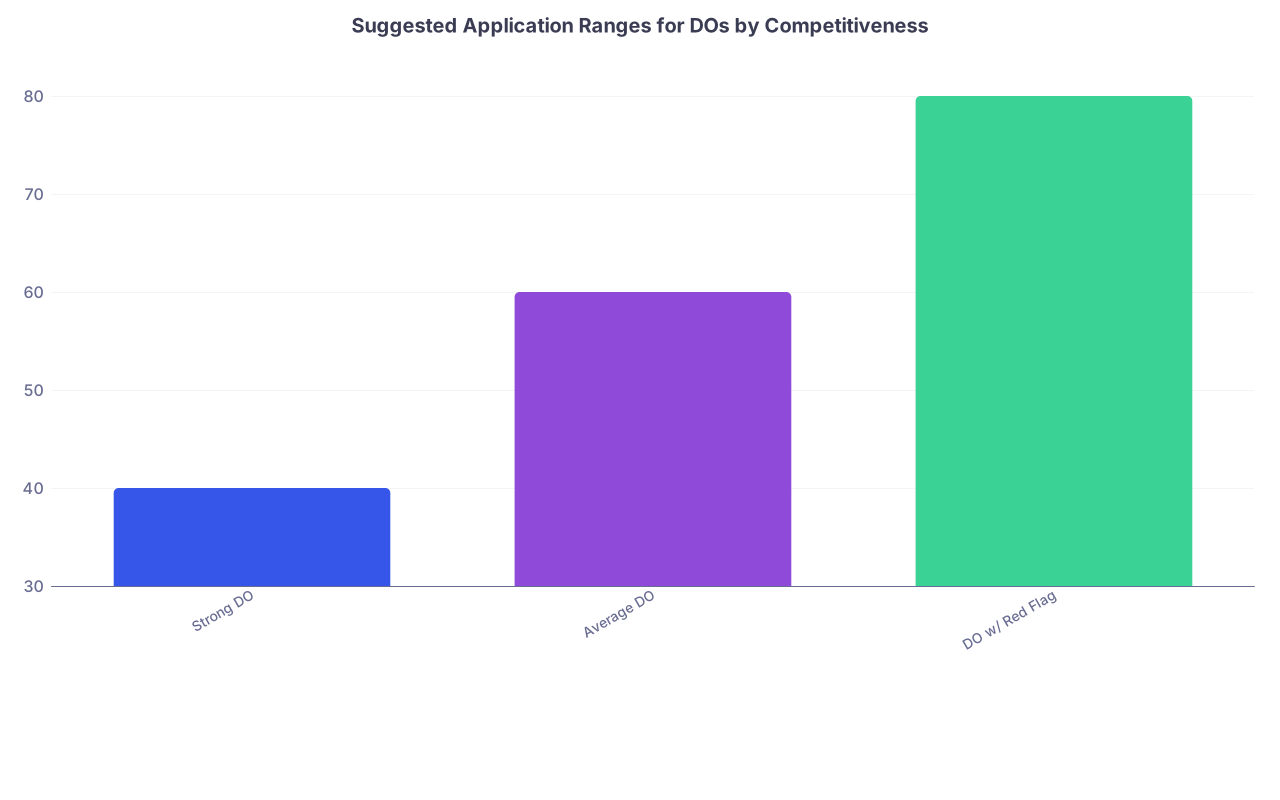
Step 3: Use program count bands, not arbitrary 100+
A rough, evidence-aligned banding for DOs might look like this (for non-ultra-competitive specialties):
| Category | Value |
|---|---|
| Strong DO | 40 |
| Average DO | 60 |
| DO w/ Red Flag | 80 |
“Strong DO” here means: competitive scores, good letters, maybe USMLE, at least one away rotation at an ACGME site.
Notice that none of these default to 100+.
You only cross 100 when:
- The specialty is very competitive, and
- You lack one or more key strengths (scores, research, home program, etc.).
The USMLE / COMLEX Issue: Where Numbers Might Creep Up
For DOs, one of the big distortions is the USMLE vs COMLEX mess.
Blunt truth: A nontrivial chunk of ACGME programs still don’t know what to do with COMLEX-only applicants. Some auto-screen them out, even if they claim they don’t.
So:
- If you took USMLE and did reasonably well, your effective pool is larger. You need fewer total applications to generate the same number of interviews.
- If you’re COMLEX-only, you might need a slightly higher number of programs to generate equal interview volume—but only among those who explicitly accept COMLEX.
What you should not do as a COMLEX-only applicant is compensate by applying to 50 programs that quietly toss your file.
That’s not a strategy. That’s denial.
The One Place Where 100+ Can Be Rational for DOs
Let me be fair. There is one scenario where I don’t roll my eyes at 100+ applications from a DO:
- Hyper-competitive specialty (ortho, derm, ENT, plastics, etc.),
- You have:
- Solid but not superstar scores,
- Some research but not 10 pubs,
- No home program,
- Decent but not mind-blowing letters.
In those fields, you’re trying to find the handful of programs nationally that:
- Actually take DOs,
- Actually look at your file,
- Actually like what you offer.
You’re looking for needles. So you search a big haystack.
Even then, the 100+ should be:
- Filtered for DO history.
- Filtered for realistic academic expectations.
- Paired with a parallel plan (more DO-friendly specialty or different region).
Panic-spraying 140 programs without that intelligent filter is still dumb, even in ortho.
The Real Metric That Matters: Number of Interviews
Stop tracking “programs applied to” like it’s a badge of honor. It’s not. It’s a measure of anxiety and how easy ERAS makes it to spend money.
What correlates with matching?
- Number of contiguous ranks (which tracks directly with number of interviews).
- How well you perform at those interviews.
- How realistic those programs are for a DO applicant with your profile.
If you apply to 70 programs and get:
- 12 interviews
- 10 ranked
you are in a far better position than someone who applied to 140, got 9 interviews, and ranked 8.
More applications did not save them. Better targeting would have.
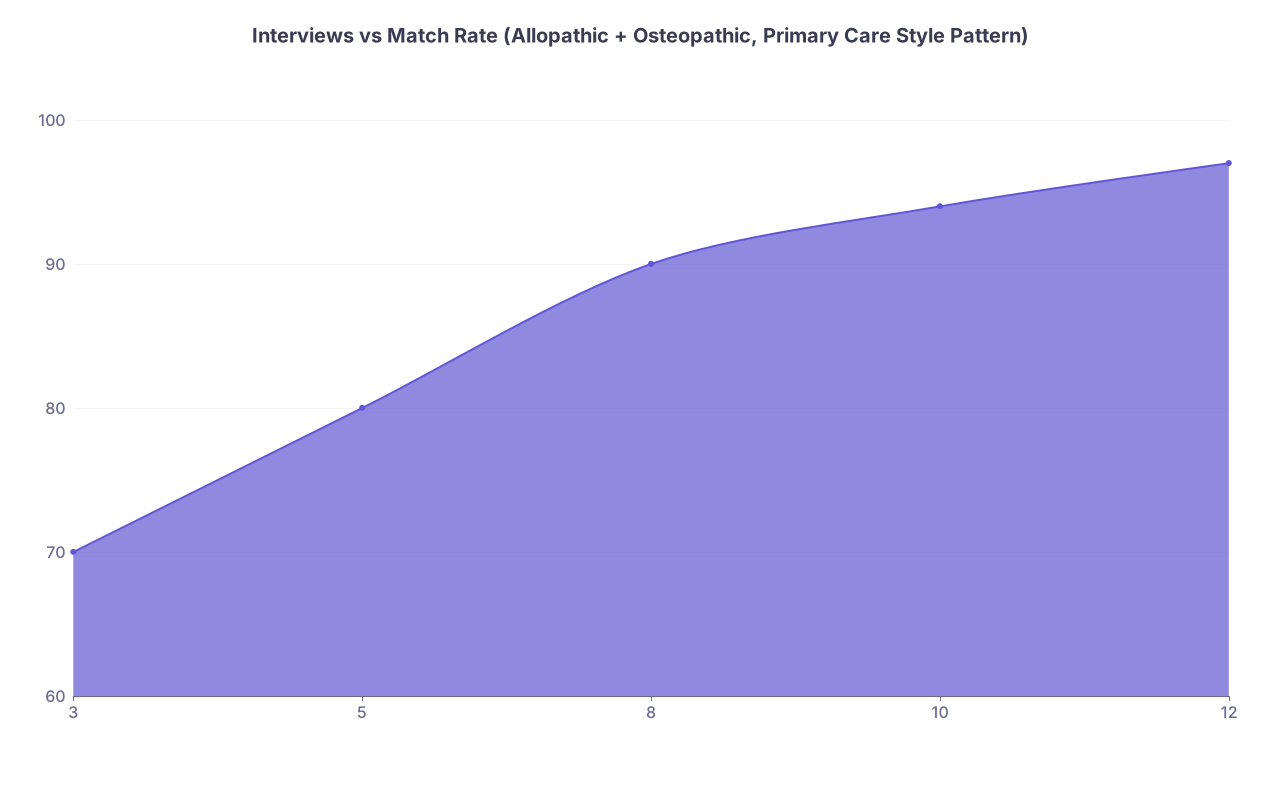
To drive it home:
| Category | Value |
|---|---|
| 3 | 70 |
| 5 | 80 |
| 8 | 90 |
| 10 | 94 |
| 12 | 97 |
Once you’re in the 10–12 interview range in a moderately competitive specialty, your odds are very good—regardless of whether you applied to 60 programs to get there or 130.
The Bottom Line for DOs Aiming at ACGME
Let me condense the real takeaways.
The “every DO must apply to 100+ ACGME programs” mantra is lazy and usually wrong. The evidence shows that number of realistic ranks, not raw applications, drives match probability.
Overapplying hurts you. It drains money, time, and focus—and often does nothing to change your actual interview count because half those programs were never going to touch a DO applicant like you anyway.
Smart DO strategy is targeted. Filter ruthlessly for DO-friendliness, be honest about your competitiveness, and aim for a right-sized list—often in the 40–80 range for mainstream specialties, only pushing past 100 when the specialty and your profile truly justify it.
Stop worshiping the application count. Start optimizing for interviews at programs that might actually want you. That’s how DOs match well into ACGME residencies—without burning their sanity (and bank accounts) in the process.