
The rumor mill in medical school is relentless. Someone's cousin failed Level 2 twice and matched into a great program. Another student passed on the third try and went completely unmatched. These stories get passed around like folklore, and the truth gets buried under anxiety.
Here's the reality: multi-attempt COMLEX scores are a factor in your ACGME application. They are not a disqualifier. The difference between those two concepts is the difference between a hurdle and a wall, and understanding that distinction will change how you approach your entire match strategy.
This article is for educational purposes only. It is not financial advice, not legal advice, and not tax advice. Figures vary by individual circumstances, so consult a qualified professional before acting.
The Direct Answer: It's a Factor, Not a Disqualifier
Let me kill the catastrophizing right now. Multiple attempts on COMLEX Level 1, Level 2, or Level 3 do not automatically close the door to ACGME accreditation. Program directors see thousands of applications from osteopathic students. They've seen every score pattern imaginable. What they're actually evaluating is whether you can handle the cognitive and clinical load of residency. A test attempt is just one piece of that puzzle.
What programs genuinely care about is the trend. Did you improve? Did you show resilience? Did you learn from the failure? An applicant who scores 215, then 225, then 235 across three attempts tells a completely different story than someone who scores 235, then 230, then 225. The first applicant is demonstrating growth. The second is demonstrating instability, which is far more concerning than a single low attempt.
Specialty competitiveness matters enormously here. A 220 on COMLEX Level 2 with two attempts might be a non-issue for a community Family Medicine program in the Midwest. That same score with two attempts applying to orthopedic surgery at a top academic center? You're probably not getting interviews. The hierarchy of risk looks roughly like this:
- Less competitive specialties (FM, Peds, PM&R, IM community programs): Multi-attempts have minimal impact, especially with an upward trend.
- Moderately competitive specialties (IM categorical, EM, Anesthesia, Psych): Multi-attempts require stronger applications elsewhere (research, audition rotations, letters).
- Highly competitive specialties (Derm, Plastics, Ortho, ENT, Neurosurgery, Rad Onc): Multi-attempts can functionally eliminate you from the running, regardless of trend.
The bottom line: your application doesn't get thrown in the trash because of a repeat. But your application does get filtered differently depending on your specialty target and your score trajectory.
How ACGME Programs View Multiple Attempts
Let's pull back the curtain on how this actually works in a program director's office. When your ERAS application lands in a screening database, it gets sorted through filters. Most programs set minimum score thresholds, and many of these filters include "number of attempts." Some programs use automated systems that will literally flag your file for human review if you've attempted COMLEX more than once or twice.
That flag is not a death sentence. It's a "look at this more carefully" trigger. What happens next is the human review, and that's where your application either shines or fails.
Here's what reviewers are specifically looking for:
Pattern recognition. Is there a clear upward trend, or are the scores stagnant or declining? A 215 → 240 progression is a strong positive signal. A 235 → 220 → 230 sequence makes a reviewer pause.
Context for the attempt. Did you fail to pass? Or did you pass but retake for a better score? These are very different scenarios. Failing to pass (a score below 199) carries significantly more weight than passing and retaking for a competitive number.
Clinical performance on rotations. If your SVI (Standardized Video Interview) comments, rotation evaluations, and letters all paint a picture of clinical excellence, that counters a weaker testing profile. Programs want residents who can actually take care of patients, not just pass tests.
Total attempts versus peak performance. A program might overlook two attempts if your final score is in their competitive range. Three or more attempts, especially without a clear improvement story, creates skepticism about test-taking endurance.
The primary metric that matters is your composite (final, highest) COMLEX score relative to the program's historical match median. If your final score is 240 and the program's median is 235, you're competitive on paper even with two attempts. If your final score is 210 and the median is 245, you're fighting an uphill battle regardless of how many times you took it.
The chart above shows the ideal trajectory. Each attempt improves meaningfully. That improvement isn't just statistical noise. It's evidence that you absorbed the material, adjusted your study strategy, and performed under pressure. Program directors respect that, even when they'd prefer to see a first-attempt pass.
Understanding the Impact of Your Specific Score
Numbers matter, but their meaning changes depending on where you're applying. Let's get concrete.
If your score falls below the 50th percentile nationally for your target specialty, the application pool narrows significantly. In a specialty like Family Medicine, that 50th percentile might be around 220. In Dermatology, it might be 250+. The same numerical score carries wildly different weight depending on context.
For lower-tier and mid-tier specialties, here's what the data actually shows in practice. A repeat score of 230 or higher often does not prevent an ACGME match in Family Medicine, Pediatrics, Internal Medicine (community), Psychiatry, or PM&R. I have personally seen DOs match into competitive IM programs with two-attempt scores in the 230s because they had strong audition rotations, geographic ties, or research. The score matters, but it's rarely the sole determinant in these specialties.
Failing to pass is a different category entirely. If you scored below 199 on any attempt, that's a major red flag. Programs interpret a failure to pass as evidence that you might struggle with in-training exams, board certification, and the cognitive demands of residency. Without substantial remediation evidence (a formal post-bac program, a research year with publication, an additional graduate degree), ACGME matches become nearly impossible in any specialty above Family Medicine. Even FM matches get significantly harder.
Geography and program personality also influence outcomes in ways that aren't obvious from national data. Some programs, particularly community-based ones in less populated areas, will interview you specifically because you've navigated a difficult path. They view multi-attempt success as a marker of grit. Other programs, particularly large academic centers with hundreds of applicants per slot, will screen you out before a human ever sees your file because they simply have the luxury of doing so.

The key insight: the road is harder for some applicants, but the destination is still reachable. Don't let the difficulty of the terrain convince you the city doesn't exist.
Your Strategic Roadmap for a Successful Application
Now for the actionable part. If you're dealing with multi-attempt scores, here's exactly what to do.
If you're still planning a retake: Your score improvement must be statistically significant. That means at least a 10-15 point gain, ideally more. Going from 218 to 222 won't move the needle. Going from 218 to 235 absolutely will. You need to demonstrate that your final score reflects genuine competency, not a lucky testing day. Show up to your retake with a fundamentally different study approach. Document that approach. Be ready to explain it in interviews.
Letters of recommendation are your secret weapon. A strong letter from a preceptor who personally observed your clinical reasoning, work ethic, and patient interactions can directly counterbalance a weaker testing profile. The most powerful letters in this situation explicitly address the testing history. Something like: "Despite facing testing challenges, [Name] has consistently demonstrated exceptional clinical judgment on rotations. I have observed [him/her] manage complex patients with a level of sophistication that exceeds most of their peers." That kind of language matters more than most students realize.
Target your program list strategically. During your application year, you should be building a list that includes:
- Community-based programs (these are more holistic in review)
- Programs in your geographic region (ties help offset score concerns)
- Programs where you've done audition rotations (they already know you)
- Newer programs with less established filtering criteria
- Programs with historical DO acceptance patterns
Avoid applying to 80 programs hoping volume will save you. Apply to 40-50 well-researched programs where you have a genuine shot.
Highlight everything except the score. Research, publications, leadership roles, volunteer work, unique clinical experiences, OMT certification, military service, language skills. Anything that gives the reviewer a reason to remember your application beyond the score report.
Consider a gap year if necessary. If your score profile is severely compromised and you're targeting a competitive specialty, taking a research year or completing a fellowship to strengthen your application may be the smartest move. A gap year costs you time, but matching into your chosen specialty is worth more than a wasted cycle.
The flowchart above distills the decision logic. Your score relative to the specialty median is the first fork. Below median? Then your trend becomes the deciding factor. An improving trend allows for a more ambitious program list. A flat or declining trend pushes you toward community programs and externships where personal relationships matter more than numerical cutoffs.
Be ready to discuss it in interviews. Program directors will ask about your attempts. Don't be defensive. Don't make excuses. Have a clear, concise explanation: "I struggled with standardized testing during my preclinical years due to [legitimate reason: personal circumstances, illness, adjustment to medical school]. I identified my weaknesses, adapted my study approach, and improved significantly on subsequent attempts. My clinical performance on rotations reflects the same dedication I've brought to passing this exam." Practice this answer. Own it. Move on.
Conclusion
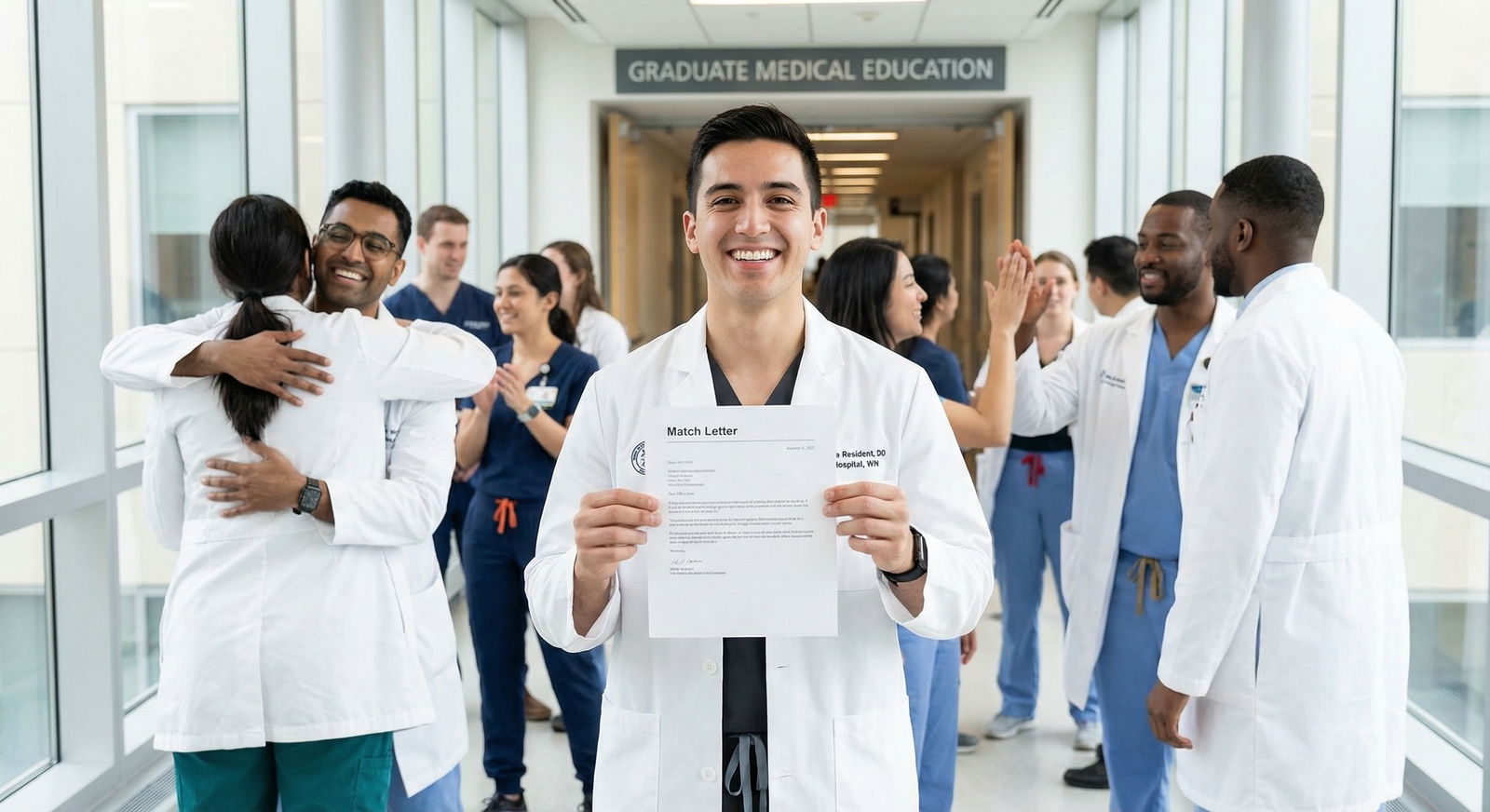
Multi-attempt COMLEX scores require extra care, intentional strategy, and honest self-assessment, but they don't constitute a guaranteed match failure. The osteopathic medical community has produced thousands of exceptional residents who stumbled on standardized testing and recovered. They matched because they presented a compelling upward trajectory, built strategic program lists, and leveraged strong clinical performance to prove their readiness.
The strongest evidence you can offer a program director isn't a perfect score report. It's the pattern of growth across attempts, supported by clinical evaluations, letters of recommendation, and personal resilience. A 215 → 240 progression is a story of grit and improvement, not a story of failure. Frame it that way, and you'll find programs willing to invest in you.
So here's the question that actually matters: are you going to let the fear of a multi-attempt history dictate your specialty choice, your program list, and your entire application strategy, or are you going to take the honest path, build a strong application around your trajectory, and give yourself permission to pursue the residency you actually want?