

What if every program director looks at your DO letters, sees zero MD mentors, and quietly tosses your application onto the “probably not” pile?
That’s the nightmare version running through your head, right?
“I’m a DO. All my letters are from DOs. No big-name MD research mentor. ACGME programs are going to think I’m second-rate.”
Let me say the scary part out loud so we can actually deal with it: some places will bias you for being DO. Some will care way too much about pedigree and initials after your name. Some will assume that MD letters are “stronger” by default.
But that’s not the whole story. And it’s definitely not the end of yours.
The Ugly Truth First: Yes, Bias Exists
Let me rip the band-aid off.
There are ACGME programs where:
- They hardly ever interview DOs, even post-merger.
- Their “DO-friendly” label on forums is basically fiction.
- The PD says things like, “We’ve accepted DOs… in the past,” with that awkward tone that tells you it was maybe one person seven years ago.
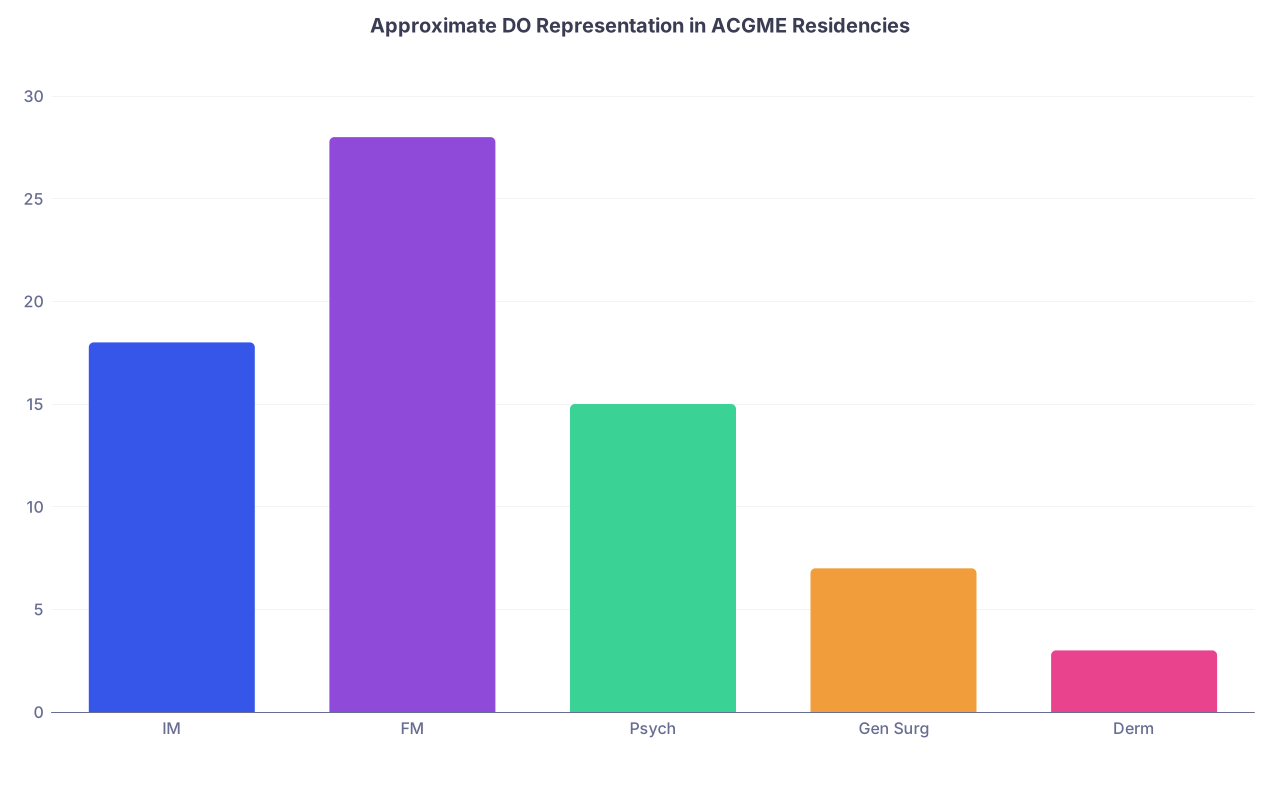
| Category | Value |
|---|---|
| IM | 18 |
| FM | 28 |
| Psych | 15 |
| Gen Surg | 7 |
| Derm | 3 |
These aren’t exact numbers for your specific year, but they reflect the general pattern: DOs are clearly present in ACGME programs, but not equally across specialties. Competitive fields (derm, ortho, plastics, ENT) are still rough for DOs, especially without strong MD advocates.
And yes, some places absolutely prefer:
- MD letters over DO letters
- Home students over “visitors”
- Big-name schools over anything they haven’t heard of
Your fear isn’t irrational. You’re picking up on real dynamics.
But you’re also over-generalizing them. Because here’s the part your brain is conveniently ignoring: there are a lot of ACGME programs that do not care whether your mentor is DO or MD—as long as the letter screams that you’re excellent.
What PDs Actually Care About (That You Can Control)
When a PD opens your file, they’re not doing a scavenger hunt for “MD mentor or bust.”
They’re looking for answers to a few blunt questions:
- Can this person do the work without falling apart?
- Are they a problem? (Unprofessional, lazy, weirdly hostile, unreliable.)
- Will they pass boards, not kill patients, and not make my life harder?
- Is there any concrete evidence that people who know them vouch for them strongly?
Mentors—whether DO or MD—matter because of what they say, not just who they are.
A DO letter that says:
“I’ve worked with hundreds of residents. This student is in the top 5%. I would unhesitatingly rank them at the top of my list.”
…is infinitely more powerful than an MD letter from some assistant professor who barely remembers you and writes:
“Student was punctual, completed tasks, and performed at the expected level.”
PDs can smell fluff. They can also smell genuine enthusiasm.
So if your letters are from DOs but they’re specific, detailed, and clearly written by someone who supervised you closely? Those count. A lot.
The “No MD Mentor” Panic: How Bad Is It Really?
Here’s the fear you’re not saying out loud:
“If I don’t have MD mentors, programs will assume I couldn’t get them. That I wasn’t good enough.”
Sometimes, yes, programs infer things from what’s missing.
But they don’t jump to “not good enough” as fast as you think. They usually jump to:
- “This person did most of their rotations in osteopathic settings.”
- “Their school or region doesn’t give a ton of access to MD faculty.”
- “They stayed where they built relationships. That’s not a bad thing.”
Where this becomes a real problem is in:
- Super competitive specialties (derm, ortho, ENT, plastics, neurosurgery).
- University-heavy programs that lean elitist.
- Programs flooded with MD applicants with big-name research mentors.
If you’re applying to something like family, psych, IM, peds, EM, or even anesthesia in many regions? Having DO-only letters is not some automatic kiss of death.
It’s a yellow flag only if:
- Your letters are generic, weak, or short.
- You have no US-based clinical letters at all.
- Your application has other soft spots (low scores, gaps, professionalism issues).
So the question isn’t really “DO vs MD mentor.”
It’s “Do I have anyone—DO or MD—who will go to bat hard for me?”
The Letters Problem: What You Can Fix Right Now
You can’t magically conjure MD mentors out of nowhere at this stage. But you can massively upgrade what you do have.
Here’s what most anxious DO students never do: they don’t tell their letter writers what’s at stake. They just meekly ask, “Would you be willing to write me a letter?” and hope for the best.
You can’t afford that.
You need letters that read like:
“This person is not just good. They’re one of the best I’ve worked with.”
That doesn’t happen by accident.
When you ask for a letter, you should:
- Ask only people who actually observed you closely.
- Ask explicitly for a “strong” letter. Not just “a letter.”
- Give them a short brag sheet: your goals, concrete examples of what you did on their service, any specific compliments they gave you previously.
And yes, you can say something like:
“I’m applying as a DO to mostly ACGME programs and I don’t have MD mentors. I’m worried I’ll be overlooked. If you’re comfortable doing so, any specific comparisons to other students you’ve taught and a clear statement of your support would really help.”
Is it awkward? Completely.
Is it better than getting a 4-sentence letter that torpedoes you? Also yes.

Where DO vs MD Mentors Actually Matters More
There are scenarios where the absence of MD mentors can hurt you more noticeably.
1. Ultra-competitive specialties
For ortho, derm, plastics, ENT, neurosurgery, competitive radiology or anesthesia programs—the game is different.
Those PDs are drowning in stellar MD applicants who:
- Rotated at their institution
- Have MD mentors in the department
- Have 2–3 glowing subspecialty letters
If you’re a DO without:
- An away rotation at a major academic center, and
- A letter from someone that department faculty know or respect,
then yes, you’re at a disadvantage. It’s not hopeless, but the bar is higher, and the hidden “pedigree” game is real.
2. Highly academic, university-heavy programs
Some big academic centers still carry outdated bias. They say they’re DO-friendly, but then you look at their current residents and see:
| PGY Year | Total Residents | DOs in Class |
|---|---|---|
| PGY-1 | 14 | 1 |
| PGY-2 | 14 | 0 |
| PGY-3 | 14 | 1 |
| PGY-4 | 14 | 0 |
If your resume is already on the weaker side (average scores, minimal research), and you show up with no MD mentors and only osteopathic letters, I’m not going to sugarcoat it: those places are long shots.
You can still apply to a few if there’s a dream program. But you can’t build your whole list around them.
Things That Matter More Than Letters Being DO vs MD
Your brain is obsessing over “DO vs MD mentors” because it’s visible and feels personal. But here’s what quietly matters more at a ton of programs:
- Board scores (COMLEX and/or USMLE if you took it)
- Clerkship performance (especially core rotations in your chosen specialty)
- Red flags (fails, leaves of absence, professionalism incidents)
- Fit with the specialty shown through your experiences and personal statement
- Evidence of being normal and easy to work with from MSPE and letters
A DO with:
- Strong scores
- Excellent clinical comments
- 3 powerful DO letters
- Thoughtful personal statement
…is going to beat an MD with mediocre scores and bland letters at many mid-tier and community programs. That’s just how it plays out.
Your anxiety is telling you you’re doomed because you lack MD mentors. Reality is more: you’re in the game if the rest of your app holds up.
How to Compensate If You Don’t Have MD Mentors
You can’t rewrite the past. But you can shape the story your application tells.
1. Make your DO mentors look clearly legitimate
Don’t bury who they are. Let them shine.
- Choose letter writers with real titles and responsibilities: clerkship directors, program directors, department chairs, long-time attendings.
- Make sure their specialty aligns, or at least makes sense, for what you’re applying into.
- If one of them is a PD or clerkship director at an ACGME or ACGME-accredited program (even if it’s community), that carries weight.
2. Crush everything else you still control
At this stage, that usually means:
- Clean, tight personal statement that actually sounds like a human with insight, not ChatGPT with clichés.
- Realistic, smart program list: a wide range, heavy on DO-friendly and community-based ACGME programs.
- Thoughtful answers in supplemental ERAS questions (if applicable).
- If interviews come—being someone they can actually imagine at 3 a.m. on call. Calm, kind, not arrogant.

| Step | Description |
|---|---|
| Step 1 | No MD Mentors |
| Step 2 | Maximize Strength of DO Letters |
| Step 3 | Target DO-Friendly Programs |
| Step 4 | Strengthen Personal Statement |
| Step 5 | Highlight Clinical Performance |
| Step 6 | Ask for Strong, Specific Letters |
| Step 7 | Include Community and Mid-Tier ACGME |
| Step 8 | Show Maturity and Fit |
| Step 9 | Emphasize Clerkship Honors & Comments |
How to Judge If a Program Will Take You Seriously as a DO
You’re not powerless in this. There are signs.
Check their current residents
Go to their website. Look at:
- How many DOs in the current classes?
- Are they scattered and rare, or consistently present?
- Are DOs only in the more recent classes post-merger, or spread out?
Ask directly (but strategically)
At open houses or Q&As, you can ask:
“As a DO applicant whose mentors are all DOs, should I be concerned about how my application will be viewed compared to MD applicants?”
If they immediately say things like:
- “We love DOs; we’ve had many successful DO residents,” and you can verify that online
- “Some of our chiefs have been DOs,”
- “We don’t distinguish between DO and MD letters,”
then that’s meaningful.
If the answer is vague, scripted, or you look at their roster and see zero DOs? Believe their behavior, not their words.

The Mental Spiral: “Everyone Else Is More Connected Than Me”
Let’s call out the anxiety spiral for what it is.
You’re imagining:
- Every MD student has an NIH-funded PI who’s texting PDs for them.
- Every IMG has some magical family connection.
- Every DO who matches had three MD mentors and NIH grants.
No. Lots of people match with:
- No famous mentors
- No MD letters
- No “network” besides the people who actually worked with them
The thing they usually do have, though?
A realistic sense of where they stand. And a plan based on that, not fantasy.
Your lack of MD mentors is not a moral failing. It doesn’t mean you’re behind forever. It means you’ll have to be more intentional about where you apply, how you frame your story, and how strong the rest of your application is.
If You’re Early Enough: How to Get MD Mentors Going Forward
If you’re not right on top of application season, you can still shift this a bit.
Ways to get genuine MD mentorship (not fake, surface-level stuff):
- Electives at hospitals with MD attendings who actually teach students regularly.
- Sub-internships at ACGME programs in your chosen specialty.
- Research projects with MD faculty at nearby universities or teaching hospitals.
But here’s the truth: forcing a superficial MD connection just to have an “MD letter” is not worth it. A generic MD letter is worse than a strong DO one.
If you do get MD exposure, your priority isn’t “get the letter.” It’s “work so well that they want to write a letter without you begging.”
What You Can Do Today
Let’s pull this out of the clouds and into something you can actually act on.
Today, you can:
Make a list of your current or potential letter writers and rank them by:
- How well they know you clinically
- Their role/title
- How likely they are to be enthusiastic
Draft a short, honest email or script for how you’ll ask for a strong letter and explain your DO situation without sounding desperate.
Open three program websites you’re interested in. Check resident rosters. Count DOs. Decide if that program is realistically DO-friendly or just saying the right words.
FAQs
1. Will ACGME programs automatically rank me lower because all my mentors are DOs?
No, not automatically. Some biased programs might, but many don’t care whether your mentors are DO or MD as long as your letters are detailed, enthusiastic, and from real supervisors. What hurts you more is weak letters, not DO letters specifically. If your DO mentors say you’re outstanding and back it up with specific examples, you’ll be taken seriously at a lot of places.
2. Should I try to get a last-minute MD letter even if they barely know me?
Usually no. A shallow MD letter is almost always worse than a deep, specific DO letter. PDs read between the lines. They can tell when someone hardly knows you. If the MD hasn’t meaningfully supervised you, that letter will read thin and might actually drag your application down. Only chase an MD letter if you can earn it through real clinical or research work, not just proximity.
3. How many DO vs MD letters do I “need” for ACGME programs?
There’s no magic ratio. For most specialties, 3 strong clinical letters—regardless of DO/MD mix—are enough. If one of them is in your chosen specialty, even better. Some ultra-competitive specialties or big-name academic programs may silently prefer MD subspecialty letters, but if that’s your main target and you have zero MD mentors, you should build in a lot of safer, DO-friendlier programs to protect yourself.
4. Will programs assume my training is lower quality because I’m a DO?
Some old-school people still think that way. A lot don’t. What convinces them is not you telling them you’re well-trained; it’s your performance: strong clinical comments, good board scores, and letters that say you handled high-volume, real-world medicine competently. If a DO PD or clerkship director writes, “This student is on par with our best MD rotators,” that neutralizes a lot of bias.
5. What if I already applied and now realize I have zero MD mentors—am I just stuck?
You’re not stuck; you’re just playing the version of the game you’ve already set up. At this point, focus on what’s still changeable: adding a few more DO-friendly or community ACGME programs if you can, preparing hard for interviews so you stand out when you get a shot, and keeping a backup plan (SOAP, prelim year, reapplying) in mind without obsessing over it. You can still match without MD mentors. Plenty of DOs do, every single year.
Open your list of letter writers right now and ask yourself, honestly: who can write the strongest, most specific letter about me—even if they’re a DO? Start there, not with chasing MD initials.


