
You walked out of your last interview an hour ago. Your brain is buzzing. The program director asked about your research, the chief resident laughed at your joke about central lines, and you genuinely connected with two of the four interviewers. Now you're staring at your laptop trying to answer one question: do you send a quick note to the program inbox, or do you hunt down email addresses and send personal thank-yous to each interviewer?
This is the exact decision thousands of applicants wrestle with every interview season. And the honest answer is going to feel unsatisfying: there's no knockout evidence that one approach beats the other. But that doesn't mean the choice doesn't matter. It just means you should stop treating it like a strategy game and start treating it like a communication decision.
Here's what the data actually shows, what it doesn't, and how to pick the right path for your situation.
What the Data Actually Says About Thank-You Emails
Let's be blunt about the evidence. There are no randomized trials showing that direct thank-you emails produce more match offers than generic inbox emails. The data we have is mostly self-reported program director surveys, most of which say some version of "we appreciate a polite follow-up" without specifying a preference for one channel over another.
Here's what the evidence does support:
- Timing matters more than channel. Programs consistently rate promptness (within 24-48 hours) as more important than whether the email lands in a shared inbox or a personal one.
- Specificity is the deciding factor. Interviewers remember the applicants who referenced a specific moment from the conversation. They don't remember whether the message came through a program coordinator or directly.
- Professionalism beats personality. A clean, typo-free note with a clear subject line signals more than choosing one route over another.
- Programs rarely say thank-yous affect ranking. When asked directly, most PDs say follow-ups are courteous but not decisive.
The data is thin. Self-report bias runs rampant. Programs vary wildly in their culture around applicant communication, and no one is publishing their actual ranking decisions tied to email behavior. Treating the inbox-vs-direct question like a ranking hack is superstition, not strategy.
What you should take from this: pick the option that lets you write the most accurate, timely, and professional note possible. Stop optimizing for a channel and start optimizing for clarity.
Generic Inbox Email vs. Direct Thank-You Email: What Each Option Is Good For
Both routes have legitimate uses. The mistake is picking one as your default for every scenario.
The generic inbox approach works when:
- You interviewed with a panel or 4+ people and don't have direct contacts for all of them.
- The program is large and uses a coordinator-managed communication channel.
- You're thanking the program as a whole for the day.
- You don't have the interviewer's email and don't want to spend an hour hunting it down on LinkedIn.
The direct thank-you approach works when:
- You had a memorable one-on-one conversation.
- The interviewer specifically said "stay in touch" or "feel free to reach out."
- You discussed a specific shared interest (research, a clinical case, a fellowship pathway) that deserves a personal reference.
- The program is small enough that direct contact is the norm.
The trade-offs are real. Inbox emails are easier and lower risk, but they often get filtered, batched, or summarized before reaching the actual interviewer. Direct emails feel more personal, but if you write them wrong, they can come off as presumptuous, especially if you barely spoke with that person during the day.
Here's the simple decision rule: if your message is about the program overall, use the inbox. If it's about a specific personal exchange, send it directly. Don't try to send the same message both ways. That just looks repetitive.
How to Choose the Best Follow-Up Strategy for Your Situation
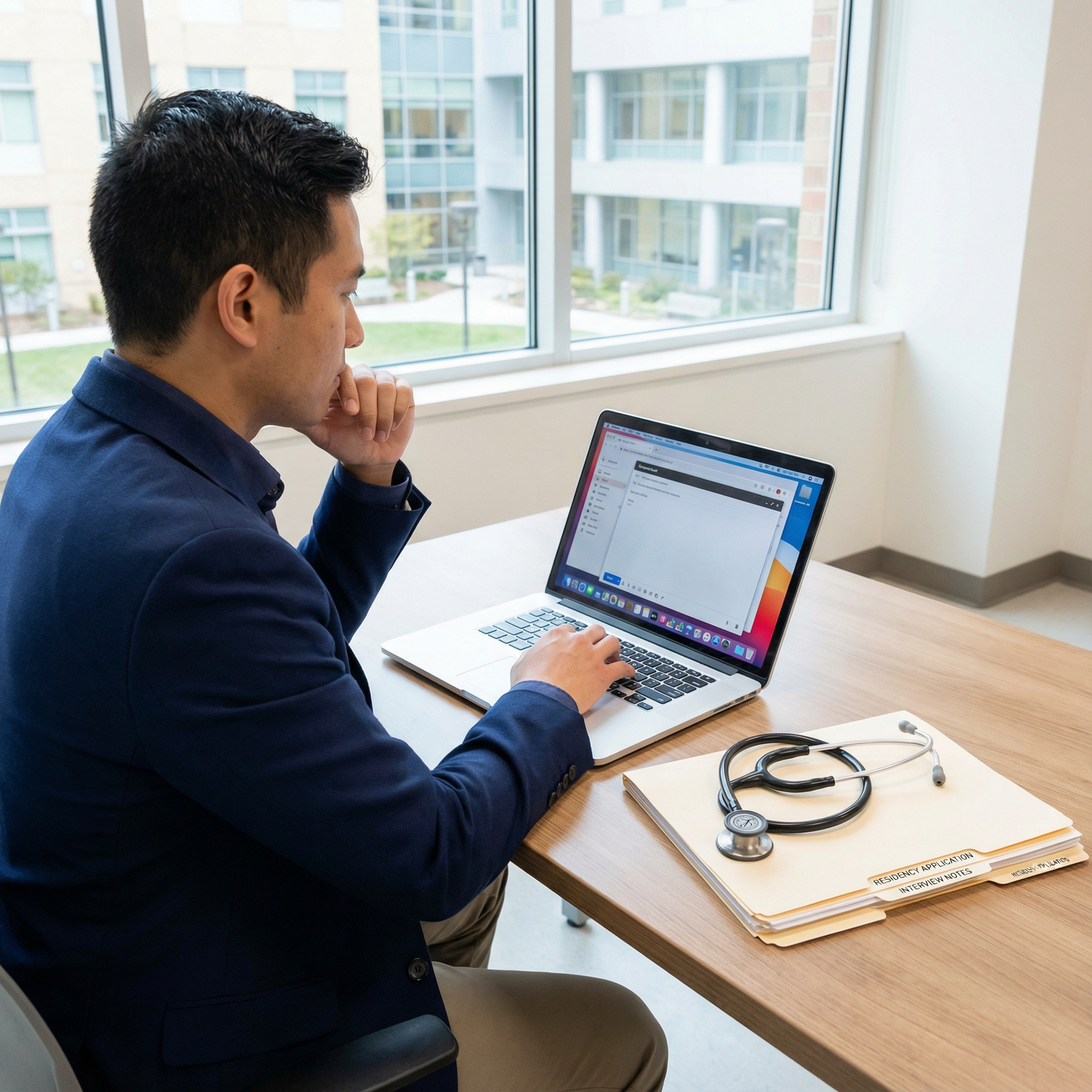
The right choice depends on three things: the format of your interview, the size of the program, and what actually happened during your conversations.
Virtual interviews tilt toward direct emails. When you only have a webcam and a 20-minute slot, the personal moments are scarcer. If you had a real exchange, lean into it with a direct note. Inbox emails from virtual interview days can feel like boilerplate.
In-person panel interviews tilt toward inbox emails. With six interviewers across a full day, tracking down six personal emails is overkill. A single well-written note to the program inbox referencing the day as a whole is appropriate and efficient.
Large academic programs often route everything through the coordinator anyway. Direct emails to attendings might get lost in spam filters or ignored. Follow the program's stated preference.
Small community programs often encourage direct contact. Faculty expect personal emails. It's a different culture.
Timing rule: Send within 24 to 48 hours. Earlier shows urgency. Later feels like an afterthought. Don't send two follow-ups unless you have something genuinely new to say (a publication update, a clarifying answer to a question you stumbled on). Most applicants who send a second message are just anxious and it shows.
Tone rule: Match the interviewer's energy. If they were formal and clinical, keep your note formal. If they were relaxed and conversational, you can mirror that. Don't try to befriend someone you met for 15 minutes.
When in doubt, ask the program coordinator. "What's the preferred way to send a thank-you?" is not a weird question. It's a professional one.
What to Write So Your Email Is Remembered for the Right Reasons

Structure beats cleverness. Here's the four-part template that works for both inbox and direct versions:
- Opening: Address them by name (or "Dear Program Team" for inbox versions).
- Specific reference: One sentence pointing to something concrete from your conversation. A patient population they mentioned. A research project they're running. A clinical philosophy they described.
- Gratitude: One sentence thanking them for their time or for a specific moment.
- Closing: A short sign-off. No begging for a spot on the rank list. No "I would be a great fit here" essay.
Examples of strong specificity:
- "I really appreciated your perspective on managing [condition] in an underserved population."
- "Our conversation about [specific research area] reinforced my interest in [track name]."
- "Hearing how your team approaches [specific topic] was the highlight of my day."
Common mistakes that tank otherwise decent emails:
- Generic praise with no reference to the actual conversation. ("I loved learning about your program" is filler.)
- Spelling the interviewer's name wrong. Triple-check this.
- Three-paragraph essays about why you're a great candidate. The interview already covered that.
- Asking about your rank position or hinting at it. Hard no.
- Overly casual tone. Even if the interview felt casual, keep the email professional.
If your direct email is just a personalized version of your inbox email, you're doing it right. If your direct email is dramatically different and longer, you've probably overthought it.
Common Mistakes Applicants Make When Comparing Inbox and Direct Emails
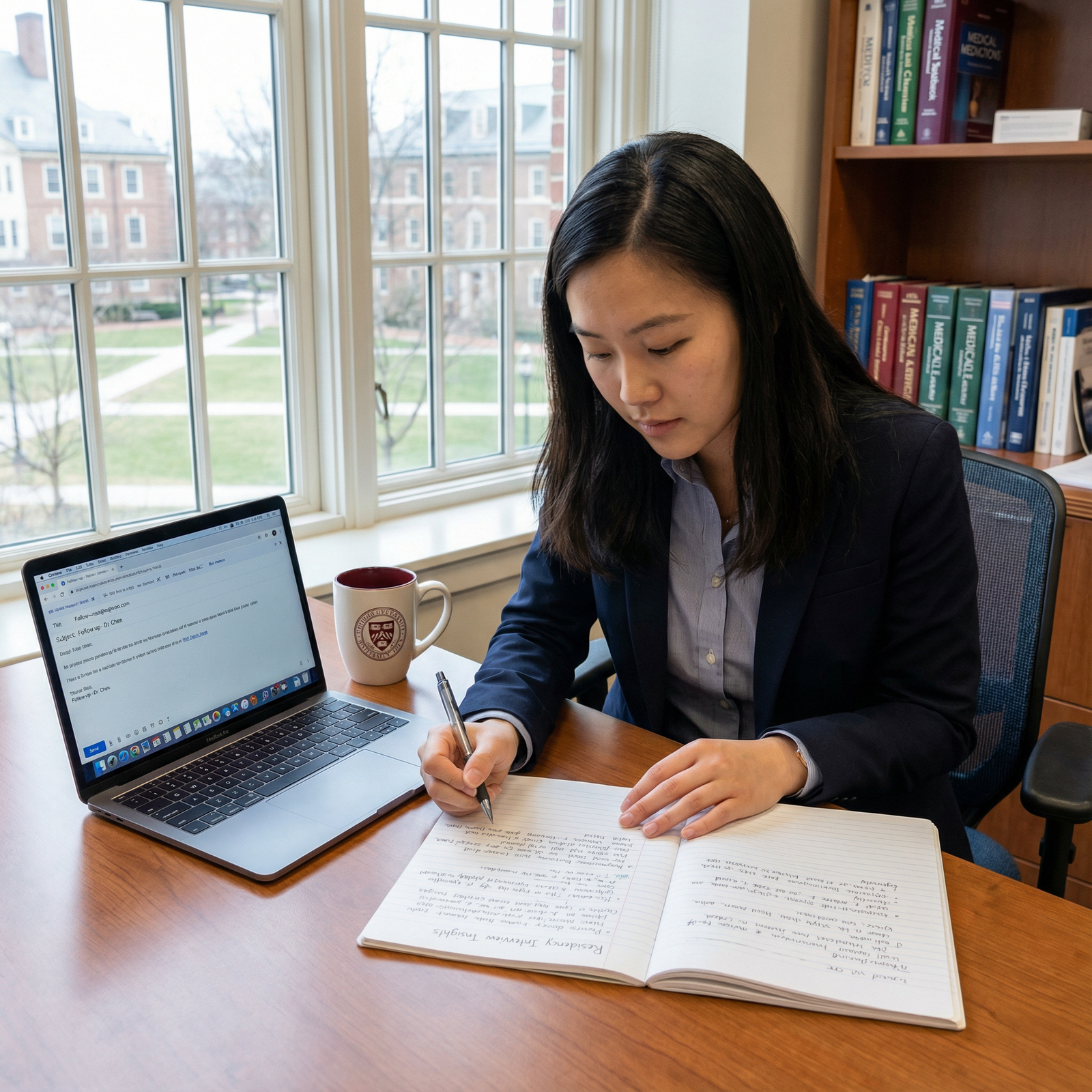
The biggest trap is treating the choice between inbox and direct like a chess move. It's not. Here are the mistakes I see every cycle:
Overpersonalizing the direct version. You talked to Dr. Smith for 18 minutes. You don't need to reference the book on her shelf behind her, the quote she mentioned about patient autonomy, and her fellowship at Mayo. One specific reference is plenty. More than that reads as surveillance.
Sending both an inbox email and a direct email to the same person. This happens when applicants can't decide. It looks disorganized. Pick one route per person and commit.
Hunting down emails you don't actually have a reason to use. If the program didn't share interviewer emails and you have to dig through a department website to find one, that's not "going the extra mile." That's overstepping. Use the inbox.
Treating the thank-you as a last chance to pitch yourself. The interview did the work. The thank-you is a courtesy, not a closing argument.
Sending a thank-you that contains more than five sentences. Brevity is respect. Long emails are work for the reader, and busy faculty have zero patience for them.
Bottom Line: Which Option Should You Use?
Stop trying to win the thank-you email. Nobody ranks applicants based on email channel. They rank applicants based on the entire interview day, and the thank-you is a small footnote at most.
Here's the hierarchy: professionalism first, specificity second, channel choice a distant third. If your email is timely, polished, references something real from the conversation, and is short enough to read on a phone in 30 seconds, you've done it right. Whether it went to the program inbox or to Dr. Patel directly matters far less than you think.
Pick the route that lets you write the most honest, least forced note. Send one. Move on. Spend your energy on your actual rank list instead.
Prompt: Cinematic photograph of a residency applicant smiling slightly while clicking 'send' on a laptop, evening light coming through a window, a notebook and coffee mug nearby, calm focused mood, shallow depth of field, warm documentary-style photography, modern medical education context
Now go send that thank-you and then close the laptop. You've done the work.