The panic you feel when you realize you forgot something huge in a residency interview is completely fixable—if you handle the follow‑up correctly.
Most applicants either overcorrect (three‑paragraph apology, emotional overshare) or undercorrect (do nothing, hope it disappears). Both are mistakes. You can absolutely recover from a missed key point, and sometimes you can turn it into a net positive—if your follow‑up is sharp, specific, and timely.
This is the playbook.
Step 1: Decide If You Actually Need To Follow Up
Not every “forgot to mention” deserves an email. If you treat every minor omission like a crisis, you will look anxious and unfiltered.
Ask yourself three blunt questions:
Would this information materially change how they see my fit or competitiveness?
Examples that usually do matter:- A significant new clinical or leadership responsibility (chief role, new QI project lead).
- A key experience directly tied to what they said they value (e.g., you forgot to mention your prior work with their exact patient population or EMR optimization project).
- A big factual correction (wrong Step score, wrong graduation year, misstated visa status).
- A major upcoming activity they explicitly asked about (e.g., they asked about research and you forgot to mention a submitted manuscript that will likely publish).
Did the interviewer explicitly ask about it and you blanked or gave a partial answer?
- “Tell me about a time you handled a conflict” → you gave a weak example but later remember a perfect one.
- “Any experience with underserved communities?” → you said something generic but forgot a major longitudinal clinic experience.
Is this something programs expect to see from serious candidates?
- Updates on significant accomplishments during interview season.
- Clarifications when you gave an answer that might be misinterpreted.
If the answer is “yes” to at least one of these, you follow up.
If it is “I forgot to say I love teaching” or “I didn’t mention I like hiking,” let it go. That content goes into your thank‑you note or stays in your head. Not in a separate “I panicked” email.
Step 2: Time It Right (Without Looking Desperate)
You have three timing windows. Each has a slightly different tone.
| Situation | Best Timing | Tone to Use |
|---|---|---|
| Simple clarification / small addition | Within 24–48 hours | Brief, factual |
| Major missed point tied to fit | Within 48–72 hours | Focused, confident |
| Post‑interview update (new achievement) | 1–2 weeks or as it occurs | Upbeat, concise |
A bad move I see all the time: sending three emails in three days—thank‑you, then “forgot to mention,” then “one more thing.” You look disorganized and anxious.
If you realized the omission before sending your main thank‑you email, you have two choices:
Option A: Fold it into the thank‑you email.
This is usually best. One clean message, one impression.Option B: Send a separate follow‑up only if it is substantial enough to warrant its own spotlight (e.g., you gave a factually wrong answer about a rotation schedule or credential).
If you already sent the thank‑you, sending one additional follow‑up is acceptable. One. Not a series.
Step 3: Know Who To Email (And How)
Use this simple hierarchy:
If you have the direct email of the interviewer → email them.
- Address them formally unless they explicitly said otherwise.
- If a resident interviewer gave you their personal email, you can still send a short professional follow‑up.
If you do not have the interviewer’s email but have the program coordinator’s or general program email → send it there and ask them to forward it.
- Keep this slightly more formal.
- Make explicitly clear which interview and which interviewer you are referencing: date, track (e.g., categorical IM), and name.
Avoid DM’ing interviewers on social media for this. It looks sloppy and unprofessional.
Step 4: Structure Every Follow‑Up So It Does Not Sound Like An Apology Letter
You are not writing an apology essay. You are adding a data point.
Your email needs five parts. Short, clean, deliberate:
- Subject line – functional, not dramatic.
- Opening line – gratitude + quick anchoring to who you are.
- One‑sentence setup – why you are writing (missed/clarifying a point).
- Core content – the point you forgot or need to clarify, tied directly to the program.
- Close – appreciation, reaffirm interest, no begging.
If your email is more than 200–250 words, you are probably over‑explaining.
Step 5: Email Templates For Common Situations
Here are the exact words. Use them as scaffolding, then adjust for your details.
Scenario 1: You Forgot a Clinically Relevant Experience That Strengthens Your Fit
You interviewed for internal medicine. Faculty asked about QI; you gave a superficial example and later remember you actually led a major sepsis bundle initiative. That is worth a follow‑up.
Template: Missed Major Relevant Experience
Subject: Follow‑up from [Your Name] – [Program Name] Interview
Dear Dr. [Last Name],
Thank you again for speaking with me during my interview for the [Categorical Internal Medicine Program] at [Institution] on [date]. I appreciated our conversation about [specific topic you discussed—e.g., quality improvement and resident autonomy].
After our discussion, I realized I did not mention one experience that closely aligns with the program’s focus on [specific value they emphasized—e.g., system‑based practice and QI]. During my third year, I led a [brief description: “resident‑driven project to reduce time‑to‑antibiotics for septic patients in our ED”]. We [one concrete outcome if available: “reduced median time from 120 to 65 minutes over six months”], and the project is now being expanded to other services.
I thought this was important to share because it reflects how I like to engage with clinical systems and work on measurable improvements, which is exactly what drew me to [Program Name].
Thank you again for your time and for considering my application.
Sincerely,
[Full Name]
AAMC ID: [XXXXXXX]
Scenario 2: You Gave an Incomplete or Weak Answer and Want to Add a Stronger Example
Do not rewrite your entire behavioral answer in writing. That is overkill. You simply point to the additional example and frame it as something you wanted to highlight, not a redo of the whole interview.
Template: Strengthening an Earlier Answer
Subject: Brief Follow‑up from [Your Name] – [Specialty] Interview
Dear Dr. [Last Name],
Thank you for the opportunity to interview for the [Program Name] [Specialty] residency on [date]. I enjoyed our discussion, especially your comments on [short nod to something they said].
During our conversation about [“managing conflict on a team” / “a challenging patient interaction”], I have been thinking about another example that better reflects how I approach these situations. Recently, during my [rotation/service], I [2–3 sentences describing the specific situation, your role, and outcome—keep it tight and concrete].
I share this because it more clearly illustrates how I [“try to address conflict directly but respectfully” / “prioritize patient safety while maintaining trust with families”], which are areas I know are important in your program culture.
Thank you again for your time and consideration.
Best regards,
[Full Name]
AAMC ID: [XXXXXXX]
Key point: you are not apologizing for the original answer. You are supplementing it.
Scenario 3: You Need to Correct a Factual Error
If you misstated something concrete—USMLE score, graduation year, visa status—you must fix it. Quickly. This is not optional.
Tone here: direct, professional, not panicked.
Template: Correcting a Factual Error
Subject: Clarification from [Your Name] – [Program Name] Interview
Dear Dr. [Last Name] / Dear [Program Coordinator Name],
Thank you again for the opportunity to interview with [Program Name] on [date]. I am writing to clarify one point from my interview.
During our conversation I misstated [what you misstated—e.g., “my Step 2 CK score” / “my planned graduation date”]. The correct information is:
- [Step 2 CK: 245]
- [Graduation date: June 2025]
- [Visa status: J‑1 eligible, no US visa currently]
I apologize for the confusion and wanted to ensure your records are accurate.
I remain very interested in [Program Name] and appreciate your understanding.
Sincerely,
[Full Name]
AAMC ID: [XXXXXXX]
Notice: brief, clear, with bullet points if there are multiple corrected facts. No novel or dramatic language.
Scenario 4: You Forgot to Mention a Big Ongoing Commitment or Leadership Role
These are things like: being class president, chief, ongoing major teaching role, longitudinal community project—especially if the interviewer or PD clearly values leadership.
Template: Missed Leadership / Longitudinal Role
Subject: Additional Context from [Your Name] – [Specialty] Interview
Dear Dr. [Last Name],
Thank you again for the opportunity to interview for the [Specialty] residency at [Program Name] on [date]. I enjoyed learning more about [“your resident‑run continuity clinic” / “the leadership curriculum”].
After our conversation, I realized I did not mention my current role as [“fourth‑year class representative” / “co‑director of our student‑run free clinic”]. In this position, I [1–2 concise responsibilities: “coordinate schedules for 40+ students, oversee clinic operations one evening per week, and work with faculty to adjust protocols based on patient feedback”].
This experience has significantly shaped how I approach teamwork and systems‑level problems, which is a major reason I am excited about the opportunities at [Program Name].
Thank you again for your time and consideration.
Best,
[Full Name]
AAMC ID: [XXXXXXX]
Scenario 5: You Want to Combine “Forgot to Mention” With a Standard Thank‑You
If you have not yet sent a thank‑you, you can merge them. The trick is to keep the “forgot” piece to one paragraph.
Template: Combined Thank‑You + Missed Point
Subject: Thank You – [Your Name], [Program Name] Interview
Dear Dr. [Last Name],
Thank you for speaking with me during my interview for the [Categorical Pediatrics] residency at [Program Name] on [date]. I appreciated hearing your perspective on [“resident mentorship” / “complex care clinic”] and how residents are encouraged to [specific detail they shared].
Reflecting on our conversation, I realized I did not mention my work in [“our complex care clinic focused on technology‑dependent children”]. Over the last [time period], I have [1–2 sentences about your role and what you actually do]. This experience is one of the main reasons I feel drawn to programs like yours that [tie back: “care for children with medical complexity in a multidisciplinary model”].
I am very enthusiastic about the possibility of training at [Program Name]. Thank you again for your time and consideration.
Sincerely,
[Full Name]
AAMC ID: [XXXXXXX]
Scenario 6: You Remembered a Strong Research or Scholarly Project That Aligns Perfectly
Especially relevant for academic programs, research tracks, or competitive specialties.
Template: Research Point You Forgot To Mention
Subject: Follow‑up on Research Experience – [Your Name]
Dear Dr. [Last Name],
Thank you again for our conversation during the [Program Name] [Specialty] residency interview day on [date]. I enjoyed hearing about the department’s work in [“health services research” / “oncology trials”].
After our interview, I realized I did not mention my ongoing project on [project title or brief description, e.g., “predictors of 30‑day readmission in heart failure patients at our institution”]. I have been [“leading the data analysis with our cardiology team and preparing a manuscript for submission to [Journal if appropriate]”]. The project has exposed me to [“risk modeling, working with a multidisciplinary team, and thinking critically about implementation”].
Given the research focus you described at [Program Name], I thought this was important context regarding my interests and how I hope to contribute as a resident.
Thank you again for your time and for considering my application.
Best regards,
[Full Name]
AAMC ID: [XXXXXXX]
Step 6: What NOT To Do In These Emails
If you want to shoot yourself in the foot, here is how: turn a simple follow‑up into an anxiety dump.
Avoid these common mistakes:
Over‑apologizing
- Bad: “I am so terribly sorry, I have been extremely anxious, and I cannot stop thinking about how badly I handled this question…”
- Good: one brief “I realized I did not mention” or “I wanted to clarify.”
Sending multiple follow‑ups with new “forgotten” items
- One follow‑up is normal. Multiple is noise.
Writing a new personal statement in email form
- Nobody is reading an 800‑word message from one interviewee out of hundreds.
Begging or signaling desperation
- Bad: “This program is my absolute top choice and I will rank you number one if given the chance.”
- If you are sending a true “love letter” later in the season, that is separate and strategically timed, not bolted onto a clarification email.
Being vague
- “I have a lot of research I forgot to mention” is useless.
- Be specific: project name, role, 1–2 outcomes.
Step 7: Adjust Tone For U.S. vs. IMG Contexts (Without Sounding Insecure)
For IMGs, there is a tendency to write overly formal, long emails. The intention is good; the effect is not. You still need to sound like a colleague, not like you are writing to a head of state.
A simple pattern that works in both settings:
- Polite salutation
- 1 line of gratitude
- 1–2 lines to add or clarify the point
- 1 line tying it to program fit or interest
- Clean sign‑off
You never need more than that.
Step 8: Manage Timing Across Multiple Programs
If you interviewed at 8 programs in 10 days and realized you forgot the same key point in several of them (for example, a very important ongoing research project), you can standardize your follow‑up.
- Keep the core paragraph about the experience identical.
- Personalize the hook and closing line for each program (what they emphasized, why your experience matters there).
Use a simple tracker so you do not lose track of who you emailed:
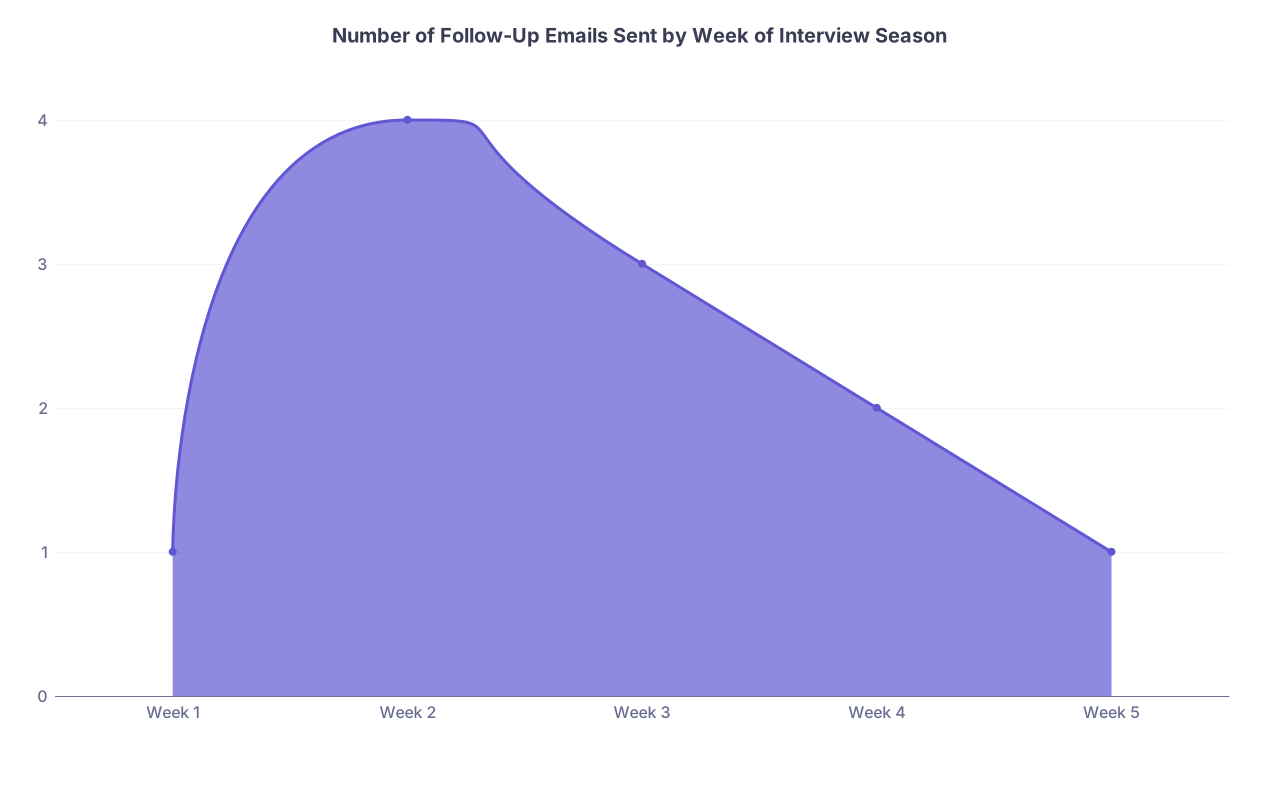
| Category | Value |
|---|---|
| Week 1 | 1 |
| Week 2 | 4 |
| Week 3 | 3 |
| Week 4 | 2 |
| Week 5 | 1 |
Not complicated. Just do not trust your brain in the middle of interview season chaos.
Step 9: Combine With Other Communications Without Being Annoying
During interview season you may send:
- Thank‑you notes
- Clarification / “forgot to mention” emails
- Significant update emails (new publication, award)
- A final interest signal late in the season
You do not want to become “the person who emails us every 3 days.”
My rule of thumb:
- Thank‑you + one additional follow‑up per program in the main season is normal.
- A late‑season interest signal (to a very small number of programs) is separate and acceptable.
- Anything more starts to feel excessive unless there is a major, truly new development (e.g., high‑impact publication, major national award).
If you are trying to decide whether to send a follow‑up: if your only justification is “I feel anxious and want reassurance,” do not send it.
Step 10: Edit Like a Professional (2 Minutes, No Drama)
Before you hit send, do this quick pass:
Read it out loud once
- You will catch 80% of the awkward phrasing and grammar mistakes just by hearing it.
Check these three things:
- Does your email fit on one screen on a phone? If not, cut.
- Did you clearly state what you are adding or clarifying?
- Did you avoid emotionally loaded language (“devastated,” “begging,” “desperate,” “ruined”)?
Subject line sanity check
- Functional is fine.
- Examples:
- “Follow‑up from [Your Name] – [Program Name] Interview”
- “Clarification from [Your Name] – [Specialty] Residency Interview”
You are done. Send it and move on to the next application activity. Obsessively re‑reading sent emails at 1 a.m. is wasted energy.
Visual: A Simple Decision Flow
If you want a quick mental model for when and how to send these, here is the logic.

| Step | Description |
|---|---|
| Step 1 | Realize you forgot or misstated something |
| Step 2 | Do nothing. Save for future conversations |
| Step 3 | Combine with thank-you email |
| Step 4 | Send brief clarification within 24-48 hrs |
| Step 5 | Send focused follow-up within 48-72 hrs |
| Step 6 | One email only, then stop |
| Step 7 | Does it materially affect fit or accuracy? |
| Step 8 | Already sent thank-you? |
| Step 9 | Factual error or key experience? |
That is the actual decision tree I walk people through when they message me panicking about “ruining” an interview. Ninety percent of the time, it is salvageable. Often, the program barely noticed what you are obsessing over.
Two Final Points To Remember
Follow‑ups exist to clarify and strengthen, not to apologize and self‑flagellate.
Treat them as small, professional updates that help the program see you more accurately. Not as confessions.One clean, timely, specific email beats three anxious, rambling ones every single time.
Get in, state the point, tie it to your fit, and get out. Then go focus on the next interview instead of replaying the last one on repeat.