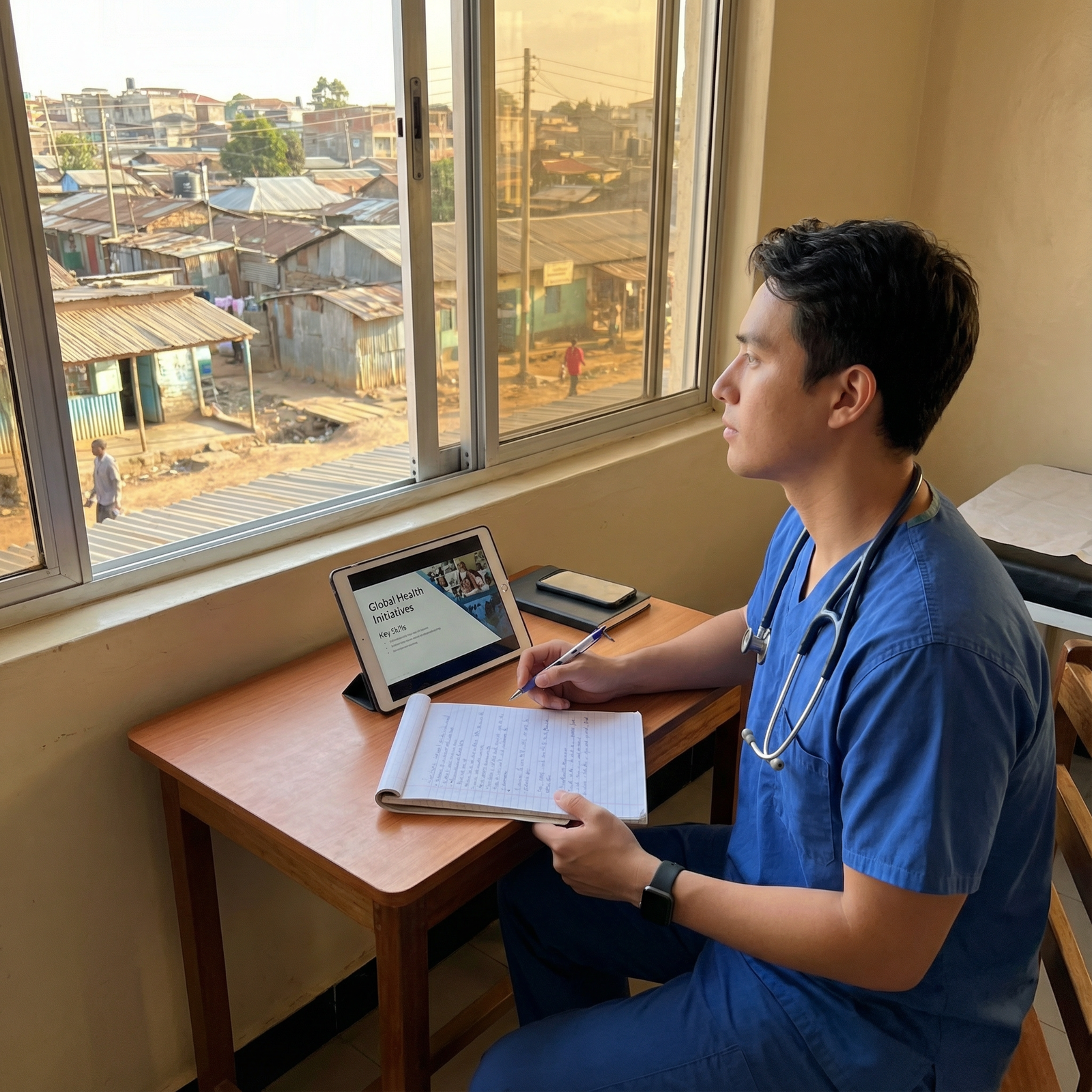
Everybody loves the myth that a passport stamp is basically an ERAS gold star. It isn’t. ERAS is not a travel scrapbook, and residency programs are not handing out points because you spent ten days in Peru, Tanzania, or rural Guatemala and came back with photos in scrubs.
Here’s what actually counts: what you did, how you were supervised, what skills you built, and whether you can explain the experience without sounding inflated or ethically tone-deaf. That’s the whole game. Not geography. Not vibes. Not the phrase “global health” pasted over something that was really a short trip with vague educational value.
I’ve seen applicants treat international experiences like magic dust. They assume “abroad” automatically means “impressive.” Then they get to interviews and can’t answer basic questions: What was your clinical role? Who supervised you? What was your scope? What changed in how you practice? That falls apart fast.
Global health electives can absolutely help your application. But only when they’re structured, clinically meaningful, and coherent with the rest of your story. If it fits your specialty goals, shows maturity, and demonstrates real work, good. If it was tourism with a stethoscope, programs can smell that a mile away.
What ERAS Actually Lets You Count
There is no special halo section in ERAS labeled “International Heroics.” That category does not exist. Global health experiences usually get folded into the same places as everything else: clinical experiences, volunteer/service work, research, leadership, advocacy, or meaningful extracurricular activity. In other words, they count the same way domestic experiences count. Through substance.
If you did a supervised clinical elective abroad, that may fit as a clinical experience. If you worked on a maternal health quality improvement project with measurable outputs, that may belong under research or QI. If you organized logistics, built partnerships, or trained peers before departure, there may be a legitimate leadership component. If you mostly provided community service in a non-clinical role, call it volunteer work. Simple. Accurate. Better than trying to stuff everything into the flashiest possible box.
What programs want in the description is painfully ordinary: site, dates, duration, patient population, your actual responsibilities, your level of supervision, and the outcomes. That last part matters. Did you present cases? Participate in triage? Help with chart review? Contribute to an education session? Co-author a poster? Work on vaccination outreach with a local team? Say that. “Participated in a global health elective and gained cultural competence” tells reviewers almost nothing.
And no, “international” does not automatically equal “competitive.” Plenty of domestic experiences are more rigorous, more ethical, and more relevant than a loosely supervised trip abroad. Programs care about credibility and continuity. They want to know whether you were functioning in a real educational structure, not free-floating through a foreign hospital collecting anecdotes.
Also, stop lumping unlike things together. An observership is not a clinical elective. A mission trip is not the same as a longitudinal partnership. A humanitarian visit is not research. Shadowing is not patient care. These distinctions matter because interviewers know them, and the minute your language gets slippery, your credibility drops.
What Actually Counts: Substance Over Geography
Here’s the blunt version: programs value responsibility, supervision, relevance, and reflection. Not your airline itinerary.
The strongest global health electives usually have a few things in common. You had real patient contact appropriate to your level. You were supervised by qualified clinicians. The experience was ethically designed. You learned something concrete. And it connects logically to the physician you’re trying to become. That’s what makes it useful on ERAS.
Patient contact matters, but not in the macho, overclaimed way applicants sometimes imply. If you were a student taking histories, assisting with exams, presenting to supervising physicians, participating in case discussions, and learning to navigate care in a resource-limited setting, that’s solid. If you’re hinting that you independently managed patients or performed procedures outside your training because “resources were limited,” that’s not impressive. That’s a red flag.
Supervision matters because it separates education from chaos. I’ve read applications where the student describes “helping deliver babies” or “running a clinic” with no clear attending oversight. That is not a flex. It raises ethical and safety concerns immediately. Good programs notice.
Cultural humility and ethics matter too. Not the cliché version. I mean the ability to understand what you didn’t know, how local systems functioned, where your assumptions were wrong, and why partnership matters more than parachuting in. Applicants who can discuss language barriers, local workflows, community health priorities, and the limits of short-term involvement come off as mature. Applicants who talk like they “saved” a population come off like amateurs.
Then there’s specialty relevance. This part is real, but people exaggerate it. Family medicine, pediatrics, internal medicine, emergency medicine, OB/GYN, and surgery may all value global health experiences differently depending on program culture. A family medicine or pediatrics program with strong community health and underserved care emphasis may see clear alignment. Emergency medicine may value adaptability and triage in resource-limited environments. OB/GYN may care if your experience involved women’s health systems, prenatal access, or public health infrastructure. Surgery may be more skeptical if the story sounds like procedural tourism and more interested if it reflects disciplined teamwork, perioperative systems awareness, or outcomes work.
The weak version of a global health elective is easy to spot: one week abroad, little responsibility, fuzzy supervision, generic “exposure,” and a lot of emotional language standing in for actual accomplishment. That’s tourism-adjacent. It doesn’t add much.
The strong version? Structured elective. Defined role. Supervised clinical learning. Evidence of adaptability, communication, teamwork, and thoughtful decision-making under constraints. That can be excellent.
How to List It on ERAS Without Sounding Inflated
This is where a lot of applicants sabotage themselves. They write global health entries like grant proposals crossed with Instagram captions. Don’t do that.
Write like a clinician. Specific, restrained, factual.
Name the site. Include dates and duration. Identify the patient population. State your role. Clarify supervision. Then mention outputs or lessons that are concrete. For example: “Four-week supervised clinical elective at district hospital in western Kenya; worked with internal medicine team taking histories, assisting with physical exams, presenting patients on rounds, and participating in outpatient HIV and diabetes clinics under attending and registrar supervision.” That sounds real because it is real.
Compare that with the bloated version: “Engaged in transformative global health work caring for underserved patients while deepening my appreciation for cultural diversity.” That sentence says nothing. It’s perfume.
Use action verbs. Presented. Documented. Assisted. Screened. Analyzed. Coordinated. Developed. Co-authored. Reflected. Those words carry weight because they imply observable behavior. Add outcomes where appropriate: a poster presentation, educational curriculum, QI deliverable, language-concordant patient education tool, follow-up project, or sustained institutional partnership.
Be honest about the category. If it was primarily service, list it as service. If it was an observership, call it an observership. If it was research on cervical cancer screening uptake with a local faculty mentor, say that and list the scholarly product if one exists. Accuracy beats marketing every single time.
And don’t overclaim scope. Interviewers are very good at sniffing out inflated stories. If your description implies you were doing intern-level work in a setting where you barely knew the system, expect questions. The more dramatic the claim, the more carefully they’ll probe.

Pitfalls, Red Flags, and the Questions Interviewers Will Ask
Let’s talk about the stuff that actually worries programs.
First: voluntourism. If the experience looks like a short trip designed more for the visitor than the community, that’s a problem. If supervision was thin, the educational goals were vague, and the main product was your personal sense of inspiration, don’t expect applause. Programs are increasingly alert to this.
Second: scope-of-practice weirdness. If you did abroad what you would never be allowed to do at home, that is not proof of grit. It’s proof that boundaries got blurry. Interviewers may ask who supervised you, whether local trainees were displaced, and how decisions were made about your role. Those are fair questions.
Third: savior language. “I went to help the poor.” No. Just no. That framing is dated, self-centered, and ethically clumsy. Better language reflects partnership, learning, reciprocity, and respect for local expertise.
Expect interviewers to ask things like: Why did you choose that site? What was your daily role? How were you supervised? What ethical challenges did you notice? How did the local team benefit? What did you learn about your own limitations? If you can answer those calmly and concretely, good. If all you have is sentiment, the experience weakens instead of strengthens your file.
Here’s the part people miss: even a mediocre elective can still be discussed well if you’re honest. You can say the supervision was more observational than expected, that you realized short-term work has limits, that the experience made you more thoughtful about partnership and scope. That kind of reflection is mature. Defensiveness is not.
And yes, one thoughtful, well-explained experience beats five shallow ones. Every time.
Bottom Line: How MD/DO Applicants Should Think About Global Health Electives
The rule is simple. If the experience was structured, supervised, clinically meaningful, and honestly described, it can absolutely strengthen your ERAS application. If it was vague, performative, or ethically messy, the international setting won’t save it.
MD and DO applicants are being judged by the same basic standard: can you show competence, maturity, judgment, and fit? Not wanderlust. Not prestige by association. Not the romance of saying you “did global health.”
Choose electives that actually teach you something. Make sure they align with your specialty goals. Be able to explain your role without embellishment. And if the best thing about the experience is that it happened in another country, that’s a warning sign, not a selling point.
The best global health story on ERAS is never “I went abroad.” It’s this: I contributed, I learned, I was supervised, and I can prove it.