

The fantasy that “good work funds itself” is killing more global health projects than malaria ever will. Funders aren’t paying for your heart. They’re paying for a product: measurable impact, control, and predictability.
Let me tell you what they really expect when they fund your mission—and what they quietly hold against you but will never say out loud.
1. The Brutal Truth: Funders Don’t Pay for Feelings, They Pay for Risk Management
In every big foundation office, every government agency, every NGO secretariat, the conversation about your project starts with one unromantic question:
“Can this team spend our money predictably, safely, and visibly?”
Not “Is this a beautiful mission?” Not “Are they nice?”
Can you manage risk. Financial, reputational, political.
That’s what your budget really signals.
I’ve sat in rooms where a perfectly worthy maternal health proposal in rural Tanzania was thrown out in 7 minutes—not because the idea was bad—but because the budget screamed chaos: no overhead, staff dramatically underpaid, zero line item for M&E, travel numbers that made no sense, and a laptop that apparently cost as much as a motorcycle.
Here’s what’s actually being read between the lines of your budget:
- Sloppy or vague budget → This team will burn cash and create headaches.
- Overly idealistic budget (no salaries, no admin) → These people have never actually run a program.
- No M&E/learning lines → We’ll get zero credible data out of this.
- No local salaries or unclear local roles → This is extractive; optics are bad.
- Bare-minimum “ethics” line (token community engagement) → They learned buzzwords, not practice.
You think they’re reading your narrative. They skim it. They study your numbers.
2. The Hidden Layers in Every “Global Health” Budget
Let’s walk through what’s actually being judged line by line, because nobody teaches this in med school or MPH programs.
a) Personnel: Where Your Ethics Show Up First
Funders look at your staffing lines and ask three questions immediately:
- Who really owns this work?
- Who is being exploited?
- Who will actually get it done?
A budget that pays a US-based PI $180,000 of “effort” while the in-country coordinator gets $12,000 for full-time work? That sets off alarms. Even when they don’t say it in reviews, it’s discussed in side emails.
At one major foundation, I watched a senior reviewer push a strong proposal from “fund” to “hold” with one sentence: “The power dynamics in this budget are terrible.”
They look for:
- Local salaries that are fair by local standards, not an afterthought.
- Transparent time allocation: “20% FTE” that actually matches the work described.
- Leadership roles for local partners that are funded, not symbolic.
If your budget tells the story that Westerners think, plan, and present while local staff execute and collect data, don’t be surprised if you get the polite “We loved your proposal but had many excellent applications” email.
Because the truth is: a lot of them quietly decided not to own that optics nightmare.
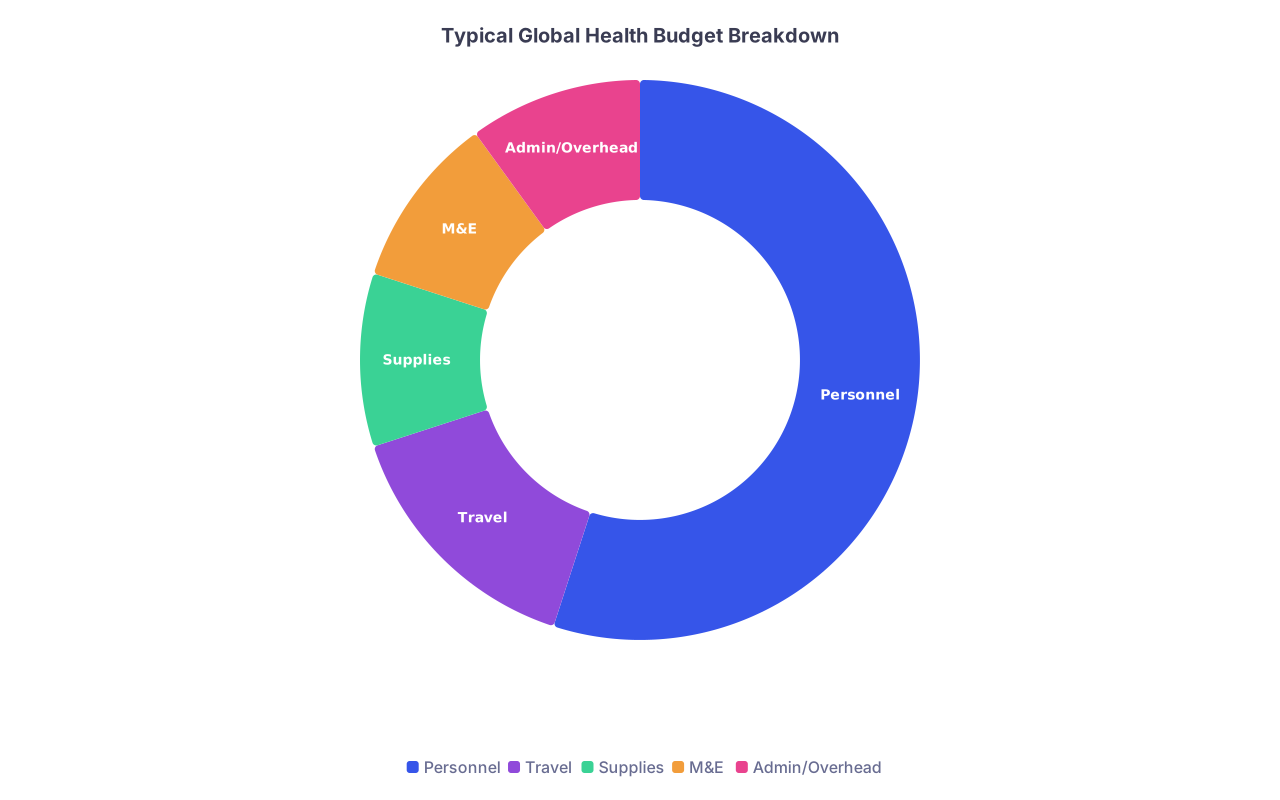
| Category | Value |
|---|---|
| Personnel | 55 |
| Travel | 15 |
| Supplies | 10 |
| M&E | 10 |
| Admin/Overhead | 10 |
b) Travel: The Line Item That Makes You Look Either Serious or Self-Serving
Travel is where early-career people show their cards.
A senior program officer I know at a big European funder once said in a meeting: “If their travel budget is bloated, I don’t trust anything else.” That’s the level of scrutiny.
Here’s what they see:
- Multiple international trips for “US-based investigators” with no clear operational need → This looks like CV-padding and global tourism.
- No travel for local staff to attend regional training or conferences → This is not capacity building; it’s extraction.
- Business class or premium travel for short projects → Unless it’s clearly justified (e.g., health condition, long haul with immediate work), it’s a bad look.
Ethically, this matters. You can write all you want about decolonizing global health; if your budget flies you in three times a year while your local partner can’t afford to attend a meeting in the capital, your values are exposed.
Funders expect you to:
- Justify every international trip with a specific operational purpose.
- Invest in local/regional travel for partners.
- Be frugal but not absurd. (If you underbudget travel, they know you’ll just raid other categories later.)
c) Monitoring, Evaluation, and Learning: The “Are You Serious?” Line
If you think you can run a “global health innovation” with 2% of the budget for M&E, you’re announcing that you don’t understand implementation.
Funders think in terms of proof and scalability. They pay for:
- Baseline and endline data collection
- Ongoing monitoring
- Possibly a learning agenda or process evaluation
- Data management and analysis
When you skip or starve these categories, they read:
“This team wants to feel good and publish anecdotes, not produce evidence we can stand behind.”
The more serious funders—Gates, CIFF, Wellcome, large bilateral agencies—expect:
- At least 5–10% of your budget devoted to monitoring, evaluation, and learning in most implementation projects.
- A clear role (with salary) for whoever is responsible: data manager, M&E officer, statistician.
- Some plan for data quality assurance, not just “we’ll collect data.”
The ethics angle is simple: You’re intervening in real people’s lives with real consequences. Not measuring what you’re doing is not just unscientific. It’s irresponsible.
3. Overhead, Admin, and the Biggest Lie Trainees Tell
If your instinct is to propose “0% overhead” to “look lean” and “maximize funds for the field,” you’re telegraphing inexperience.
I’ve sat through internal review meetings where someone said, “They’re either lying or they don’t know what indirect costs are. Either way, that’s a risk.”
Funders know:
- You use electricity.
- Someone does financial reporting.
- There are HR, legal, IT, and institutional costs.
When you pretend those don’t exist, they assume you’ll either:
- Steal from program lines to cover them, or
- Burn out a staff member who is secretly trying to do 3 jobs.
Both are problems.
There are three hidden expectations here:
- Transparency – Show what it really costs to do this work.
- Sustainability – If your model only works with heroic unpaid admin, it’s not scalable.
- Integrity – Understating admin costs looks nice on paper and ugly in practice.
I’ve seen funders quietly prefer a proposal with a realistic 10–15% overhead over an unrealistic 0–3%, even if that means slightly fewer direct outputs. Because they trust that the first group will actually manage the funds.
Ethically, this is about not building a program on the backs of invisible, unpaid labor. Usually women. Often local staff. Almost always under-recognized.
4. What They Won’t Say Out Loud: Power, Optics, and Control
Here’s the part nobody tells you in “global health ethics” lectures.
Funders aren’t just paying for good outcomes. They’re paying to avoid three nightmares:
- A scandal (misused funds, exploitation, unsafe research)
- A PR disaster (photo of a white trainee doing a risky procedure in a rural clinic they’re not trained for)
- A partnership meltdown (local ministry or hospital feeling used and going public)
So your budget is quietly screened for red flags around:
a) Tokenism vs Real Partnership
If the local partner organization gets a few thousand dollars while your institution gets hundreds of thousands “to coordinate,” that’s noticed.
They ask:
- Who actually holds the money?
- Who can say no?
- Who can walk away?
Some funders now explicitly want local sub-awards, local budget authority, and local PI roles. Others are slower. But almost all of them have internal conversations about power.
Your budget can show respect—or extraction. Funders pick up on it.
b) Hidden Capacity Building (or the Lack of It)
They scan for genuine investment:
- Training lines that are specific, not vague “capacity building – $10,000”
- Salaries for local staff over enough time to actually grow
- Equipment that stays local, not laptops that fly back to the US
When they see every high-value line attached to your visiting team and every low-value or “support” role attached to local partners, reviewers talk about it. I’ve watched a proposal from a top US institution get shredded behind closed doors because, verbatim, “This is 1990s mission-trip global health with better branding.”
c) Control Over the Narrative
Remember: funders have their own stakeholders—boards, governments, the public.
They expect your budget to make it easy to:
- Report clean numbers
- Attribute success
- Claim a decent cost-per-outcome story
If your budget makes it impossible to later say “This is what $X achieved per life saved, per visit, per vaccination,” you’ve created a headache. You might still be funded—once. You probably won’t be renewed.
5. The Ethics of “Who Gets Paid” vs “Who Gets Thanked”
This is where the personal development and ethics piece really shows up.
Walk through your draft budget and ask yourself:
- Whose names are on the papers?
- Whose careers visibly advance?
- Who’s doing the tedious, daily, unglamorous work that makes the whole thing function?
Then see if the numbers match.
If the local nurse who becomes the backbone of your TB screening project is funded at half-time while you’re funded at 20% “for oversight and manuscript preparation,” there’s a disconnect.
Funders may not always call this out in reviews, but the good ones see it. Some have started pushing back quietly:
- “Can you clarify why the US-based co-investigator is budgeted at twice the effort of the in-country PI?”
- “How did you determine these local salary scales?”
- “Can you expand the role and support of the in-country M&E lead?”
Those are polite ways of saying: fix the ethics in your budget.
You keep hearing “nothing about us without us” at conferences. The budget is where you prove you believe that. Or don’t.

6. What Different Types of Funders Really Expect (But Rarely Publish)
Not all funders think the same way. If you treat a major bilateral agency like a small family foundation—or vice versa—you’ll confuse them immediately.
Here’s the behind-the-scenes archetype breakdown.
| Funder Type | What They Secretly Care About Most | Budget Red Flag They Hate |
|---|---|---|
| Big Foundations | Evidence, optics, scalability | No M&E, exploitative salaries |
| Bilateral/Multilateral | Compliance, reporting structure | Vague categories, weak controls |
| Small Foundations | Personal trust, narrative coherence | Overly complex, bureaucratic budgets |
| Academic Internal Funds | Publications, feasibility | Unrealistic no-overhead fantasy |
Let me translate that into real behavior you’ll actually see:
Big foundations: They will forgive some clunkiness if you have a strong evidence plan and ethically solid staffing. They will not forgive data chaos or anything that looks like neocolonial theater.
Bilaterals (USAID, DFID/FCDO, etc.): They live and die by audit risk. If your budget looks hard to track, or your institution has weak financial controls, they push you down the list.
Small family foundations: They want to feel like they’re paying for something tangible and coherent. A simple story: “$X trains Y community health workers who serve Z villages.” Overly intricate budget structures annoy them.
Internal university or hospital grants: They know you’re early-career. They’re testing: can this person design a project that doesn’t implode?
If you’re smart, you’ll align your budget with their psychology, not just their public RFP language.
7. How to Build a Budget That Makes Funders Relax, Not Flinch
Let me be very concrete about what makes reviewers lean toward “yes” before a single score is given.
a) The Ratios Look Reasonable
They don’t need to be perfect, but they need to be sane. For a typical implementation project:
- Personnel: ~50–65%
- M&E/learning: ~5–15%
- Travel: ~10–20% (lower if local, higher if multi-country)
- Supplies/equipment: ~10–20% (depending on the nature of the work)
- Overhead/admin: Either your institutional rate or a reasonable flat percentage
That’s not law. But when something is wildly off, it triggers closer scrutiny.
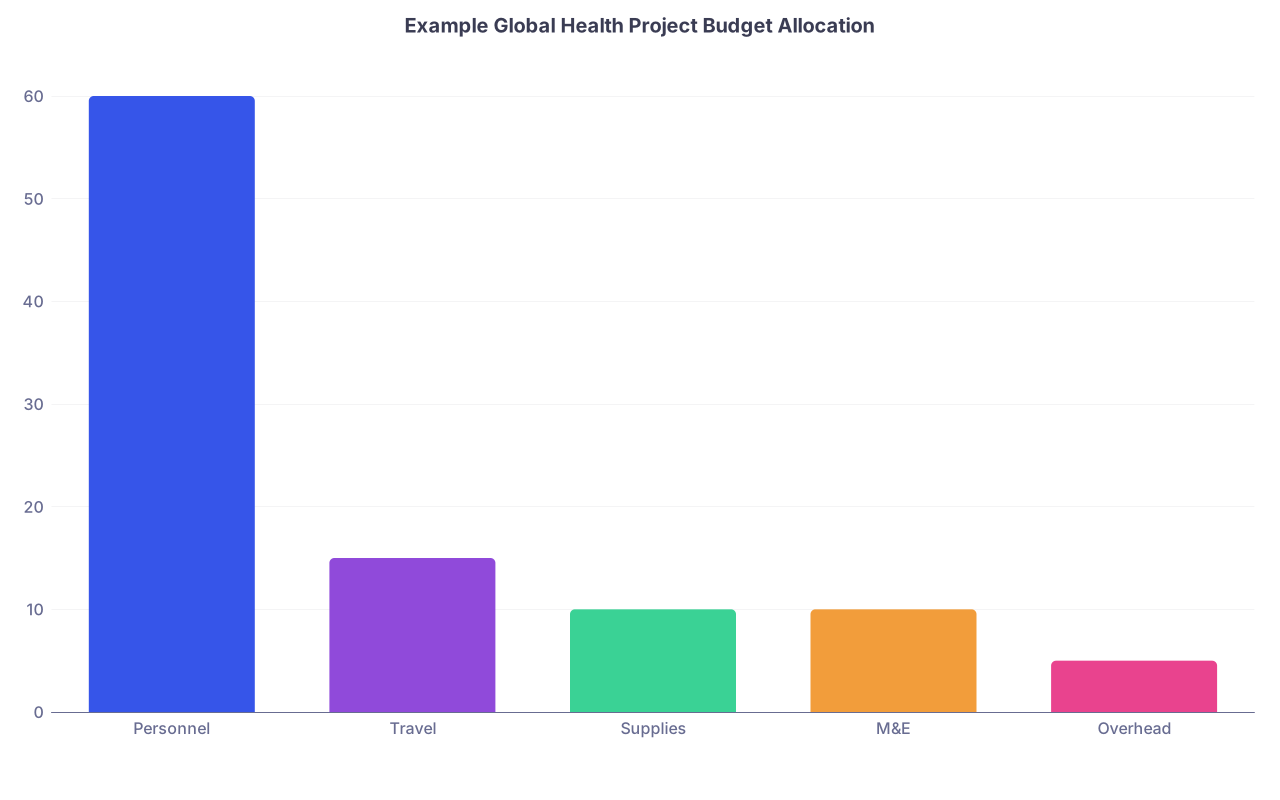
| Category | Value |
|---|---|
| Personnel | 60 |
| Travel | 15 |
| Supplies | 10 |
| M&E | 10 |
| Overhead | 5 |
b) Every Big Line Has a Story You Can Say in One Breath
If I point at:
- That $80,000 equipment line
- That $50,000 travel budget
- That $100,000 “consultant” line
…you should be able to explain each in a single, clear sentence that ties directly to outcomes.
If you can’t explain it simply, they assume you don’t really know what it’s for—or you’re hiding something.
c) Local Partners Aren’t Just an Afterthought
A budget that makes reviewers calm usually has:
- Funded local leadership roles
- Capacity building that is more than a single workshop
- Salaries that match real responsibilities
- Assets (equipment, software) that stay with local partners
Ethically, that’s the baseline. Strategically, that’s what gets funded again and again.

8. Your Personal Development: Learning to Think Like a Steward, Not a Beneficiary
If you’re serious about a career in global health, you need to stop thinking of funding as a gift to you and start thinking of it as money entrusted to you on behalf of people who will never sit in that room.
That mental shift changes everything about how you build a budget.
You start asking:
- Would I be comfortable explaining this salary difference to the local nurse who keeps this project afloat?
- Could I walk a journalist through this travel budget without embarrassment?
- If this were audited, would I feel clean?
That’s ethics in practice. Not a lecture. A spreadsheet.
The most trusted people I’ve worked with in global health all do the same thing: they obsess over budgets not because they love Excel, but because they understand that budgets are moral documents.
They reveal what—and who—you actually value.
9. A Simple Reality Check Before You Hit Submit
Before you send your next global health proposal, do this:
- Print the budget and the justification.
- Hand it to someone not on your project—ideally someone from another country or context.
- Ask them: “Does anything here feel unfair, unrealistic, or self-serving?”
If they flag something, don’t defend it immediately. Sit with it. Adjust it.
Because someone in a funder’s office, with less patience and less context, is going to have the same reaction. And they have the power to say no.

| Step | Description |
|---|---|
| Step 1 | Proposal Received |
| Step 2 | Quick Budget Scan |
| Step 3 | Low Priority or Reject |
| Step 4 | Full Technical Review |
| Step 5 | Revise or Downgrade |
| Step 6 | Recommend for Funding |
| Step 7 | Any Major Red Flags |
| Step 8 | Ethics and Optics Concerns |
FAQ (Exactly 3 Questions)
1. Is it ever acceptable to underpay myself or leave out my own salary to make the budget “leaner”?
No. That’s a rookie move. Funders see it as a sign you don’t understand sustainability. Ethically, you create pressure to “make it up” later—through consulting gigs, hidden stipends, or unpaid overtime from others. Budget your real effort at a reasonable rate. If the project can’t afford that, the scope is wrong.
2. How much should I push back if my institution demands a huge overhead rate that makes the proposal less competitive?
You should push—once—by explaining the funder’s typical expectations and showing examples. But do not try to secretly lower the institutional rate without approval. That’s how you end careers. If the institution won’t budge, you re-scope the project or you target other funders. Never build your academic future on financial games.
3. What’s the single most common ethical red flag funders quietly notice in global health budgets?
Unjustified power and pay gaps between foreign and local staff. When the US/European team is funded generously for “oversight, analysis, and dissemination” and the local team carrying daily operational risk is underpaid and under-titled, reviewers see it instantly. Fix that, and you’re already ahead of half the field.
Key points: Your budget is not paperwork; it’s a moral document and a risk profile. Funders are buying control, predictability, and optics—not just your mission statement. If your numbers don’t reflect respect for local partners, real M&E, and honest overhead, they’ll quietly walk away and fund someone else.


