

The myth about global health fellowships is simple: people think enthusiasm and a passport stamp are enough. They are not.
Let me tell you what fellowship directors actually say when you’re not in the room.
They’re not asking, “Who’s the most passionate about helping the underserved?” They’re asking:
“Who will not implode in the field, embarrass our program, or turn my WhatsApp into a 3 am crisis line?”
You think they’re screening for idealists. They’re really screening for risk.
The First Filter: Who Is Safe to Send Abroad?
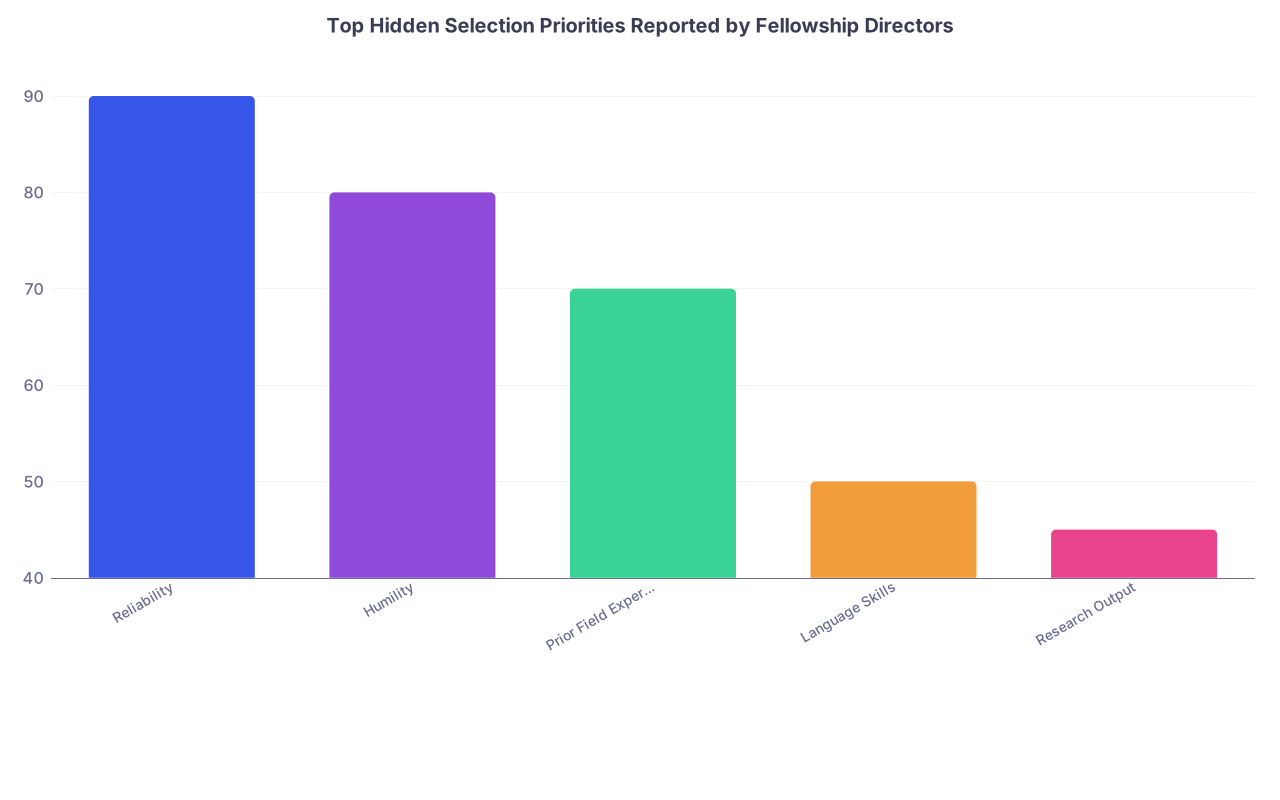
| Category | Value |
|---|---|
| Reliability | 90 |
| Humility | 80 |
| Prior Field Experience | 70 |
| Language Skills | 50 |
| Research Output | 45 |
I’ve sat in those meetings where applications are spread across a conference table, coffee is cold, and people are blunt. The first question is never “Are they passionate?” It’s:
“Can I put this person alone in a district hospital 8 hours from the nearest tertiary care center and sleep at night?”
Directors are responsible for your safety, the program’s reputation, and the relationships that took 10–20 years to build with partner sites. They do not gamble on people who seem nice. They look for hard evidence that you won’t be a problem.
They look for:
- Proof you finish what you start. Longitudinal commitments. Not a weekend trip with selfies.
- Signs you can practice safely with limited supervision. Solid clinical foundation, not a tourism mentality.
- Emotional stability. Nobody wants the fellow who spirals every time the Wi-Fi goes out and someone codes in the hallway.
When you read “must be able to work independently in resource-limited settings,” that’s code for: We will not handhold you. Show us you’ve done hard things already and didn’t melt down.
If your application screams “adventure-seeking,” “savior complex,” or “I’m here to get great photos and a Lancet paper,” it goes quietly into the no pile. People won’t say that to your face. I’ve heard it said in exactly those words behind closed doors.
The Experiences That Actually Matter (And the Ones That Don’t)

Here’s the harsh truth: most “global health experiences” on CVs look the same from the director’s chair. And most of them are unimpressive.
A 2-week “medical mission” as an M2? Almost no director cares. If that’s your main global health experience and you’re applying to serious fellowships, you’re not a competitive applicant. Not for the programs that actually do real work.
What fellowship directors really respect:
Longitudinal involvement
Not “I went to Uganda once.” But:- You worked with the same site or population over multiple years.
- You moved from observer → contributor → owner of a small but discrete piece of work.
- There’s a story of sustained engagement, not a bucket-list trip.
Local mentorship and integration
They love seeing:- Letters from partners in-country or with immigrant/refugee communities at home.
- Evidence you didn’t parachute in, but actually listened to local clinicians and adapted.
- Experiences where you worked under local leadership rather than calling the shots as a visiting student.
Real clinical grind in resource-constrained settings
This can be abroad or domestic (FQHCs, Indian Health Service, safety-net EDs). What matters:- You’ve seen what it’s like when everything is not instantly available.
- You learned to prioritize, to work with uncertainty, to tolerate imperfection.
- You can function without 10 consults and a full diagnostic panel on every patient.
Project ownership
Directors look for something that was clearly yours:- A QI project you implemented and followed up.
- A registry you helped build.
- A small clinical protocol you helped design and actually rolled out.
Not just “I helped collect data for Dr. X.”
Here’s what’s overvalued by applicants and under-valued by directors:
| Overrated on CVs | Underrated (but loved by directors) |
|---|---|
| 1–2 week medical mission | 2 years in a local free clinic |
| “Shadowing” abroad | Owning a QI project at a partner site |
| Generic global health electives | Specific, mentored longitudinal collaborations |
| List of countries visited | One site, many years, deep relationships |
| Inspirational essay language | Concrete outcomes and sustained follow-up |
If your story is “I went to Country A, then Country B, then Country C,” you look like a tourist. If your story is “I’ve worked with X partner in Y place for 4 years and here’s how my role grew,” you look like a fellow.
The Personality Traits Directors Screen For (And Against)
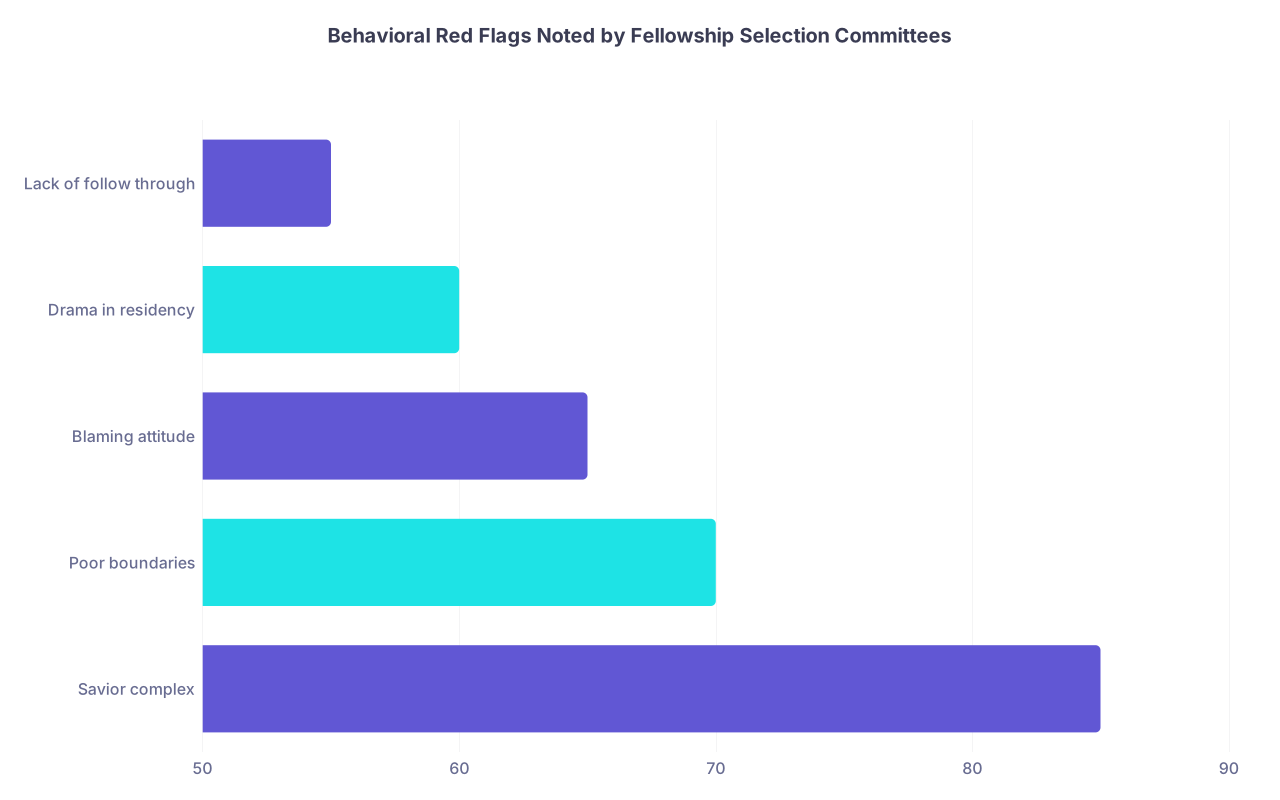
| Category | Value |
|---|---|
| Savior complex | 85 |
| Poor boundaries | 70 |
| Blaming attitude | 65 |
| Drama in residency | 60 |
| Lack of follow through | 55 |
Let me be blunt. The biggest reason people get quietly blacklisted in global health? Personality. Not skill.
Fellowship directors have long memories. They hear from site partners. WhatsApp messages get forwarded. Someone who was a pain as a resident doesn’t magically become a dream fellow.
They are actively screening for:
Humility
Everyone says they have it. Very few actually do. Here’s what humility looks like to a director:
- You listen to community health workers and nurses and do not treat them like assistants.
- Your letters describe you taking feedback well, not defending yourself to the death.
- Your personal statement doesn’t reek of “I’m here to bring advanced Western medicine to the poor.”
Psychological resilience
Global health fellowships are emotionally brutal. You will watch preventable deaths. You will confront your own limits. Directors want:
- A track record of doing hard, messy work without dramatic exits.
- Someone who doesn’t catastrophize every setback.
- No whiff of repeated interpersonal conflicts or professionalism issues.
Respect for boundaries and ethics
This is where a lot of “gung-ho” applicants fail. Directors are wary of:
- People eager to operate beyond their training “because the setting is low-resource.”
- Applicants who brag about doing procedures abroad they weren’t credentialed for at home.
- People who’ve engaged in unapproved research or bypassed IRB because “it’s low-income, they need help.”
There’s a specific phrase that makes directors’ eyes narrow:
“I loved being able to do more advanced procedures than I can at my home institution.”
Translation in their heads: You are a liability.
If your global health narrative glorifies operating without oversight, that’s a huge red flag. Safe fellows know their limits and respect them, especially when nobody’s watching.
The Ethics Test: Are You Just Exporting Bad Habits?

| Step | Description |
|---|---|
| Step 1 | Clinical opportunity abroad |
| Step 2 | Decline or observe only |
| Step 3 | Proceed ethically |
| Step 4 | Discuss with supervisor |
| Step 5 | Within my training level |
| Step 6 | Locally standard and supervised |
| Step 7 | Still unsafe |
Global health fellowship directors talk a lot about ethics in internal meetings. A lot more than you’d guess from the brochures.
They’re asking:
- Will this person exploit the partner site for their own CV?
- Will they respect local protocols, or impose their own?
- Will they protect trainees and patients, or just chase cases and publications?
They scrutinize your record for ethical maturity. That’s a real thing. You show it (or don’t) in specific ways.
Ethical maturity looks like:
- You’ve done IRB-approved research or at least asked the right questions about oversight.
- You did not collect data “informally” on a vulnerable population for a quick abstract.
- You’ve clearly thought about power dynamics, not just “these poor people need me.”
Programs that partner with institutions in Rwanda, Malawi, India, Haiti, you name it, have had bad experiences. The visiting trainee who ignored local leadership. The resident who shared patient photos on Instagram. The “cowboy” who did procedures unsafely. That stuff burns bridges for years.
So directors now read between the lines of your application:
Do you talk about what you learned from local colleagues or just what you “taught”?
Do your mentors describe you as collaborative, or “high energy and very driven” with no mention of listening skills? Because that last phrase is usually code for “steamrolls people.”
What Directors Read in Your CV, Personal Statement, and Letters
Let’s walk through how your application actually gets dissected.
Your CV
Directors scan your CV fast. They’re hunting for:
- Pattern, not volume. They don’t care that you have 18 posters. They want to see a thread: maybe maternal health, TB, surgical systems, refugee medicine.
- Time commitment. Were you involved for 2–3+ years with something, or did you sample a bunch of things superficially?
- Role progression. Did you move from volunteer → coordinator → project lead? Or did you stay “member” on everything?
They also notice gaps:
You say you’re deeply committed to global health, but there’s nothing in MS1–MS3, nothing in residency until PGY-3, and one elective abroad. That reads as opportunistic, not core to who you are.
Your Personal Statement
This is where people kill themselves with good intentions.
Directors are allergic to:
- “I have always dreamed of helping the underserved overseas.” (They’ve read that 300 times.)
- Trauma tourism stories about “the little boy in X country whose eyes changed my life.”
- Savior narratives where you’re the hero in a setting you barely understand.
They lean forward when:
- You describe one location or population you’ve worked with over time and how your view of global health has matured.
- You talk concretely about partnership, capacity-building, task-shifting, or health systems rather than vague “service.”
- You acknowledge mistakes or blind spots you’ve corrected, without turning it into confession theater.
Strong statements often sound more like:
“I arrived thinking the biggest problem was lack of resources. I was wrong. The real issue was X, and here’s how local partners had been working on it for years before I showed up.”
That demonstrates you’re capable of growth. And that you understand you’re not the protagonist of global health.
Your Letters of Recommendation
This is where a lot happens in code.
Fellowship directors read LORs with a very jaded eye. They’ve seen the templates. They know every school’s grade inflation in adjectives.
What they look for in global health letters:
- From someone who has actually seen you in the field or in similar environments.
- Specifics: “She stayed late to help sort out a complex transport issue,” not “He is very dedicated.”
- Indicators of how you behave under stress and uncertainty: calm, panicky, rigid, creative?
Red flag wording (these are real phrases I’ve seen raise eyebrows):
- “He is very enthusiastic and energetic” with no mention of judgment or maturity.
- “She would benefit from more structure” – not what you want for a fellow working semi-independently abroad.
- “He is very confident in his skills” – if not balanced by something about insight or listening, that’s code for “makes us nervous.”
Programs give huge weight to letters from site partners or people who have a long track record in global health themselves. A strong letter from a respected global health faculty often matters more than one from a department chair who barely knows you.
The Unsexy Stuff: Skills That Quietly Make You a Top Applicant

Everybody talks about passion. Let’s talk about what actually makes life easier for a fellowship director.
Here are the “boring” skills that make you jump to the top of the list:
Language ability
You do not need to be fluent in five languages. But any real, usable competence in the languages used at partner sites is a massive plus. Even intermediate. Even halting but committed.
It signals:
- You’re willing to do hard, unglamorous work (vocabulary drills, awkward conversations).
- You respect communication enough not to rely entirely on others to bridge the cultural gap.
Teaching ability
Most serious global health programs care about capacity-building, not just direct care.
Directors want fellows who can:
- Teach with a chalkboard, not just PowerPoint.
- Adapt teaching to different baseline levels and cultural contexts.
- Handle the fact that local trainees might be more clinically savvy than you in that environment.
If your application shows you’ve taught residents, nurses, community health workers – and enjoyed it – that’s gold.
Systems thinking
This is where the best fellows separate from the rest. You see systems, not just episodes.
Evidence directors love:
- You’ve done QI that actually changed something, not just a poster.
- You talk about supply chains, referral pathways, financing, policy – not just “we need more ventilators.”
- You understand that sustainability is not a buzzword; it’s structure, ownership, and local leadership.
Logistical competence
This one never shows up on websites, but ask any director off the record: they adore people who are simply operationally competent.
That means:
- You answer email. On time.
- You can organize travel, visas, and paperwork without constant hand-holding.
- You document your work, follow-up data, and send trip reports without nagging.
Nobody wants the brilliant but disorganized fellow who loses receipts, forgets meetings with partners, and disappears mid-project.
How to Actually Become the Kind of Applicant They Want
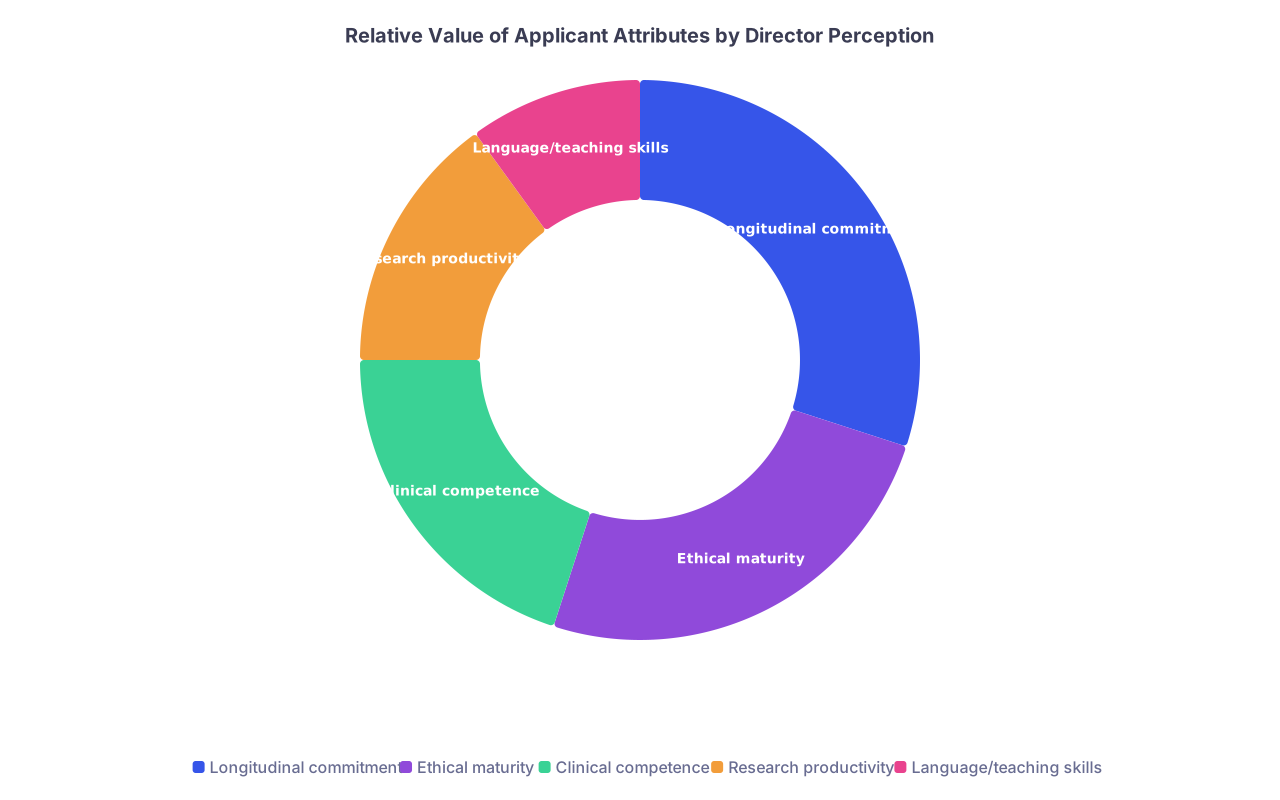
| Category | Value |
|---|---|
| Longitudinal commitment | 30 |
| Ethical maturity | 25 |
| Clinical competence | 20 |
| Research productivity | 15 |
| Language/teaching skills | 10 |
If you’re early – MS1, MS2, PGY-1 – you have time to fix your trajectory. If you’re late – PGY-3 or beyond – you have less flexibility but you can still sharpen your story.
The core moves are the same.
Anchor yourself. Choose one or two themes or sites and dig in.
That could be:
- Maternal health in one specific region.
- Refugee health in your city.
- Non-communicable disease care at a longstanding partner site.
- Surgical systems at one hospital you return to over and over.
Then:
- Show growth over time in that world. More responsibility, more nuance.
- Seek mentorship from people with real global health credibility, not just title inflation.
- Ask explicitly for feedback on your blind spots – especially ethical and cultural issues.
You also need to clean your own house. If you’ve had professionalism hiccups, interpersonal conflicts, or a reputation as “that intense person,” you have to fix that now. Directors talk to your PD. They hear the subtext.
And yes, research helps – but not the way you think. One thoughtful, context-aware project that genuinely mattered to a partner site beats ten opportunistic abstracts slapped together and abandoned.
FAQ: What Global Health Fellowship Directors Really Look for
1. Do I need to have worked abroad to be competitive for a global health fellowship?
No. Abroad experience helps, but it’s not mandatory. Many directors respect deep work with immigrant/refugee communities, Indian Health Service, border clinics, or FQHCs just as much. What matters is whether you’ve worked over time with marginalized or structurally disadvantaged populations, taken on ownership, and shown you understand power dynamics and systems issues. If you have only one short abroad elective but rich, longitudinal domestic work, you can still be a very strong candidate.
2. How much research do I “need” for a strong application?
There’s no magic number. Serious academic programs want to see that you can carry a project from idea to product: at least one publication or meaningful abstract in a global health–relevant area is ideal. But directors care more about whether your work shows depth, respect for ethics/IRB, collaboration with local partners, and follow-through. A single well-done project integrated into a partner’s priorities beats multiple superficial, extractive studies.
3. What are the biggest red flags that get applicants rejected despite strong CVs?
Three repeat offenders:
- Savior complex language or behavior – talking like you’re bringing modern medicine to the “voiceless” rather than working in partnership.
- Operating or doing procedures clearly beyond your training abroad and then bragging about it. That terrifies directors.
- Patterns of poor professionalism – hard to work with, boundary issues, drama in residency. Those come through in whispers, in letters, in calls from your PD. A single misstep rarely kills you; repeated themes do.
4. If I’m late in training and my global health experience is thin, is it too late?
It’s late, not impossible. You can’t fake a decade of commitment in six months, but you can still salvage your trajectory by being honest and targeted. Own the fact that your interest crystallized later, then show what you’ve done to engage seriously: intensive work with a specific population, a concrete project with real deliverables, strong mentorship, and clear, realistic fellowship goals tied to your prior training. Directors will take a later-blooming but grounded, self-aware applicant over an early but shallow “global health tourist” any day.
With this lens, you’re no longer guessing what they want. You know what’s actually being said in those selection meetings. Your next step is to align your real work – not just your words – with that reality. Do that, and you’ll stop looking like an applicant chasing an exotic credential and start looking like exactly what they’re hunting for: someone they can trust with their partners, their reputation, and the kind of work that still matters long after the fellowship ends. The interview trail and on-the-ground realities of those fellowships? That’s a story for another day.


