

The idea that “all global health paths are basically the same” is wrong. Choosing between academic global health and NGO field work will shape your day-to-day life, your stress, your impact, and your career ceiling for years.
Let me walk you through this like I would with a resident in my office who says: “I want to do global health, but I have no idea which lane is right for me.”
1. First, be brutally honest about what you actually want
Forget the labels for a minute. Ignore what sounds impressive on paper. Ask yourself four blunt questions:
- Do I get more energy from ideas, data, and systems… or from being in the thick of messy, under-resourced clinical reality?
- Do I want my name on papers and grants, or on project reports and impact metrics?
- Am I okay with slow, bureaucratic progress… or does that make me crazy?
- Do I want a stable academic base, or am I willing to live out of suitcases and guesthouses for long stretches?
Here’s the core distinction, stripped down:
- Academic global health = universities, research institutes, teaching hospitals. Your tools: research, teaching, policy advising, curriculum building.
- NGO field work = operational organizations (MSF, Partners In Health, IRC, Save the Children, local NGOs). Your tools: service delivery, program implementation, logistics, rapid problem-solving.
Neither is “more ethical.” Neither is “more impactful” by default. Both can be excellent or a waste of time depending on how you do them.
But they are very different lives.
2. How your daily life actually looks in each path
If you cannot picture the day-to-day, you will make a bad decision. So let’s get concrete.
Typical week: Academic global health (mid-career example)
You’re an assistant professor in global health / ID at a university with a “global health center.”
Your week might look like:
- Monday: Zoom call with partners at a teaching hospital in Malawi to review progress on a maternal health study; revise an RCT manuscript and respond to reviewer comments.
- Tuesday: Teach a 2-hour seminar on ethics of global clinical electives to MPH students; meet with med students planning a short-term rotation abroad; write part of a grant proposal.
- Wednesday: Institutional review board (IRB) follow-ups; data meeting with statisticians; draft policy brief for Ministry of Health partners.
- Thursday: Protected “research day” that gets partially eaten by committee meetings; answer endless emails; mentor a PhD student.
- Friday: Department meeting; adjust budgets on your NIH/Fogarty grant; finalize slides for a conference presentation.
You might travel to partner sites 2–8 weeks a year. You are not usually in the field running day-to-day clinical services. You are building evidence, systems, and people.
Typical week: NGO field work (medical lead in a crisis or program)
You’re working for an NGO as a field physician or program manager in, say, South Sudan or rural Haiti.
Your week might look like:
- Monday: Morning ward round in a crowded ward with limited labs; negotiate with logistics when you are short on essential meds; troubleshoot why vaccination coverage dropped last month.
- Tuesday: Train local nurses on triage or emergency obstetrics; sit under a tree with community health workers talking about barriers to care; write a weekly situation report.
- Wednesday: Meet with the local health director to coordinate referral pathways; revise cholera or TB treatment protocols based on reality, not textbooks.
- Thursday: Security briefing; someone on your staff is sick; adapt clinic flow based on floods/blockades; push HQ for more staff and supplies.
- Friday: Data review—cases seen, mortality, stockouts; prepare for donor visit or audit; debrief a traumatic case with your team.
Email is intermittent. There are no grand rounds. There is a lot of improvisation, moral distress, and occasional deep satisfaction.
3. Side-by-side: what you gain and what you give up
Here’s the blunt comparison:
| Dimension | Academic Global Health | NGO Field Work |
|---|---|---|
| Main focus | Research, teaching, policy | Service delivery, operations |
| Time horizon | Long-term, 3–5+ year projects | Short- to medium-term programs |
| Base | University / research institute | Field sites, regional offices |
| Travel pattern | Short trips, conferences | Extended deployments, rotations |
| Career stability | Higher (tenure, benefits) | Variable (contracts, funding cycles) |
| Daily pace | Slower, bureaucratic | Fast, unpredictable |
Neither column is “better.” The question is: which column feels like your oxygen?
4. Ethical tradeoffs you cannot ignore
You said this is under “personal development and medical ethics.” Good. Because global health without ethical clarity becomes performative tourism or institutional empire-building very fast.
Common ethical pitfalls in academic global health
I’ve watched these play out repeatedly in “highly ranked” programs:
- Parachute research: Designing studies in Boston or London, flying in for a site visit, leaving local partners to do all the hard work, then owning the publications.
- Asymmetric benefit: You get the grant, the career lift, the keynote; your partners get a small budget, more work, and their name buried in the middle of the author list.
- Student-centered, not partner-centered: Projects exist primarily to give students “global experience,” not because they solve a problem identified by local colleagues.
You avoid this by making a few non-negotiables:
- Local co-PIs on every project with real power.
- Data ownership shared or led by the local institution.
- Capacity building (training, infrastructure) baked into every grant, not as an afterthought.
- Saying no to “global visits” that are purely educational tourism.
Common ethical pitfalls in NGO field work
On the NGO side, the ethical traps are different:
- Savior complex: The unspoken narrative of “We are here to save you” poisons everything—from how programs are designed to how local staff are treated.
- Short-termism: Project cycles of 6–18 months that ignore long-term system building, leaving fragile services that vanish when funding ends.
- Bypassing local systems: Running parallel clinics, supply chains, and data systems that undermine the Ministry of Health rather than strengthening it.
How you reduce that:
- Insist on working with, not around, local health authorities where possible.
- Design exit strategies at the start. What will remain if your NGO leaves?
- Treat national staff as the center of the program, not as helpers.
Both paths demand that you keep asking: “Who benefits most from my presence and this structure—me, my institution, or the community we claim to serve?”
5. Personality fit: what kind of person thrives in each?
Here’s where you have to stop lying to yourself.
You’re likely a better fit for ACADEMIC GLOBAL HEALTH if:
- You enjoy writing—grants, manuscripts, curricula. Not tolerate. Enjoy.
- Data does not scare you. You can live with long delays before results.
- You want to mentor students and build a niche of expertise.
- You like sustained partnerships: 10+ year institutional collaborations, not just one-off projects.
- You value job security, benefits, and a home base.
You’re likely a better fit for NGO FIELD WORK if:
- You like making decisions with incomplete information and limited resources.
- You’re energized by clinical chaos and logistical puzzles.
- You’re okay with risk: security concerns, disease exposure, unstable housing.
- You care more about service and impact today than about publications.
- You can handle being away from home for weeks to months at a time.
And yes, there is overlap. Some people move between the two. But usually one feels more like “home.”
6. Career progression and long-term options
You’re not just choosing your next year. You’re teeing up the next 10–20.
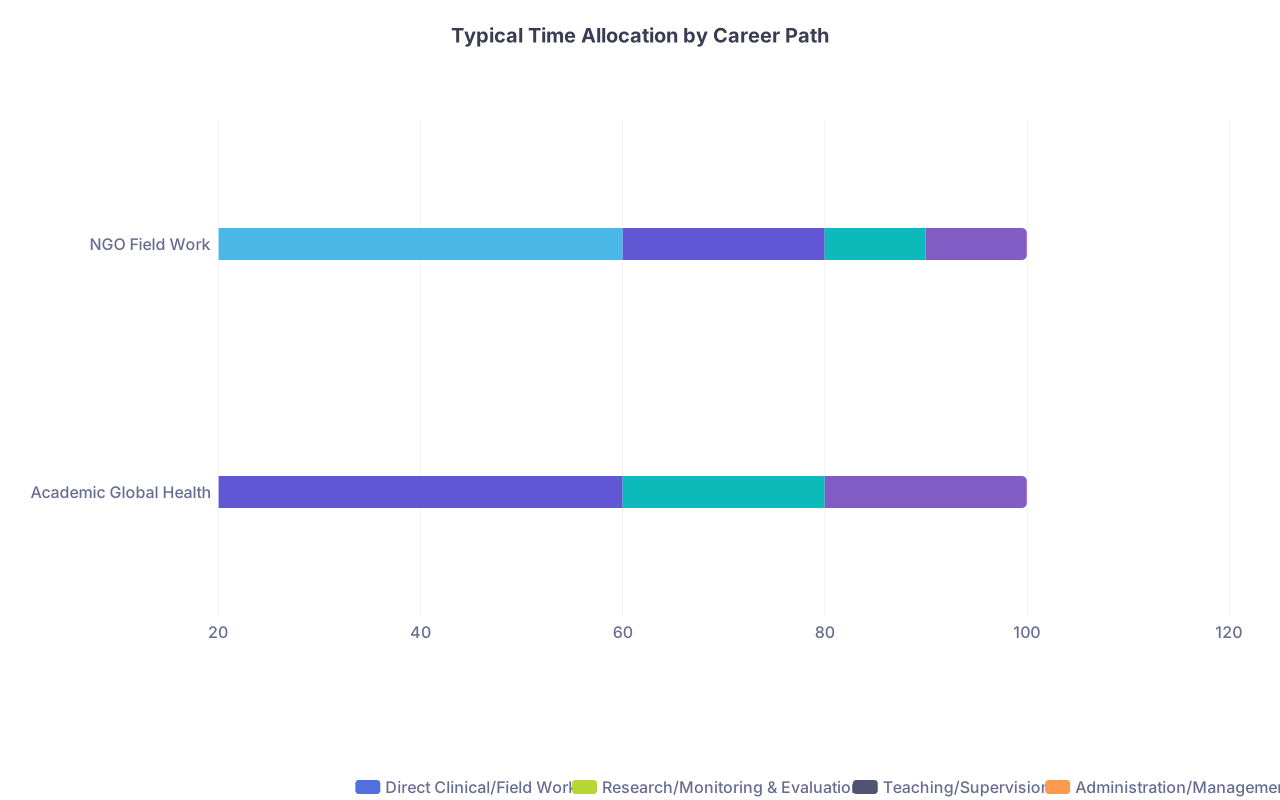
| Category | Direct Clinical/Field Work | Research/Monitoring & Evaluation | Teaching/Supervision | Administration/Management |
|---|---|---|---|---|
| Academic Global Health | 20 | 40 | 20 | 20 |
| NGO Field Work | 60 | 20 | 10 | 10 |
Academic global health: where this can go
Long term, you can:
- Become a tenured professor leading a global health center.
- Advise WHO, ministries, or large global initiatives (GAVI, Global Fund).
- Shape guidelines, national programs, and frameworks used by thousands.
Upside: strong platform, influence on policy, stable salary, ability to shape future generations.
Downside: constant grant-chasing, publication pressure, bureaucratic meetings, distance from direct patient care.
NGO field work: where this can go
Long term, you can:
- Become a medical coordinator, country director, or regional advisor.
- Shift from field roles to HQ technical advisory positions.
- Move into global humanitarian leadership, philanthropy, or global program design.
Upside: deep operational experience, credibility with implementers, clear impact in specific places and populations.
Downside: burnout, vicarious trauma, unstable contracts, limited traditional academic credentials (which can matter if you later want academic roles).
7. Decision framework: what to do in the next 12–24 months
Here’s the practical roadmap if you’re still undecided.

| Step | Description |
|---|---|
| Step 1 | Clarify your priorities |
| Step 2 | Lean toward Academic Global Health |
| Step 3 | Lean toward NGO Field Work |
| Step 4 | Test both with short-term roles |
| Step 5 | Find mentors in universities |
| Step 6 | Find mentors in NGOs |
| Step 7 | Do 1 academic project and 1 field deployment |
| Step 8 | Prefer research and teaching? |
| Step 9 | Prefer operations and field work? |
Step 1: Do one real thing in each space (not just shadowing)
If you can, before committing:
- Academic side: Join a serious research or implementation project with a global health faculty member. Not just a two-week trip. Something where you help with a paper, protocol, or data.
- NGO side: Do a 3–6 month field assignment (clinical or program) with a reputable NGO, even as a junior.
Short “exposure trips” don’t count. You need to feel the grind.
Step 2: Pay attention to how you feel, not just what looks good
After each experience, ask:
- Did I leave energized or drained?
- Could I do a version of this for 5–10 years?
- Did the ethical compromises feel tolerable and workable, or did they clash with my core values?
Write it down that week. Your memory will sanitize things later.
Step 3: Choose a primary lane but keep the door open
You do not have to marry one path forever. But you do need a primary identity for at least a few years.
- If you choose academic: you can still consult for NGOs, teach in field sites, or take sabbaticals for operational roles.
- If you choose NGO: you can still co-author papers, contribute to research, or later pursue advanced degrees and shift toward academia.
The key is being intentional: “I’m going to lean into X for the next 3–5 years, while staying connected to Y enough that a switch is possible.”
8. Red flags and green flags when choosing specific roles
Do not just pick a path. Pick healthy versions of that path.
Academic global health – green flags
- Long-term institutional partnership with clearly defined governance and mutual priorities.
- Local investigators as co-PIs, first/last authors, or program leads.
- Funding for local capacity building (training, infrastructure).
- Clear policies on authorship, data ownership, and decision-making.
Academic global health – red flags
- “We have a site in X country” but no local leadership on the website.
- Projects driven entirely by trainee interests rather than local need.
- Short “service trips” marketed heavily to students with no continuity.
NGO field work – green flags
- Strong local staff in leadership roles; expats in supportive, not dominating positions.
- Clear duty-of-care: security, mental health support, reasonable working hours.
- Explicit commitment to work with local health authorities, not bypass them.
NGO field work – red flags
- Vague chain of command, chaotic logistics, or “we figure it out when you get there.”
- Romanticized language about “heroes” and “saving lives” with no mention of systems.
- Zero discussion of exit strategy or long-term local ownership.
9. How to talk about this decision in interviews and applications
Whether it is a fellowship, residency, or job, you’ll get asked: “So what are your goals in global health?”
Here’s how to sound like a grown-up, not a tourist:
- Be specific: “I’m deciding between an academic global health path focused on implementation research in maternal health and an NGO-based path focusing on operational leadership in humanitarian settings.”
- Name your ethical anchors: “Whichever route I take, I’m committed to long-term partnerships, shared decision-making with local colleagues, and building local capacity rather than extracting data or experience.”
- Show you’ve tested reality: “I’ve worked on X-year collaboration with Y Hospital, and I’ve done Z-month field deployment with NGO Q. Both taught me different sides of what ‘impact’ actually means.”
That signals that this is not a fantasy. You’ve seen the mess.
FAQ: Academic Global Health vs NGO Field Work
1. Can I realistically combine academic global health and NGO field work?
Yes, but not at full intensity on both fronts. Common hybrid models:
- Academic base with periodic NGO consulting or short deployments.
- NGO career first (5–10 years) then transitioning into academia with operational expertise. What does not work well: trying to hold a demanding tenure-track job and do constant long field deployments. One of them will suffer.
2. Do I need a PhD or MPH for academic global health?
You don’t need a PhD, but you do need research skills and credibility. Options:
- MD + MPH with strong research track record can be enough.
- MD/PhD or PhD in epidemiology, implementation science, or related fields gives you more leverage for major grants and promotion. For NGO field leadership, degrees matter less; field experience and performance matter more.
3. Is NGO field work “less prestigious” on a CV than academic work?
Prestige in global health circles is heavily skewed toward papers and grants, so academia wins on traditional metrics. But in many serious global health spaces (WHO, big NGOs, some funders), deep operational experience is highly respected. If your ego needs constant bibliometrics, academia fits better. If you care more about credibility with implementers and communities, field work carries serious weight.
4. Which path is better if I ultimately want to influence policy?
If your goal is formal policy roles (WHO, ministries, major funders), both can work:
- Academic path gives you evidence-generation credentials and policy-relevant research.
- NGO path gives you implementer credibility and grounded understanding of what policies look like in practice. The strongest policy voices usually have both: they can read and generate data, and they’ve seen how policies crash into reality on the ground.
5. What should I do in the next 6–12 months if I’m still completely unsure?
Three concrete moves:
- Attach yourself to one serious academic global health project (data, manuscript, or grant—not just a trip).
- Do the longest high-quality field experience you can reasonably manage (3+ months with a reputable NGO or solid local partner).
- Find two mentors: one academic global health leader, one senior NGO person. Ask each of them, bluntly: “Given what you see in me, which world do you think I’d thrive in, and why?”
Then decide on a primary lane for the next few years and commit to it.
Bottom line:
- Academic global health and NGO field work are different careers, not just different employers.
- The “right” choice depends on your personality, tolerance for chaos vs bureaucracy, and how you want to balance service, research, and stability.
- Test both in real life, listen to your ethical discomfort, then pick a primary lane—knowing you can pivot later if you choose strategically.


