

The way most people present global health on their CV makes them look shallow, not committed.
You can do months of hard work in Tanzania, Guatemala, or rural India and still come across as a “global health tourist” on paper. I have watched excellent applicants get quietly dropped from shortlists because their CV screamed: short-term, photo-op motivated, ethically naive.
Let me walk you through the mistakes that sink global health credibility and how to avoid them.
1. Treating “Global Health” As Synonym For “Trip Abroad”
The fastest way to look superficial is to frame global health as “places you traveled” instead of “problems you worked on.”
If your CV reads like a passport stamp collection, you are in trouble.
Red flags I see over and over
- Section header: “Global Health”
Entries:- “Medical mission trip, Honduras, June 2022”
- “Volunteer trip, Ghana, January 2023”
- “Short-term clinic, Nepal, March 2024”
No outcomes. No responsibilities. No continuity. Just geography.
Programs read that and think:
“Ah. They like taking pictures with kids in village clinics.”
You may have done real work. But your CV is not showing it.
How to avoid this
- Organize by role, not by country
Do not center the location. Center the work.
Bad:
- “Kenya Global Health Experience – Nairobi, Kenya”
Better:
- “Clinical Research Assistant – Maternal Health Outcomes Project – Nairobi, Kenya”
You are a role, attached to a problem, in a place. In that order.
- Show topic continuity across locations
If you have multiple experiences, link them by theme (e.g., HIV, primary care access, maternal health), not just “I went to lots of low-income countries.”
You want your CV to say:
“I care deeply about X issue and have approached it in A, B, and C contexts.”
Not:
“I jump on every trip that sounds ‘global’.”
- Drop the “mission trip” language
It is loaded. It often signals paternalism and religious proselytizing even when you do not intend it.
Use neutral, descriptive labels:
- “Short-term clinical elective”
- “Community health outreach rotation”
- “Mobile primary care clinic volunteer”
You are not there to “save” anyone. Do not write like you were.
2. Overinflating Your Role (You Were Not Running The Clinic)
Nothing destroys credibility faster than inflated titles or responsibilities that clearly do not match your level of training.
I have seen preclinical students list things like:
- “Managed a rural clinic serving 5,000 patients”
- “Led surgical team in resource-limited setting”
- “Directed public health campaign”
No, you did not. And everyone reading knows you did not.
Common overstatement patterns
- Using “led” when you meant “participated”
- Using “managed” when you meant “assisted”
- Using “designed” when you meant “contributed to planning”
- Using lofty public health language that masks very basic tasks
If your bullet says: “Developed a national TB strategy” and you are a second-year medical student, you look ridiculous. Or dishonest.
How to fix this
- Use verbs that match your training level
Appropriate for students:
- Assisted
- Supported
- Conducted (for data collection, surveys, interviews)
- Coordinated (specific tasks, logistics)
- Contributed to
- Shadowed (for clinical observation)
Be specific:
- “Assisted in triage and documentation for ~20 patients/day under physician supervision”
- “Conducted 60 household surveys as part of a malaria prevalence study”
- Anchor your role in supervision
Signal that you respected the hierarchy and scope of practice.
Bad:
- “Provided medical care to underserved populations in Peru”
Better:
- “Performed basic history taking and vital signs under direct supervision of local physicians in a community clinic in Peru”
- Avoid heroic language
Drop:
- “Transformative”
- “Life-changing” (for you, maybe—but that centers you)
- “Provided critical care to vulnerable populations”
Tell people what you actually did, not what you imagined you were doing.
3. No Evidence Of Long-Term Commitment Or Follow-Through
One 2-week trip in M2 listed under “Global Health” is a red flag.
Two or three unconnected 2-week trips scattered across years is an even bigger red flag.
Selection committees are tired of dabblers. They are looking for people who treat global health as a sustained area of work, not an Instagram theme.
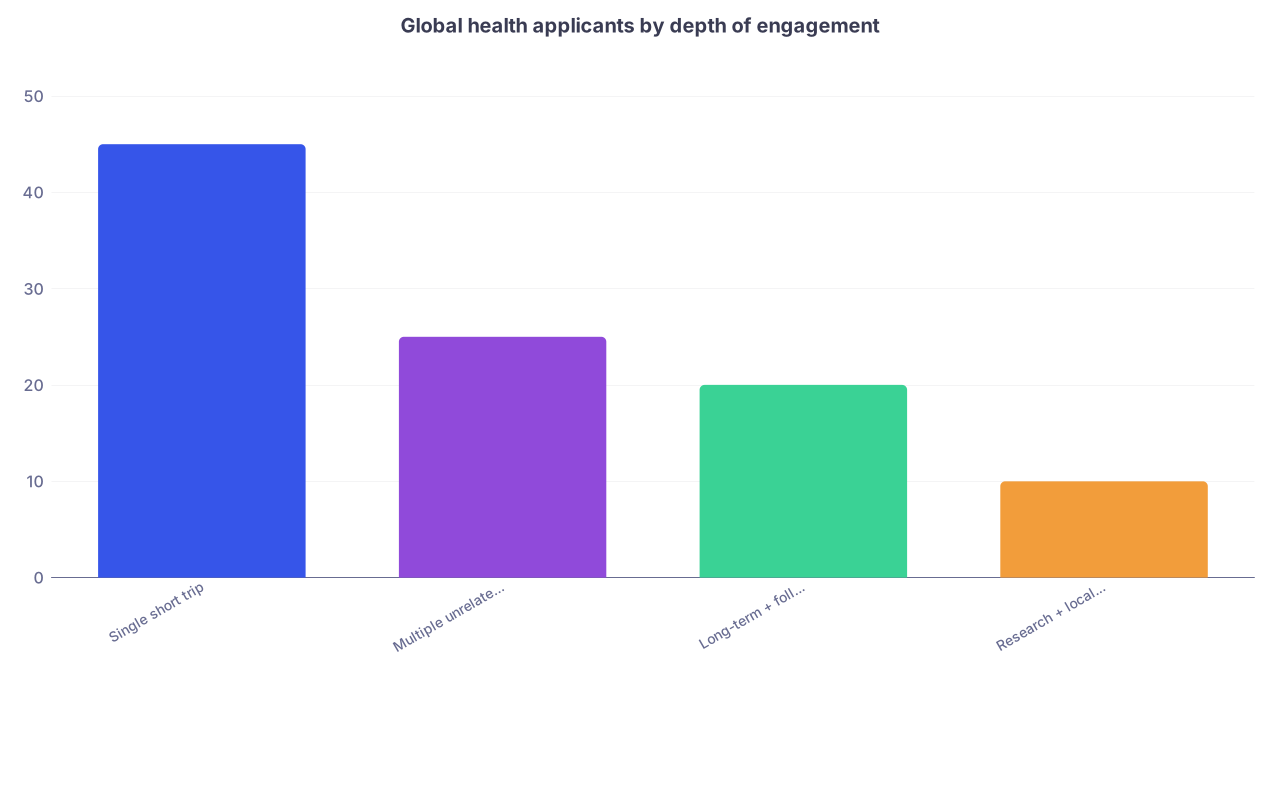
| Category | Value |
|---|---|
| Single short trip | 45 |
| Multiple unrelated trips | 25 |
| Long-term + follow-up | 20 |
| Research + local/global work | 10 |
Roughly how it feels in applicant pools: many short-term tourists, few with depth.
Signs your CV looks superficial
All your global health activities are:
- Short (≤ 4 weeks)
- In different continents
- With different, unrelated organizations
- With no follow-up or ongoing role
No:
- Presentations
- Quality improvement projects
- Manuscripts
- Continued remote involvement
- Related local work back home
How to show continuity
- Connect your overseas and local work
If you worked on:
- TB in Uganda → local TB screening or advocacy in your city
- Maternal health in Guatemala → local prenatal clinic or doula support involvement
Do not separate “global” and “local” like they are morally different universes. List them under consistent headings like “Health Equity and Global Health Work.”
- Show you stayed engaged after the trip
Examples that belong on your CV:
- “Co-authored abstract on under-5 malnutrition trends submitted to [Conference] based on field data collected in [country]”
- “Coordinated monthly virtual case discussions with partner clinic after returning”
- “Contributed to remote data cleaning and follow-up analysis for 6 months post-rotation”
- Use time frames clearly
Do not hide short durations.
Bad:
- “Global health volunteer, 2022”
Better:
- “Global health volunteer, June–July 2022 (4 weeks), continued remote data work Aug 2022–Mar 2023”
You are not penalized for realistic time limits. You are penalized for pretending you did more than you did.
4. Ignoring Power, Ethics, And Reciprocity Entirely
This one is subtle but fatal: your CV can show that you never thought seriously about ethics or power in global health.
How? By listing only:
- Your presence
- Your “impact”
- Your procedures performed
…and nothing about the host partners, local leadership, or what they got out of it.
Ethical red flags on a CV
“Performed procedures not normally available in home institution”
Translation: you did things abroad you were not qualified to do at home.“Provided clinical care in areas without physicians”
Translation: you probably exceeded your scope of practice.“Conducted research in low-income community” (no mention of IRB, local approvals, or community role)
Translation: extractive research.
How to demonstrate ethical awareness on a CV
You cannot write an essay in your CV, but you can signal a few crucial things.
- Name the local partners and leadership
Bad:
- “Global health elective – rural hospital in Malawi”
Better:
- “Global health elective – partnered with [Local Hospital] under supervision of Dr [Local PI], supporting their ongoing hypertension registry project”
That one line changes the entire ethical tone. You are clearly a guest, not the protagonist.
- Mention approvals and local input for research
Include phrases like:
- “Study developed with local co-investigators; approved by [Country] National Ethics Committee and [Home Institution] IRB”
- “Community health workers involved in tool design and implementation”
You are showing that:
- You did not parachute in with your own protocol
- You respected local regulations and expertise
- Highlight mutual benefit and capacity building (honestly)
But do not lie. If there was real training or capacity building, state it concretely:
- “Co-developed and delivered 3-session ultrasound training series for local residents; materials adapted and now used by host institution”
Do not say “capacity building” if what you did was a one-off lecture no one wanted.
5. Listing Procedures You Had No Business Doing
This is the most dangerous mistake and unfortunately common. Students trying to impress will list every procedure they touched abroad.
Selection committees notice the mismatch between your level of training and what you claim.
Common offenders:
- “Performed deliveries independently”
- “Performed minor surgical procedures”
- “Administered anesthesia”
- “Managed inpatient wards”
If you could not legally do it at home, and you did it abroad, you are advertising unethical practice.
What your CV should do instead
- Be brutally honest about your scope
If you:
- Assisted with deliveries → say “assisted with”
- Observed C-sections → say “observed”
- Performed portions of procedures under supervision → say that
Examples:
- “Assisted with 15 vaginal deliveries under direct supervision of attending midwives; responsibilities limited to [x, y, z]”
- “Performed simple wound care and dressing changes with on-site physician oversight”
- Explicitly state supervision where it matters
Do not assume it is obvious.
Better:
- “Performed focused ultrasound exams under attending physician supervision after structured training and competency assessment”
- If you crossed the line, do not brag about it
Ethically, that is its own issue. But do not also hand the evidence to residency programs in bullet form.
If a situation was problematic, be prepared to discuss how you learned from it in an interview. Just do not frame it as a triumph on your CV.
6. Vague, Empty Buzzword Bullets
Many global health CV bullets are packed with noble words and zero content.
You have seen it:
- “Worked with underserved populations to improve health disparities”
- “Engaged in culturally competent care across diverse communities”
- “Advanced global health equity in resource-limited settings”
These say nothing. You sound like you copy-pasted from a mission statement.
What committees are actually scanning for
They want evidence of:
- Concrete activities
- Measurable contributions (even small ones)
- Skills gained
- Reflection and adaptation
Not your personal branding.
How to fix your bullets
Use a simple structure:
- Action verb + specific task + scale/context + result or learning (when possible)
Bad:
- “Improved public health in rural communities”
Better:
- “Conducted 45 household surveys on water access and diarrheal disease as part of ongoing community health needs assessment; contributed to local clinic’s planning of sanitation education sessions”
Another: Bad:
- “Provided culturally sensitive patient care”
Better:
- “Used local language phrases and trained interpreter support to obtain histories from ~10 patients/day in outpatient HIV clinic; adapted counseling scripts with local staff to reflect community norms”
You are not just claiming sensitivity. You are showing the behaviors that back it up.
7. No Context For The Program Or Organization
Another subtle mistake: listing a program or NGO that is either unknown, controversial, or primarily student-focused “voluntourism” with no explanation.
If an experienced reader sees:
- “[Popular student mission organization] – Short-term medical mission” they already have concerns.
Some programs have reputations for:
- Poor supervision
- Scope-of-practice violations
- Disruptive short-term clinics
You cannot fix the organization’s history, but you can present what you did within it responsibly.
How to protect yourself on paper
- Clarify supervision and structure
Even if the umbrella organization is shaky, your specific experience might have been better.
Example:
- “Short-term global health elective in [country] with [org], assigned to district hospital inpatient ward; supervised directly by local internist, integrated into existing care team”
- Emphasize alignment with local systems, not parallel clinics
If you worked within government facilities or long-standing local institutions, say so:
- “Worked in Ministry of Health-affiliated primary care clinic with existing community health worker network”
- If the organization is clearly voluntourism-heavy, do not center it
Lead with:
- The hospital / clinic name
- The project type
Not the US-based student organization that just coordinated flights and T-shirts.
8. No Metrics, No Outputs, No Evidence You Did Anything
Another pattern: global health entries that list the trip but offer no sense of scale, responsibility, or outcome.
Example:
- “Global health elective – internal medicine – 3 weeks – Malawi”
That tells me nothing. You could have shadowed in the corner. Or you could have contributed meaningfully to ward flow. I have no idea.
How to add rigor without puffing yourself up
Include:
- Volume (approximate numbers are fine)
- Type of patients / cases
- Specific tasks
- Any concrete outputs
Examples:
- “Participated in daily inpatient ward rounds (avg 30 patients) and outpatient clinics (avg 15 patients/day); responsibilities included chart review, vitals, and preliminary assessments presented to attending”
- “Cleaned and entered 300 survey responses into REDCap database; assisted in preliminary descriptive analysis using R”
If there was a downstream product, add it as a separate line:
- “Co-author on poster presented at [Conference Name], based on data collected during above rotation”
| Version | Example Bullet |
|---|---|
| Weak | Assisted in global health project in rural clinic |
| Strong | Collected and entered 120 patient encounters into hypertension registry at district hospital; developed simple follow-up tracker used by clinic nurse for missed visits |
| Weak | Volunteered in mission trip to provide care |
| Strong | Supported triage and health education during 10-day mobile clinic campaign, seeing ~40 patients/day under local physician supervision; delivered brief blood pressure counseling using locally developed materials |
9. Zero Reflection Anywhere In Your Application Ecosystem
Strictly speaking, CVs are not reflection documents. But reviewers do not see your CV in isolation. They cross-reference it with your personal statement, activities descriptions, and, later, how you talk during interviews.
The mistake: your CV lists global health things, but:
- Your personal statement ignores them
or - Your statements about them are shallow: “I learned how lucky I am” and “it opened my eyes”
That last phrase? I have seen it hundreds of times. It signals that the main outcome of your work was your own emotional awakening. Not great.
How to avoid the “savior complex” vibe
- Align CV bullets with more sophisticated reflections elsewhere
If your personal statement discusses:
- Health systems
- Task-shifting
- Resource allocation
- Community agency
Then the CV bullets should highlight:
- Teamwork
- Systems-level observations
- Local leadership
Not just poverty and suffering.
- Be ready to defend any global health entry with depth
If you cannot answer:
- “What did the host community gain from your presence?”
- “How was your work integrated after you left?”
- “What power imbalances did you notice and how did you respond to them?”
Then your CV is already over-claiming.
10. Burying Or Mislabeling High-Quality Global Work
Last mistake is almost the opposite: you actually did solid, ethical, sustained work—but hid it among generic volunteer entries.
Examples I have seen:
- Longitudinal work on migrant health listed as “Volunteer – Student-run clinic”
- Years of global health research buried under “Miscellaneous research”
- Co-authored policy briefs stuck under “Other experiences”
You accidentally undersell your best evidence of seriousness.
How to showcase it properly
- Use a clear, honest heading
Examples:
- “Global Health and Health Equity Work”
- “Global and Local Health Systems Research”
- “Health Equity, Migration, and Global Health”
Do not segregate “global” and “health equity” work. Real global health includes your local, domestic work.
- Elevate substantial roles
If you:
- Coordinated multi-site data collection
- Led a subproject
- Co-authored guidelines
- Worked for a WHO collaborating center, MSF, Partners In Health, etc.
Do not hide that under generic headings.
- Distinguish between observation and contribution
Shadowing experiences belong under:
- “Clinical Observerships”
Substantive work belongs under:
- “Research Experience”
- “Global Health Projects”
- “Leadership and Program Development”
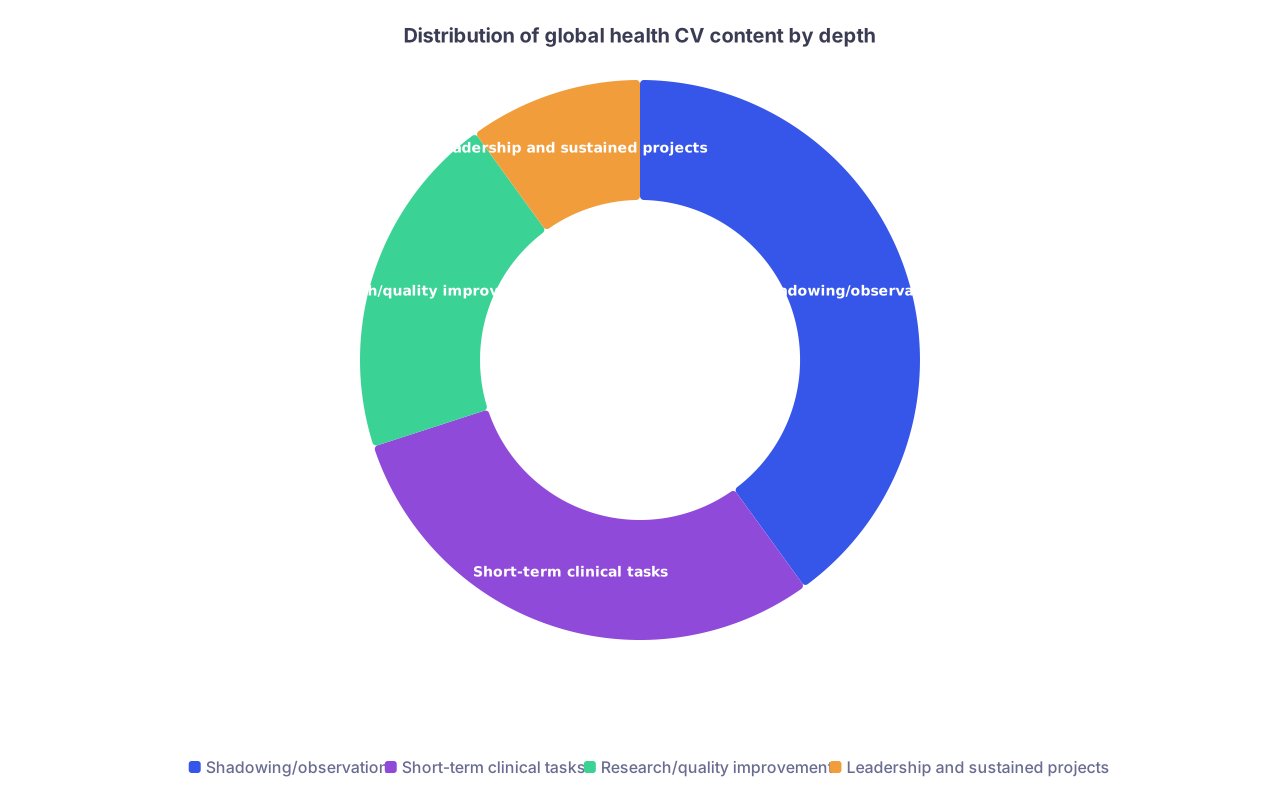
| Category | Value |
|---|---|
| Shadowing/observation | 40 |
| Short-term clinical tasks | 30 |
| Research/quality improvement | 20 |
| Leadership and sustained projects | 10 |
You want to shift yourself from the first two categories into the last two over time—and present it that way.
11. A Quick Rewrite Example
Let me show you what this looks like in practice.
Superficial version
Global Health
- Medical mission trip, Honduras, June 2022 – Provided care to underserved communities and improved health outcomes
- Volunteer trip, Ghana, January 2023 – Worked with vulnerable populations to increase access to care
This makes you look like exactly the kind of “global health tourist” you probably do not want to be.
Stronger, still honest version
Health Equity and Global Health Work
Clinical Elective Student – Internal Medicine, Hospital Nacional de Occidente, Santa Rosa de Copán, Honduras (4 weeks, June 2022)
- Participated in daily ward rounds (approx. 25–30 patients) under supervision of local internists; responsibilities included vital signs, chart review, and presenting preliminary assessments
- Observed management of advanced heart failure, CKD, and infections in a resource-limited setting; discussed systems-level constraints and adaptations with host physicians
Community Health Project Volunteer – Hypertension Outreach, Kumasi, Ghana (2 weeks, Jan 2023; continued remote data entry Feb–Apr 2023)
- Conducted 80 household blood pressure screenings with local community health workers; entered data into clinic registry for follow-up
- Collaborated with Ghana Health Service nurses to adapt existing patient education materials for low-literacy populations
Notice:
- No savior language
- Clear roles and supervision
- Integration into local systems
- Modest but real contributions
Now you sound like someone who understands their place and respects their hosts. That matters.

| Step | Description |
|---|---|
| Step 1 | Global health experience |
| Step 2 | Show role clearly and avoid overclaiming |
| Step 3 | Highlight continuity and outputs |
| Step 4 | Do not list or reframe honestly |
| Step 5 | State supervision and tasks |
| Step 6 | Link local and global equity work |
| Step 7 | Add metrics and partner details |
| Step 8 | Short term only |
| Step 9 | Performed procedures |
The Bottom Line
Three points to keep you out of trouble:
- Do not make your CV about where you went. Make it about what you did, with whom, under what supervision, and how ethically.
- Never inflate your role or advertise out-of-scope procedures. In global health, overclaiming is not just tacky. It is an ethical red flag.
- Show continuity, partners, and concrete contributions. Even small, well-described, ethically grounded work looks far better than a string of dramatic but shallow “mission trips.”


