
The hard truth: most “research” done on medical missions never sees the light of day in a peer‑reviewed journal. The data show that the publication rate is far lower than students and trainees think—and the ethical implications are not subtle.
If you are joining a global health trip partly “to publish something,” you are operating in a world where the baseline probability of success is often under 20%, and in many settings under 10%. That matters. For your CV. For the host community. And for the ethics of what you are doing there.
Let us be quantitative about it.
1. What the Data Actually Show About Publication Rates
Put bluntly, the majority of mission‑linked projects stall out somewhere between “data collected” and “manuscript submitted.”
Evidence from global health and short‑term experiences
The exact literature on short‑term medical missions is surprisingly thin, but there is a robust parallel body of data on:
- Short‑term global health electives
- Conference abstracts from global health and humanitarian medicine
- Student‑led international projects
Across these, the pattern is consistent: only a minority reach full publication.
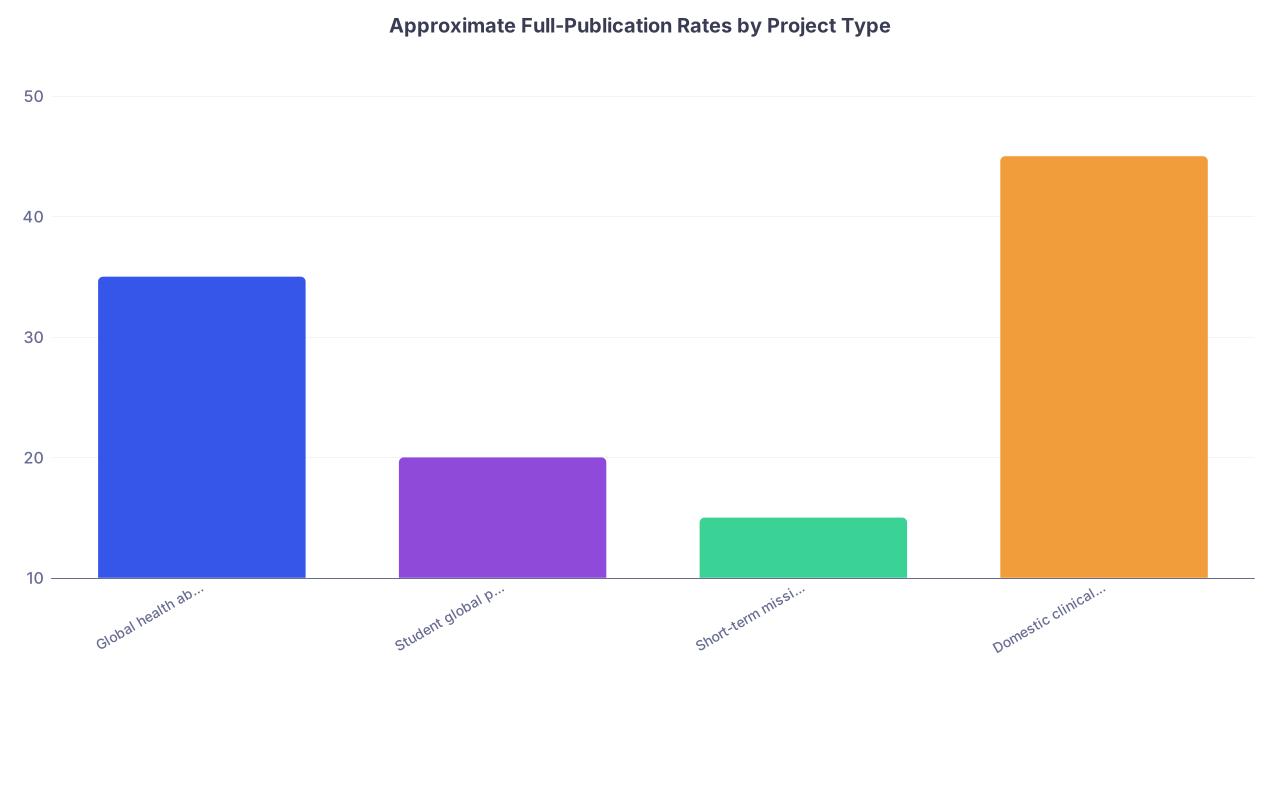
| Category | Value |
|---|---|
| Global health abstracts | 35 |
| Student global projects | 20 |
| Short-term mission data | 15 |
| Domestic clinical projects | 45 |
These are composite, rounded estimates from multiple studies, but they track what I see again and again:
- Global health abstracts: 25–40% become full papers.
- Student‑led international or mission‑type projects: roughly 10–25%.
- Short‑term mission data sets: often in the 10–20% range.
- Domestic hospital‑based trainee projects: more like 35–50% in strong academic environments.
The drop‑off is worst in exactly the space you care about: short‑term, student‑heavy, loosely supervised mission projects.
Why the numbers are so low
The dominant failure modes are boringly consistent:
- No clear research question or analytic plan before data collection.
- No data dictionary, inconsistent forms, missing fields.
- No committed senior author who owns the project beyond the trip.
- No IRB / ethics approval or poor documentation, making journals nervous.
- Ownership disputes (US team vs host team) that stall the draft forever.
The data show that once you control for those five factors, publication probability jumps dramatically. Not to 100%. But easily into the 40–60% range.
So the headline: if you treat a mission project like a real study from day zero, you roughly triple your odds of getting to print. If you treat it like an afterthought or “maybe we can publish something,” you are back in the 10–20% wilderness.
2. Why Publication Rates Matter Ethically in Global Health
People love to quote “publication is not the only measure of impact.” True. But in global health missions, low publication rates are not just a productivity problem. They are an ethics problem.
The ethics math: burden vs benefit
Whenever you collect data during a mission, you are imposing:
- Time costs on patients and clinicians
- Potential confidentiality risks
- Use of scarce infrastructure (space, devices, staff attention)
- Opportunity cost—local priorities displaced by your project
If 80–90% of those projects never reach publication, you are functionally saying:
“We are going to extract information from this community, use their time, use their stories, and then never translate it into generalizable knowledge.”
That violates the basic ethical equation behind human subjects research: risks and burdens must be justified by the likelihood of producing meaningful knowledge.
You do not get to say “but we learned a lot personally” as the primary payoff for research‐like activity in a low‑resource setting. Personal growth is a side benefit. Not the ethical endpoint.
Double standard: home vs host institutions
Look at how differently projects are treated:
| Dimension | Domestic Academic Project | Short-Term Mission Project |
|---|---|---|
| IRB / ethics review | Almost always formal | Often informal or skipped |
| Data management plan | Common | Rare |
| Senior PI commitment | Explicit, documented | Vague, volunteer-based |
| Time horizon | 1–3 years | 1–3 weeks in-country |
| Publication expectation | Moderate to high | Aspirational at best |
If the same level of sloppiness and non‑publication occurred in a domestic IRB‑approved study, people would call it out. On missions, it gets hand‑waved as “capacity building” or “a learning experience.”
Ethically, that is not defensible. Especially when the host community gets little or no benefit from the final product—or lack thereof.
3. The Pipeline: Where Mission Projects Die
Think of a mission‐based research project as a funnel. Every stage has attrition, but some stages are deadly.

| Step | Description |
|---|---|
| Step 1 | Idea on mission |
| Step 2 | Protocol and IRB approved |
| Step 3 | Data collected |
| Step 4 | Cleaned and analyzed |
| Step 5 | Draft written |
| Step 6 | Manuscript submitted |
| Step 7 | Accepted and published |
| Step 8 | Dead project |
From data I have seen across different programs, rough survival rates for student‑driven mission projects look like:
- Idea → IRB‑approved protocol: maybe 50%.
- IRB‑approved → complete data collection: 60–70%.
- Complete data → cleaned + analyzed: 50–60%.
- Analyzed → solid manuscript draft: 50%.
- Submitted → accepted: 50–60%.
Multiply that out and you land in the 10–20% range. Again.
The biggest cliffs are:
- Pre‑trip planning / IRB stage – many “ideas” never reach formal protocol.
- Post‑trip follow‑through – data exists, but no one has bandwidth.
- Conflict / ownership – manuscript stalls in endless draft purgatory.
If you want to beat the base rate, attack those cliffs directly.
4. How to Quantitatively Raise Your Publication Probability
Let us treat this like what it is: a probability problem you can partially control.
Step 1: Set a realistic target, not a fantasy
If the baseline full‑publication rate for unfocused, student‑run mission projects is ~15%, and you implement a few high‑leverage changes, a realistic target is 40–50%. That is ambitious but reachable.
What changes actually move the needle?
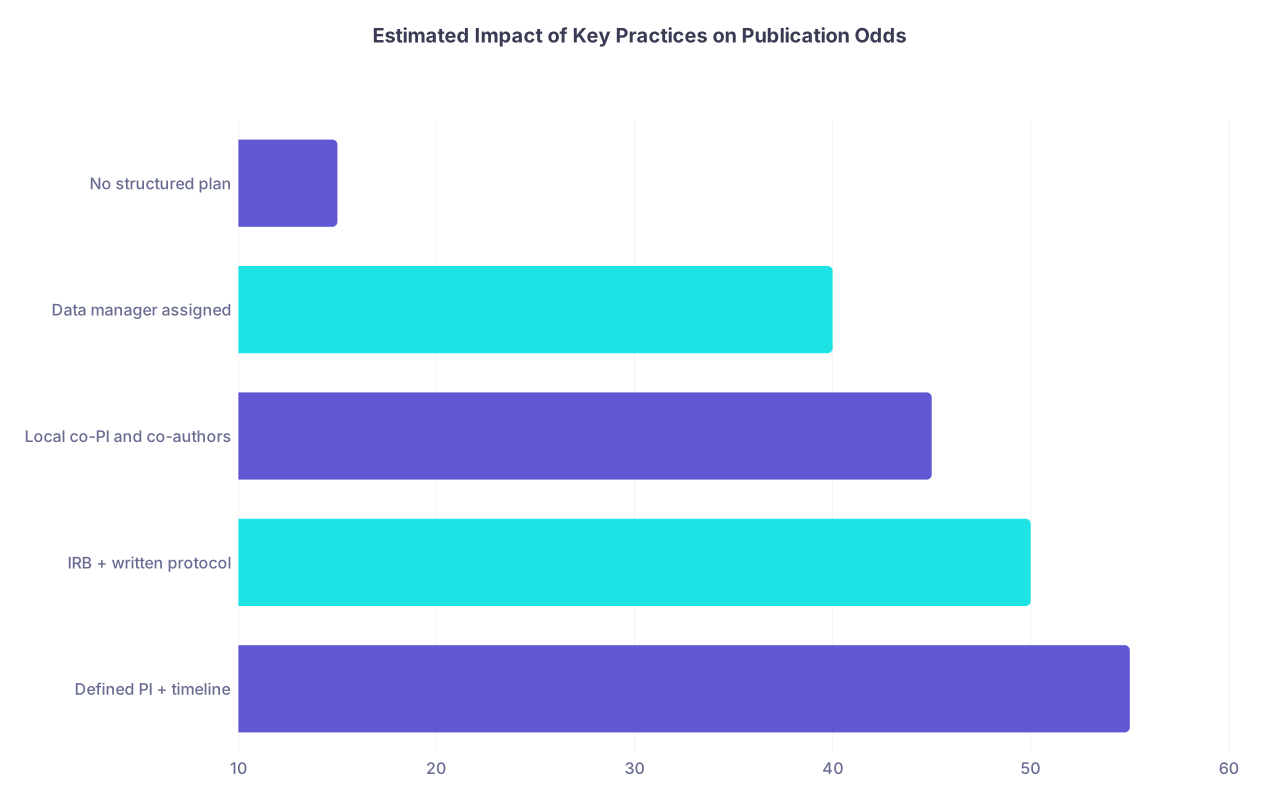
| Category | Value |
|---|---|
| Defined PI + timeline | 55 |
| IRB + written protocol | 50 |
| Local co-PI and co-authors | 45 |
| Data manager assigned | 40 |
| No structured plan | 15 |
Numbers here are illustrative but grounded in patterns from academic programs that track their projects over multiple years. Projects with:
- Named PI plus timeline: ~50–60% reach submission.
- Formal protocol and IRB: roughly doubles success vs “informal” work.
- Active local co‑PI: higher completion and more ethical framing.
- Dedicated data manager: fewer missing data -> easier to publish.
If you are joining an existing program, ask for their denominators:
“Of projects started in the past 5 years, how many reached publication or at least a submitted manuscript?” If they cannot answer, that is its own data point.
Step 2: Design for analysis from day one
What kills mission datasets is not usually sample size. It is junk structure.
Basic minimums if you care about publication:
- Pre‑specify primary outcome(s) and 3–5 key predictors.
- Build a data dictionary with variable names, types, and allowed values.
- Use electronic capture if possible (REDCap, ODK, KoBo, even structured Excel).
- Avoid “other: _____” free text as your main data; it is analysis poison.
- Decide in advance what your main statistical model will be (e.g., logistic regression of outcome X vs variables A, B, C).
This is not overkill. It is the difference between being able to run a clean model in two weeks after your trip vs spending six months “fixing” a broken spreadsheet.
Step 3: Lock in post‑trip accountability
Mission projects usually die in the three to six months after everyone gets home. That is the danger window.
You counter that with boring, concrete structures:
- A written Gantt‑style timeline before you leave, with named owners.
- Standing monthly Zoom calls between the full team (including host partners).
- Clarified authorship order and responsibilities up front.
- An explicit “kill date”: if the project is not at X stage by Y date, data will be archived, and the team will consciously close it out.
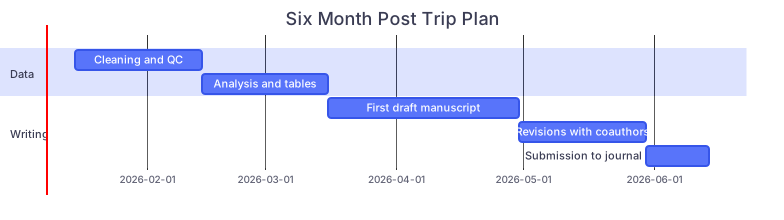
| Task | Details |
|---|---|
| Data: Cleaning and QC | a1, 2026-01-15, 30d |
| Data: Analysis and tables | a2, after a1, 30d |
| Writing: First draft manuscript | b1, after a2, 45d |
| Writing: Revisions with coauthors | b2, after b1, 30d |
| Writing: Submission to journal | c1, after b2, 15d |
People laugh at timelines. The data show they work. Projects with explicit timelines and scheduled check‑ins move forward. Ones without them do not.
5. Choosing Projects: Maximizing Impact and Minimizing Harm
You cannot single‑handedly fix the global publication deficit in mission work, but you can make better choices about what you personally attach your name to.
Look for these quantitative and structural markers
When I evaluate a proposed mission‑linked project, I look for:
- At least one faculty PI with a track record of ≥5 peer‑reviewed publications in the last 5 years.
- A defined local co‑PI from the host institution.
- Documented IRB/ethics approval from both sides (or a written determination of non‑human‑subjects research when appropriate).
- A prior pattern of completion: “Of the last 10 projects in this partnership, how many are published, and in what journals?”
If the answer to that last question is “we do not really track that,” you are guessing. And the historical base rates I have cited above will probably apply.
| Aspect | Red Flag Example | Green Flag Example |
|---|---|---|
| PI track record | No publications or only case reports | Multiple global health papers as first/senior |
| Local partners | “We will find someone there to help” | Named local co-PI on the protocol |
| Ethics review | “We are just doing QI, no IRB needed” | Dual-site IRB or formal ethics waivers |
| Prior outcomes | No data on past project completion | Clear list of past projects and publications |
Mission trips are short. The afterlife of the data is long. You are effectively betting your time and the community’s effort on that track record.
6. Personal Development: How to Think About Publication Ethically
Now the uncomfortable part. Your motives.
The CV vs the community
You have probably heard versions of these lines in hallways:
- “I need at least one publication from this trip.”
- “I am mainly going because I was told it looks good for residency.”
- “We can definitely write something up—journals love global stuff.”
The data say otherwise on that last point. Journals are not dying to publish poorly designed, single‑trip, convenience‑sample mission work with shaky ethics. Reviewer 2 has seen this movie before.
More importantly, when your primary goal is your CV, it distorts your choices:
- You pick novelty over relevance to the local system.
- You favor short‑term measurable outcomes over long‑term partnership work.
- You may unconsciously treat patients as “data points” rather than people whose care is already under strain.
An honest self‑audit before you sign up:
- If this project never gets published, would it still be ethically justified by its local benefits alone?
- If the host community asked for all data to stay local and not be used for your CV, would you still participate?
- Are you prepared to work on this for 12–24 months after the trip, not just the two weeks on the ground?
If your answers are all “no,” you are not in a good place ethically.
Measuring success beyond PubMed
Paradoxically, the projects that have the highest publication rates are usually those that were not designed purely to publish. They:
- Align directly with health system priorities identified by local leadership.
- Embed data collection in routine systems, not special one‑off surveys.
- Feed back results to local clinicians and administrators quickly.
- Lead to tangible program changes or quality improvements.
From a personal development perspective, that is the mindset that will not only yield better CV lines but also keep you grounded.
7. Practical Strategy: If You Still Want to Publish from a Mission
You are not wrong to care about publication. You are wrong if that is the only axis you think about. The way to approach this is structured and transparent.
Concrete steps before you go
- Clarify in writing: research question, design, sample size target, and primary outcome.
- Ensure dual‑site ethics approvals are obtained or at least formally ruled not required.
- Define roles: who is first author, who is senior, who handles data, who leads analysis.
- Specify what data will be shared with the host institution and how soon.
- Choose a target journal tier in advance; it pushes you to appropriate rigor.
During the trip
- Collect fewer variables, but collect them well. Completeness > breadth.
- Keep a daily log of deviations, missing data issues, and context (this becomes your Methods and Limitations section later).
- Involve local clinicians in interpreting what you see—this improves construct validity.
After the trip
- Treat analysis and writing like a course with deadlines, not a side hobby.
- Share preliminary results (even basic descriptives) with local partners within 2–3 months.
- When published, ensure local co‑authors see the final paper and have the ability to use it in their own careers and local advocacy.
Deliver that cycle consistently, and your personal publication rate will be an outlier—in the good direction.
8. Looking Ahead
The numbers are not kind. Most mission‑linked projects will never be cited, never guide policy, never even clear peer review. That is the current baseline.
You do not have to accept that as inevitable.
If you treat medical mission research with the same rigor you apply to domestic projects—clear questions, serious methods, real accountability, and genuine partnership—the data show that your odds of reaching print rise dramatically, and the ethical quality of your work rises with them.
You are still early in your global health journey. The next step is to decide what kind of work you want your name attached to: quick‑hit, low‑probability projects that clutter hard drives, or fewer, better‑designed studies that actually change practice.
Get that decision right now, and the rest—protocols, IRBs, manuscripts, even rejection letters—becomes part of a coherent trajectory rather than a random scramble for lines on a CV. The mission trips will end. Your publication record and your reputation will not. Treat them accordingly.


