
The romantic narrative about global health careers is financially misleading. The data show a clear pattern: you will almost certainly take an income hit in the short and medium term—but under the right structure, you can engineer long‑term gains in autonomy, career resilience, and, sometimes, actual earnings.
Let me walk through what the numbers really look like, specialty by specialty and pathway by pathway, rather than the hand‑waving “you will not be rich but you will be fulfilled” line you usually hear.
1. The Baseline: What You’re Actually Giving Up
You cannot understand the “impact” of global health without anchoring to a baseline. In high‑income countries, physician compensation is reasonably well characterized.
Representative median annual compensation (recent ranges, USD, rounded) for full‑time clinicians in the United States:
| Specialty / Role | Median Annual Compensation |
|---|---|
| Family Medicine | $250,000 |
| General Internal Medicine | $275,000 |
| Pediatrics | $240,000 |
| General Surgery | $420,000 |
| Emergency Medicine | $420,000 |
| Anesthesiology | $450,000 |
Take these as your “control group.” Now compare.
If you spend 20–30% of your time in classic, uncompensated global health fieldwork—short‑term trips, unpaid NGO work, volunteer teleconsults—and you do not replace that time with paid clinical work, the math is brutal.
Example: a general internist at $275,000 working 5 days per week.
- 1 day per week to global health (volunteer): 20% time
Income hit ≈ 0.20 × $275,000 = $55,000 per year - 6 weeks per year abroad, fully unpaid, with no compensatory increase during the rest of the year (common academic model): ~11–12% time
Income hit ≈ 0.11 × $275,000 ≈ $30,000 per year
That is before you factor in travel costs, opportunity costs of missed bonuses, or slower promotion compared with peers who stay home and churn RVUs.
The key question is not “will I lose money?” You almost certainly will. The question is: how large is the hit, and can you structure your career so the global health component does not permanently suppress lifetime earnings?
2. Five Common Global Health Career Configurations (and Their Income Profiles)
The income impact depends heavily on how you do global health, not just whether you do it.
2.1 Academic Global Health Track
This is the classic route: faculty appointment at a university, split between clinical duties, teaching, research, and global fieldwork.
Typical FTE distribution (what I commonly see on actual contracts):
- 60–70% clinical
- 20–30% research/teaching
- 10–20% fieldwork / program building (often grant‑funded or partially funded)
Income patterns:
- Academic base salaries are usually 15–30% lower than pure private practice for the same specialty.
- Research + teaching + admin time often paid at lower “protected time” rates (sometimes baked into a fixed academic salary).
- Fieldwork time may be:
- Grant‑funded at a lower rate than clinical work, or
- In‑kind (travel funded, but no true salary beyond your academic base).
Approximate example for general internal medicine:
- Community hospitalist, 1.0 FTE: $300,000
- Academic internist with 0.6 clinical / 0.4 non‑clinical (research, global health): $210,000–$240,000
Data‑driven takeaway: many academic global health physicians accept a 20–35% salary discount relative to community peers in the same specialty.
That becomes a six‑figure gap by mid‑career.
2.2 NGO / International Organization Employment
Here we are talking about:
- Large NGOs (e.g., MSF/Doctors Without Borders, Partners In Health)
- UN agencies (WHO, UNICEF, UNFPA)
- Development contractors (e.g., USAID implementing partners)
- Global foundations and large non‑profits
Compensation structure is very heterogeneous, but patterns are clear:
- Mid‑career MD on an international NGO contract: often $80,000–$180,000 per year.
- Senior technical lead at a large global health organization: $140,000–$250,000+, often with good benefits.
- UN/World Bank–type roles may pay more, especially at P4/P5/D1 levels, but these are competitive, often require advanced degrees and substantial prior experience, and you will be less of a clinician and more of a policy / management professional.
Relative to US clinical practice, this is usually a 40–70% pay cut for procedure‑heavy specialties and a 30–50% cut for primary care.
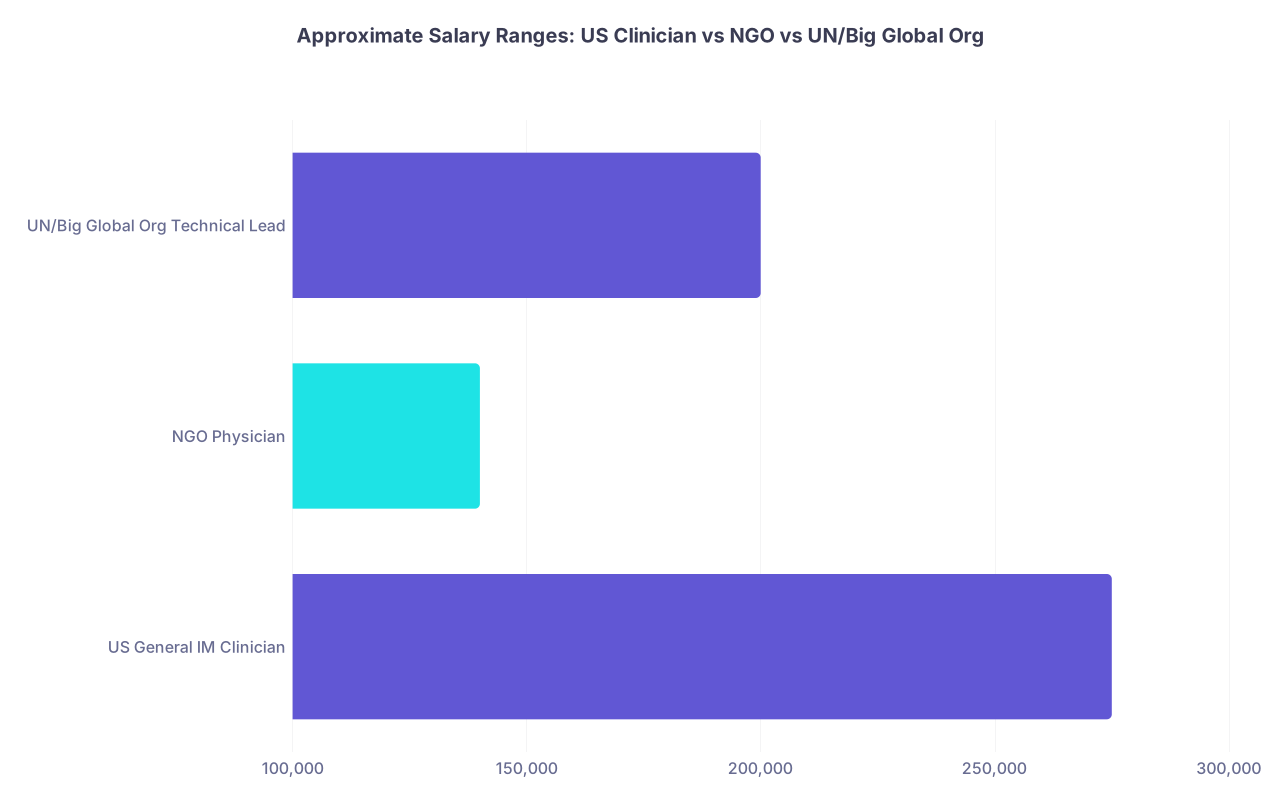
| Category | Value |
|---|---|
| US General IM Clinician | 275000 |
| NGO Physician | 140000 |
| UN/Big Global Org Technical Lead | 200000 |
This is why you rarely see high‑compensation subspecialists (orthopedic surgeons, radiologists, dermatologists) permanently leaving domestic practice purely for NGO roles. The income delta is simply too large unless they have independent financial security.
2.3 Hybrid Model: High‑Income Clinical Work + Structured Global Health
This is where the numbers start to look smarter.
The hybrid model usually looks like:
- 0.6–0.8 FTE clinical work in a high‑income market (often high‑RVU or high‑hour roles: telemedicine, nocturnist, urgent care, locums, procedure‑heavy practice).
- 0.2–0.4 FTE global health activities:
- Short but recurrent field visits
- Longitudinal support to a partner site
- Remote program oversight, tele‑education, research collaboration
Key tactics that turn this into an actual financial strategy instead of a charity hobby:
Maximizing hourly rate in the “home” market.
Example: A hospitalist working locums at $220–250/hour, compressing shifts into clusters.Maintaining near‑full income with less time.
Example: Working 24 weeks a year at very high intensity to fund 10–12 weeks of field work.
Numerical illustration (realistic scenario):
- US hospitalist locums: $230/hour, 14 twelve‑hour shifts per month, 11 months per year.
Annual income ≈ $230 × 12 × 14 × 11 ≈ $425,000 - If that same person drops to 9 months a year for 3 months of field work:
$230 × 12 × 14 × 9 ≈ $348,000
Income hit ≈ $77,000 per year, but still above “standard” employed hospitalist salaries (~$300,000–$350,000). You have effectively bought yourself 3 months per year of global health at a cost equal to what many pure academics lose anyway, but with more autonomy and control.
Data‑driven point: hybrid models shift the conversation from “poor global health doctor” to “high‑productivity clinician subsidizing mission‑driven work on their own terms.”
2.4 Industry / Global Health Adjacent Roles
Some physicians pivot into roles like:
- Pharmaceutical global health portfolios (vaccines, TB/HIV drugs, NTDs)
- Digital health / telemedicine platforms targeting LMICs
- Global regulatory, access, or health economics work
Compensation for physician roles in these arenas often ranges:
- Entry to mid‑level physician roles in pharma / biotech: $220,000–$300,000 total compensation, sometimes more with bonuses and stock.
- Senior roles (medical director, VP) easily reach $300,000–$500,000+.
These roles are not classic “boots on the ground” global health, but they sit squarely in the global health ecosystem. The key point: income hit may be negligible or nonexistent. In some cases, it is a gain.
So if your definition of global health includes scaling vaccine access or designing global clinical trials, the financial story is far less grim.
2.5 Domestic “Global Health” and Safety-Net Work
There is a quiet category: working with immigrant health, refugee health, and underserved populations domestically, often with a global health approach.
Financially:
- Many FQHC (Federally Qualified Health Center) physicians earn $200,000–$250,000 (US primary care).
- Loan repayment programs (NHSC, state equivalents) may add $25,000–$50,000 per year equivalent in debt relief.
- Academic safety‑net hospitals may pay slightly below market but provide stability and benefits.
Relative to private primary care or concierge practice, you may take a 10–25% salary hit, but you gain meaningful loan repayment and sometimes more predictable hours.
This is still part of the “you will earn less” narrative, but the gap is smaller and partially offset by structural benefits.
3. Lifetime Earnings and the Cost of “Purpose”
Medicine is a long game. One of the more honest questions students ask is: “How much am I giving up, in lifetime dollars, if I commit to global health early?”
Let us run a simple, stylized comparison.
Assumptions:
- Career length: 30 years post‑training.
- Discount rate for present value: 3% annually (to reflect time value of money).
- Path A: Conventional high‑income clinician (general IM, hospitalist style). Starting at $275,000 with modest growth.
- Path B: Academic global health with 25% income reduction.
- Path C: Hybrid high‑productivity clinical + global health with 10–15% income reduction overall.
This is conceptual, not a perfect financial model, but it is directionally correct.
Approximate present value of lifetime earnings:
- Path A (conventional clinician): baseline 100%
- Path B (academic global health, −25% income): lifetime earnings ≈ 75–80% of Path A
- Path C (hybrid model, −12% income): lifetime earnings ≈ 85–90% of Path A
So a sustained 25% salary difference, compounded over 30 years, is not “just a little.” It can represent millions of dollars in foregone earnings, even before investment growth.
That is the real magnitude of the “purpose premium” you are paying.
Now, is it “worth it”? That is not a question the data alone can answer; but the data can at least quantify the trade‑off. You are not giving up a luxury car. You are giving up a paid‑off house or two and a significantly earlier retirement date.
4. Ethical Tensions: Money, Mission, and Power
Global health lives at the intersection of ethics and inequality, so the income discussion is not just personal budgeting. It is about power dynamics.
A few recurring ethical tensions I see:
High‑income lifestyle vs. the populations you serve.
When you fly business class to a country where per‑capita GDP is $1,500, and your day rate exceeds the monthly income of local clinicians, the asymmetry is obvious. Many global health programs quietly pay expatriate physicians 5–10 times more (including benefits) than local counterparts. That reality colors every “salary hit” narrative.Is it ethical to demand market‑rate Western salaries for global work?
If you insist on earning $400,000 while working in a setting where the local specialist earns $20,000, are you just recreating the structural inequities you claim to fight? Some would argue yes. The counterargument: if you do not pay competitively, you lose talent to other sectors, and programs suffer.Volunteerism vs. system strengthening.
Long term, replacing paid local physicians with revolving-door foreign volunteers who are essentially subsidizing care with their own income is ethically shaky and often damaging to local health systems. The data on “voluntourism” are not flattering. Sustainable programs increasingly prioritize:- Paid local staff
- Training and task shifting
- Equitable, not extractive, partnerships
Financial security as an ethical enabler.
Personal financial fragility makes people cut corners. If your own student loans, childcare, and mortgage are constantly pressing, you are more likely to compromise on the quality of your global work just to keep the lights on. There is a strong argument that physicians who build a stable financial base early (even in higher‑pay roles) are more capable of doing responsible, long‑term global health later.
So ethically, the “noble underpaid global health doc” archetype is not simple virtue. Underpaying yourself, burning out, and then disappearing from the field helps no one.
5. Strategies to Minimize Salary Hits Without Abandoning Global Health
Now to the practical side. The data show clear patterns about which decisions preserve income while allowing meaningful global engagement.
5.1 Front‑load Your Earnings and Debt Reduction
First 5–10 years out of training are leverage years.
If you spend them in:
- High‑pay specialties or high‑intensity clinical roles
- Regions or arrangements that pay well (locums, rural, high‑RVU systems)
- With an aggressive plan to eliminate debt and build savings
…you buy yourself options later.
For example:
- A physician who earns an extra $75,000 per year for 10 years and invests it at a modest real return (say 4–5%) can accumulate $900,000–$1.0M+ in additional assets.
- That nest egg can subsidize substantial salary gaps in mid‑career global health work—easily $30,000–$50,000 per year for decades.
The math is not subtle. Early high‑income years compound massively.
5.2 Build Monetizable Skills That Travel
Global health rewards certain skill sets disproportionately:
- Implementation science and health systems strengthening
- Epidemiology and biostatistics
- Program design and evaluation
- Policy analysis and health economics
- Educational design and capacity building
These skills are marketable both in global health and in domestic consulting, academia, or industry. Physicians who can credibly manage budgets, evaluate programs, and publish outcomes move into higher‑paying leadership positions in NGOs, governments, or global orgs.
Data point: Leadership roles in large global health programs or organizations often pay 2–3x what junior field clinician roles pay.
So if you are serious about staying in this world, do not limit yourself to pure clinical service; invest in the analytic and managerial competencies that actually change systems and pay better.
5.3 Design a Formal Global Health FTE, Do Not Just “Volunteer on the Side”
The physicians who get crushed financially are usually the ones who:
- Stay in low‑pay academic roles
- Add global work on top of their full load
- Do not negotiate explicit FTE allocation or funding
Better model:
- Negotiate a formal global health FTE in your contract (e.g., 0.2–0.3).
- Tie this FTE to grant support, program budgets, or institutional funding.
- Anchor your clinical time at a rate that is competitive for your specialty.
The goal is not to make global health “as profitable as private practice,” but to avoid the scenario where you quietly give away 10–20% of your labor indefinitely.
5.4 Choose Geography and Licensing Smartly
Some regions and systems are structurally more favorable:
High‑income countries with physician shortages and good locums markets (e.g., parts of US, Canada, Australia, New Zealand, Gulf states) allow you to:
- Work intensely for part of the year
- Command high hourly rates
- Maintain long stretches for field work or remote program leadership
Remote telemedicine roles across time zones can let you:
- Live in lower‑cost settings (including some middle‑income countries)
- Keep an income indexed to high‑income markets
Data-wise, your cost of living ratio matters. A physician earning $220,000 working mostly remotely from a moderate‑cost city, with 3–4 months per year in the field, may end up financially better off than a $300,000 clinician in a high‑cost metro area with no time flexibility.
5.5 Use Data to Justify Your Role
Institutions are not altruistic. They respond to metrics.
If you can show:
- Reduced readmissions, improved outcomes in a partner program
- Increased grant revenue linked directly to your global work
- Measurable impact on recruitment, brand, or academic output
…you have leverage to argue that your global health work is not charity; it is a value‑generating line item.
Track your work. Publications, grants, trainee recruitment, reputation metrics. Boring, but powerful.
6. Comparative Snapshot: Income Impact by Pathway
Here is a simplified comparison to bring the threads together.
| Pathway | Approx vs. Standard Clinician | Annual Impact (Gen IM baseline $275k) |
|---|---|---|
| Pure private practice (no global health) | 100% | $275,000 |
| Academic global health (classic track) | 65–80% | $180k–$220k |
| NGO / field clinician (full-time) | 50–70% | $140k–$190k |
| Hybrid high-intensity clinical + GH | 85–95% | $235k–$260k |
| Industry / big global org leadership | 90–120% | $250k–$330k+ |
This is not exact. But the pattern is consistent across data sources: the larger the fraction of your time spent in traditional NGO/academic field roles, the deeper the salary hit—unless you move into leadership or pair it with a high‑income clinical base.
7. So…Should You Do It?
From a pure numbers standpoint, classic global health careers are financially suboptimal compared with private, procedure‑heavy, or industry roles. You will almost certainly earn less, often a lot less.
From a human standpoint, that may be an acceptable trade if:
- You are deliberate about your financial base early.
- You structure your career to avoid chronic underpayment and burnout.
- You aim for roles that magnify your impact (and your bargaining power), not just perpetual volunteerism.
The worst outcome is unplanned sacrifice: drifting into global health because it feels meaningful, while ignoring the compounding effect of a 25–40% income gap over 30 years. That is not noble; that is just bad forecasting.
Design your path like a data‑driven project:
- Define your required income floor.
- Pick a configuration that hits it while preserving global engagement.
- Measure and adjust over time.


