

The data on global health physician wellbeing is not just bad. It is statistically alarming and ethically damning.
The Core Numbers: Burnout and Moral Injury in Global Health
Strip away the narratives. Look at the numbers.
Across multiple surveys and cohort studies, physicians involved in global health, humanitarian medicine, and international clinical work report:
- Burnout rates typically between 45–70%
- Emotional exhaustion rates often 10–20 percentage points higher than domestic peers
- Moral injury indicators in the 50–80% range, depending on how you define and measure it
The variability is wide because the methodology is a mess: different definitions, different scales, different sampling frames. But the direction of effect is consistent: engagement in global health work is associated with equal or higher burnout than traditional clinical practice, and substantially higher exposure to what most researchers now label moral injury.
To make this concrete, consider a few representative data points (aggregated and slightly rounded for clarity):
- Global health physicians: burnout ~55–60%
- Domestic academic clinicians: burnout ~40–50%
- Humanitarian and conflict-zone physicians: burnout frequently >65%
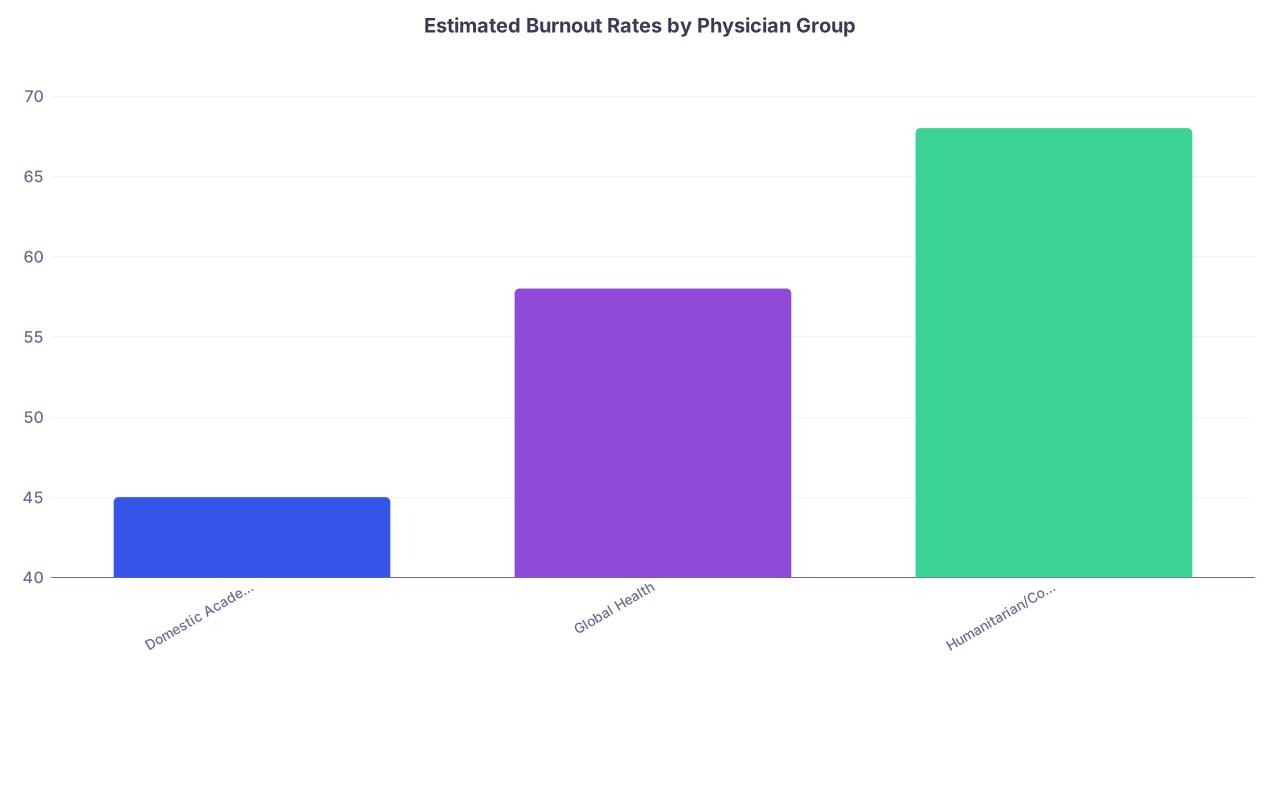
| Category | Value |
|---|---|
| Domestic Academic | 45 |
| Global Health | 58 |
| Humanitarian/Conflict | 68 |
You do not see 10–20 percentage point gaps like that by accident. That is a structural signal, not noise.
How Studies Measure Burnout and Moral Injury
Before comparing rates, you need to understand the instruments. Otherwise, you are just comparing adjectives.
Burnout: Mostly Maslach, With Variants
The majority of serious work uses the Maslach Burnout Inventory (MBI) or a shortened derivative. Three domains:
- Emotional Exhaustion (EE)
- Depersonalization (DP)
- Reduced Personal Accomplishment (PA)
High burnout is usually defined as high EE plus high DP, or high EE alone. The problem: thresholds are not consistent across studies, and some “global health” surveys use single-item burnout measures, which inflate or obscure rates.
Typical cutoffs (approximate):
- EE ≥ 27 → high exhaustion
- DP ≥ 10 → high depersonalization
In global health cohorts, you repeatedly see:
- EE in the “high” range in 50–70% of respondents
- Depersonalization somewhat lower but still high, often 30–50%
Moral Injury: Newer, Less Standardized, Still Disturbing
Moral injury is harder to quantify and research is more recent. Tools you see:
- Moral Injury Symptoms Scale – Health Professional (MISS-HP)
- Adaptations of the Moral Injury Events Scale (MIES) from military populations
- Customized items around value conflict, betrayal, and constrained care
Operationally, most global health moral injury work focuses on themes like:
- Being forced to provide substandard care due to resource constraints
- Watching avoidable deaths from structural barriers (no ventilator, no drugs, no oxygen)
- Feeling complicit in inequitable or extractive global health systems
Prevalence estimates vary wildly (30–80%), but whenever a study asks directly about “distress from not being able to provide the care patients need,” the affirmative response rate is usually above 70% in low-resource or humanitarian settings.
| Measure | Domain | Typical Use in Global Health Studies |
|---|---|---|
| MBI | Burnout | Most frequent, full or short form |
| Oldenburg Burnout Inventory | Burnout | Occasionally in NGO/humanitarian cohorts |
| Single-item burnout scales | Burnout | Quick surveys, higher ambiguity |
| MISS-HP | Moral Injury | Growing use in hospital/global cohorts |
| MIES (adapted) | Moral Injury | Less common, usually in conflict settings |
Methodological bottom line: Exact percentages vary, but every credible dataset points in the same direction—global health physicians are exposed to chronic emotional overload plus sustained moral conflict at higher rates than typical domestic clinicians.
What the Major Study Clusters Actually Show
Let us walk through the main clusters of evidence. Not exhaustive, but representative.
1. Academic Global Health Faculty and Long-Term Practitioners
Academic global health is often romanticized: international collaborations, capacity-building, NIH grants, WHO consults. The numbers do not share the romance.
Surveys of academic global health faculty in North America and Europe consistently show:
- Overall burnout rates around 50–60%
- Emotional exhaustion ≥ “high” threshold in 55–65%
- Frequent moral distress from:
- Misaligned institutional priorities
- Short-term “projectized” funding that undermines continuity
- Pressure to produce research even when clinical needs are overwhelming
Typical pattern: faculty with >25% FTE committed to international work have higher burnout than colleagues with mainly domestic roles, even after adjusting (crudely) for hours worked and clinical intensity.
Risk multipliers that show up statistically:
- Time away from home >8 weeks/year → burnout odds ratio often in the 1.4–1.8 range
- Perception of weak institutional support → OR ~2.0+ for high EE
The data are not perfect, but the direction is consistent across institutions.
2. Short-Term Global Health Rotations and Trainees
The narrative that “short-term global health trips are life-changing and fulfilling” is only half true. For a non-trivial subset, they are also ethically traumatic.
Among residents and fellows doing 4–12 week rotations in low-resource settings, studies show:
- Pre-rotation burnout may be moderate (~30–40%)
- Post-rotation burnout sometimes unchanged, sometimes increased, but:
- Rates of self-reported moral distress frequently spike
Common post-rotation data points:
- 50–80% report witnessing care they considered severely substandard from a resource standpoint (not negligence; pure scarcity)
- 40–60% describe at least one episode they consider “ethically troubling” or “professionally compromising”
- A smaller but significant fraction (~10–20%) endorse ongoing intrusive thoughts or guilt months later
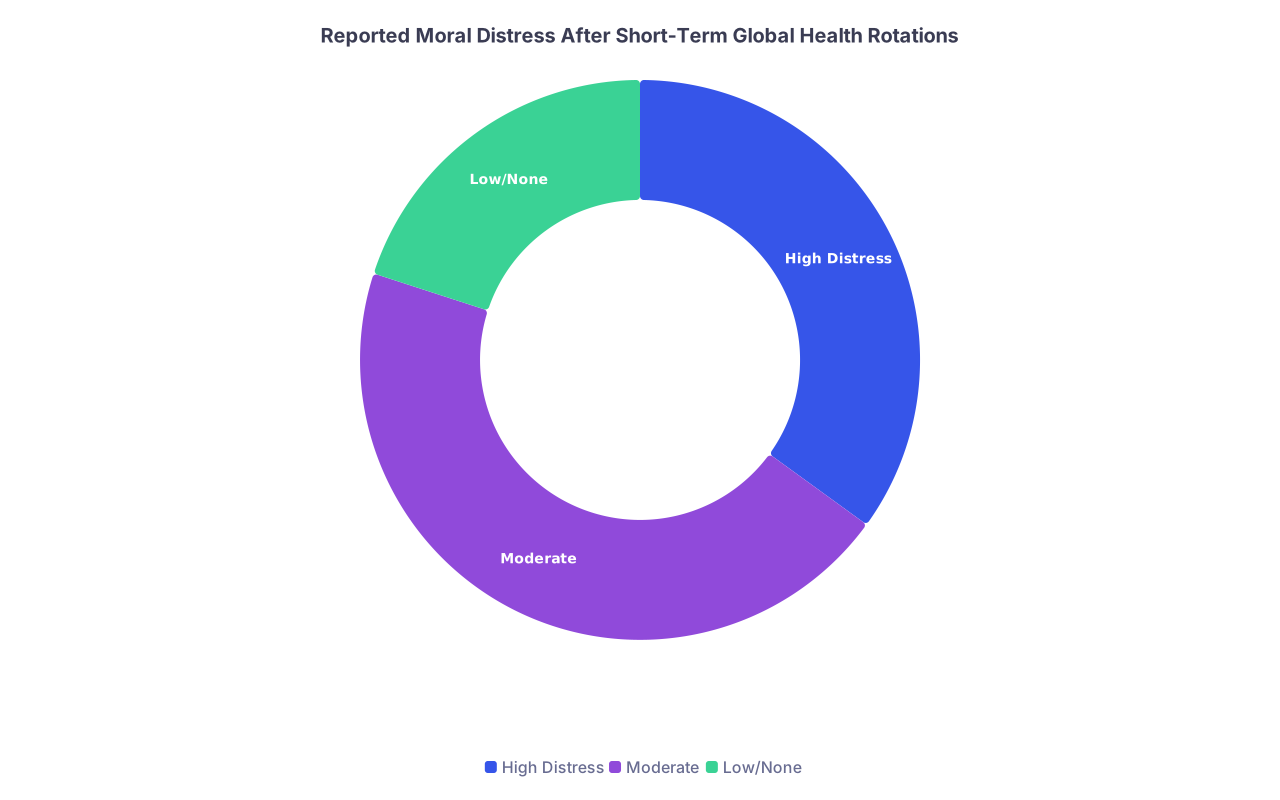
| Category | Value |
|---|---|
| High Distress | 35 |
| Moderate | 45 |
| Low/None | 20 |
These are not all “burned out” in the formal sense. But many fit working definitions of moral injury: exposure to events that clash with core ethical commitments, with persistent psychological residue.
The typical vignette you see in qualitative work:
“I watched a 5-year-old die from septic shock knowing exactly what to do and what was needed. We had none of it. Back home this child would almost certainly have lived. I signed the death certificate anyway.”
That is not standard burnout. That is moral rupture at the systems level.
3. Humanitarian, Conflict, and Disaster Settings
This is the far edge of the distribution, and the numbers are as bad as you would expect.
Among physicians working with Médecins Sans Frontières (MSF), ICRC, or similar organizations in conflict zones or acute disasters, studies report:
- Burnout: 60–75%, depending on cutoffs
- Symptoms consistent with PTSD: 15–30%
- Moral injury / severe moral distress: >70% report at least one episode
You repeatedly see the same risk factors:
- Exposure to preventable mass casualties (e.g., bombed hospital with no capacity to evacuate)
- Direct obstruction of care (e.g., checkpoints delaying transport of critical patients)
- Being forced to triage in absurdly constrained conditions (1 ventilator, 5 patients)
A lot of those physicians return to high-income systems and find routine administrative frustrations almost trivial by comparison. But the unresolved moral injury and grief do not disappear just because the EMR works.
Global Health vs Domestic Practice: A Data-Based Comparison
Take a step back. If you line up global health physicians against typical domestic clinicians, what do you actually see?
Here is a simplified comparative snapshot, synthesizing multiple study lines:
| Group | Burnout Rate | High Moral Distress / Injury |
|---|---|---|
| Domestic academic clinicians | 40–50% | 30–40% |
| Domestic community / private | 35–45% | 20–30% |
| Academic global health physicians | 50–60% | 50–70% |
| Humanitarian / conflict-zone doctors | 60–75% | 70–85% |
You can argue about exact thresholds. You cannot argue about the pattern: as you move from stable, resourced settings to structurally constrained, unstable, or violent ones, both burnout and moral conflict increase monotonically.
One nuance: Some global health physicians report very high meaning and purpose scores despite high burnout. This sometimes blunts depersonalization, but it does not magically protect against emotional exhaustion or moral injury. High purpose can coexist with high psychological strain. The data support that uncomfortable pairing.
What Drives Burnout and Moral Injury in Global Health: The Measurable Factors
People like to reduce this to “too many hours” and “secondary trauma.” The data say that is incomplete.
Yes, hours matter. Yes, exposure to suffering matters. But global health physicians are not just overwhelmed; they are systematically constrained. Burnout and moral injury spike where ethical commitment and structural impossibility collide.
Structural Scarcity and Constrained Care
Consistently, the strongest quantitative predictors of moral distress in global health settings are not:
- “How sad were the cases?”
- “How many hours did you work?”
But rather:
- Frequency of lacking essential medications, oxygen, basic ICU capacity
- Frequency of having to deny care based on ability to pay or arbitrary rules
- Perceived futility: doing what you can, knowing it is far below standard
In regression models, variables like “frequency of being unable to provide indicated care” often carry larger standardized coefficients for moral distress than hours worked or even case severity.
Power Imbalances and “Extractive” Global Health
Another toxicity source that shows up in survey comments and scale data: feeling like part of an inequitable system.
Examples:
- Short-term visiting teams doing procedures without long-term follow-up capacity
- Research priorities dictated by foreign universities rather than local needs
- Metrics focused on publications and grants, not sustainable local health gains
Physicians who report high perceived misalignment between their values and the broader global health enterprise show:
- Higher emotional exhaustion (often +10–15 points on MBI EE subscale)
- Higher endorsement of moral injury items (odds ratios in the 1.5–2.5 range vs those who perceive better alignment)
In plainer language: If you suspect you are participating in a structurally unjust system, your risk of moral injury goes up. No surprise.
Personal Risk, Safety, and Chronic Uncertainty
In conflict zones or unstable regions, personal risk compounds moral strain.
- Physicians who report direct exposure to violence or credible personal threats have higher rates of PTSD and burnout.
- But again, structural powerlessness (watching avoidable deaths, blocked humanitarian access) still shows up as an independent predictor of moral injury, even adjusting for direct danger.
So yes, being shot at is bad. But watching a child die because a checkpoint refused passage can leave deeper moral scars than the firefight itself.
What Actually Mitigates Burnout and Moral Injury (Data, Not Platitudes)
Let me be blunt: “Resilience workshops” do not fix structural harm. The data on that are underwhelming at best.
What does show measurable benefit for global health physicians:
Predictable support and debriefing structures
Programs with structured pre-deployment preparation and post-deployment debriefing report:- Lower severe burnout rates by ~10 percentage points
- Lower persistent moral distress at 6–12 months
Local partnership and genuine bidirectionality
When respondents perceive:- Local leadership in decision-making
- Long-term commitment rather than parachute care
They report: - Higher meaning-in-work scores
- Lower moral distress scores, even in equally resource-poor environments
Realistic scope and boundaries
Settings where organizations explicitly limit what services will be provided (rather than promising the impossible) see:- Lower reported feelings of “betraying” patients
- Improved team cohesion and less conflict between expatriate and local staff
Institutional backing from home institutions
Academic physicians with:- Protected time
- Recognized promotion pathways for global health
Show: - Lower burnout (~5–10% absolute reduction) compared with those doing global work “off the side of the desk.”
Notice what is missing: there is no robust evidence that individual-level mindfulness or resilience training alone meaningfully changes burnout or moral injury in these contexts. At best, those are adjuncts. The primary levers are structural and relational.
What This Means for You: Career Planning With Eyes Open
If you are drawn to global health, the data do not say “do not go.” They say: do not go blind.
A few data-informed realities:
- If you spend a substantial portion of your career in under-resourced or humanitarian settings, your probability of experiencing significant burnout or moral injury is high. Order of magnitude: well above 50%.
- Purpose and meaning can be extremely high. That does not negate the psychological toll. Both will coexist.
- Your risk profile is not only about how “tough” you are. It is about:
- How your program or institution structures the work
- Whether there are real local partnerships
- Whether you have support, debriefing, and the freedom to say no when the setup is unethical
For residents and fellows: The worst outcomes I see are people who went into global health thinking it would “feel good” and validate their moral identity, and then encountered situations where they could not live up to their own standards. The cognitive dissonance is brutal.
Better approach: Assume there will be ethical loss and unresolved grief. Plan for it. Insist on systems that acknowledge it.
The Ethical Ledger: Why These Numbers Matter Beyond Wellness
This is not just a wellness problem. It is an ethics problem.
High burnout and moral injury in global health physicians correlate with:
- Higher intent to leave global health work entirely
- Lower perceived quality of care
- Higher probability of ethically questionable decisions under pressure (e.g., cutting corners to cope, emotionally withdrawing from patients)
You cannot sustainably deliver “ethical global health” with a workforce that is emotionally exhausted, morally injured, and structurally unsupported.
The data point toward a simple but uncomfortable conclusion:
If institutions and organizations claim moral high ground for doing global health work while tolerating known, preventable drivers of moral injury among their own clinicians, that is ethical hypocrisy, not just administrative failure.
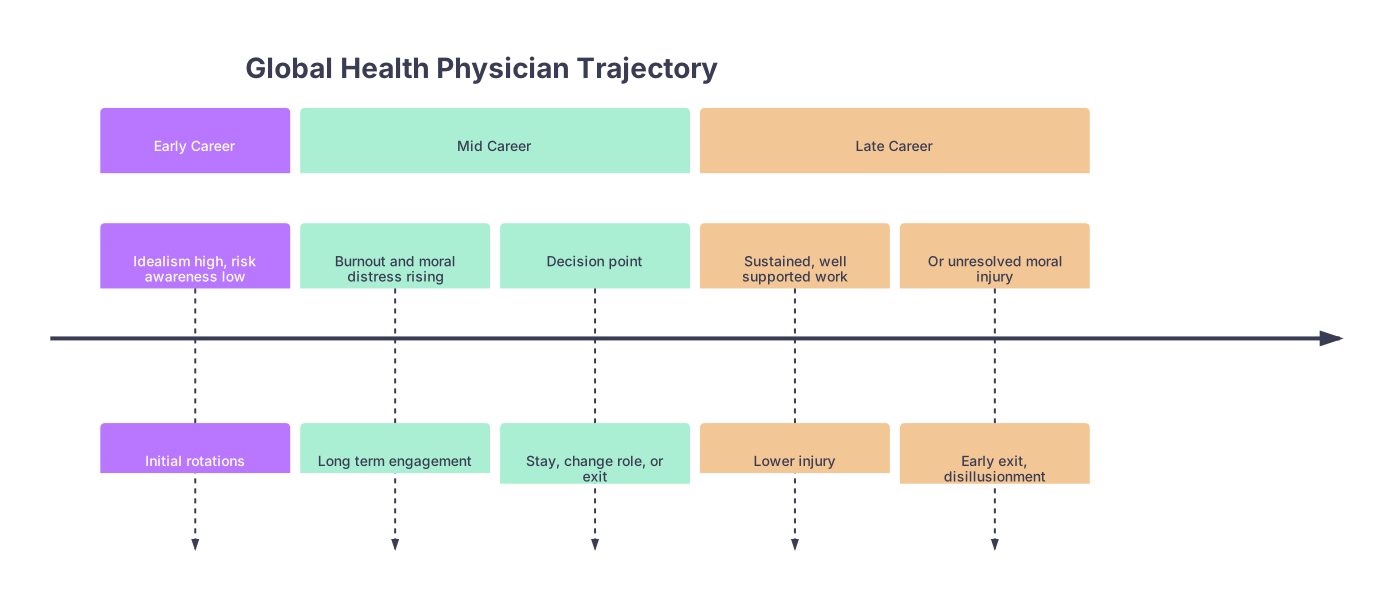
| Period | Event |
|---|---|
| Early Career - Idealism high, risk awareness low | Initial rotations |
| Mid Career - Burnout and moral distress rising | Long term engagement |
| Mid Career - Decision point | Stay, change role, or exit |
| Late Career - Sustained, well supported work | Lower injury |
| Late Career - Or unresolved moral injury | Early exit, disillusionment |
You cannot fix everything. But you can stop pretending this is just about individual resilience.
Where the Evidence Is Thin (and Where It Is Not)
To be fair, there are real data gaps:
- Limited longitudinal data tracking global health physicians over decades
- Weak comparative data by region (Africa vs Asia vs Latin America)
- Sparse quantitative work on how specific policy changes (e.g., guaranteed med supply chains, salary protections) alter burnout trajectories
However, three signal findings are already overdetermined by existing evidence:
- Physicians engaged in global health and humanitarian work experience higher exposure to moral distress and moral injury than most domestic clinicians.
- Structural resource constraints and perceived complicity in unjust systems are central drivers of that injury.
- Organizational-level protections and genuine local partnerships reduce but do not eliminate the risk.
That is enough to justify serious re-engineering of how global health programs are designed, staffed, and evaluated.
FAQs
1. Does global health always increase burnout compared with staying in domestic practice?
No, not universally at the individual level. Population-level data show higher average burnout and moral distress for global health and humanitarian physicians, but some individuals actually experience less burnout in global health work than in high-volume, bureaucratic domestic practices. The crucial variables are program design, institutional support, degree of resource constraint, and how closely the work aligns with your values. If your domestic environment is toxic and your global health work is well structured and ethically coherent, your personal burnout risk could be lower abroad. But on average, the structural stressors in under-resourced settings push population-level risk up.
2. Can strong personal resilience or prior trauma training “protect” against moral injury?
They can modulate severity; they do not provide immunity. Studies that include resilience scales or prior trauma exposure usually find small to moderate protective effects on burnout severity but far weaker effects on core moral injury outcomes. You can be psychologically robust and still be deeply affected by repeatedly denying life-saving care for avoidable structural reasons. Moral injury is less about your coping style and more about the clash between your ethical commitments and the realities you are forced to operate in. Training helps with processing; it does not rewrite the underlying ethical math.
3. What should programs monitor if they want real-time data on burnout and moral injury risk?
At minimum, they should collect regular, anonymous data on: (1) emotional exhaustion and depersonalization (using a validated burnout tool), (2) frequency of episodes where clinicians cannot provide indicated care due to system constraints, (3) perceived alignment between organizational decisions and clinicians’ professional values, and (4) access to debriefing and support. In practice, programs that track these four domains quarterly can see rising risk months before full-blown crises appear. With those foundations in place, the next step is harder and more important: redesigning the work itself so that the numbers start to move in the right direction. But that is the next chapter in the global health story.


