

Supervision and Training Errors Residents Make on International Electives
You land in-country on a Sunday night after three flights and one terrifying taxi ride. Monday morning, you’re in a crowded clinic. Someone introduces you as “the doctor from America.” There are forty patients in the waiting room, one supervising physician who keeps disappearing, and a nurse shoving a chart into your hands saying, “Doctor, please see this one, very sick.”
Here is where people start making serious supervision and training mistakes.
Not because they’re bad people. Because they’re tired, flattered, overconfident, under-supervised, a bit confused about their role, and honestly—desperate to feel useful.
If you’re heading into an international elective, or already there and feeling uneasy about what you’re being asked (or allowed) to do, read this carefully. A lot of residents have crossed lines they still regret years later. You really do not want to be one of them.
1. Confusing “Being Helpful” with “Working Unsafely”
The biggest mistake: thinking “They need help so badly” is a license to work beyond what’s safe or ethical.
You see this all the time: a PGY-1 internal medicine resident doing C-sections because “there was no one else,” or a PGY-2 EM resident running a pediatric ICU service solo because “the local doc trusted me.”
That is not a compliment. That is a system failure. And you’re about to be complicit if you lean into it instead of pushing back.

Red flags you’re crossing the line
- You are the most senior person in the room… when you absolutely should not be.
- You’re asked to do procedures you’ve never done under supervision at home.
- There’s no attending-level oversight, and no clear chain of responsibility.
- People keep saying, “We trust you, do what you think is best.”
“Trust” is not a substitute for training.
If you would not be allowed to do the task alone in your home institution, doing it solo in a more vulnerable population is not “helping.” It’s using patients as practice material because they’re poor and far away. That’s the ugly version. Do not dress it up.
How to avoid this
Before you arrive, write down a clear scope of practice for yourself:
- What you can do independently.
- What you can do only with direct supervision.
- What you do not do in any context.
Share that scope with:
- Your home program director.
- The host site supervisor (and get explicit agreement).
When pushed, use clear language:
- “I’m not trained to do this safely without a supervisor.”
- “At my home institution, this would require attending-level oversight.”
- “I can assist, I cannot be the primary operator.”
If you’re thinking “But they really need me…”, that’s exactly when you’re at highest risk of rationalizing bad decisions.
2. Accepting “Supervision” That’s Not Supervision
In some electives, “supervision” is a name on a form and a WhatsApp number that sometimes works.
That’s not supervision. That’s plausible deniability.
| Aspect | Safe Supervision | Fake Supervision |
|---|---|---|
| Supervisor presence | On-site regularly, sees your work | Off-site, “available by phone sometimes” |
| Case review | Structured, daily or regular rounds | Ad hoc, only if something goes wrong |
| Responsibility | Clear who is legally/clinically in charge | Vague, “we all share responsibility” |
| Feedback | Specific, ongoing teaching | Generic praise, no critical feedback |
If you’ve gone a week without a local attending watching you examine a patient or directly reviewing your decisions, you are essentially unsupervised. That’s a problem.
Common supervision traps
“Our senior nurse will show you everything.”
Nurses are critical. They are not a substitute for physician supervision if you’re functioning as a doctor.“We’ll review difficult cases only.”
You are not experienced enough to reliably know which cases are “difficult” in a new setting, new diseases, new presentations.“We trust residents to manage most of it.”
Translation: “We’re understaffed and you’re cheap labor.”
What to do instead
Ask uncomfortable but necessary questions early:
- “Who is my direct clinical supervisor day to day?”
- “Will they be on-site when I’m seeing patients?”
- “How often will we review my patient list together—daily, several times a week?”
If the answers are vague, you have three options:
- Narrow your role (e.g., focus on observation, teaching students, QI projects).
- Insist on more structured oversight, even if that “slows things down.”
- In extreme cases, your ethical move is to pull back or leave the clinical role.
You’re not there to be free labor plugging a staffing crisis.
3. Overestimating Your Skills Because the Bar Is Lower
Another common disaster: you think you’re “doing great” because you look good compared to severely overstretched systems.
You’re the only one hand-washing between patients. You recognize sepsis earlier than some staff. You know current guidelines. People praise you constantly.
That praise is dangerous. It can tempt you into doing things that feel heroic but are actually reckless.
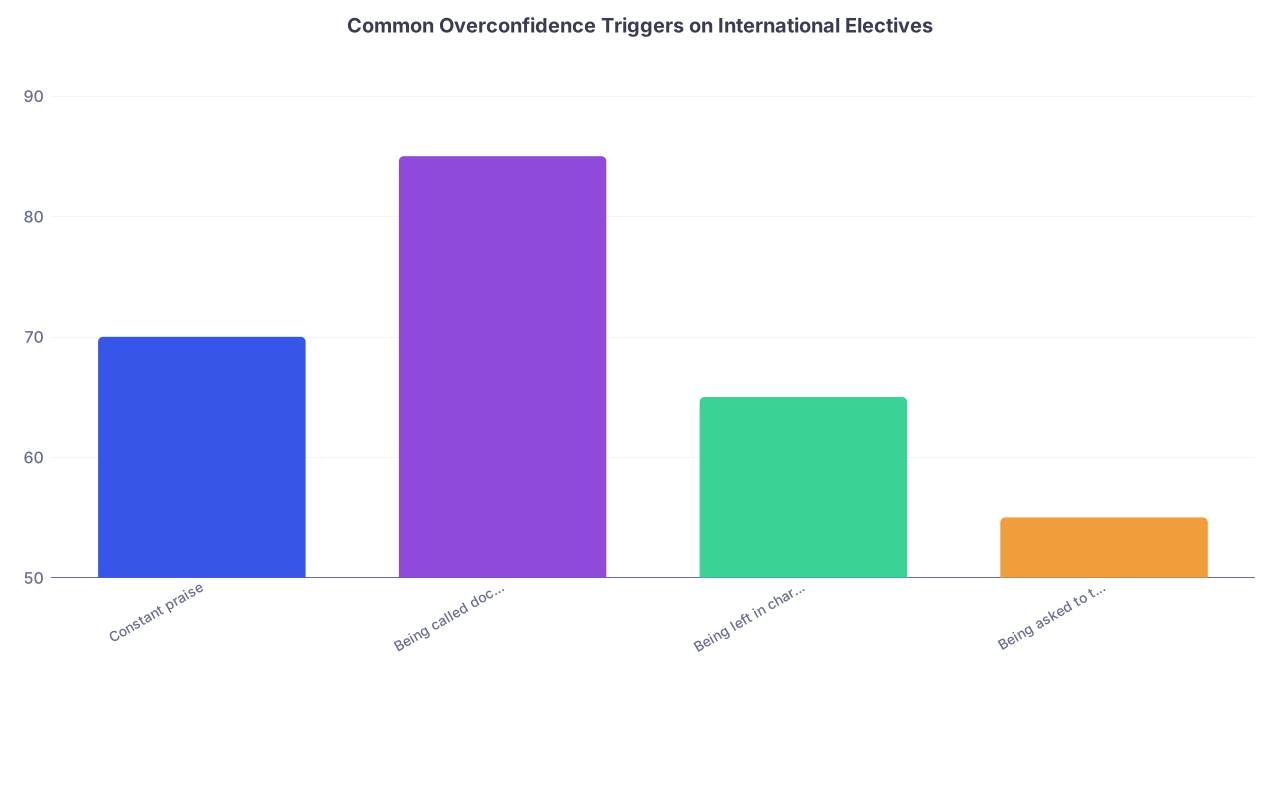
| Category | Value |
|---|---|
| Constant praise | 70 |
| Being called doctor | 85 |
| Being left in charge | 65 |
| Being asked to teach procedures | 55 |
Classic overconfidence scenarios
- You start making independent decisions in diseases you barely see at home (severe malaria, advanced TB, rheumatic heart disease).
- You adjust chemo regimens, HIV regimens, or TB therapy with only cursory local input because “I read the WHO guidelines.”
- You lead resuscitations using equipment you’ve never used before, with drugs you’re unfamiliar with.
Knowing the guideline is not the same as knowing the local reality. Resistance patterns, drug availability, follow-up capacity—all different. I’ve watched residents switch antibiotics to “what we’d use at home” without realizing the lab could not monitor levels or the drug was impossible to continue after discharge.
Guardrails to keep your ego in check
- Assume you know less than you think, especially for local pathology.
- Defer to local standards unless:
- They explicitly ask you for evidence-based alternatives, and
- You discuss feasibility and follow-up.
- Phrase your input as questions, not orders:
- “Would this be an option here?”
- “At home we might consider X; is that realistic here?”
When praise comes—“You’re very smart” or “You know so much more than our interns”—use it as a reminder to slow down, not speed up.
4. Using Patients as Training Props
Here’s a line you cannot cross: doing things to patients primarily so you can learn.
In high-volume, under-resourced settings, you’ll be tempted. There’s endless pathology, fewer specialists, and a culture that may assume “the foreign doctor must be qualified.”
Examples I’ve actually seen:
- A surgery resident offering to “practice” a spinal anesthetic in a rural OR with minimal monitoring because “I need to get comfortable with this.”
- An EM resident arranging an ultrasound teaching session on inpatients without explaining they were being used for training, not clinical indication.
- A pediatrics resident pushing for LPs in questionable indications partly “so I don’t miss meningitis” but also “because I don’t get to do many at home.”
If you’re honest with yourself and the true primary beneficiary is you, stop.
Ethical test questions
Ask yourself:
- Would I be allowed to do this in my home hospital under the same level of supervision?
- Would I offer this same intervention to an insured, English-speaking patient where I live?
- If the patient’s family fully understood my training level and the risks, would they still say yes?
If the answer to any of those is “Probably not,” then using their vulnerability and context as a training opportunity is exploitation, not education.
How to train ethically
- Focus procedures on:
- Those clearly indicated for the patient.
- Those where an appropriately trained supervisor is present and responsible.
- Be transparent with patients (through interpreters or local staff):
- “I’m a resident physician, I have done this X times under supervision; Dr. Y is supervising me today.”
- Accept that you might do fewer procedures than you imagined. That’s fine. Your job is not to maximize your logbook. It’s to do no harm.
5. Ignoring Power Dynamics with Local Trainees
Another nasty pattern: residents from high-income countries barging into teaching spaces and overshadowing local learners.
You arrive. Suddenly you’re giving mini-lectures at the bedside, doing all the interesting parts of procedures, and getting more attention from the attendings than the local interns. You feel great. They feel replaced.
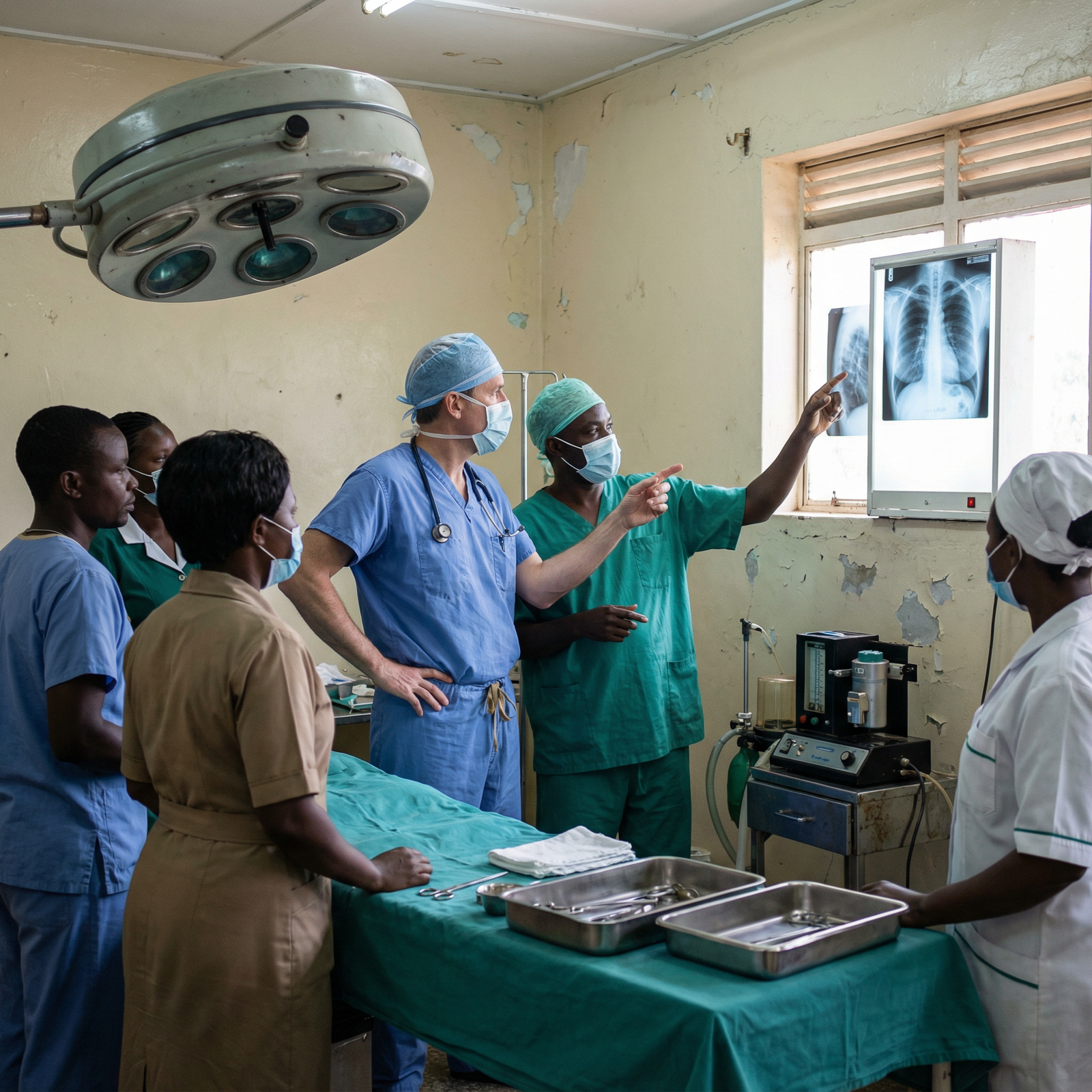
How this goes wrong
- You “take over” ward rounds because your English is better or you’re more assertive.
- Attendings defer to you for management decisions to impress you or be polite.
- You get first dibs on procedures, leaving local trainees to just write notes and fetch equipment.
End result: the people who are actually staying in this system long term lose learning opportunities so a visitor can “get experience.” That’s backwards.
How to not be that visiting resident
- Default rule: local trainees come first. You’re a guest.
- Before any procedure, ask:
- “Is there a local trainee who should do this instead of me?”
- If you’re asked to teach:
- Ask local faculty, “What would be most useful for your trainees long term?”
- Coordinate, do not improvise in front of a room uninvited.
If you notice local students hanging back, silent, or being overridden every time you speak, that’s your cue to shut up and redirect:
- “I’d like to hear how the local team usually handles this.”
- “Maybe [local trainee name] can walk us through their plan.”
You’re not there to be the star of the show.
6. Failing to Understand Legal and Institutional Responsibility
Residents often assume: “If my home institution approved this elective, everything must be covered.” Wrong.
I’ve seen residents:
- Work in clinics that had no formal agreement with their home hospital.
- Prescribe under someone else’s license without clarity.
- Perform emergency procedures in a setting where they technically had no right to practice medicine at all.
If something goes wrong—serious complication, patient death, allegation of misconduct—everyone suddenly cares about:
- Who had legal responsibility?
- Who was credentialed?
- Who authorized your scope?
If the answer is a shrug, you’re exposed. Ethically and legally.
Questions to clarify before you go
Ask your global health office or PD, and then ask the host site:
- Am I formally credentialed here as a trainee? Under what category?
- Who is the licensed physician legally responsible for the care I participate in?
- Am I covered by malpractice insurance in this country and for this scope?
- Are there things I am explicitly not permitted to do here?
If nobody can answer, or you get hand-waving like “We’ve never had a problem,” that’s not reassuring. That’s a red flag.
Your safest move when the legal situation is muddy: limit yourself to:
- Observation
- Clearly supervised care
- Education and systems work
You are not obligated to take risks your own institution won’t even define clearly.
7. Skipping Real Orientation and Cultural Training
Another mistake: treating orientation as optional.
You show up late. You skim the email about local norms. You half-listen when someone explains hierarchy and communication styles because you want to “get to work.”
Then you’re shocked when:
- The nurse seems offended you questioned an order publicly.
- Families look upset when you deliver bad news directly without including the senior doctor.
- No one calls you out, but suddenly doors close and you’re less included.
A poor cultural fit can morph into a supervision problem when staff stop engaging with you. Less engagement = less oversight = more unsupervised practice without feedback.
Things you cannot afford to ignore
- Who speaks to patients about prognosis? (Often not the visiting trainee.)
- How do teams round—who speaks first, who decides?
- Are there topics that are handled differently (e.g., HIV status disclosure, end-of-life decisions)?
Ask explicitly in week one:
- “In what situations should I definitely not speak directly to the family?”
- “What decisions should always go through you first?”
If you blow through those norms, some staff will quietly pull back. That leaves you making more solo decisions than you realize, without the course correction you need.
8. Not Debriefing Mistakes and Near Misses
On these electives, things will go wrong. Different diseases, different meds, different systems—of course you’ll have near misses.
The mistake is pretending everything is fine because you’re a guest and you “don’t want to cause trouble.”
I’ve seen this play out: a visiting resident gives the wrong dose of a drug; a nurse catches it early; they all quietly fix it and move on. No structured debrief. No systems learning. No discussion with the supervisor.
That’s how errors repeat.
Build your own debrief habit
Even if the site doesn’t have a formal process, you can create small, honest routines:
- End-of-day check-in with a supervisor:
- “These were the hardest cases today. Here’s where I felt out of my depth. Anything you would have done differently?”
- Write down:
- 1 mistake you made
- 1 system issue you noticed
- 1 thing you need teaching on tomorrow
You’re not there to impress everybody. You’re there to learn safely. That requires admitting where you screwed up or almost did.
9. Treating the Elective as a Moral Exemption Zone
A subtle but dangerous mindset: “This is global health. The usual rules don’t apply.”
No. The rules apply more here because patients are more vulnerable and oversight is weaker.
Common rationalizations:
- “We don’t have time for consent the way we do at home.”
- “Privacy is different here; everyone listens at the door.”
- “They’re grateful for any care; we don’t need to explain all the risks.”
That’s how people slide into ethically gross territory without noticing.

| Step | Description |
|---|---|
| Step 1 | Arrive with good intentions |
| Step 2 | Face resource constraints |
| Step 3 | Make small exception to usual standards |
| Step 4 | Start doing procedures with weak consent |
| Step 5 | Work beyond training because system needs it |
| Step 6 | Normalize lower ethical bar for poor patients |
You will feel pressure, explicitly or not, to relax your standards. Resist it.
Use this rule of thumb:
- If something would feel wrong to you in your home hospital, it’s wrong here.
- If an ethics committee at home would raise an eyebrow, you should stop.
Your passport doesn’t give you a moral discount.
10. Leaving Without Handover or Reflection
Last error: you vanish at the end of the elective like you were never there.
No structured handover of patients you’ve been closely involved with. No feedback from supervisors on your performance. No personal reflection on what you did well and badly.
For continuity and for your own growth, that’s a mistake.
Minimum you should do before leaving
- Handover:
- Document clearly any plans you influenced.
- Verbally brief a local clinician about complex patients you followed.
- Feedback:
- Ask your supervisor directly: “What did I do that worried you at times?”
Not “Was I okay?” but “Where did you see my limits?”
- Ask your supervisor directly: “What did I do that worried you at times?”
- Reflection:
- Write down the most ethically uncomfortable moments you had.
- Ask yourself honestly: “Did I ever cross a line I wouldn’t cross at home?”
If your answer to that last one is yes, do the uncomfortable work of unpacking it with a mentor when you’re back. That’s how you prevent repeating the same mistake in a different setting later.
Key Takeaways
- Do not confuse being needed with being qualified. Your scope of practice doesn’t magically expand because the clinic is busy and you flew a long way.
- Real supervision is active, present, and accountable. If your oversight is “call me if there’s a disaster,” you are functionally unsupervised and must narrow your role.
- You’re a guest, not the hero. Prioritize patient safety and local trainee learning over your own logbook, ego, or desire to “feel useful.”


