

You have just landed in-country for your first real global health rotation. New clinic, new language, new hierarchy you do not understand. Within 48 hours you are seeing patients, adjusting doses, asking questions through a translator. People are smiling, nodding, calling you “doctor” even if you are a student.
You feel like it is going… fine.
Except a senior nurse has become noticeably short with you. A local trainee has stopped offering to interpret. The supervising physician signs your notes but now double-checks everything you order. Patients still come, but they look at the nurse, not you, when you speak.
You did not make one dramatic error. You did not scream at anyone, breach confidentiality, or commit an obvious ethical violation. The damage is smaller and more insidious: a series of cultural missteps that quietly erode trust in you and strain the team around you.
That is what this is about. The things that do not look like “big mistakes” but absolutely are.
The First Quiet Break: Treating Local Staff as “Support,” Not Colleagues
The fastest way to lose the team is to act like you outrank everyone by default.
I have watched visiting clinicians walk into a clinic in rural Kenya, Haiti, India, you name it, and do some version of this within the first day:
- Hand charts or tablets to nurses like they are scribes.
- Ask the translator to “tell them this” without even looking at the patient.
- Question a local doctor’s plan in front of the entire team.
Nobody yells at you when you do this. They just mentally move you into the “unsafe outsider” category.
Here is the mistake: assuming that your training, your home institution, or your passport automatically place you higher in the hierarchy than the local staff.
You do not see the years of experience behind that quiet nurse who has managed complex cases with no labs, no CT, and intermittent electricity. You do not understand how much social capital the local physician has with the community — and how fast your behavior can burn it.
Signs you are drifting into this mistake:
- You are giving instructions more than you are asking questions by week one.
- You routinely “explain evidence” instead of asking how things are done here.
- You interrupt local staff during patient encounters “for efficiency.”
Do not do this.
The safer alternative:
- On day one, state clearly: “I am here to learn your system first. Please correct me when I misunderstand.”
- Ask nurses how they usually structure rounds, triage, handoff. Then follow it.
- When you disagree clinically, pull the physician aside privately: “Can you walk me through why we manage X this way here?”
Every time you treat a local staff member as a full colleague — not a helper — you buy trust. Every time you treat them like support staff for your learning experience, you lose it.

Patients Are Not “Teaching Material”: The Objectification Trap
Another common quiet disaster: you turn real people into interesting cases.
You walk into a room with three other visiting students, plus a camera (even if you do not take pictures), plus an interpreter. You cluster at the foot of the bed and start:
“Can we present this patient? She has an amazing murmur.”
“Wow, I have never seen this stage of disease before.”
“Can I examine you too?”
The patient is listening. Even if they do not understand every word, they know exactly what is happening. They have become a specimen.
Here is where trust dies:
- You focus on rarity, not suffering.
- You ask for repeated exams without any clear benefit to the patient.
- You debrief about the case loudly outside the room using dehumanizing language.
I have seen this in pediatric wards more than anywhere else. A child with rheumatic heart disease or advanced HIV becomes a parade of hands. Every visiting trainee must hear the murmur, see the lesions, watch the neuro exam. No one asks how many times this happened already that week.
Cultural twist: in many settings, patients will not say no. They are too polite, too deferential, or believe that declining will hurt their care. So your “consent” is not as voluntary as you tell yourself.
How to avoid this:
- One learner examines. One. The others watch or step out.
- Ask the interpreter to explain honestly: “There are students here. One person would like to examine you to learn, but you can say no and your care will be the same.” Then actually accept no.
- Save teaching language for outside the room, and even then, strip the spectacle out of it.
The test is simple: if this were your family member in your home hospital, would this be acceptable? If not, do not pretend the context makes it ok now.
“We Know Better Care”: Disrespecting Local Standards and Constraints
Here is a subtle but lethal one: you signal — explicitly or implicitly — that the local standard is inferior and you are here to “fix it.”
You may not say it. You do not need to. It shows up in your face when you see five patients in a bed. In your tone when you ask why they are not on some guideline-recommended medication that costs a week’s salary. In your offhand comments:
“At home, we would never accept these lab turnaround times.” “Why are we still using this drug? It is obsolete.” “This ward is so behind.”
Some of those statements might be factually correct. They are still the wrong thing to say, and especially the wrong people to say it to.
Here is the mismatch:
You are evaluating care against the standards of a high-resource system with insurance, specialists, and litigation risk. The team is practicing in a context that has unstable supply chains, intermittent funding, and constraints you do not even see yet.
When you frame everything as “behind,” you are doing three things:
- Insulting people who have built workarounds you could not survive a week with.
- Ignoring creative adaptations that do not exist in your home system.
- Positioning yourself as the benchmark, not a partner.
That corrodes trust fast. People stop sharing problems with you, because they are tired of being judged by someone who is not staying long enough to share the consequences.
The better approach:
- Ask, “What are the biggest constraints you are up against here?” and then shut up and listen.
- Before proposing any change, ask, “Has someone tried X here before? What happened?”
- Avoid value-laden words like “behind,” “primitive,” or “unsafe,” especially in mixed groups. Focus on specifics: mortality rates, resource gaps, concrete harms.
You can still advocate for better care. But if you do it from a place of superiority instead of solidarity, you will lose the team.
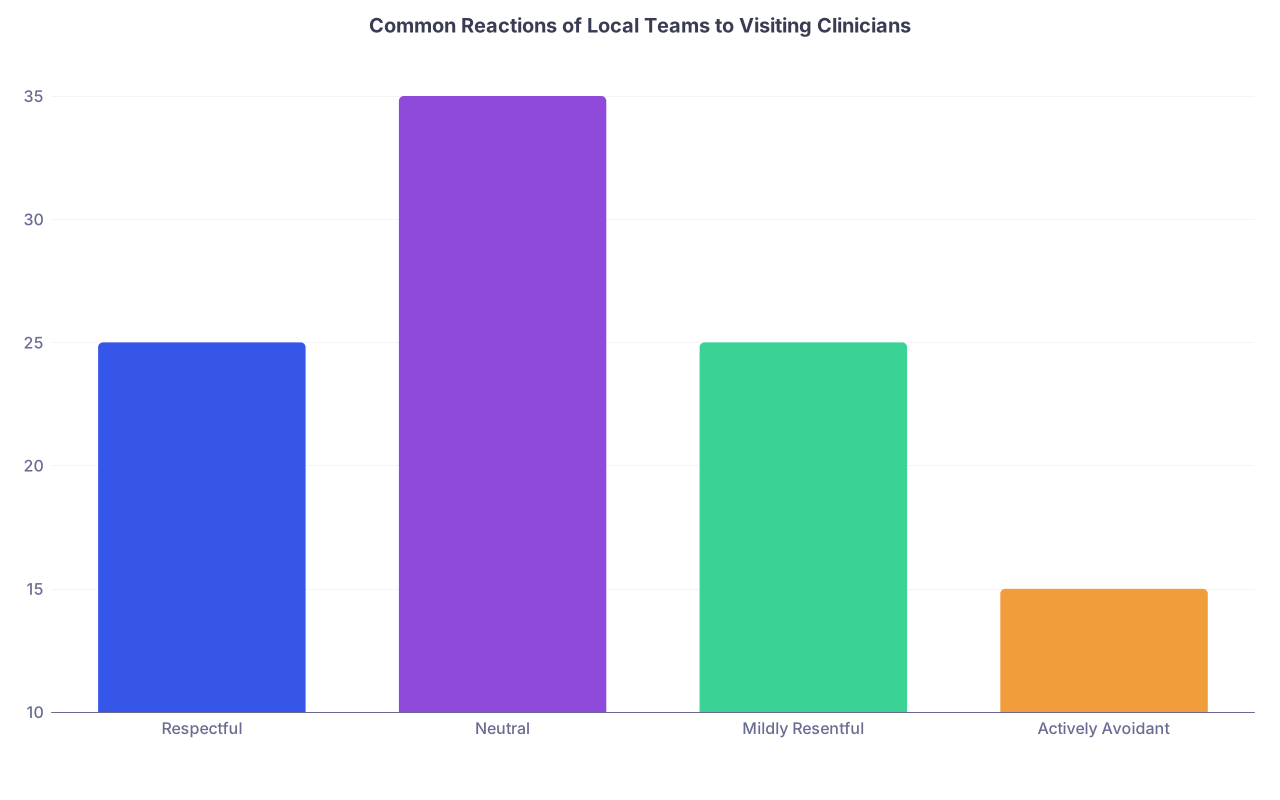
| Category | Value |
|---|---|
| Respectful | 25 |
| Neutral | 35 |
| Mildly Resentful | 25 |
| Actively Avoidant | 15 |
Language and Interpreters: Tiny Slips, Big Ethical Consequences
Language is where many global health visitors quietly do the most damage without realizing it.
Two common, dangerous habits:
- Using interpreters as tools, not professionals.
- Pretending comprehension that is not really there — for you or the patient.
You know the classic scene: you face the interpreter, talking rapidly, “Ask her when the pain started, if it radiates, if she has had fevers, if she is taking anything, if…” while the patient sits and watches your mouth move without being addressed once.
Or worse, you use a family member — often a child — to interpret complex, stigmatized information. HIV status, pregnancy loss, end-of-life decisions. I have seen twelve-year-olds asked to tell their grandmother she is dying because “she speaks English best.”
Do not do this.
Invisible harm:
- Patients feel sidelined in their own care.
- Key concepts get lost or softened because family interpreters avoid shameful topics.
- Children are forced into impossible psychological positions as information brokers.
The ethical version:
- Look at the patient. Always. Speak to them directly. “Can you tell me…” Then pause. Let the interpreter do their job.
- Before heavy conversations, ask quietly if there is a professional interpreter or trained staff who can interpret, even if it needs to be by phone.
- If you must use a family member, never use a minor for serious or stigmatized content if there is any other option.
And do not lie to yourself about your language competence. Speak the local language if you can actually conduct a full, nuanced medical conversation with it. If you are at “ordering food” level, do not use it for oncology discussions.
The worst combination for trust: half-understood local language plus overconfident clinician.

| Step | Description |
|---|---|
| Step 1 | Start Encounter |
| Step 2 | Proceed in shared language |
| Step 3 | Use professional interpreter |
| Step 4 | Use family with caution |
| Step 5 | Delay nonurgent heavy discussion |
| Step 6 | Address patient directly |
| Step 7 | Language barrier present |
| Step 8 | Professional interpreter available |
| Step 9 | Adult family suitable |
“Short-Term Savior”: Making Promises You Cannot Keep
Short-term global health work is infamous for this mistake: visiting clinicians make emotional, resource, or follow-up promises they have no power to fulfill.
You see a child who needs surgery that is not available locally. You are moved. You say some version of: “We will try to get you to our hospital.” “I will send medicine from home.” “I will talk to people and see what we can do.”
You fly home. Life happens. Rotations, exams, new responsibilities. The email draft about fundraising sits unsent. The child and family, meanwhile, are waiting for help that will not come.
From your perspective, you expressed a wish. From theirs, you made a commitment.
This is how distrust spreads in communities. You are not the first outsider to say, “We will help.” They are tallying how often those promises materialize.
Three rules to protect trust here:
Do not promise anything you cannot personally and realistically deliver.
If you do not control the resources, visas, or institutional decisions, do not guarantee outcomes.Use conditional, honest language.
“I do not know if this is possible, and I cannot promise it, but I can ask my team when I return if there are any programs that might help. Your doctors here remain your main team.”Coordinate with local clinicians before saying anything.
Ask them, “If I mention possible external support, will that cause problems or false hope?” If they look uneasy, that is your answer.
This is not about being cold or detached. It is about refusing to generate a cycle of broken promises that other clinicians will inherit after you leave.

The Hidden Power Dynamics in “Teaching” and “Helping”
Global health attracts people who like to teach and help. Those impulses turn toxic when you ignore power dynamics.
Here is what I mean.
You are asked to give a talk to local trainees about sepsis or stroke protocols. You grab your home-institution slide deck, maybe trim a few things, and deliver it as if your audience has the same resources. You imply, without meaning to, that if they were just more up-to-date or careful, outcomes would improve.
You are “teaching.” They are hearing: “You are doing this wrong.”
Or you join a ward round and jump in with “pearls” that do not actually account for the setting: recommending monitoring that does not exist, medications not on formulary, lab tests that require a three-day trip and out-of-pocket payment.
Again, the team will nod. They are polite. Then they will go back to what actually works in their context — and mark you as someone who does not understand their reality.
To avoid this:
- Before any teaching, ask for a brief from a local senior: “What would be most helpful for your team right now? What resources do you actually have for this condition?”
- Strip your teaching down to principles that can be adapted: early recognition, low-cost interventions, prioritization strategies, communication.
- When you do not know local constraints, explicitly say so: “At my home hospital, we do X. I know the context here is different. How might this translate or not?”
Same for “helping” with quality-improvement projects. Dropping in with a polished QI project that nobody asked for, nobody can sustain, and nobody owns locally is a classic mistake. It lets you publish a paper and leaves them with a half-functioning change that dies when you leave.
Ask first. Design with, not for.
| Scenario | Harmful Approach | Better Approach |
|---|---|---|
| Sepsis lecture | Use home ICU protocol slides as-is | Co-create talk with local senior physician |
| Stroke management | Recommend CT, MRI for all | Focus on early signs, basic stabilization |
| Antibiotic stewardship | Push drugs not on formulary | Discuss principles, local resistance data |
| QI project | Launch solo, publish quickly | Build with local co-leads and ownership |
Disrespecting Local Ethics and Social Norms
Ethics are not culture-free. Many global health visitors assume their home-country ethical framework is universal. It is not.
Two big friction points:
- Autonomy vs family/community decision-making.
- Truth-telling norms around prognosis and bad news.
In some settings, family or community leaders are expected to be involved in decisions that you would frame as purely individual under Western bioethics. Telling a patient a devastating diagnosis without involving their family might be seen as cruel or even dangerous.
In other places, direct disclosure of terminal illness is not standard; bad news is filtered or given in stages. Marching in with, “The patient has a right to know everything, now” without understanding how that will land socially can do real harm — to the patient and to the trust in the team.
This does not mean you abandon your ethical core. It does mean you slow down and ask:
- “How are serious diagnoses usually discussed here?”
- “Who is normally involved in medical decisions for adults? For elders? For children?”
- “Have there been problems in the past when outside teams handled this differently?”
Then calibrate.
The mistake is not holding on to your values. The mistake is assuming you are the only one in the room with any.
Documentation, Photos, and Social Media: Quiet Breaches That Spread Fast
Another place people get themselves and their hosts into trouble: documentation and “sharing the experience.”
You take photos on the ward. You justify it: “I will blur faces.” You post a picture of “our clinic in [country]” with a line about how grateful you are to serve. Maybe you share an unusual case on Twitter or a slide deck back home.
You think you are being careful. You are not.
Harm you might not see:
- Patients did not really consent to photography; they agreed because you are a doctor.
- The image reinforces stereotypes: crowds, bare beds, dramatic illness without context.
- Local staff see themselves portrayed as “backdrop” in your savior narrative.
In several programs I know, this has blown up badly enough that partnerships were paused. Not because of one shocking image. Because of steady, low-level extraction of images and stories that benefited the visiting individual more than the community.
Safer practice:
- Ask your host institution about explicit photo and social media policies. Then follow them strictly.
- Do not post any identifiable patient images, period, even “blurred,” without written institutional approval from the local site.
- Ask yourself honestly: “Who benefits from me sharing this? Does it help the patient or community in any way, or just me?” If the answer is “just me,” close the app.
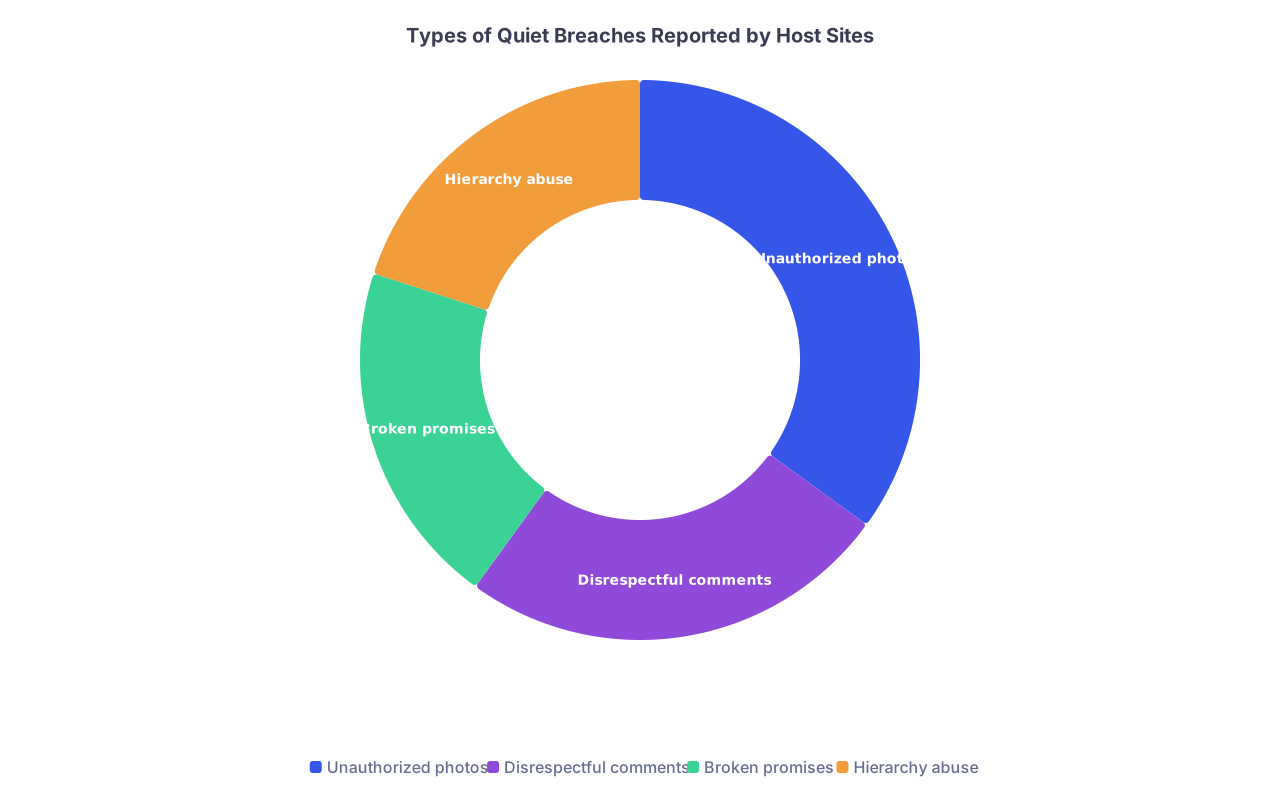
| Category | Value |
|---|---|
| Unauthorized photos | 35 |
| Disrespectful comments | 25 |
| Broken promises | 20 |
| Hierarchy abuse | 20 |
When You Are the Outsider: How to Course-Correct in Real Time
You will get some of this wrong. Everyone does. The serious harm happens when you refuse to see it or double down defensively.
Signs you have already done damage:
- The interpreter stops volunteering nuance and sticks to minimal translation.
- Nurses start routing complex cases around you instead of to you.
- A local trainee who was engaged on day one now avoids eye contact.
If you see some of this, do not explain it away as “they just do not like foreigners” or “they are resistant to change.” That is the lazy interpretation.
Try this instead:
- Ask one trusted local colleague privately: “I want to be sure I am not creating problems without realizing it. Have I done anything that came across as disrespectful or out of line here?”
- When they tell you — and if they trust you, they will — do not justify. Say, “Thank you for telling me. I see how that came across. I will do that differently.” Then actually change.
- If appropriate, apologize briefly to those you affected. Nothing long or dramatic. “Yesterday I interrupted you several times in front of the patient. That was disrespectful. I am sorry, and I will not do that again.”
These quiet course corrections do more for trust than any perfectly crafted predeparture training.

Three Things to Hold on To
If you remember nothing else:
You are a guest, not a savior.
Treat every local clinician, nurse, interpreter, and staff member as a full professional with knowledge you do not have. Assume the system knows things you do not, even when it is constrained.Patients are people first, cases second.
Do not turn them into teaching props or global health stories. Protect their dignity in how you examine, speak, photograph, and write about them — exactly as you would want someone to do for your own family.Promises and posture matter more than you think.
Be ruthless about what you promise, explicit about what you do not control, and humble in how you teach or propose changes. Most of the real damage in global health happens in quiet, seemingly small interactions. Do not underestimate those.
You will still make mistakes abroad. The goal is to make them smaller, rarer, and repairable — not the kind that quietly poison trust long after you board your flight home.


