

The fastest way to lose an overseas clinic is not a war, not a pandemic, not even funding cuts. It’s paperwork you thought you could “figure out later.”
The Hard Truth: Good Intentions Don’t Protect You From Regulators
I’ve watched well-meaning global health projects implode because someone treated licensing and visas as background noise. They are not background. They are infrastructure. When you ignore them, you are building a clinic on a sinkhole.
Here’s the pattern I’ve seen too many times:
- A team flies in, starts seeing patients under a visiting NGO.
- Everyone’s thrilled. Photos, reports, donors impressed.
- Six months later, a health inspector or immigration officer walks in.
- Operation stops that day. Records seized. Staff questioned. Patients left confused.
And the worst part? In many cases, the local partners pay the highest price, not the foreign doctors who fly back out.
Let’s walk through the major mistakes that can shut you down — and how not to be that story.
Mistake #1: Assuming Your Home License “Carries Over”
This one is lethal.
You trained in the US, UK, Canada, wherever. You’re board-certified. You’ve done mission work before. You think, “Surely they’ll let me practice. I’m more trained than most here.”
That thinking will get your clinic closed.
Most countries treat foreign medical practice like this:
- No local registration = you are not a doctor here.
- Full stop.
There is usually:
- A medical council or health professions council.
- A defined registration category for:
- Full clinical practice
- Temporary/mission practice
- Teaching-only roles
- Telemedicine or advisory roles
If you’re not in the right box, you’re exposed.
| Route Type | Typical Use Case | Risk Level if Misused |
|---|---|---|
| Full registration | Long-term, independent practice | High |
| Temporary license | Short-term missions, courses | High |
| Teaching-only | Training, supervision | Medium |
| Observer/visitor | Shadowing, no direct patient care | Lower |
Classic errors here
Practicing under a “training” or “observer” status
I’ve seen people hold a paper that literally says “Not authorized for independent practice,” then proceed to:
- Write prescriptions
- Perform procedures
- Sign charts as primary clinician
That’s practicing without a license. If something goes wrong, your defense is zero.
Hiding behind the local partner’s license
“We practice under Dr. X’s license” might be reality in a practical sense, but regulators do not see it that way unless it’s formally documented.
If the local consultant isn’t:
- Officially the medical director
- Clearly responsible in ministry paperwork
- On-site or legitimately supervising
…you are improvising legal coverage.
Letting the NGO’s reputation substitute for registration
“We’re with a big international NGO; they’ve been here 20 years” is not a license category. I’ve watched famous organizations get shut down over a single unregistered foreign doctor in a rural outreach.
How to avoid this
- Before you touch a patient:
- Get written confirmation from the country’s medical council or ministry:
- What category you’re in
- What you’re allowed and not allowed to do
- Keep a copy of your registration and scope in the clinic. On the wall is better.
- Get written confirmation from the country’s medical council or ministry:
- If your status is “observer” or “trainer only,” respect it. Do not “just quickly” suture or prescribe “because otherwise the patient will wait.” That’s how exceptions become evidence.
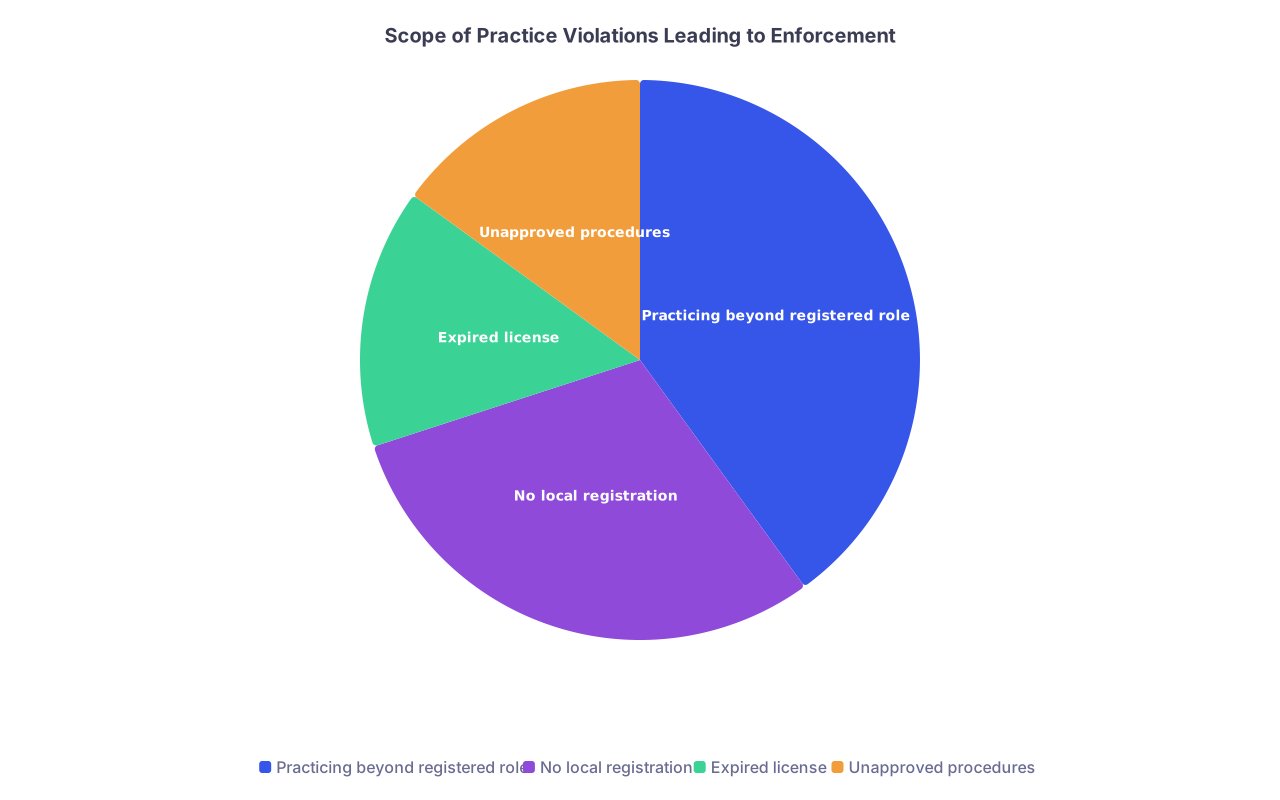
| Category | Value |
|---|---|
| Practicing beyond registered role | 40 |
| No local registration | 30 |
| Expired license | 15 |
| Unapproved procedures | 15 |
Mistake #2: Ignoring the Visa–Practice Mismatch
Your visa category is not a technicality. It defines what you’re legally allowed to do in that country.
The common lazy assumption is: “I have a visa, so I’m fine.” No. The question is: what kind of visa?
Common categories:
- Tourist
- Volunteer
- Business
- Work/employment
- Missionary/religious
- Student
- NGO/charity staff
Here’s the painful truth: in many jurisdictions, seeing patients is “work,” even if unpaid. So that “volunteer tourist” stamp you got on arrival? Completely incompatible with running a clinic.
Dangerous combinations I’ve actually seen
Tourist visa + daily clinic work
- Immigration sees photos online, or a disgruntled ex-staff tips them off.
- You get detained, fined, or deported. Clinic credibility tanks.
Religious/missionary visa + unregistered clinical work
- Official purpose: religious activities, teaching, community support.
- Actual activity: surgeries, prescriptions, deliveries.
- Outcome: government accuses organization of operating under false pretenses.
Business visa + hands-on clinical care
- Issued for setting up a company, attending meetings.
- You’re actually performing procedures. Not what you’re there for legally.
The overlap trap
Even if the health ministry is okay with you clinically, immigration might not be. These are separate systems. They do not cross-check nicely just to help you.
I’ve watched one ministry invite foreign volunteers while immigration simultaneously cracked down on “illegal workers” — and the volunteers were caught in the middle.
Protect yourself (and your clinic)
- Get this in writing, not verbally:
- From your local legal counsel or registered NGO:
- “This visa category allows X, Y, Z types of activities.”
- From your local legal counsel or registered NGO:
- Match your visa purpose and your daily behavior.
- When in doubt:
- Limit yourself to mentoring and observation until you confirm you’re covered.

| Step | Description |
|---|---|
| Step 1 | Enter Country |
| Step 2 | Consult local lawyer or NGO |
| Step 3 | Restrict to training or observation |
| Step 4 | Obtain proper registration |
| Step 5 | Proceed with clinical duties |
| Step 6 | Visa category clear? |
| Step 7 | Visa allows clinical work? |
| Step 8 | Local license in place? |
Mistake #3: Operating a “Shadow Clinic” Under Another Facility’s License
This one looks clean at first glance:
- A local hospital or private clinic “hosts” you.
- They say, “Just run your project under our license.”
- You build a semi-independent operation in a wing, church building, or outreach site.
Then something bad happens:
- Maternal death
- Surgical complication
- Outbreak linked to your facility
Regulators come in and ask:
- Whose facility is this, legally?
- Who is the registered medical director?
- Where is this site listed in the official license?
If your location is not specifically registered as:
- A branch
- A satellite clinic
- A mobile outreach point
…then you are effectively running an unlicensed facility, even if you cling to the partner’s documents.
Warning signs you’re a shadow clinic
- The clinic address isn’t on any official license document.
- Your name or organization doesn’t appear on any paper at the ministry.
- The local partner says, “Don’t worry, it’s covered,” but cannot show you updated licenses that list that site.
- Inspections never happen because “they don’t know about this building.”
I’ve heard this exact line: “We’re under Dr. K’s license.” Then in an audit, Dr. K tells the inspector, “They’re just an outreach project; I don’t manage their day-to-day.” That gap is where clinics get shut down.
What to do instead
- Insist on clarity:
- Is your clinic a:
- Registered branch?
- Official outreach program?
- Separate facility with its own license?
- Is your clinic a:
- Get your clinic’s:
- Name
- Address
- Services explicitly stated in:
- Ministry approvals
- Health facility registration
- Never start delivering services from a new site (school, church, tent, mobile unit) without checking what the rules are for outreach sites.
Mistake #4: Neglecting Local Staff Credentials and Delegation Rules
Foreign clinicians love to focus on their own paperwork while ignoring the people who will actually stay when they leave.
Common failures:
- Hiring “nurses” who are unlicensed assistants
- Letting non-physician staff prescribe or perform tasks clearly outside their scope
- Assuming rural or under-resourced = no rules
Every country has some combination of:
- Nurse practice acts
- Midwifery scopes
- Pharmacy regulations
- Community health worker policies
You may think you’re empowering local staff. Regulators may see you as running an illegal training camp.

Red flags
- Staff can’t produce:
- Licenses
- Registration numbers
- Certification cards
- You have “nurse” on everyone’s badge, regardless of their training.
- People in your clinic:
- Dispense medications without a licensed pharmacist where required
- Insert long-acting contraceptives or IUDs after a 2-day workshop with no formal approval
- Perform deliveries or minor surgeries without being licensed to do so
If a complication occurs, regulators will ask:
- Who authorized this person to perform this task?
- Where is the written protocol?
- Does national policy allow this cadre to do this?
If the answer is “we needed them to because we’re short-staffed,” you’ve just admitted you knowingly bent the rules.
How to handle delegation correctly
- Get the country’s official task-shifting or scope documents. Not just NGO guidelines.
- Create a written matrix:
- Who can:
- Prescribe
- Insert devices
- Perform procedures
- Sign off on charts
- Who can:
- Train staff to refuse tasks outside their scope — and back them up when they say “no.”
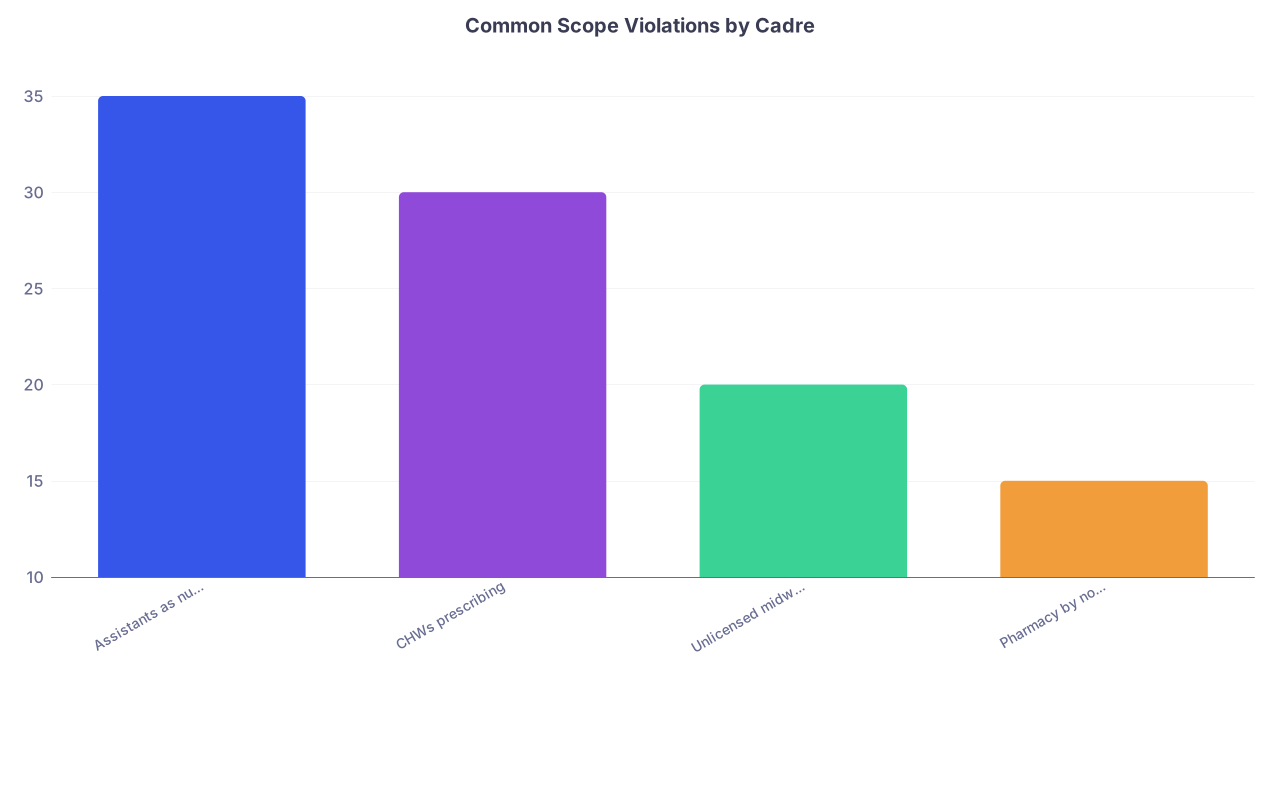
| Category | Value |
|---|---|
| Assistants as nurses | 35 |
| CHWs prescribing | 30 |
| Unlicensed midwifery | 20 |
| Pharmacy by non-pharmacists | 15 |
Mistake #5: Treating Renewals, Reporting, and Inspections as Afterthoughts
Plenty of clinics actually start legally… then drift into illegality because nobody maintains the paperwork.
I’ve seen this exact mess:
- License expired 2 years ago.
- Work permits lapsed 6 months ago.
- Mandatory quarterly reports never submitted.
- But the clinic is busy and “doing a lot of good.”
That only buys goodwill until the wrong person notices.
Where people get burned
Expired facility licenses
- Sometimes they must be renewed annually or every 2–3 years.
- Renewal might require:
- Fire inspection
- Infection control approval
- Staffing review
Unrenewed professional registration
- Foreign or local clinicians forget to:
- Pay annual fees
- Complete required CPD/CME
- They keep working as if nothing changed.
- Foreign or local clinicians forget to:
Missed mandatory reports
- TB, HIV, maternal deaths, certain notifiable diseases often require:
- Immediate or periodic reporting
- Failing to report can lead to audits and sanctions.
- TB, HIV, maternal deaths, certain notifiable diseases often require:
Practical ways to avoid this slow-motion disaster
- Build a compliance calendar:
- Expiry dates for:
- Facility license
- Professional registrations
- Work permits
- Memoranda of understanding (MOUs)
- Expiry dates for:
- Assign one person (ideally a local admin) whose job includes:
- Tracking deadlines
- Keeping scanned and hard copies of all documents
- Treat inspections like part of operations, not an interruption.
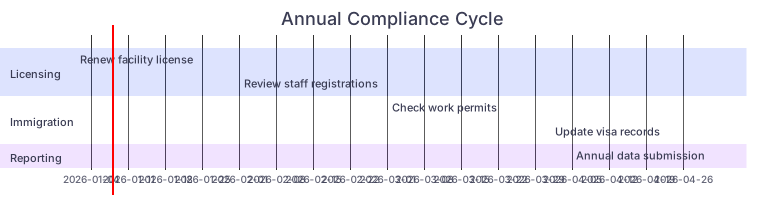
| Task | Details |
|---|---|
| Licensing: Renew facility license | a1, 2026-01, 1m |
| Licensing: Review staff registrations | a2, 2026-02, 1m |
| Immigration: Check work permits | b1, 2026-03, 1m |
| Immigration: Update visa records | b2, 2026-04, 1m |
| Reporting: Annual data submission | c1, 2026-05, 1m |
Mistake #6: Assuming Ethics = “Helping the Poor,” Not “Respecting the Law”
This is where personal development and medical ethics really collide.
A lot of global health folks quietly run this script in their heads:
- “The system is corrupt / inefficient / broken.”
- “These people need care.”
- “We’re the only ones who will help them.”
- “So we’ll bend the rules a bit.”
I understand the impulse. I’ve had the same internal argument at 2 a.m. in a rural ward.
But here’s the uncomfortable ethical reality:
- Laws and licensing exist — imperfectly — to protect patients.
- When you circumvent them, you unilaterally decide whose rules matter.
- That’s a form of power, and power without accountability is dangerous.
Unethical patterns disguised as “service”
- Using local staff as legal shields:
- Putting their names on documents while you actually run the show.
- Hiding clinical work behind education:
- Calling it a “training workshop” when in reality you’re running unsanctioned surgery camps.
- Playing jurisdictional games:
- Switching locations every year to avoid scrutiny.
- “Ask forgiveness not permission”
- Sounds bold. In healthcare, it’s reckless.

The ethical bottom line
If you:
- Would not tolerate an unlicensed foreign doctor doing this in your home country…
- Then do not justify it because you are the one flying in.
Solid global health work is slower, more bureaucratic, and frankly less glamorous than the Instagram versions. But it respects local law, local professionals, and patient safety.
Mistake #7: Poor Documentation of Authority and Responsibility
When regulators show up, they care less about your website mission statement and more about who is actually responsible for what.
If your documents are vague, contradictory, or missing, you’re handing them reasons to shut you down.
Documents that must not be fuzzy
Clinic governance structure
- Who is the:
- Medical director
- Nursing lead
- Pharmacist in charge
- Who is the:
Memoranda of Understanding (MOUs)
- Between you and:
- Local hospital
- Ministry
- NGO partners
- They should specify:
- Who owns equipment
- Who is responsible for clinical outcomes
- Who holds liability
- Between you and:
Job descriptions
- For local and foreign staff:
- What are they allowed to do?
- Who supervises them?
- For local and foreign staff:
If your MOU says “capacity building support” but you’re running an ICU, you’re out of alignment. That gap is where closures, lawsuits, and media scandals emerge.
| Document Type | Core Question Answered |
|---|---|
| Clinic license | Is this facility legal? |
| Medical director letter | Who is clinically accountable? |
| MOU with partners | Who owns and runs what? |
| Staff job descriptions | Who can do which tasks? |
| Immigration/visa records | Who may legally work? |
Mistake #8: No Exit Strategy for Legal and Ethical Handover
You won’t be there forever. The clinic, or its impact, should outlast you. But if your entire legal framework is built around your presence, your departure can trigger a collapse.
Common failures:
- Licenses all in the name of a foreigner who leaves.
- Clinic officially attached to a mission team that rotates every year.
- No local entity prepared to:
- Hold the license
- Maintain compliance
- Renew approvals
When that happens, ministries often choose the simplest option: shut it down quietly.
How to avoid an ugly ending
- From day one, design for:
- Local ownership of:
- Licenses
- MOUs
- Staff contracts
- Local ownership of:
- Gradually:
- Move authority (on paper and in practice) to local leadership.
- Before any foreign lead leaves:
- Review:
- Facility registration
- Professional registrations
- Key MOUs
- Confirm:
- They remain valid
- They list a stable local person or entity
- Review:
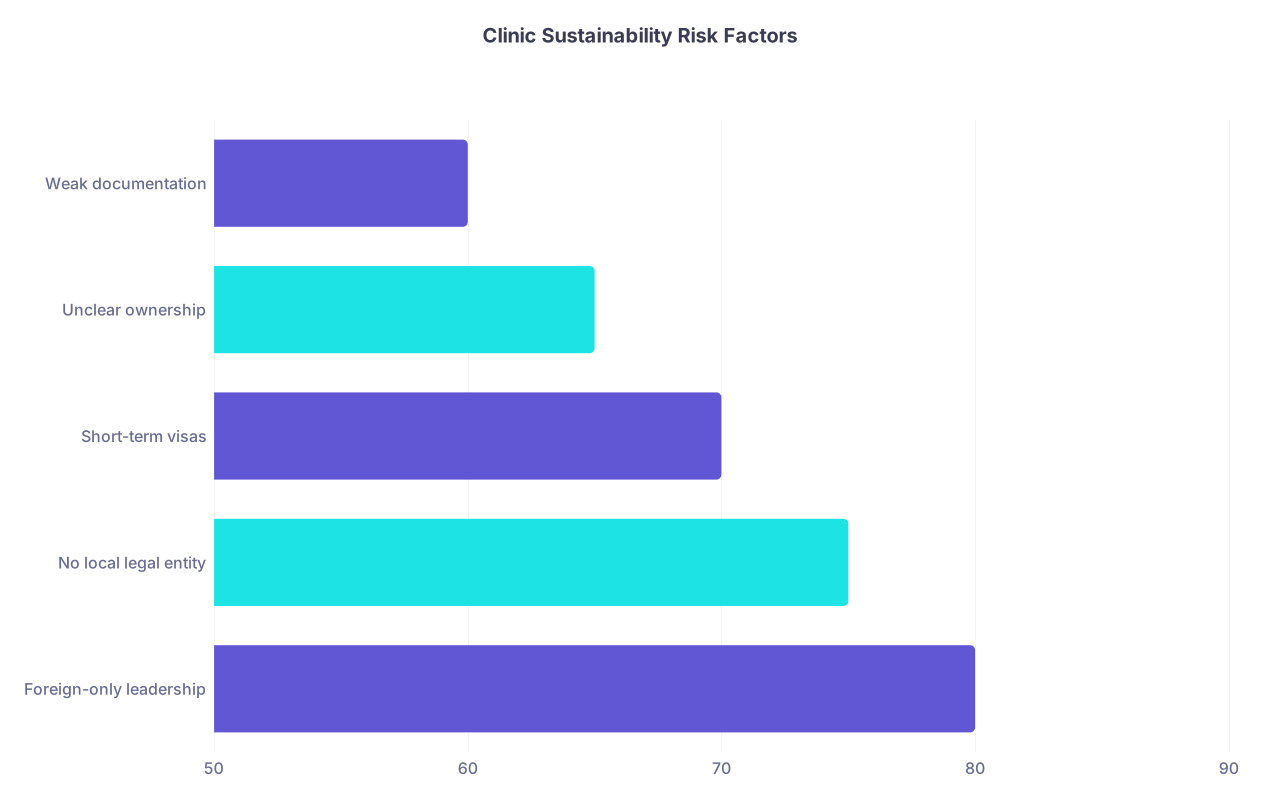
| Category | Value |
|---|---|
| Foreign-only leadership | 80 |
| No local legal entity | 75 |
| Short-term visas | 70 |
| Unclear ownership | 65 |
| Weak documentation | 60 |

A Quick Reality Check Before You Open (or Expand) a Clinic
If any of these are true for you right now, you’re walking toward a shutdown:
- You’re on a tourist or religious visa and seeing patients daily.
- Your name isn’t on any local registration, but you’re leading clinical care.
- Your facility’s exact location is not on any Ministry of Health approval document.
- You can’t list renewal dates for:
- Clinic license
- Your own registration
- Your work permit
- The local staff’s credentials are “somewhere in HR,” but nobody can produce them this week.
- Your justification is mostly: “We’re helping people; that should count for something.”
It won’t. Not with regulators. And not ethically, once something goes very wrong.
The Three Things You Cannot Afford to Get Wrong
Let me keep the ending sharp and simple.
Licensing and scope
If you’re not clearly and correctly registered to do what you’re doing — in that country, in that role, at that site — you’re a shutdown waiting to happen.Visa and work authorization
If your immigration status doesn’t match your day-to-day reality, you’re giving authorities a loaded weapon pointed at your clinic.Local accountability and documentation
If there’s no clear, local, legal owner of the clinic and its responsibilities — on paper and in practice — your good work is fragile, temporary, and ethically shaky.
Do not build a clinic on legal quicksand and hope your intentions will hold it up. They won’t.


