

You’re in a cramped Ministry of Health conference room in a low‑income country. The AC is half-working, the Wi‑Fi is not working, and the Permanent Secretary just walked in 35 minutes late with three advisors you have never met. Your dean back home wants a signature on an MOU by next week. The Minister wants your “support” for a national NCD program. The WHO country office is “very interested in collaborating.”
And you? You just wanted to help patients and maybe publish a paper.
Let me tell you what actually goes on when foreign health workers “partner” with Ministries of Health (MoHs). What gets said on official letters is not what drives the decisions.
The Ministry Is Not A Person — It’s A Battlefield
The first thing most visiting clinicians get wrong: they talk and think about “the Ministry” like it’s a single entity with a unified goal.
It’s not.
A Ministry of Health is a constantly shifting coalition of:
- Politically appointed leadership (Minister, Deputy Minister, sometimes PS)
- Senior technocrats (directors of programs, chief medical officers)
- Mid‑level civil servants who actually make things happen (or not)
- External partners embedded inside the building (WHO, UNICEF, big NGOs)
- Parallel power centers (First Lady’s office, Presidential advisors, military health services)
They do not all want the same thing. They are not all talking to each other. And they’re definitely not all aligned with your pristine “global health” agenda.
The Minister wants political wins before the next election.
The Director of HIV wants to protect their donor pipeline.
The NCD unit wants to exist at all.
The Planning department wants control over every proposal and budget.
You walk in thinking: “We have an amazing cervical cancer screening project.”
They hear: “Who is going to control this budget, own this success, and take the blame when it fails?”

| Step | Description |
|---|---|
| Step 1 | Minister |
| Step 2 | Permanent Secretary |
| Step 3 | Political Advisors |
| Step 4 | Directors |
| Step 5 | Program Managers |
| Step 6 | Hospital Leadership |
| Step 7 | External Partners |
If you don’t map out these relationships, you will get played. Or sidelined. Or used as a prop.
What “Ownership” Really Means (And How You Get Trapped By It)
You’ll hear this phrase a lot: “The project must be Ministry‑owned.”
Sounds good. Local ownership, sustainability, equity. The buzzword bingo is comforting.
Here’s the part nobody tells you: “ownership” is often a coded question about who gets credit, who controls money, and who has veto power.
I’ve sat in meetings where:
- A national director refused to sign off on a training program because the logo order on the banner put the university partner ahead of the Ministry.
- A Minister demanded that a study’s authorship list include his cousin (a non‑clinician) if the team wanted the data‑sharing agreement approved.
- A powerful program manager blocked a highly effective NGO from presenting outcomes at a national review meeting because “they are not speaking under Ministry authority.”
Ethically, this can get ugly fast. You came for patient outcomes and capacity building. You end up arguing over whether your local PI can be first author if the MoH “owns” the project.
Here’s the unspoken rule:
If you let the Ministry “own” everything on paper but still make all the real decisions yourself, you are performing decolonization while practicing paternalism.
If you truly share ownership, you will lose control over timeline, branding, and sometimes scientific purity.
That tension is where the real ethical work lives.
The Quiet Currency: Data, Visibility, and Patronage
Everyone thinks the main currency is funding. It’s not. Money matters, but three other currencies matter just as much with Ministries of Health: data, visibility, and access.
Data
Every MoH is starved and flooded at the same time. Starved of good, usable, timely data. Flooded with crap PDFs and “pilot” results no one can scale.
When you bring a surveillance platform, EMR, registry, or large dataset, you’re not “just helping.” You are walking in with leverage.
And the Ministry knows exactly how valuable that is.
I’ve watched directors demand raw datasets as a condition for collaboration, then sit on them for years because the data were politically inconvenient. I’ve also seen smart visiting teams insist on joint data governance committees and secure servers—only to realize that the real data governance happens when a politically connected cousin shows up with a USB stick.
The ethical trap: you think, “We must protect patient data from misuse.” They think, “Who are you to tell us how to manage our own national data?”
Visibility
Press conferences, international conferences, WHO side events. Ministries trade in visibility. Your presence as the white coat from a prestigious institution is part of that trade.
You’ll be invited to stand behind the Minister during a launch you had almost nothing to do with. You’ll be left out of the photo when you did 90% of the work. Both are deliberate decisions.
If you’re not careful, your face and institutional logo will be used to legitimize policies you’ve never reviewed and projects you might not ethically endorse. I’ve seen a visiting residency program director realize—too late—that their program’s name was on a national policy endorsing a task-shifting model they were deeply uncomfortable with.
Patronage
Here’s the part people usually whisper.
Positions, training slots, scholarships, and even equipment distribution are regularly shaped by patronage networks. Not always corrupt in the envelope-under-the-table sense. But very often tilted toward who is politically useful.
You propose training 20 anesthesia providers from regional hospitals. The Ministry “recommends” a list of 20 candidates, including four relatives of senior officials and three people from central hospitals that already have staffing.
Do you push back? Do you accept and rationalize it as “relationship building”? There’s no clean answer. But pretending this isn’t happening makes you complicit without being intentional.
Donors, NGOs, and the MoH Triangle: Who’s Really In Charge?
Most foreign clinicians think the real relationship is: You ↔ Ministry of Health.
Wrong triangle. The reality is: You ↔ Donor/NGO ↔ MoH.

If your funding comes from:
- USAID
- CDC
- Global Fund
- Gates Foundation
- A big international NGO
Then your “partnership” with the MoH is mediated by that funder’s priorities, reporting structures, and political baggage.
I’ve seen Ministries publicly embrace a project because the donor behind it was politically desirable—even when the technical people hated it. I’ve also seen MoHs stonewall an excellent program because it came from the “wrong” geopolitical bloc.
Ethically, you’ll face things like:
- Being asked to “frame” your results to support a donor’s continuation of funding
- Pressure to avoid public criticism of a failing national program because it’s tied to a major donor
- Quiet warnings from MoH staff: “Don’t say that in front of the Ambassador”
Let me be blunt: if you don’t understand the donor politics in the country, you don’t understand your own ethical risks.
How Ministries Use You (And How You Use Them)
This is the part most people never say out loud.
Ministries use foreign partners for:
- Political cover: “We followed international best practice” really means “If this fails, we can blame the foreigners.”
- Technical dumping grounds: Complex, thankless tasks (like guideline rewrites) get outsourced to you and your students.
- Legitimacy in front of other donors: Your presence signals that the country is a “serious” partner.
- Short‑term gap filling: Staffing specialist clinics, providing drugs or supplies in politically sensitive areas.
You use Ministries for:
- Legitimacy at home: “We have an MoU with the Ministry of Health of X country.”
- Access to data, facilities, and patient populations.
- Easier IRB/ethical approvals under the banner of national collaboration.
- Career building: “National program advisor,” “technical consultant to the Ministry,” etc., look fantastic on a CV.
None of that is inherently unethical. It becomes unethical when you lie to yourself about it. When you pretend one side is purely altruistic and the other is just “capacity constrained.”
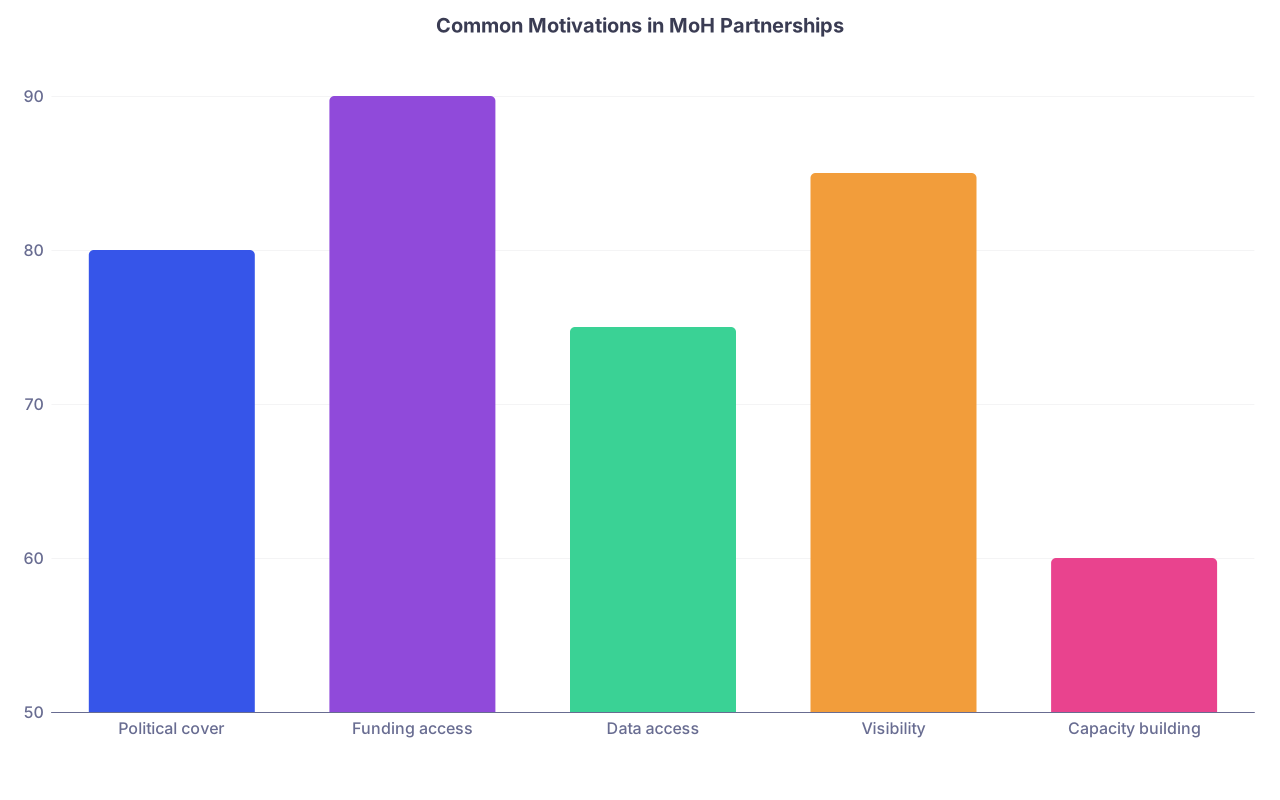
| Category | Value |
|---|---|
| Political cover | 80 |
| Funding access | 90 |
| Data access | 75 |
| Visibility | 85 |
| Capacity building | 60 |
Those percentages? Not real numbers, obviously. But they’re closer to the relative importance I’ve heard voiced in closed‑door conversations than anything written in memoranda of understanding.
The MOU: Theater vs. Reality
You’ll spend weeks, sometimes months, negotiating an MoU. Lawyers circling clauses. Deans emailing at 2 a.m. Program directors fussing about indemnity language.
Let me tell you what most MoH insiders say about MoUs when the visitors aren’t in the room:
- “Useful if someone gets in trouble.”
- “Good to wave at donors.”
- “We’ll see if they actually show up or disappear after one year like everyone else.”
The MoU is not the partnership. It’s a prop.
The real partnership lives in:
- Who can walk into which office unannounced and get 15 minutes
- Whose WhatsApp messages actually get answered on a weekend
- Who gets copied on internal memos about policy changes
- Whether the Director of Planning thinks you’re an asset or a headache
I’ve watched a team with a beautiful, carefully crafted 10‑year MoU get completely sidelined because a new Minister took office and brought in his own favored international partner. The MoU mattered less than a single dinner between the Minister and a rival NGO’s country director.
Ethically, banking on paper agreements while ignoring the human relationships is naïve at best and negligent at worst. You can’t promise your trainees or your funders a “long‑term sustainable partnership” if it’s pinned to one political appointee’s goodwill.
The Ethical Landmines You Don’t Read About In Journals
Let’s get specific with the kinds of situations that will put you in a moral vise.
1. Reporting Bad News
You successfully implement a maternal mortality review project. The numbers show preventable deaths tied to political decisions: drug stock‑outs from corrupt procurement, unstaffed rural facilities after budget cuts.
You write the report honestly.
The Minister’s office asks you—informally—to “tone down” the language before public release. “You don’t understand the political context,” they say.
Do you soften the report, risking complicity? Or do you publish the truth, risking your relationship and possibly your local colleagues’ positions?
2. Parallel Systems
Your donor funds a parallel HIV supply chain because the national one is broken. Patients get drugs. Great.
But now you’ve created a two‑tier system where “your” clinics have reliable medication and neighboring clinics don’t. When the Ministry finally tries to integrate systems, your donor balks at “loss of control.”
You are invited to advise. Do you protect your patients now or push for integration that may fail and jeopardize them—but is more equitable nationally?
3. Quiet Exclusion
You propose a training program emphasizing evidence-based family planning, including methods that are politically sensitive. A senior MoH official unofficially tells you: “We can fund this if you leave out that module.”
You know what the evidence says. You know what the politics will tolerate. Pick.
These are not hypothetical ethics textbook cases. They are Tuesday afternoon in plenty of MoHs.
How To Be Less Naïve And More Useful
You can’t control the politics. But you can decide whether you’re walking in blind or with your eyes open.
Here’s how the people who actually last more than a year tend to operate.
1. Map the Real Power, Not the Org Chart
Before you propose anything ambitious, sit down with at least three types of people:
- A senior MoH technocrat who has survived multiple Ministers
- A mid‑level program manager who does the daily grind
- A local partner (university/NGO) who’s been burned before
Ask: “If this project fails, who gets blamed?”
That question alone will tell you who really cares about it.
| Role | What They Really Control |
|---|---|
| Minister | Political direction, public framing |
| Permanent Secretary | Civil service, execution capacity |
| Program Director | Day-to-day resources and staff |
| Planning/Policy Unit | Approval bottlenecks, strategy docs |
| Donor Focal Person | External funding and partner access |
2. Be Honest About Your Own Incentives
Spell out—internally, at least—what you’re getting from this partnership:
Career advancement?
Publications?
Access to data?
Institutional prestige?
If you pretend those don’t exist, you will unconsciously prioritize them. If you acknowledge them, you at least have a shot at mitigating the distortions they cause.
3. Protect Local Colleagues From Your Courage
You might be willing to publish a hard‑hitting critique or push back on a political directive. Your local collaborators may not have that luxury.
Never forget: you get to leave.
Design publications, presentations, and advocacy strategies that do not hang your local colleagues out to dry. Rotate who is visible, who speaks, who signs. Discuss risks with them explicitly, not performatively.
4. Negotiate Data Governance Up Front
Do not treat data governance as an afterthought. That’s amateur hour.
Before your first patient is enrolled, know:
- Who legally owns the data
- Who has server access
- What happens if there’s political pressure to release or bury results
- What your university’s lawyers will back you on, and where they’ll fold
Put it in writing. Then understand it won’t fully protect you—but it gives you ground to stand on when the pressure comes.
A Pragmatic Ethical Frame: Harm, Benefit, and Replaceability
You’re not going to create a politics‑free global health bubble. So how do you decide what to do inside this mess?
I use three blunt questions when advising people:
- Harm – Who could be harmed by this decision, and can I realistically protect them?
- Benefit – Who genuinely benefits, and is that benefit contingent on my presence?
- Replaceability – If I walk away on principle, who fills this gap? Someone better, worse, or no one?
If softening a report’s language prevents your expulsion and allows you to continue work that clearly benefits patients, that might be the morally defensible call—especially if you find alternative ways to get the truth into safe hands.
If agreeing to a politicized staff selection for a training harms no one and buys you long‑term trust to make more important technical stands later, it might be a compromise worth making.
There’s no formula. But there is a mindset: strategic, honest, and unsentimental about your own role.
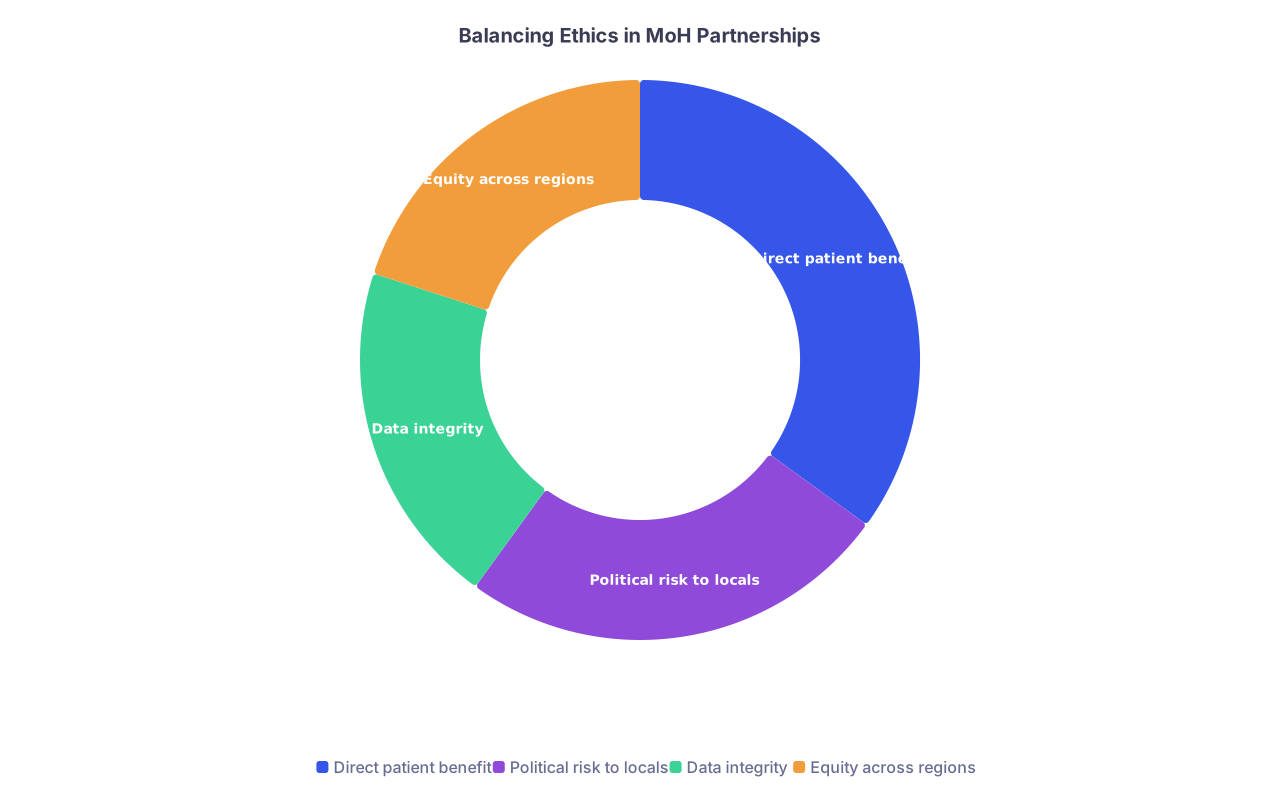
| Category | Value |
|---|---|
| Direct patient benefit | 35 |
| Political risk to locals | 25 |
| Data integrity | 20 |
| Equity across regions | 20 |
How This Shapes You As A Physician And Ethicist
This isn’t just about managing a partnership. It’s about who you become in the process.
You will learn to sit with compromise. To choose between flawed options. To accept that “least unjust” is sometimes the best you can do.
You will also learn something else: whether you’re the kind of person who needs the story to be clean, or the kind of person who can work in the mud without pretending it’s pure.
Both types have their place. But only one survives inside a Ministry’s orbit without burning out or selling out completely.
Years from now, you won’t remember every meeting in every shabby conference room. You’ll remember the moments you drew a line—and the moments you chose to cross one consciously. That’s the real politics of partnering with Ministries of Health abroad. Not the speeches. Not the MoUs. The choices you make when no one’s drafting the press release.


