
Short-term global health trips can quietly wreck your reputation if you do them wrong.
You won’t hear that in the glossy brochure. But faculty quietly talk about “that applicant who did surgery on a mission trip as a premed” or “the resident who posted a selfie with a dying child.” And those stories stick.
If you’re thinking about, planning, or remembering a short-term medical or service trip, you need to be more afraid of the ethical landmines than your peers usually are. Because the mistakes you make at 20 can come back up when you’re 35 and up for promotion, credentialing, or a global health role.
Let me walk you through the ethical pitfalls that actually matter and how to not sabotage your future self.
1. Practicing Beyond Your Training: The “Hero” Story That Becomes a Red Flag
This is the big one. The mistake that makes experienced reviewers roll their eyes—or raise an eyebrow.
You know the pattern:
- Premed goes on a “medical mission,” comes back talking about “suturing wounds” or “delivering babies.”
- M2 goes on a 10-day trip and suddenly they’re “running the clinic.”
- Someone proudly writes in a personal statement: “They had no doctor, so I stepped up…”
Here’s the hard truth:
What feels like “stepping up” on your trip can sound like unethical, unsupervised practice to anyone reading your application or hearing your story later.
Why this is so dangerous
- It violates scope of practice. If you wouldn’t be allowed to do it in your own country, doing it on another continent doesn’t magically make it ethical.
- It screams “colonial savior complex.” It suggests you think standards can drop when patients are poor, brown, or far away.
- It’s a liability nightmare. You may not get sued now. But you absolutely can have someone question your judgment years later when reviewing your global health CV.
Common beyond-scope mistakes
- Premeds:
- Independently performing physical exams or diagnosing
- Giving injections or starting IVs without clear, continuous supervision
- Deciding medications or doses
- Medical students:
- Performing procedures (suturing, deliveries, lumbar punctures) without appropriate training and direct supervision
- Being left alone to “run” a room or ward
- Residents:
- Taking on attending-level roles in settings where their training doesn’t match local expectations
- Making system-level decisions for a facility they barely understand
If you ever catch yourself thinking, “I could never do this at home, but here it’s fine,” stop. You’re about to make the kind of mistake that will haunt you.
How to avoid this trap
- Ask before you go:
- “What exactly will my clinical role be, and how does it align with my current training and licensure?”
- “Who is supervising me, and will they be physically present?”
- Refuse tasks you’re not trained or allowed to do. Yes, refuse. Even if everyone’s looking at you.
- Don’t brag in applications or interviews about “hands-on” experiences that were clearly beyond your usual scope. That doesn’t impress serious programs. It concerns them.
If a trip sells itself to students with language like “you’ll get to do things you’d never be allowed to do in the US,” that’s not a learning opportunity. That’s a giant red flag.
2. Using Patients as Props: Photos, Stories, and the Exploitation You Didn’t Notice
The fastest way to tank your ethical credibility?
Turn vulnerable patients into Instagram content.
I’ve watched selection committees scroll an applicant’s public social media while reading about a “global health passion,” only to find:
- Selfies with sick children (faces clearly visible)
- Photos inside an OR with patients identifiable
- Before/after images of wounds or deformities
- Savvy captions like “I came to give hope” or “Changing lives in [country]”
You may think you’re inspiring others. What programs see:
- “This person doesn’t understand consent or privacy.”
- “This person uses suffering as a backdrop for self-branding.”
- “Huge risk in any future global work.”
The ethical problems here
- Consent is murky at best. Language barriers. Power imbalances. Vulnerable people. “Nodding” is not informed consent for putting their image on your U.S.-based account.
- HIPAA may not apply there, but professionalism does. If it would violate privacy at home, it looks bad if you do it abroad.
- It feeds a savior narrative. You’re centered. Patients are scenery.
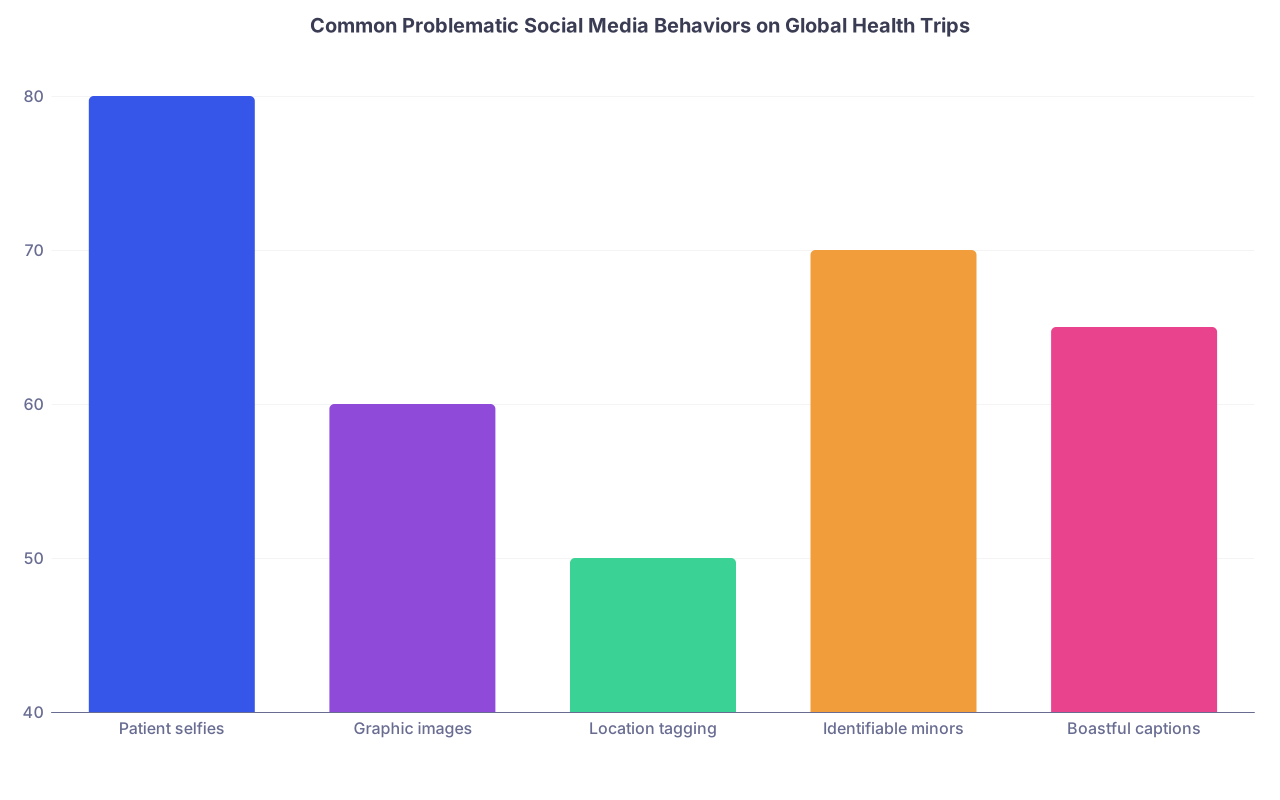
| Category | Value |
|---|---|
| Patient selfies | 80 |
| Graphic images | 60 |
| Location tagging | 50 |
| Identifiable minors | 70 |
| Boastful captions | 65 |
Percentages here are based on what faculty, program directors, and responsible global health people repeatedly complain about when they talk about student trips. I keep hearing the same themes.
Safer practices that don’t haunt you later
- Default: Don’t photograph patients at all. Especially not their faces. Especially not minors.
- If photos are clinically approved for teaching:
- Obscure all identifiers.
- Don’t post them on personal accounts. Ever.
- Stories in statements/interviews:
- Don’t use trauma porn. You don’t need the most shocking case you saw.
- Focus on what you learned about ethics, systems, or humility, not your emotional “awakening” at someone else’s expense.
If you already posted problematic content, remove it. Now. Do not wait for an application cycle to “clean up.” Screenshots are forever, but don’t make it easier.
3. Voluntourism and “Hit-and-Run” Care That Leaves Chaos Behind
Another mistake that looks harmless when you’re 19: signing up for a one-week “medical brigade” that sweeps into a community, hands out meds, and disappears.
You feel useful. Locals seem thankful. But here’s what people in global health, public health, and serious ethics work see:
- No continuity of care
- Unknown quality of medications
- Destabilization of local providers (“Why go to the clinic if free foreigners come sometimes?”)
- Zero evaluation of long-term impact
When you later claim “I care about sustainable global health,” but your CV is filled with disorganized, one-off trips with no local partnerships, it does not help your credibility.
Classic red flags of short-term medical voluntourism
- The program can’t name specific local partners or health authorities they work with.
- No plan for follow-up care after you leave.
- Bringing in your own formulary of random meds from donations with no integration into local systems.
- Clinics held in churches/schools with no documentation feeding into any local record system.
- Groups bragging more about “how many patients we saw” than about strengthening local capacity.

How this bites you later
- Serious global health fellowships and MPH programs can spot voluntourism on a CV from a mile away.
- Mission-trip-heavy applications with no depth, no long-term engagement, and no clear learning arc look immature.
- If asked, “What long-term impact did your work have there?” and you have no answer, it’s obvious.
What you should do instead
- Prefer programs that:
- Are invited and co-led by local partners
- Integrate into existing health systems
- Have clear processes for continuity of care
- Put emphasis on local capacity, not foreign student “experience”
- Better yet:
- Commit to the same site long term (years, not days).
- Or start with domestic underserved work that teaches you about structural issues before you fly overseas to “help.”
Short-term trips can be ethical, but not if they exist mainly to give you photos and a sense of moral achievement.
4. Documenting Work Poorly: The Sloppy Paper Trail That Can Haunt Credentials
Everyone loves the excitement of a trip. Few students pay attention to documentation, licensing, or formal approvals. That’s how you create headaches for your future self.
You do not want, years later during credentialing or a global health job application, to be asked:
- “Under what license did you practice there?”
- “Who supervised your clinical work?”
- “Do you have documentation of your appointment/role?”
And your answer is, “Uh, I just kind of went with this NGO and did what they told me.”
The quiet, unsexy details you can’t ignore
- Did the host country recognize your supervisors’ licenses and roles?
- Were you officially attached to a local institution/hospital/clinic?
- Were there MOUs or affiliation agreements between your school and the host site?
- Did your malpractice coverage (if any) extend to that country and those activities?
| Item | Why It Matters |
|---|---|
| Written role description | Proves you weren’t freelancing care |
| Supervisor’s name/credentials | Connects you to legitimate oversight |
| Institutional affiliation | Shows this wasn’t rogue or ad hoc |
| Proof of predeparture training | Signals some ethical preparation, not chaos |
| Any local approval letters | Demonstrates host-country consent |
If you ever can’t answer, “Whose license was I working under?” that’s not just a small oversight. It’s a serious ethical and legal problem.
How to protect yourself
- Before you go:
- Ask where your role is defined on paper.
- Clarify supervision and licensure lines explicitly.
- Confirm that your own institution is aware and supports the trip.
- After you return:
- Keep copies (digital and physical) of:
- Confirmation emails
- Role descriptions
- Trip syllabi (if it was for credit)
- Evaluation forms
- Keep copies (digital and physical) of:
You’ll thank yourself when someone asks, ten years later, “Tell me more about this work in Malawi—who were you working with there?”
5. Ethics Training: Skipping It Now, Paying for It Later
Here’s a blunt observation:
The students most excited about going abroad are often the least patient with predeparture ethics training.
They want the adventure. The photos. The “I saw things you wouldn’t believe” story. They don’t want to sit in another lecture about power, colonialism, and structural violence.
But if you skip or half-pay-attention to serious global health preparation, it shows. In your language. Your decisions. Your writing. And ultimately, in how trustworthy you look.
What skipping ethics prep looks like later
- Personal statements that frame you as “saving” people, not learning from them.
- Describing “how happy they were even though they had nothing” (huge cliché; also condescending).
- Discussions of health inequity that ignore politics, history, and systems—and center your feelings.
Programs doing any kind of global work are allergic to this now. They’ve seen the damage.
What solid ethics preparation should include
If your program or trip doesn’t include at least most of this, that’s a sign:
- Power dynamics and postcolonial critique (yes, really)
- How to talk about and with patients across cultures without stereotyping
- Scope of practice and supervision in low-resource settings
- How to say no ethically when pushed beyond your skill level
- Media and photography ethics
- Sustainability and partnership principles
If you haven’t had that kind of training yet, seek it out before your next trip. A short, high-quality predeparture course or workshop can prevent you from doing the kind of thing that gets whispered about later in selection committees.
6. Writing and Talking About Trips in a Way That Damages Your Reputation
I’ve sat in on discussion of applications where the trip itself was fine—but the way the applicant wrote about it torpedoed their image.
The stories that cause problems almost always sound like:
- “They had no access to health care until we arrived.”
- “I was the only one who could help.”
- “I realized how privileged I am and decided to go fix this problem.”
That kind of self-centered, factually shaky narrative suggests you learned very little.
Phrases that send up red flags
Avoid these like they’re contaminated sharps:
- “Gave them hope” / “brought them joy”
- “They were so grateful for anything”
- “They had nothing but were so happy”
- “We were their only resource”
- “I did things I would never be allowed to do in the US”
When faculty hear that last one, they don’t think, “innovative.” They think, “dangerous.”
How to talk about short-term trips without shooting yourself in the foot
- Focus on:
- Systems issues you observed (supply chains, staffing, infrastructure)
- How local colleagues led and you followed
- Mistakes you didn’t make because you understood your limits
- How the experience changed your understanding of power and responsibility
- Be honest about limitations:
- “I realized a one-week trip could not fix chronic underfunding.”
- “I became more skeptical of fragmented, short-term efforts.”
If your trip narrative ends with “so now I want to go back and fix it,” you’ve missed something. If it ends with “so now I respect local leadership and aim for long-term, equitable partnerships,” you’re on better ground.
7. Choosing Bad Programs: If the Sales Pitch Feels Off, Believe It
Let’s be blunt: there are terrible global health “experiences” marketed aggressively to students who don’t know better. And saying yes to them is an ethical mistake you own, even if you were naive at the time.
Programs that should make you walk away:
- They guarantee clinical procedures for undergrads or early medical students.
- They emphasize “you’ll get to do X that’s not allowed in your country.”
- They have no clear, named local medical partners.
- They can’t answer detailed questions about:
- Continuity of care
- Supervision structure
- How they know they’re not undercutting local providers

| Step | Description |
|---|---|
| Step 1 | Offered Short Term Global Trip |
| Step 2 | Do not go |
| Step 3 | Non clinical or decline |
| Step 4 | More likely ethical |
| Step 5 | Clear local partner? |
| Step 6 | Defined role and supervision? |
| Step 7 | Within your scope? |
| Step 8 | Continuity of care plan? |
You’re responsible for asking the hard questions. “I didn’t know” is understandable once. Repeating the same kind of trip, year after year, without ever engaging with the ethics? That starts looking like a pattern of poor judgment.
FAQ (4 Questions)
1. I’m a premed and was offered a chance to “help in a clinic” abroad. What’s actually okay for me to do?
Observation is fine. Assisting with logistics, vitals under supervision, patient flow, basic health education scripted by professionals—also usually fine. Independently examining, diagnosing, prescribing, or doing procedures? Not okay. If your role wouldn’t be allowed at home, don’t let the country change your ethics.
2. I already did a trip that, in hindsight, crossed ethical lines. Am I doomed?
No, but you need to own it. Don’t brag about the questionable parts. If it comes up, frame it as: “I realized later that I’d been put in roles beyond my training. That discomfort is exactly why I sought out formal ethics training and now choose only structured, supervised programs.” Growth is acceptable. Defensiveness is not.
3. Can I ever post any photos from my trip?
Only if: (1) no patients are identifiable, (2) your institution and host site agree it’s appropriate, and (3) the purpose is educational, not self-promotional. Group photos of your team outside clinical spaces? Usually fine. Anything with vulnerable people in clinical or traumatic contexts? Keep it off the internet.
4. Are short-term trips always bad?
No. They’re often poorly done, but not inherently unethical. The key questions: Were you invited by local partners? Was your role clear and within your training? Was there continuity of care? Did the trip prioritize local capacity over your “experience”? If yes, you’re on more solid ground. If not, think very hard before signing up again.
Remember these core points:
- If you wouldn’t be allowed to do it at home, don’t do it abroad.
- Patients are not props for your story or your social media.
- Short-term trips that ignore systems, supervision, and sustainability will follow you longer than you think.
Protect your future self now. The people reviewing your applications later are far less impressed by “adventure” than by restraint, humility, and a clear ethical spine.


