

The fear that you’ll freeze in a crisis zone is not a red flag. It’s a sign your moral compass actually works.
I’m just going to say the quiet part out loud: a lot of people going into global health secretly worry, “What if I’m useless when it really matters?” Not just nervous. Useless. Frozen. In the way. The kind of fear you don’t put on your motivation letter.
You’re not crazy for thinking that. You’re honest. And honestly scared.
Let’s unpack this in a way that doesn’t just say “you’ll be fine” and pat you on the head, because that doesn’t help at 3 a.m. when you’re imagining kids bleeding in the hallway and your hands not moving.
The ugly “what if” loop in your head
Here’s how the mental horror movie usually goes, right?
You picture yourself finally getting deployed with an NGO—maybe MSF, ICRC, Partners In Health, whoever. There’s been a bombing, or a cholera outbreak, or a mass casualty event. People screaming, blood, chaos. Someone shouts your name, asks for help, and…
Silence.
Your brain goes blank. Your hands don’t move. You’re in the corner, heart pounding, watching other people jump into action. Later, people talk about “that trainee who froze.” You get sent home early. You’re ashamed for months. Maybe years.
And then the guilt spiral:
“If I freeze there, I don’t just embarrass myself. I could literally cost someone their life.”
I’m not going to insult you by saying, “Oh that won’t happen.” Because freezing is a real response. I’ve seen excellent clinicians lock up for a few seconds in their first real trauma. I’ve seen people cry in a supply closet after a code. You’re not weird for worrying about this.
But here’s what you’re getting wrong: you’re picturing freezing as a permanent character flaw instead of a temporary neurophysiologic reaction that can be anticipated, softened, and worked around by actual systems and training.
Freezing isn’t moral failure. It’s your nervous system doing its job.
This isn’t about being “brave enough” or “caring enough.” That’s the myth. The whole “heroes don’t freeze” thing? Garbage.
Under extreme stress, humans have a few basic responses: fight, flight, freeze, fawn. In healthcare we glamorize “fight” (jump in, do compressions, call the shots) and pathologize “freeze” like it means you don’t care enough. That’s not how it works.
Freezing is your brain doing an emergency systems check:
- Threat level: off the charts
- Sensory input: overwhelming
- Options: not yet sorted
So it slams on the brakes. You feel detached, tunnel vision, or like time slows. You’re not choosing that. It’s automatic.
Most people don’t realize: short freezes are common even in experienced staff. They just get shorter and less visible with practice and structure. It goes from “30 seconds staring at the patient” to “half a heartbeat while your protocol training kicks in.”
And that’s what you’re really afraid of, right? The long, visible freeze.
The bad news: you can’t completely eliminate the possibility.
The good news: you can absolutely reduce the duration and impact, and you’re almost never alone in these situations.
Crisis zones aren’t solo hero movies. They’re choreography.
You’re picturing a nightmare where it’s just you and twenty injured patients, like some movie scene where you’re the only one with a stethoscope.
Reality in most structured deployments is messier but also safer than your imagination:
- There’s a team. Usually multi-level: local staff, expats, logistics, security.
- There are protocols. Triage colors, cholera treatment protocols, PEP flowsheets.
- There’s usually a chain of command. Someone whose literal job is to direct traffic.
You as a newcomer are very rarely the top of that chain. You’re not meant to be the calm center on day one.
You know what your “job” often is in a mass casualty, especially early in your career? Things like:
- Hold pressure here.
- Start this IV.
- Move this patient to that zone.
- Keep track of these vitals.
All things you can still do even if your brain is screaming and your heart rate is 140. Because they’re broken down into small, specific tasks.
The times I’ve seen people truly paralyzed for longer than a few seconds? Usually when they were:
- Alone or felt alone.
- Given zero clear role.
- Seeing something completely outside their training with no structure.
Which means your preparation strategy isn’t “be fearless.” It’s “be trained enough and integrated enough that when fear hits, you have rails to hold on to.”
What you can do before deployment to blunt the freeze
You want concrete, not fluffy reassurance, so let’s get practical.
1. Get uncomfortable now, in controlled ways
You can’t simulate a war zone, but you can train your nervous system to keep functioning while stressed.
Seek out:
- High-acuity rotations (ED, trauma bay, ICU) where you’re allowed to participate, not just stand in the back.
- Simulation labs with code situations, mass casualty drills, difficult airway scenarios. The more ridiculous your heart rate gets in sim, the better. That’s reps.
- Even basic life support and ACLS refreshers, but done seriously, not as a checkbox.
Pay attention to your body in those situations: sweaty palms, dry mouth, mental fog. That’s your rehearsal space.
The win isn’t “I was totally calm.” The win is “I noticed panic and still executed Step 1, then Step 2.”
2. Script your first 30 seconds
The worst freeze usually sits in the “I don’t know what to do first” gap. So fill that gap now. Literally write it.
For example, in any acute crisis, your internal script can be:
- Breathe out once, slowly.
- Look for whoever is clearly in charge and go to them.
- Say: “I’m [name], [role]. What do you need me to do?”
That’s it. Your first job is not “save everyone.” It’s “attach to the system that’s already trying.”
Then have tiny sub-scripts for common roles:
- If someone hands me a patient: check ABC (airway, breathing, circulation).
- If they say “triage”: look at breathing, bleeding, mental status, then color-code.
- If they say “just hold pressure”: do that, and keep talking to the patient.
You can practice these in your head like mental reps. Yes, it feels silly. Do it anyway.

| Step | Description |
|---|---|
| Step 1 | Arrive at Scene |
| Step 2 | Exhale once |
| Step 3 | Identify leader |
| Step 4 | State name and role |
| Step 5 | Ask what is needed |
| Step 6 | Focus on that task |
| Step 7 | Ask again or help with basics |
| Step 8 | Assigned a task |
3. Accept that you’re not the hero, you’re a helper
This sounds small but it’s massive for performance. If you think you’re supposed to be the anchor that holds the whole place together, of course you’ll freeze. You’ve already decided that anything less than “flawless” is failure.
Reframe:
“I’m one part of a system. My job is to be one more pair of competent, willing hands.”
You are allowed to be scared. You are allowed to say, “I need a second” as long as you communicate. You’re allowed to lean on a nurse who’s seen this a hundred times more than you have.
I’ve seen junior people beat themselves up for days because they “weren’t decisive enough,” while the rest of the team was just grateful they stayed in the room and did the basics.
The ethics knot: is it wrong to go if I might freeze?
This is the darker thought under everything:
“If there’s even a chance I’ll freeze, maybe I’m being selfish to deploy at all.”
Let me answer bluntly:
Going to a crisis setting with honest awareness of your limits and a commitment to training is ethical.
Going in with delusions of invincibility and no self-awareness is far more dangerous.
Most reputable global health organizations are not expecting perfection. They expect:
- You understand you will be out of your comfort zone.
- You’ll follow protocols and hierarchy.
- You’ll speak up if you’re out of depth.
- You’ll debrief and learn.
They will screen you. They’ll check your clinical experience, references, resilience markers. You’re not sneaking onto the front lines undetected.
If you’re worried about the ethics of “what if I can’t cope,” ask these questions of yourself and the organization:
| Area | Question to Ask Yourself |
|---|---|
| Motivation | Am I going for patients and team, not my CV? |
| Training | Have I practiced emergencies in any setting? |
| Honesty | Will I actually say “I’m not comfortable” if true? |
| Support | Is there mental health / debriefing support? |
| Supervision | Will I be supervised appropriate to my level? |
If you can’t honestly say “yes” to most of those—and the organization can’t either—then the issue isn’t your fear. It’s the deployment planning.
What it actually feels like the first time things go bad
Let me demystify this with a realistic scenario instead of your brain’s apocalypse version.
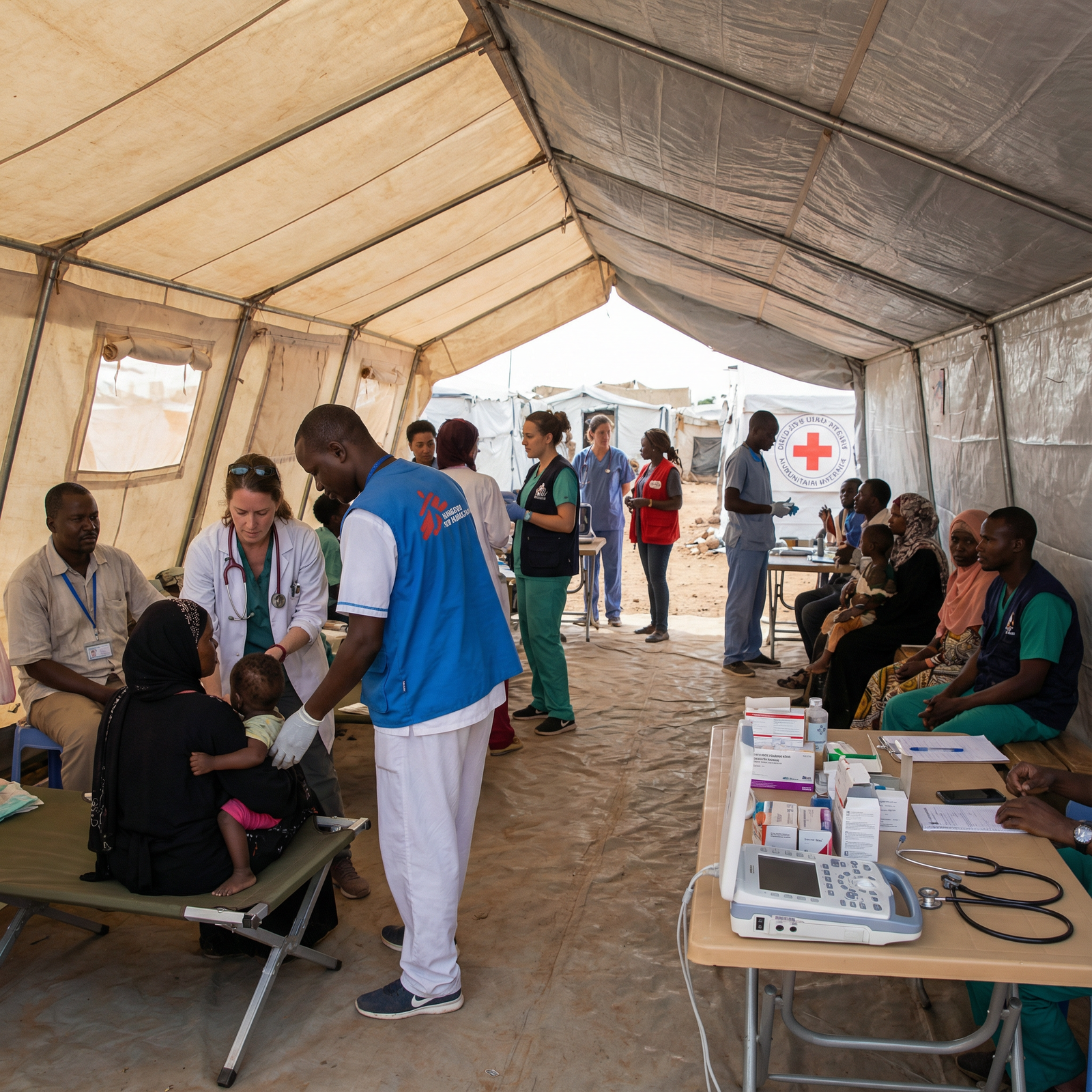
You’re in a field hospital in a conflict area. There’s been an explosion in a nearby market. Several trucks pull up with injured people.
What happens is not “someone dies in front of you while you stare.”
What tends to happen:
- Someone yells that mass casualty is incoming. Everyone moves into predefined positions. Even if it’s a bit messy, there is a pattern.
- Senior clinician or nurse sets up triage at the door. Runners, scribes, airway team, procedure team, etc.
- You get told: “You’re with triage,” or “You’re in the red zone,” or “You’re only doing IVs and vitals, nothing else.”
Your heart starts pounding. You’ll feel too slow. You’ll make minor mistakes—maybe fumble a cannula, forget a blood pressure, need to be reminded of a drug dose.
You might freeze for a second when you see your first truly awful injury. That’s normal. The key is that the system around you is designed so that one person’s two-second pause doesn’t stop the entire response.
I’ve watched people visibly shake but still:
- Keep holding a bag valve mask.
- Still talk to a terrified child.
- Still pass instruments in a minor procedure.
That “I’m scared but I’m still here” counts. A lot more than your fear wants to admit.
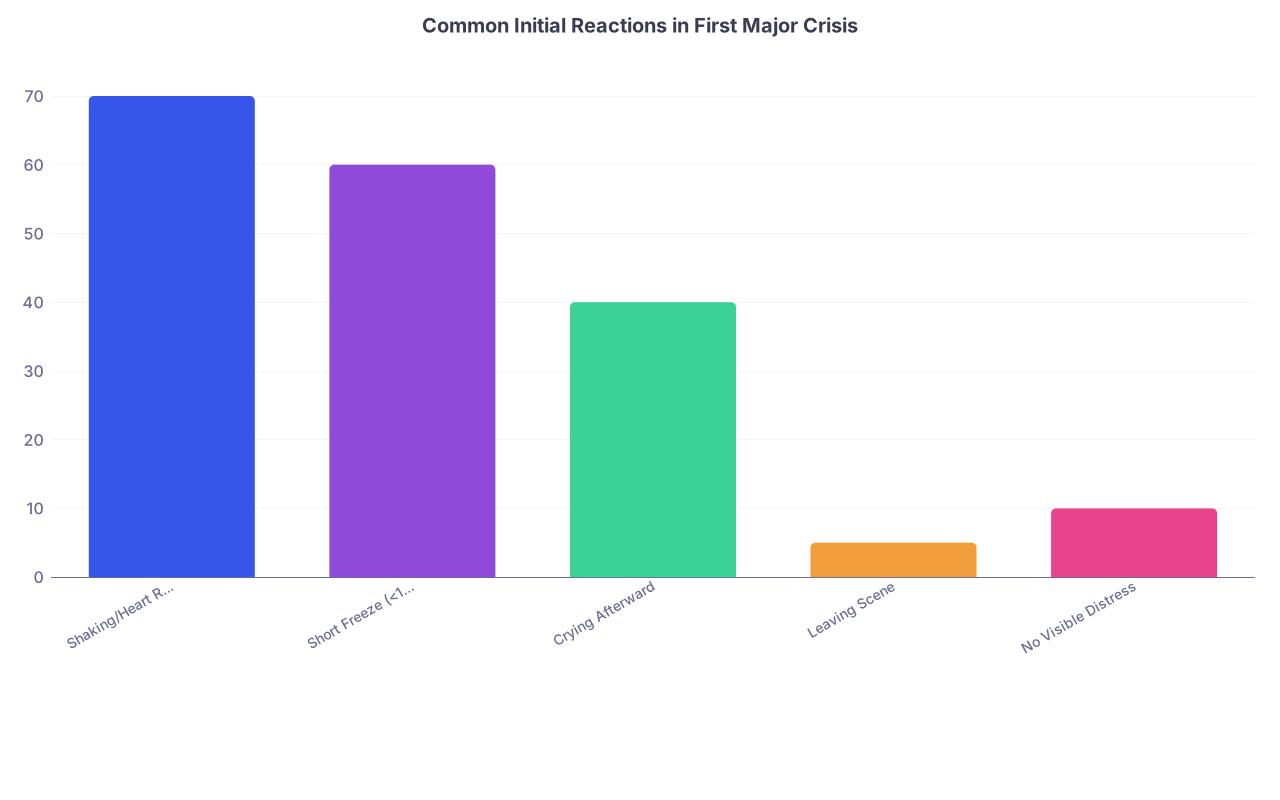
| Category | Value |
|---|---|
| Shaking/Heart Racing | 70 |
| Short Freeze (<10 sec) | 60 |
| Crying Afterward | 40 |
| Leaving Scene | 5 |
| No Visible Distress | 10 |
(Hypothetical but realistic proportions based on what people actually report. Notice how “short freeze” is normal and “leaving the scene” is rare.)
What if I do freeze in a really bad way?
Let’s say worst case: you lock up, can’t act, and someone else has to physically move you aside. Your fear’s worst nightmare.
Is that ideal? No. Does that permanently brand you as “unfit”? Also no.
What usually happens afterward, in decent teams:
- Someone checks on you. Maybe right away, maybe at the debrief.
- You get a chance to process what you saw and felt.
- You get assigned different tasks next time that match your current capacity.
- You might get pulled from the very front edge of things for a bit.
People don’t instantly assume bad character. They assume human nervous system, first big crisis.
What becomes more problematic is if you:
- Deny it happened and refuse to reflect.
- Blame everyone else.
- Ignore feedback and keep pushing past your limits without talking.
Ethically, what matters isn’t “Did I ever freeze?” It’s “How did I respond afterward? Did I learn, adjust, seek help, or did I pretend I was fine?”
Your fear imagines a one-shot pass/fail exam. Real life is more like repeated OSCEs: you mess up, you go over it, you try again, you build skills.
Building a personal “anti-freeze” toolkit
You’re not going to meditate your way out of the physiology of fear, but you can give yourself tools.
Here’s what’s actually useful (and what’s fluff):
Useful:
Short grounding techniques you can do in 3 seconds: feel your feet, exhale, name one concrete task you’re doing next.
Clear self-talk: “I’m scared and I can still do X.” Not “I must be calm.” Just “and still.”Fluff:
Vague “stay positive” slogans.
Imagining you’ll be serene and wise under fire from day one.
Before deployment, literally write a one-page plan:
- What I do in the first 30 seconds of chaos.
- What I will say if I feel overwhelmed (“I need a hand here” / “I’m not comfortable leading this”).
- Who I can talk to on my team afterward.
- What coping skills I’ve used before under stress that actually helped (journaling, short walks, music, quiet corner).
It feels overkill until you’re actually there. Then you’re glad Past You thought of it.
When is it actually a sign you shouldn’t go?
Your brain will try to interpret any anxiety as “proof” you’re not cut out for this. That’s not true. But there are situations where it’s wise to pause.
Consider delaying or reconsidering deployment (for now) if:
- You have uncontrolled panic attacks in much lower-stress clinical situations already, and you’re not in treatment.
- You dissociate (lose time, feel outside your body) frequently under stress and this is untreated.
- You have recent severe trauma of your own that you haven’t had any support for, and crisis work would likely re-trigger it.
- You feel a desperate need to “prove” yourself or “escape” your own life more than a steady desire to serve patients.
Not “never go.” But “do the inner work first, with a therapist who understands trauma and/or global health work.” That’s not weakness. That’s professionalism.
Programs that take mental health seriously won’t punish you for saying, “I want to be sure I’m stable enough to do right by the patients.”
The thing you’re forgetting to give yourself
You’re mentally narrating a story where everyone else is calm, flawless, efficient—and you’re the only one shaking in the corner.
Reality check: people self-edit when they talk about their “field experience.” They highlight the wins, compress the panic into one sentence—if they mention it at all.
I’ve had residents quietly admit:
- “I almost threw up during my first code.”
- “I walked into the bathroom and cried between patients.”
- “I didn’t do anything for the first minute; I just watched the nurse and copied her.”
Yet these are the same people students later idolize as “ so calm under pressure.”
You’re not allowing yourself that human arc. You’re demanding you start where others ended up after years.
The ethical, mature thing you’re doing—which you’re not giving yourself credit for—is asking the question before you go. Imagining worst case and trying to plan around it.
That’s what I wish more applicants did.
FAQs (the ones that keep me up at night)
1. What if other people on the team secretly judge me for being scared?
Some might. There are always a few people who cope by acting tougher-than-thou. But most experienced staff have their own stories of fear and overwhelm. The ones who matter will judge you on whether you show up, follow directions, learn, and communicate—not on whether you ever got shaky. And honestly, if a place’s culture is “weakness is forbidden,” that’s a red flag about the organization more than about you.
2. Should I tell the organization about my fear before deployment?
Not in a dramatic confessional way. But yes, you can be honest in a grounded way. Something like: “I’m aware I haven’t seen mass casualties before and I know I get anxious in new high-stress situations. I’m actively training in ED/ICU and sim to prepare, and I’m committed to working within a team structure and asking for help if I’m overwhelmed.” That signals self-awareness, not incapacity.
3. Is it unethical to leave a deployment early if I can’t handle it emotionally?
Staying when you’re dangerously non-functional is more unethical than leaving. The key is how you leave. You don’t just vanish. You talk to your supervisor, explain what’s happening, help hand off your responsibilities, and arrange a reasonable transition. That’s painful, yes. But it’s not a moral failure. It’s protecting patients and the team from an unsafe situation.
4. Can I prepare for this without a fancy sim center or trauma rotation?
Yes. You can still do a lot: get BLS/ACLS certified, volunteer in a busy ED as a non-clinical helper if allowed, shadow rapid response teams, run through mental rehearsals of emergency algorithms, read field manuals (like MSF guidelines), and practice grounding techniques under smaller stresses (exams, OSCEs, hectic clinics). It’s not perfect, but it builds some muscle memory and emotional tolerance.
5. How do I know the difference between “healthy fear” and “I’m actually not suited for this work”?
Healthy fear nags you but still leaves room for curiosity, preparation, and a sense of “I think I could grow into this.” Deep misalignment feels more like dread and revulsion that doesn’t shift even when you imagine yourself well-supported and well-trained. If every version of the story—no matter how structured, supervised, and gradual—makes you feel sick, it might be a sign your contribution to global health should be in a different lane (policy, research, long-term primary care, etc.), which is completely valid.
Two things to hold on to from all this:
- Freezing is a human reflex, not a verdict on your character. With training, structure, and a real team, it becomes a moment, not your identity.
- The fact that you’re worried enough to read this, to imagine the worst and plan around it, is exactly the kind of mindset that makes you safer—not more dangerous—in a crisis zone.


