

The residents who land elite global health tracks are not always the smartest, the kindest, or the most “passionate.” They’re the ones who understand how the system actually decides who is safe to put on a plane with the institution’s name on their chest.
Let me tell you what really happens behind those selection meetings. Because it’s not what the glossy brochure suggests.
Program directors and global health faculty are not just picking “future changemakers.” They’re asking a much colder question: Who will not embarrass us, ethically or politically, 8,000 miles from home? Once you understand that, the selection patterns make brutal sense.
Below the mission statements and the photos of smiling kids, this is a risk‑management exercise wearing a humanitarian mask.
What Elite Global Health Tracks Really Are
Forget the marketing language for a second.
Elite global health tracks—the branded ones at places like UCSF, Harvard, Hopkins, Baylor, Duke, Michigan—are three things at once:
- Talent pipelines for future faculty and grant winners.
- Relationship maintenance tools with partner sites that took decades to build.
- High‑visibility PR projects for the institution.
When faculty sit down to choose residents, they’re not thinking a lot about your personal dream to “serve the underserved.” They’re thinking:
- If I send this resident to our Rwandan, Ugandan, Indian, or Guatemalan partner, will they respect local clinicians and not play white savior?
- If something goes wrong—a boundary violation, a social media scandal, a patient harmed—will this come back to me as the idiot who picked them?
- Can this person function without a CT scanner and four consultants on speed dial without melting down or acting superior?
That’s the real filter.
The mistake you’re probably making is assuming it’s about your interest level and your CV volume. It’s not. It’s about predictive trust and ethical maturity under pressure.
The Shortlist Is Made Long Before You Apply
Here’s the part people hate hearing: by the time the formal application opens, the selection committee already has a mental shortlist.
They know:
- Who showed up to the poorly attended global health journal club at 7 pm when there was no credit.
- Who stayed after the global health seminar to ask sharp, respectful questions—instead of telling stories about their “impact” on a 2‑week trip.
- Who quietly did the unglamorous work of data cleaning or QI help for a faculty member’s international project.
On paper, the selection criteria might look like this:
| Factor | How Programs Actually Weigh It |
|---|---|
| Prior overseas work | Helpful if mature, harmful if naive |
| Research/QI output | Strong plus, especially global-focused |
| Faculty advocacy | Critical for borderline candidates |
| Professionalism record | Non-negotiable filter |
| Language skills | Bonus, rarely decisive |
In the meeting, it sounds more like this:
- “I’ve worked with her on the maternal health project. She doesn’t need a lot of hand‑holding. She listens.”
- “He did that elective in Kenya but everyone said he was a cowboy—doing procedures he wasn’t trained for. Hard no.”
- “She’s very high‑energy but sucks the oxygen out of the room. I don’t want to inflict that on our partners.”
You see the problem. You’re obsessing over how your personal statement sounds. They’re trading stories about how you behaved when you thought no one was evaluating you.
The Unspoken Blacklist
There’s also a quiet blacklist. No one writes it down, but it exists.
Residents get silently filtered out for things like:
- Chronic lateness or no‑shows to didactics.
- Complaints from nurses about rudeness or dismissiveness.
- Social media postings from “mission trips” where they posed with patients, or wrote patronizing captions about “grateful people with nothing.”
Did anyone tell them this would kill their global health chances? No. But when your name comes up, the room goes cold.
“I’m not comfortable sending them abroad.”
That sentence is the death blow. It might be about your ethics. It might be about your emotional stability. Sometimes it’s basic: you’re clinically unsafe and no one wants to say it bluntly to your face.
Why That Other Resident Got Picked Instead of You
Let me walk you through a very real dynamic I’ve watched play out.
Two PGY‑2s in internal medicine apply to an elite global health equity track.
- Resident A: High Step scores, chief resident material, did a summer in Peru in med school, big talker about “structural violence,” no publications, lots of Insta posts from past trips.
- Resident B: Average scores, quieter, did several years of local refugee clinic work, co‑authored a small paper with a global health attending, known as solid and unflappable on wards.
If you looked at their ERAS or their personal statements, A “sounds” more global health‑y. Lots of buzzwords. Big dreams. But when the committee meets, here’s what happens:
Someone says about A:
“Sharp kid, but I worry he wants this for the story, not the work. Remember his Cambodia trip photos? Also, he tried to volunteer for a procedure he wasn’t credentialed for on night float. Makes me nervous.”
Then about B:
“She’s not flashy, but she has shown up for the refugee clinic every month for two years. The partners will like her. She’ll respect the boundaries. If something goes wrong, she’ll ask for help, not improvise.”
B gets the spot. A ends up asking, “What did I do wrong?”
Answer: nothing dramatic. He just never convinced anyone that he was safe to put in a politically and ethically charged environment.
What Faculty Look For That You Don’t See
There are a few traits that virtually every serious global health faculty member screens for, whether they say it out loud or not.
1. Humility That Survives Stress
Everyone can write about humility. Few people can demonstrate it when cross‑covered, exhausted, and deprived of their usual resources.
Faculty look for:
- How you handle uncertainty: Do you say “I don’t know, I need help” or confidently guess?
- How you treat non‑physician staff: Are you kind to interpreters, nurses, community health workers? Or only when it’s obvious someone’s watching?
- How you talk about past experiences: Do you center your learning or your “impact”?
This is partly why local, longitudinal work (refugee clinics, FQHCs, asylum evaluations) counts more than your one‑off “medical mission.” It lets them see your behavior repeated over time.
2. Ethical Reflexes, Not Just Ethics Talk
Ethics lectures are easy. Ethical reflexes—those snap decisions in messy situations—are what scare program directors.
They imagine you facing:
- A family asking you for medications you know you can’t sustainably provide.
- A local trainee pressured to copy your practice even if it’s not consistent with local guidelines.
- A senior local physician saying, “Just sign this; we always do it this way,” and it feels… wrong.
When faculty read your application and talk to your references, they’re asking: Will this person pause, think, and seek guidance? Or will they improvise and apologize later?
They’re watching for red flags like:
- Stories where you were the “hero” and locals are props.
- Casual dismissal of local practices as “backwards.”
- Research projects that look suspiciously like data extraction: you got the line on your CV; what did the local site get?
3. Adaptability Without Drama
Global health tracks don’t want residents who crumble outside academic tertiary‑care comfort. They also don’t want adrenaline junkies.
They want residents who can:
- Accept that they won’t have their usual diagnostic toys and not complain endlessly.
- Adapt to slower systems without constant comparison to “how we do it in the States.”
- Function in ambiguity without using it as license to be sloppy.
People who’ve done real work in low‑resource domestic settings often show this better than those with one stamp in their passport.
4. Genuine Partnership Mindset
Elite programs are obsessively protective of their long‑term partnerships. Some of these relationships took 10–20 years of repeated visits, shared grants, shared papers.
They’re asking: If we send you to our partner in Haiti or Malawi or Nepal, will you behave like:
- A guest in someone else’s house?
- Or an “expert” bringing modern medicine to the natives?
How do they tell? The way you talk about “capacity building” vs “helping,” whether you know the names of local collaborators, whether any of your work has their names first on the project.
You put “global health” on your CV. They’re quietly looking for “global reciprocity.”
How Selection Decisions Actually Get Made
Let’s pull back the curtain on the meeting itself.
You think it’s a formal, point‑based process. Something like, “5 points for publications, 3 for language skills.” Sometimes there’s a rubric. It’s mostly there for show.
Here’s what it really sounds like in the room.
First, they throw out the obvious nos:
- Someone with recent professionalism or boundary concerns.
- Someone with major performance remediation.
- Someone who treated a previous global elective like vacation.
Then they go through the rest. One by one.
A faculty member who knows you will say a version of:
- “I’d be comfortable sending her anywhere.”
- “I’d send him, but only with a very structured site.”
- “I don’t want my name on this if we pick her.”
That phrase—I’d be comfortable sending them anywhere—is the gold standard. It’s a code for: good judgment, adaptable, humble, clinically safe, not a nightmare to supervise remotely.
You don’t hear this language publicly. But I’ve heard it dozens of times in rooms where your file is open on the table.
The Role of Faculty Champions
One more harsh truth: faculty advocacy trumps most CV details.
If a global health leader says, “I want this person,” 9 times out of 10, that person gets a spot. Not because the process is corrupt, but because the person making that statement is also saying, “I’m willing to stake my reputation on them.”
You think you’re building an application. They think they’re building a risk profile. A champion is someone saying, “I’ll absorb some of that risk.”
If you’ve never really worked with any global health faculty beyond a hallway conversation, you’re not in that protected zone, no matter how “interested” you are.
Why Your “Mission Trip” May Be Hurting You
Let’s talk about the elephant in the room: pre‑residency “mission trips” and short‑term outreaches.
Used correctly, they can be a starting point. Misused, they’re a red flag. I’ve watched committee members pull up a candidate’s old social media (yes, they do this when unsure) and cringe.
The patterns that kill you:
- Photos of you performing procedures you were clearly not licensed to do at home.
- Photos of children without consent, with pity‑porn captions.
- Blog posts where you romanticize poverty or talk about “changing lives in just 10 days.”
When you then write a personal statement about “ethical global partnerships,” you’ve already lost the room. They no longer trust your judgment.
Global health faculty care deeply about do no harm in a context where harm is much easier to cause and much harder to see. If your past behavior suggests you like being the hero more than being the learner, you will not get chosen.
The Ethics Piece You’re Underestimating
You labeled this as “personal development and medical ethics.” Good. That’s where the real work is.
Let’s be blunt: many residents who do not get picked are technically strong but ethically undercooked. They see global health as an exotic extension of their training rather than a long‑term commitment to equity and partnership.
The ethical gaps that programs watch for:
- Saviorism vs solidarity. Are you there to fix or to join? Residents who see themselves as rescuers make reckless decisions.
- Consent and power. Do you understand that patients and local trainees might not feel empowered to say no to you? That your presence skews the room?
- Exploitation. Are you using low‑resource settings as a backdrop for your learning and your Instagram story, or are you investing in mutual benefit?
Residents who get chosen usually have some moment in their past where they got uncomfortable with their own role—where they realized they were getting more out of the encounter than the patient or community—and they changed course.
They can talk about that honestly. Without self‑flagellation. Without spinning it into a hero story.
That’s what makes faculty think: “Okay, this one’s seen the dark side and didn’t look away.”
How to Actually Become the Resident They Pick
You want to stop being the person asking, “Why not me?” and start being the person faculty fight for in the room. So let’s talk about the part you can control.
No fluff. Here’s where to put your energy.
1. Build a Local Track Record Before You Fly Anywhere
If I see someone with two years of consistent work at a local free clinic, refugee health service, asylum network, or migrant farmworker program, I pay attention. That tells me something about your stamina and sincerity.
If, on the other hand, all your “global health” shows up as a 2‑week trip in M4 and nothing before or after, you look like a tourist.
Start where you are. Show up. Monthly. For years. Let people see you when it’s boring, not just when it’s photogenic.
2. Attach Yourself to Serious Global Health Faculty
You don’t need to be a research machine. But you do need to be known by someone who sits at that selection table or talks to them.
That means:
- Volunteering to help with the unsexy parts of projects: data entry, translations, chart reviews, protocol drafts.
- Attending their talks and following up with real questions, not performative ones.
- Asking for feedback on your goals in a way that doesn’t sound like, “How do I get into your track?” but more, “How do I become safe and useful in this space?”
Over time, you want at least one person who would say, “Yes, I’ve seen them work. They’re solid.”
3. Scrub Your Past Behavior and Fix Your Future Behavior
If you’ve got problematic social media from old trips, stop pretending it doesn’t exist.
- Take it down.
- Replace it, if you must, with posts about organizations and local leaders—not photos of you doing procedures.
- Reflect on why it was problematic, so if someone asks, you can answer without defensiveness.
More important: stop creating new ethical liabilities. Do not go on unsupervised short‑term trips where you’ll be pressured to practice beyond your level. Do not sign up with random “medical mission” groups for CV padding.
Faculty are not impressed by “adventure.” They’re impressed by judgment.
4. Learn the Language of Global Health Ethics
You don’t need a master’s. You do need to stop sounding like a tourist in your own narrative.
Read about:
- Short‑term medical missions ethics.
- Colonial legacies in global health and “brain drain.”
- Concepts like task‑shifting, capacity building, bidirectional exchange.
Why? Because if you can’t talk coherently about why your presence in a low‑resource setting might be morally fraught, no serious program is going to throw you into one.
You’re not expected to be perfect. You are expected to be uneasy in the right ways.
5. Be Unmistakably Safe Clinically and Professionally
This part is brutally simple.
If your PD can’t say, “Yes, they are safe, reliable, and not a professionalism risk,” your global health dreams are postponed or dead.
Do your job. Close your charts. Treat nurses well. Don’t melt down when things get busy. Don’t be that person people roll their eyes about on call.
You can’t fix this with a personal statement. Your day‑to‑day behavior is the personal statement people actually trust.
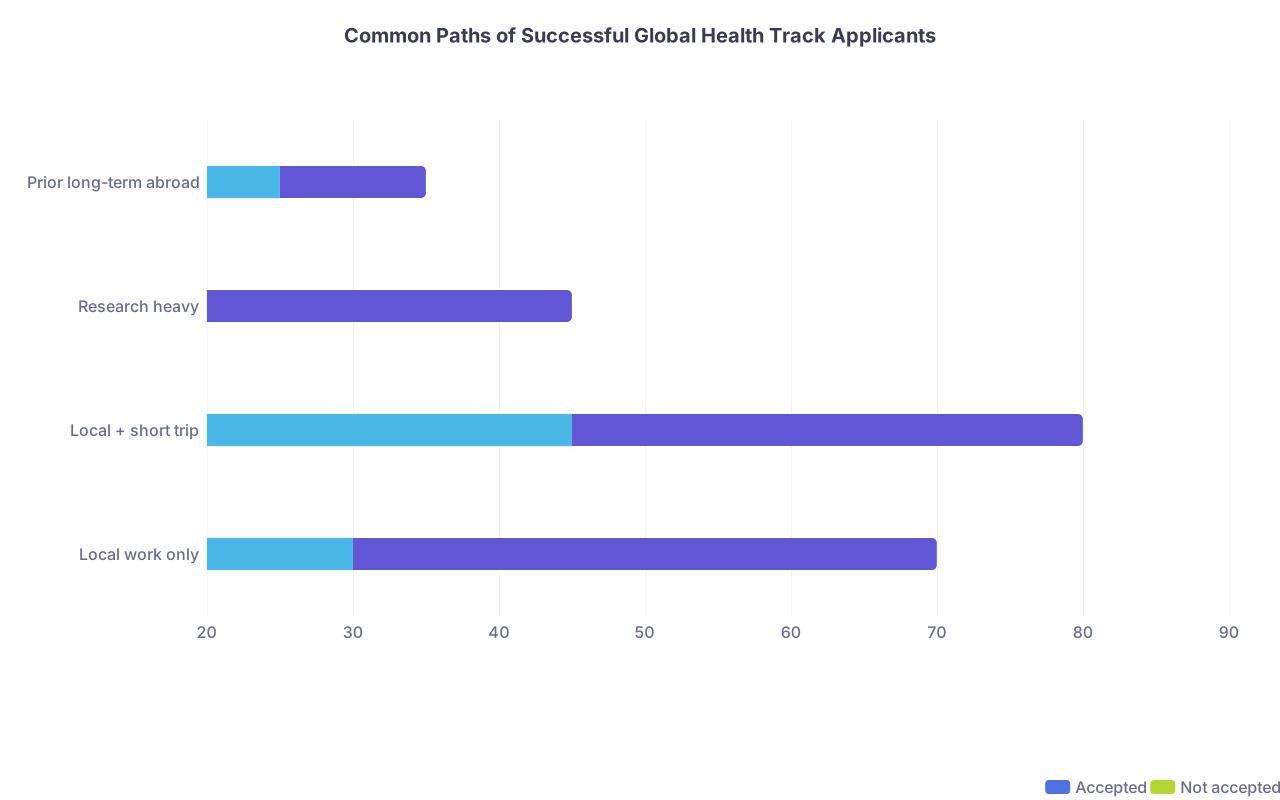
| Category | Accepted | Not accepted |
|---|---|---|
| Local work only | 30 | 40 |
| Local + short trip | 45 | 35 |
| Research heavy | 20 | 25 |
| Prior long-term abroad | 25 | 10 |
The pattern: multi‑year local engagement plus thoughtful, supervised exposure tends to beat one‑off overseas tourism every time.

| Step | Description |
|---|---|
| Step 1 | Start Residency |
| Step 2 | Engage in Local Underserved Work |
| Step 3 | Connect with Global Health Faculty |
| Step 4 | Contribute to Ongoing Project |
| Step 5 | Demonstrate Clinical Safety and Humility |
| Step 6 | Apply to Global Health Track |
| Step 7 | Selected |
| Step 8 | Not Selected |
| Step 9 | Seek Feedback and Rebuild |
| Step 10 | Faculty Trust Level |
What You Should Do Next
You can’t retroactively rewrite your past, but you can absolutely change the story faculty will tell about you a year from now.
If you’re early in residency, you have time to:
- Root yourself in local, longitudinal service.
- Attach to a serious global health mentor.
- Clean up your ethical footprint and tighten up your clinical game.
If you’re already applying and not getting picked, your next move isn’t to write a longer personal statement. It’s to sit down with someone who was in that selection room—or close to it—and ask, sincerely, “What would need to be true of me for you to feel comfortable sending me abroad in three years?”
Then do the unglamorous work of becoming that person.
The spots in these elite tracks are limited. Yes, they’re competitive. But the biggest divider is not brilliance—it’s trust. Trust in your ethics, your judgment, your humility.
You want to be on that plane? Start behaving like someone another human being would stake their reputation on, in a country that is not theirs, with patients whose stories will never be on your CV.
With that foundation in place, you won’t just be ready for the global health track—you’ll be ready for the much harder part that comes after: staying in this work without burning out or burning bridges. But that’s a story for another day.


