
The Real Reason Your ‘Global Health’ CV Lines Don’t Impress Committees
It’s January. You’re polishing your CV for residency applications, ethics essays, maybe an academic global health fellowship. Under “Global Health” you’ve proudly stacked: two short-term trips, one ‘medical mission,’ a week in Guatemala, a month in Uganda, a telehealth project with an NGO.
You’re thinking: this is my edge. Committees will love this.
Let me tell you what actually happens in that room.
The PD scrolls. Skims your Step scores, class rank, letters. Then the eyes hit: “Global Health Experience – 2 weeks, Honduras,” “Volunteer Medical Mission – Peru,” “Short-Term Clinical Elective – Kenya.”
There’s a small pause.
Then one of three things happens:
- Someone says, “Another one.”
- Someone says nothing and scrolls past.
- Someone sighs and says, “I hope they actually understand what they were doing there.”
Your “global health” lines are not the golden ticket you think they are. And often they’re a liability, not a strength.
I’m going to walk you through why.
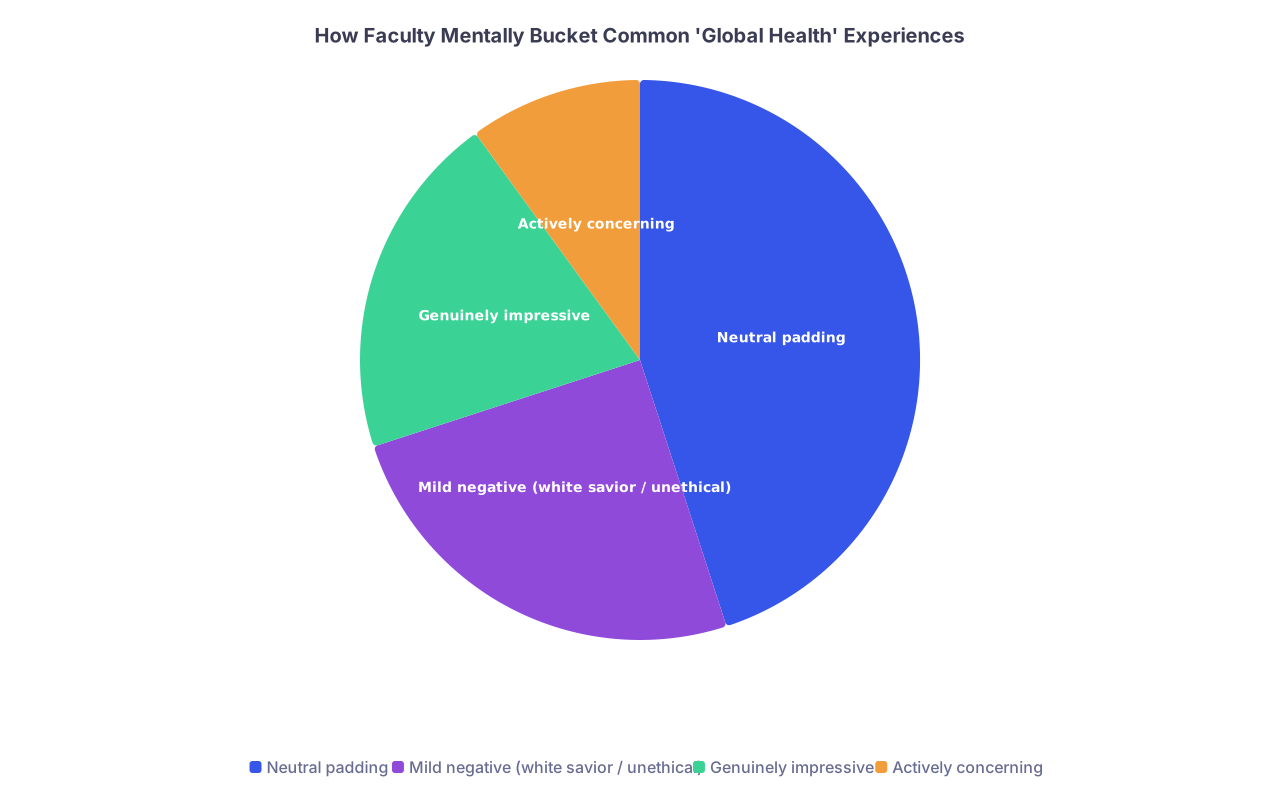
| Category | Value |
|---|---|
| Neutral padding | 45 |
| Mild negative (white savior / unethical) | 25 |
| Genuinely impressive | 20 |
| Actively concerning | 10 |
What Program Directors Actually See When You Write “Global Health”
On paper, you see: “Meaningful service, cultural humility, global exposure.”
They see categories. They’ve looked at a few thousand of these. Patterns jump out.
Roughly, the mental bins look like this:
First, the “tourist medicine” group. Two-week brigades where you did blood pressures, maybe “helped” with wound care, took photos of children, and posted them with inspirational captions. Faculty have seen it a hundred times. It reads as indulgent, not serious.
Second, the “scope-of-practice creep” group. You’re a preclinical or early clinical student who writes things like, “assisted in deliveries,” “managed diabetic patients,” “performed minor procedures,” in a country where you do not speak the language and definitely do not hold a license. This sets off alarms. Medicolegal, ethical, and professional.
Third, the “grant-funded, mentored, longitudinal” group. A student with a multi-year project, supervision by real global health faculty, IRB approval, local collaborators listed by name, and careful language about their role. Those are rare. And they stand out immediately.
Programs know this: almost every med school now has some flavor of global health. A certificate. An interest group. An elective. The bar for “this impresses us” is much higher than students realize.
You see “I’m different because I went to X country.”
They see “you did what 60% of applicants now do, and you might not understand the ethical problems.”
And that last part — your ethical blind spots — is what committees really care about.
Why Short-Term Trips Usually Hurt You More Than Help
I’ve sat in on these conversations. Here’s the brutal truth: short-term, student-centered global health trips are under heavy suspicion now.
Not because global health is bad. Because bad global health is everywhere, and committees are tired of seeing you proudly advertise it.
Patterns that instantly downgrade your “global health” line from asset to liability:
You centering yourself instead of the system. Phrases like “I was able to provide care to…” “I treated many patients with…” as an MS1/2 in a rural clinic with no supervision. Faculty read that and think: you don’t grasp your limitations or the ethics of power and context.
You showcasing suffering. Any hint of “I saw so much poverty; it made me grateful for what I have” is a massive red flag. That is extractive. You used other people’s hardship as your personal character-development retreat.
You describing yourself doing things you weren’t trained or licensed to do. I’ve seen students brag about “suturing multiple lacerations alone” as a second-year with no formal procedural training… in a community where patients have no recourse if you screw up. That is not impressive. That’s reckless.
You making it all about “resourcefulness” or “improvisation.” Stories like, “We had no ultrasound, so we learned to rely on our physical exam.” But you were there for 10 days. This reads as romanticized deprivation. The people who live in that system don’t find it charming.
You never mentioning local partners by name. Serious global health folks always talk about who their local collaborators were, how the project fit into existing systems, what the host institution needed. When your CV and PS are devoid of that, it screams student-centric, not partnership-centric.
And committees notice the omission. They’ve read applications from people who’ve actually done this well. The contrast is harsh.
The Ethical Problem You Think No One Sees (We Do)
Here’s the core issue: most “global health experiences” students advertise are ethically fragile at best, and sometimes outright unethical.
And you are broadcasting that you don’t know that.
Let me spell out what faculty are thinking but rarely put in writing.
They worry you went because you wanted procedures you could not do at home. That you used structural inequity to bypass safeguards that protect vulnerable patients. If your story is, “I got to do so much more than I could in the US,” you’ve just admitted to using global health as an ethical loophole.
They worry you didn’t get informed consent in any meaningful way. You did not speak the language, yet you talk about counseling patients, delivering difficult news, or “discussing management options.” With what interpreter? Under what supervision? Whose standard of consent?
They worry your presence displaced local trainees or providers. This is the part students almost never think about. When a brigade shows up, local clinicians cancel clinics, rearrange schedules, and often have to spend their time supervising you. Many faculty on selection committees have watched this happen firsthand. They’re not impressed; they’re tired.
They worry you treated the trip as moral theater. The students crying during debriefs, the group photo in scrubs around the clinic sign, the Instagram captions about “feeling called to serve.” Meanwhile, you fly home, and that community continues without meds, continuity, or any say in your narrative.
So when you proudly list “Global Health Mission – 10 days – Nicaragua,” what some of them actually see is: “This applicant likely participated in structurally exploitative care and doesn’t realize it.”
That’s what turns your line from “meh” to “concerning.”
| CV Description Snippet | How It’s Commonly Read |
|---|---|
| “2-week medical mission trip, helped provide care to underserved villagers” | Likely short-term, student-centric trip. Ethically weak. Neutral to mildly negative. |
| “1 month elective at XYZ Hospital in Malawi; observed rounds and assisted with QA project under Dr. ___” | Neutral to mildly positive. Respectful, realistic role. |
| “3-year partnership with ABC University, co-authored paper on NCD management, local PI Dr. ___” | Strong. Serious commitment, mentorship, academic output. |
| “Performed procedures and managed patients independently in rural clinic” | Red flag. Scope, supervision, ethics all questioned. |
| “Global health certificate, no clear longitudinal involvement or specific project” | Padding. Reads as checkbox, not substance. |
What Actually Impresses Global Health Faculty
Now the part you actually need: what moves your “global health” line from eye-roll to “we should talk to this person.”
No, it’s not how many countries you’ve visited.
The serious people on committees look for three things: depth, humility, and systems-thinking.
First, depth over tourism. One site, long-term. Multiple returns to the same partner institution. Or one multi-year project that grows from basic data collection to something with real implementation or policy relevance. A student who has three years at one site, learning the language, working with the same team, always looks more serious than someone with five trips to five countries.
Second, intellectual and ethical humility. The best applicants talk almost painfully clearly about their limits. “I realized I was not there to fix anything. I was there to learn how local clinicians managed within constraints and to support a project they designed.” When a student writes that and backs it up with specifics, faculty exhale. You get it.
Third, engagement with power and structure. If you talk about global health without mentioning colonialism, power asymmetry, or structural determinants at least somewhere, people doing this work for real know you’ve been spoon-fed a shallow narrative. You do not need to drop buzzwords. But you do need to show you’ve thought about why short-term, high-income-country–driven “service” can be harmful.
Also: serious mentorship. If you can name the global health faculty who supervised you, the local PI, the partner institution, and produce a poster, paper, or presentation out of it, that immediately separates you. Output is a proxy: not because publications are morally superior, but because they require structure, follow-through, and accountability.
And one more thing programs care about but don’t advertise: continuity. Do you keep caring once the plane lands? Are you involved with refugees or immigrant health locally? Are you working on language skills? Do you join the boring Zoom calls, not just the photogenic trips?
That’s what makes you read as real.
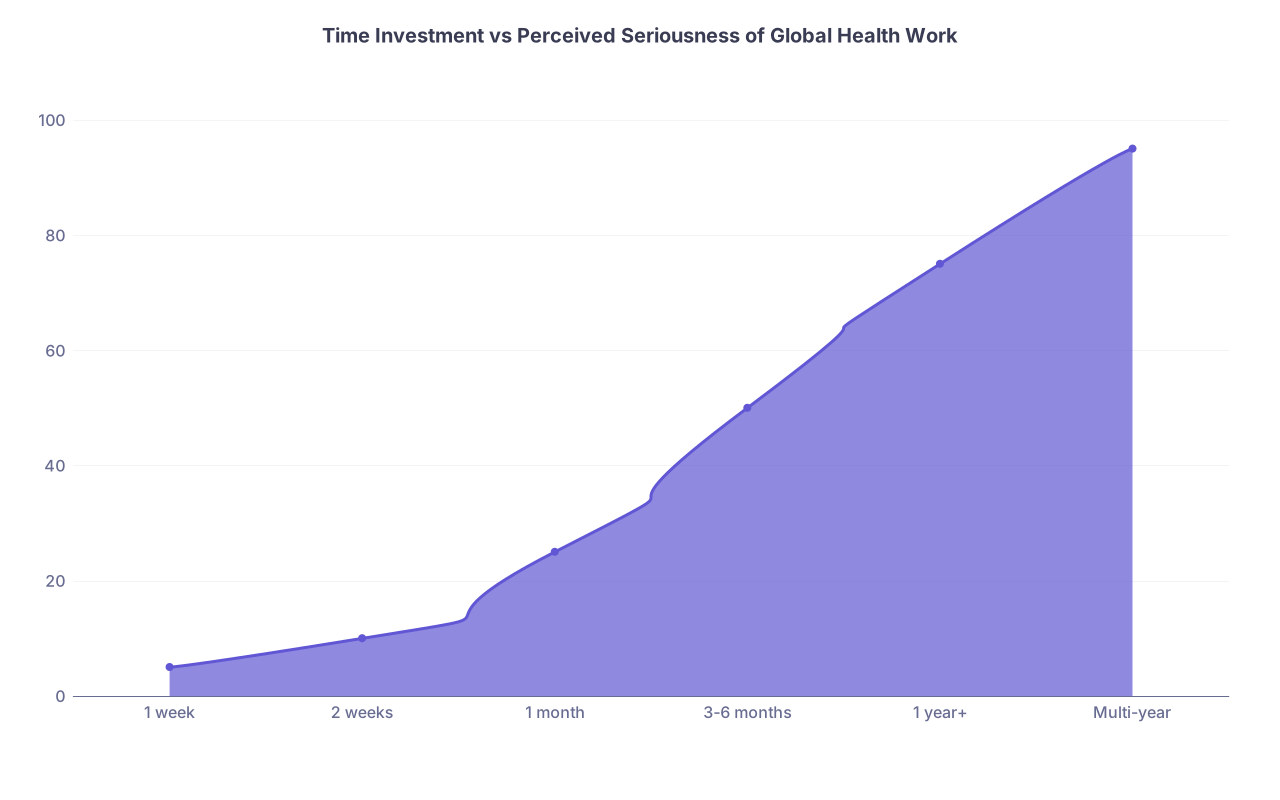
| Category | Value |
|---|---|
| 1 week | 5 |
| 2 weeks | 10 |
| 1 month | 25 |
| 3-6 months | 50 |
| 1 year+ | 75 |
| Multi-year | 95 |
(Y-axis is rough “seriousness” score out of 100 in the mind of a skeptical faculty member.)
How Your Global Health Story Should Evolve Over Training
You’re not expected to be Paul Farmer as an MS3. But committees do expect a trajectory.
The rough progression that looks healthy to people reading your file:
Early on you observe. You read. You do local work with refugee clinics, community health centers, maybe a language course. If you travel, you’re very clear that you were an observer or assistant under strict supervision. No heroics. No procedures you wouldn’t be allowed to do at home.
Midway you contribute. Short but focused work — data collection for an existing project, a QI initiative, a curriculum translation, something that responds to a need the partner identified. You might do a 4-8 week elective with a clear role: “I collected follow-up data for an ongoing registry, under supervision of Dr. X at Hospital Y.”
Later you lead small pieces, but not alone. Maybe you co-lead a small arm of an existing project, or coordinate between your school and a partner site, or help design a reasonable protocol with strong mentorship and joint authorship. You’re not “starting a clinic.” You’re strengthening one.
Throughout, your language and framing become more nuanced. Early PS: “I saw health disparities.” Later PS: “I began to understand how donor-driven priorities can distort local health systems, and I made mistakes assuming I understood community needs.” That evolution matters.
When committees see that arc, they’re reassured you’re maturing, not collecting stamps.
How to Fix Your Existing “Global Health” CV Lines
You might already have a few ethically messy trips under your belt. You can’t un-fly to Haiti. But you can stop making it worse.
Step one: strip the hero language. Replace “provided care to underserved populations” with “assisted local clinicians in outpatient clinics by performing basic tasks within my training level (vitals, patient flow, documentation).” That alone lowers the ethical temperature.
Step two: be explicit about supervision and limits. “As a preclinical student, I observed inpatient rounds and conducted basic chart reviews under the supervision of Dr. X.” Do not pretend you did more. The faculty who actually worked with you abroad will see your application sometimes. They talk.
Step three: center the host institution. Name the hospital, the local PI, the department. “Elective at Muhimbili National Hospital, Department of Internal Medicine, under supervision of Dr. __.” This shifts it from “I went to Africa” to “I trained, briefly and humbly, in a specific professional environment.”
Step four: acknowledge the learning, not the saving. Emphasize what you learned about systems, resource allocation, or clinical reasoning — not how much they needed you. As a student, they did not.
If you’re asked about it in an interview, be honest about what you would do differently now. I’ve watched applicants salvage pretty problematic trips by saying, very directly: “Looking back, I realize that as a preclinical student I overestimated my usefulness and underestimated the ethical complexity. It pushed me to seek formal training and to focus now on partnership-driven work.”
That answer reassures committees you can self-correct.
If You Actually Want a Career in Global Health, Start Acting Like It
Here’s the uncomfortable truth: if global health is more than a branding exercise for you, your life starts to look less glamorous and more like slow, un-photogenic work.
You learn a language. Not perfectly, but you commit. Spanish, French, Portuguese, Swahili, doesn’t matter — anything that moves you closer to your patient population. Committees notice when your CV shows language courses, interpreters training, or real proficiency.
You read deeply. Farmer, Mullan, Biehl, the Lancet Commission reports, critique pieces on short-term medical missions. In interviews, this comes through. You stop saying “helping the less fortunate” and start saying “working in partnership to address structural barriers and strengthen systems.”
You build local experience. Global health is not a plane ticket. It’s a way of understanding inequity. Work with migrant workers in your state. Refugee populations. Underserved urban clinics. Tribal health. When committees see that your “global” concern includes the people 5 miles from your campus, they take you more seriously.
You align with real mentors. Find faculty who do this work; show up to their boring meetings. Help with their data grunt work. Yes, it’s thankless. That’s the point. The students who stick with it are the ones faculty are willing to write real letters for — “This person is actually dependable, not just here for the trip.”
And you accept that some opportunities are unethical for you to take. You turn down trips where you’ll be encouraged to “practice procedures” on patients with no alternatives. You ask hard questions about supervision, continuity of care, and local training programs. When something feels exploitative, you step away.
The committees that matter — the ones at programs with real global health work — recognize that stance immediately.

| Step | Description |
|---|---|
| Step 1 | Interest in Global Health |
| Step 2 | Local Underserved Work |
| Step 3 | Find Global Health Mentor |
| Step 4 | Join Existing Project |
| Step 5 | Short Supervised Elective |
| Step 6 | Longitudinal Collaboration |
| Step 7 | Scholarly Output and Reflection |


