The biggest ethical failures in global health do not happen in the clinic. They happen in the manuscript draft.
Everyone talks about “sustainability” and “capacity building.” Meanwhile, in the background, visiting students quietly turn communities into data farms and local clinicians into unpaid research assistants who do not even get first authorship. That is the real story in a lot of global health publishing. I have watched it for years from faculty offices, IRB meetings, and awkward Zoom calls with “collaborators” who see the paper only when the PDF is online.
You want the unspoken rules. The ones people enforce in email threads and behind closed doors, not in ethics lectures. Let’s get into it.
Rule #1: If you would be embarrassed to show your draft to the community, you probably should not publish it
Here’s how it actually plays out.
A medical student returns from a 4‑week rotation in Uganda. They have a messy Excel sheet: 300 patients, basic demographics, diagnoses, maybe a few outcomes. They send an excited email:
“We collected incredible data in [Country] and think this could be a great paper on barriers to care.”
The data were never collected for research. There was no local IRB. “Barriers to care” will be based on 20 convenience-sampled informal interviews done via a nurse interpreter in the hallway between patients. The student writes the draft anyway. Their US mentor says, “We can probably frame this as exploratory.” And suddenly it’s on its way to Global Health Action.
Here’s the quiet rule real global health faculty use: if the community, the local clinicians, and the local Ministry of Health saw the draft and felt misrepresented, cherry‑picked, or used, the paper is dirty. Ethically dirty, even if it slides past IRB and peer review.
The problem is simple: a lot of trainees write as if the community will never read it. And in the old days, that was almost true. Today, PDFs get forwarded on WhatsApp within days of publication. I’ve seen district health officers send a screenshot of a figure with one line: “Is this what you think of us?”
You want to protect yourself? Write like the most senior, no‑nonsense person in that country will read every line and then email your dean.
Ask yourself as you draft:
- Would I say this about my own hospital back home, in public, in front of patients?
- Have I described limitations honestly, or buried the ugly methodological shortcuts in one vague sentence?
- If the local partners saw our “interpretation” of their system, would they call it insightful—or arrogant?
If you hesitate, that’s your warning light. Ignore it, and you’ll join the long list of people who technically “published” but lost any chance of genuine partnership going forward.
Rule #2: Authorship is power—and most visiting teams hoard it
The most consistent ethical mess I see? Authorship.
Let me tell you how the sausage is usually made. Not the formal ICMJE criteria. The actual back‑room process.
There’s a US PI who controls the grant. They bring one or two residents and a couple of students down for “fieldwork.” The data are collected almost entirely by local staff—nurses doing extra forms on night shifts, community health workers walking extra miles, a local junior faculty member who spends weekends cleaning the database.
Then, once everyone flies home, the WhatsApp messages start drying up. Six months later, a manuscript “magically” appears, with:
- US PI as last author
- US trainee as first author
- Maybe one local person tucked in the middle
- Senior local person missing entirely “because they didn’t help write”
Here’s the part no one says out loud: this is theft dressed up as “productivity.”
Program directors and promotions committees see the author list. They see who gets credit. And like it or not, that list reflects who is perceived to have intellectual ownership—even when that’s not the reality.
Most local faculty will not fight you about authorship. They are polite. They do not want to jeopardize the relationship, the supplies, the training. So they swallow the insult and just quietly refuse to fully engage the next time.
If you want to play this game right, use a simple, enforceable principle: no local partner, no project. No local co‑first or senior authorship on a locally driven idea? Then you are doing extractive work, even if you smile in every group photo.
Here is how seasoned, respected global health groups actually structure authorship (and yes, I’ve seen these conversations behind the scenes):
| Scenario | Typical Reality | Ethically Strong Pattern |
|---|---|---|
| US-initiated project, local data collection | US trainee first, US PI last, 0–1 local middle | Local lead co-first, local senior co-last |
| Locally-initiated project, US support | US PI last, local PI middle | Local PI last, US PI middle |
| Ongoing long-term site collaboration | Same US team repeatedly first/last | Rotate first and last between local and US over time |
| Short-term student project | Student first, no meaningful local authors | Local mentor first, student shared or second |
If you want a simple litmus test:
Would this paper exist without the local team’s access, trust, and labour? If the answer is no, then they deserve visible, meaningful authorship. Full stop.
Rule #3: “Quality improvement” is not a cheat code to bypass ethics review abroad
Here’s a trick a lot of trainees learn early: when IRB requirements get annoying, slap the label “quality improvement” and keep moving. Works sometimes at home. Abroad, it becomes downright dangerous.
What actually happens:
A US mentor wants quick data from a partner hospital in Kenya. They tell the trainee, “We’ll call it QI, just chart review.” No Kenyan IRB. Maybe not even a hospital ethics review. The trainee abstracts chart data, merges it into a spreadsheet, and runs analyses in Stata.
Later, when it turns out the findings might be publishable, someone says, “We should frame this as research.” Nobody goes back to get proper approval because the data are already in hand and the student is graduating.
I’ve watched the fallout. Local ethics committees get blindsided by publications that never passed through them. Ministries start tightening rules for all foreign partners. Local collaborators look complicit even though the emails and design came from the US side.
The unspoken rule faculty silently enforce now: serious partners expect dual approval. Your home IRB and local review—formal or legitimate informal review depending on the country’s structure. If your only ethics approval is from the US and the work is entirely on foreign soil, you’re on thin ice. Many senior global health folks will not touch that project once they look closely.
The other lie: “But it’s de‑identified, so it’s fine.” No. In small communities, “woman with twin pregnancy who delivered at 28 weeks after crossing the border on June 3” is not anonymous, even without a name. People can be recognized from context.
Professional approach: treat local review as more than a box. Email the local IRB or ethics body early. Ask what they consider research vs QI. Document that. If they say, “This falls under hospital-level QI,” fine—get that in writing from the appropriate leader.
And if the answer is, “This needs formal review and might delay your timeline”? You respect that. Or you do a different project. Otherwise, you are saying their ethical framework is optional when it becomes inconvenient for you.
Rule #4: Do not publish what you are not willing to stay and fix
This one separates performative from serious global health work.
The publishing pattern I see over and over: a visiting team rolls in, documents a problem in excruciating detail (catastrophic delays, unsafe practices, outrageous shortages), publishes a paper practically shaming the local system, and then… disbands. New med students cycle in, same hospital, next project.
You want an insider view? Those papers linger. Administrators remember your names. The local clinicians who were courageous enough to talk to you feel exposed. And when the system does try to change, they have to work around the fact that you’ve now frozen their worst moment into a permanent, searchable PDF.
Here’s the rule more thoughtful faculty follow, even if they rarely state it out loud: do not publicly dissect a system’s failures unless you are part of a realistic plan—driven by locals—to address them over time. That doesn’t mean you must solve everything. But the work cannot just be: “Look how broken this is. Please cite us.”
Ask yourself before submitting that “Barriers to Care in Rural X” paper:
- Are local partners comfortable with how we describe these barriers?
- Is there any concrete pathway, grant, program, or local initiative our data can plug into?
- Did we give the system a chance to respond before we went to print?
I’ve seen smart groups do something unusual and decent: they present the findings first locally—to the hospital, district, or ministry—months before they submit anywhere. They let locals critique the framing, argue with interpretations, and sometimes veto pieces that would cause harm with little benefit.
Do that, and your name starts to mean something different. Not just “the resident who came for 4 weeks and left a mess behind.”
Rule #5: Interpretation without lived context is where most global health papers go off the rails
The methods sections in these papers are often fine. The stats are usually serviceable. The real damage happens in the “Discussion.”
Here is a move you’ll see constantly:
Short‑term visitor analyzes local data, then adds sweeping statements about “cultural beliefs,” “systemic mistrust,” or “preferences” of a population they barely lived with for a month. No deep language skills. No long history. No serious qualitative training. But several confident paragraphs on “why” people behave as they do.
From the faculty side, this is where we silently triage trainees into two categories:
- The ones who know what they do not know and keep interpretation narrow
- The ones who confidently extrapolate, and therefore cannot be trusted with sensitive work again
Want to stay in the first group? Here’s how.
If your time in-country was short, limit your claims to what your data actually supports. Use local co-authors as your guardrail. When a local clinician or researcher says, “This conclusion is off,” believe them even if “the numbers look significant.” In many places, your regression is battling decades of context you do not see.
This is why real partnerships insist on genuine intellectual contribution from local authors. Not just data handoff. They want local eyes on the introduction, on the framing of the problem, on every line of the discussion. They want to catch the sentences that sound like this:
“Patients often fail to seek care due to cultural beliefs and misunderstanding of disease.”
When the reality is closer to:
The clinic is 3 hours away, transportation is unsafe, clinicians are absent 40% of the time, and the last 3 times a child went, the medication was out of stock.
If you care about ethics, strip your writing of lazy explanations that pathologize patients and communities. Talk about structure. Talk about policy. Talk about historical reasons for mistrust. But do not reduce complex survival decisions to “noncompliance.”
Rule #6: Data ownership is not what you think it is
There’s a quiet war happening right now in global health: who owns the data.
Every time a trainee emails me, “I’d like to take the data from my trip and write it up for my residency application,” I ask one question: “Whose data is it?”
Silence. Then confusion.
Behind the curtain, ministries and hospitals are waking up. They know foreign teams have been walking out with USB sticks full of patient data for years. They see publications based on their registries that they never authorized, never saw, and never shared authorship on.
The unspoken—but rapidly changing—rule used to be: whoever had the software and knew how to analyze data effectively “owned” it. That era is dying.
If you want to operate legitimately now, assume:
- The primary owner of the data is the local institution or ministry, not you and not your home university.
- Any sharing of raw data should be governed by a written agreement—data use agreement, MOU, or explicit email chain at minimum—signed by someone with actual authority locally.
- You do not unilaterally upload someone else’s data to open repositories until they understand and consent to that plan.
I’ve sat in meetings where ministries explicitly said: “No more foreign publications on our national registries without co‑authorship and government review.” You ignore statements like that and push on with “open science,” and you will find doors quietly closing to your institution.
Want a practical approach that earns trust instead of burning it?
- Negotiate data ownership early: who decides on future analyses, who must approve manuscripts, who can share with third parties.
- Put in writing that local partners have veto power over sensitive secondary uses of the data.
- Make sure local servers or systems hold a complete copy of the cleaned data, with documentation, not just your laptop.
This slows you down. Good. Fast extraction is what got global health into this mess in the first place.
Rule #7: Timing and transparency matter more than the impact factor
Students obsess over where to publish. High‑impact journal, mid‑tier, local journal. That’s the wrong hierarchy for global health work.
Here’s how seasoned global health faculty actually think:
- Would this paper, in this journal, be findable and usable by the people most affected?
- Does the publication timeline match any upcoming local decisions, policy windows, or program cycles?
- Did local collaborators see and approve the final manuscript before submission, not after acceptance?
Impact factor is a vanity metric for your CV. Ethical publishing is about usefulness and honesty.
I’ve seen students chase an extra 5 points of impact factor and in the process delay a paper so long that local partners moved on, new policies were made without data, and by the time it came out, no one cared but the promotions committee.
Your real “impact factor” in global health is much simpler:
- Did your local colleagues feel respected in the process?
- Did anything on the ground improve—training, protocols, awareness—even a little, as a result of the work?
- Would they willingly work with you again?
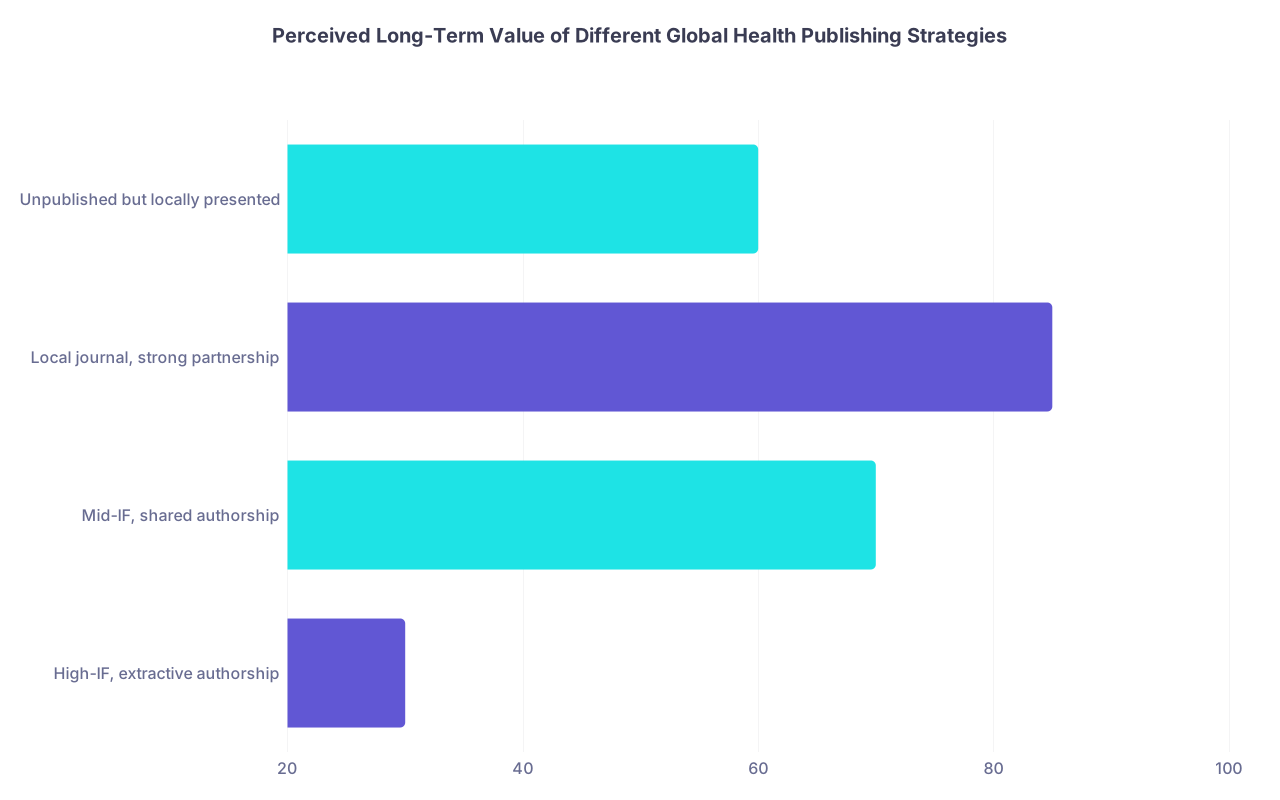
Let me spell out how different publishing strategies actually play out over a trainee or early‑career arc:
| Category | Value |
|---|---|
| High-IF, extractive authorship | 30 |
| Mid-IF, shared authorship | 70 |
| Local journal, strong partnership | 85 |
| Unpublished but locally presented | 60 |
You will get more long‑term doors opened by a modest paper with exemplary ethics and shared credit than by a flashy paper everyone locally resents.
And one more unspoken rule: if you send a manuscript in for submission without your local coauthors having seen the final version, you’ve already failed. It does not matter if the journal never asks. It matters that you knew and did it anyway.
Rule #8: Your “personal development” is not a justification for unethical research
Global health is crawling with people who treat other countries as a character‑building exercise.
They want a story: “That time I did research in rural X and learned about resilience.” They want a bullet point: “First author on barriers to care.” They want to be “shaped” by the experience. The downside, the mess, the consent shortcuts, the token authorship? Collateral damage.
From the faculty side, this is becoming a hard red line. The best programs are starting to say no to student‑designed “original research” on short rotations unless there is a long‑term infrastructure. Because they know how this ends: rushed design, thin consent, superficial analysis, bad optics, damaged relationships.
Your growth does not need to be justified by a PubMed ID. If what you really want is to learn, to witness, to think about injustice—do that. Take meticulous notes for yourself. Read. Reflect. Discuss quietly with mentors and local colleagues. That is personal development.
Once you decide to publish, you are no longer just “learning.” You are entering a public record, altering perceptions of a community or a system, influencing how donors and future trainees see that place. That is power. And power without accountability is exactly what global health claims to oppose.
So be honest. Are you publishing this because it will change something meaningful for that community, or because it will change something meaningful for your ERAS application?
If the answer is mostly the latter, you want to be extremely strict about your ethics and humility. Or rethink whether this needs to be a paper at all.
How to actually do this right (without being paralyzed)
You might be thinking, “If I follow all of this, I’ll never get anything published.” That’s not true. But the bar is higher than the watered‑down version you get on student electives.
Let me show you what a respectable pathway looks like, from the side of people who’ve seen both the good and the ugly.

| Step | Description |
|---|---|
| Step 1 | Idea from fieldwork |
| Step 2 | Discuss with local mentor |
| Step 3 | Adjust or drop |
| Step 4 | Joint protocol & IRBs |
| Step 5 | Local data collection with training |
| Step 6 | Shared data cleaning & analysis |
| Step 7 | Draft with local coauthors |
| Step 8 | Local review of framing |
| Step 9 | Present locally first |
| Step 10 | Submit to agreed journal |
| Step 11 | Share publication & discuss next steps |
| Step 12 | Local priority? |
That is the sequence that earns you a reputation as someone safe to trust with people’s stories and systems.
Is it slower? Yes. Will you write fewer papers? At first, probably. But you’ll be able to look your collaborators in the eye the next time you step off the plane. That matters more than you think.
The part no one tells you: your future depends on the stories others tell about you
Letters and formal evaluations are one thing. The real currency in global health is what people say about you when you are not in the room.
I’ve sat in those conversations:
- “She was meticulous about getting local approval and checking with us on every interpretation.”
- “He submitted a paper without even sending us the final draft. We found out on Google Scholar.”
- “Their team always insists on a local first author if the idea started here.”
- “They showed our hospital in such a bad light we had to explain it to the ministry.”
You think you’re just securing a line on your CV. You’re actually shaping a reputation that will follow you across countries and conferences.
The unspoken rules of publishing from global health fieldwork are not about pleasing journals. They’re about whether you become the kind of person local colleagues warn each other about—or the one they email first when a hard, important project comes up.
You’re still at the easy stage: forming habits, picking mentors, deciding what kind of work you’ll tie your name to. Get this right now, and the rest of your “global health career”—if you decide to build one—will have a very different foundation.
You’ve learned how not to turn communities into data farms and colleagues into token names. The next challenge is harder: learning how to build projects that locals would still want to do even if there were zero chance of publication. That’s when you know you’re no longer just visiting. But that’s a story for another day.
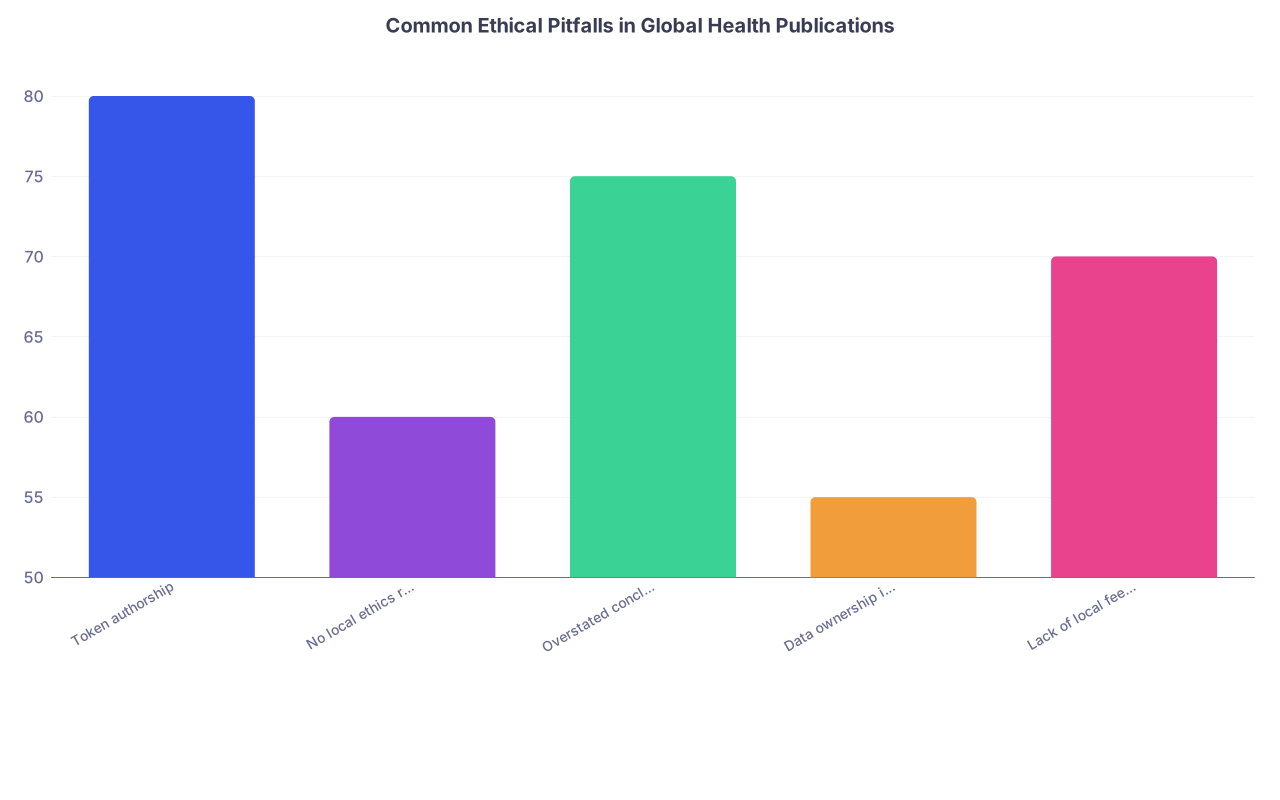
| Category | Value |
|---|---|
| Token authorship | 80 |
| No local ethics review | 60 |
| Overstated conclusions | 75 |
| Data ownership issues | 55 |
| Lack of local feedback | 70 |