

The dirty little secret about short‑term medical missions is this: a lot of senior faculty smile in public and roll their eyes in private.
They won’t say that at your school’s global health info session. They won’t put it in the brochure. But in committee rooms, over coffee between meetings, and at promotion reviews, they say versions of the same thing: “Is this actually about the patients… or about the student’s CV and Instagram?”
Let me walk you through what they really think, because I’ve heard these conversations behind closed doors for years.
What Senior Faculty Say When You Leave the Room
Here’s the scene. You present your “global health interest” to a career advisor. You mention a one‑week trip to Guatemala where you “helped deliver babies” or “ran a clinic.” They nod politely.
Then you step out, the door closes, and a more honest conversation starts.
I’ve heard variations of these lines from senior faculty at multiple institutions (big and small, US and international):
- “Another safari mission.”
- “Let’s hope they did not put that baby at risk.”
- “So they bypassed continuity of care and local systems for a week of feel‑good medicine.”
- “Who was supervising? Anyone with a license in that country?”
There’s a pattern to how experienced faculty think about short‑term medical missions (STMMs). They sort them — very quickly — into three buckets: exploitative, naïve, or serious.
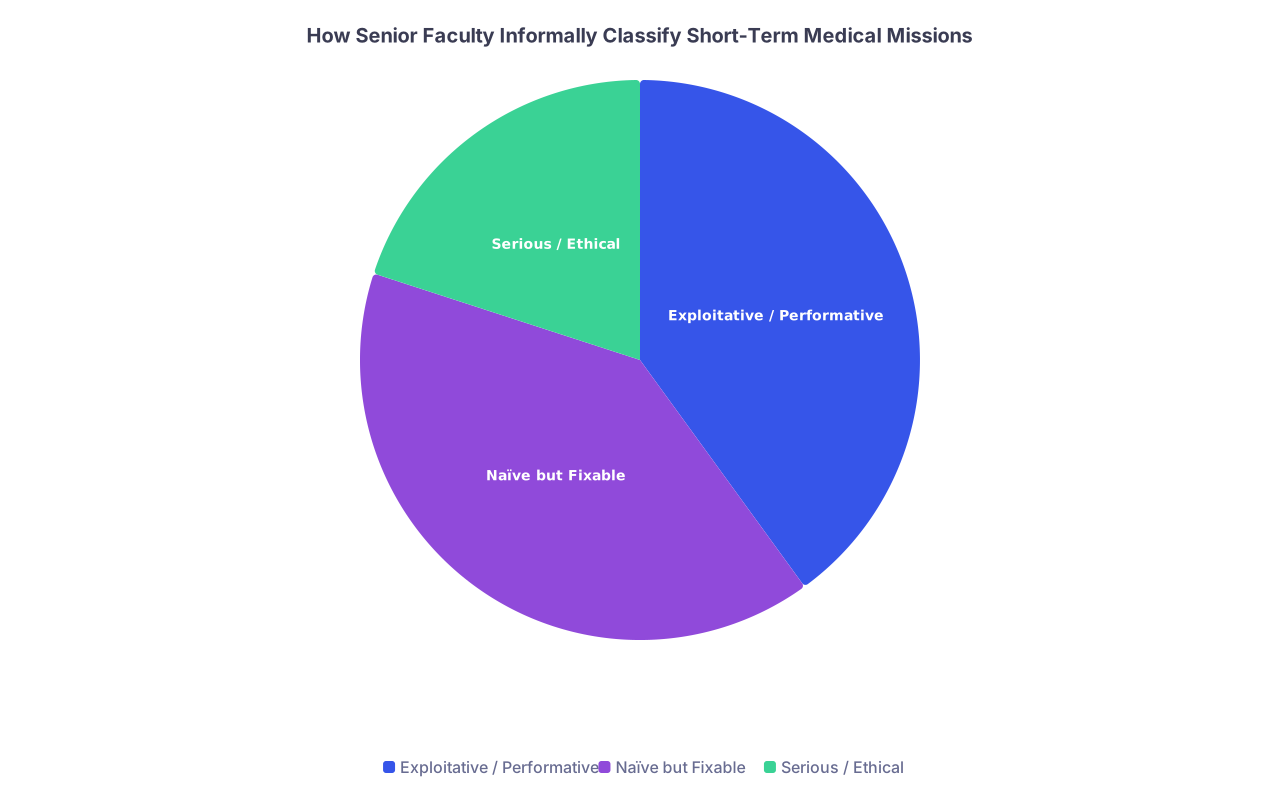
| Category | Value |
|---|---|
| Exploitative / Performative | 40 |
| Naïve but Fixable | 40 |
| Serious / Ethical | 20 |
They rarely say this to your face, because schools love “global health” branding. But if you want to be taken seriously in global health or ethics circles, you need to understand the mental sorting algorithm they’re running on you.
The Parts They Secretly Hate (But Won’t Publicly Attack)
The first thing that makes senior faculty’s blood pressure rise is the performative heroism.
The Facebook albums. The scrub selfies with “my patients.” The fundraising emails that sound like colonial travelogues: “I’m going to bring healthcare to a village that has never seen a doctor.” I’ve watched professors literally push their chair back and stare at the ceiling when they read those lines in personal statements.
There are a few recurring red flags that immediately turn them off.
1. Scope Creep: Students Playing Doctor
Nothing poisons your reputation faster, long‑term, than stories of you doing things abroad that you’d never be allowed to do at home.
I’ve heard residents brag: “I got to do C‑sections in [country] as an MS3, it was amazing!” They think this sounds impressive. Senior faculty hear: You participated in unsafe, unethical care using poor patients as a training substrate.
They ask quiet questions you may not realize exist:
- Was there a local licensed physician with legal authority supervising?
- Did the patient know your level of training?
- Would your malpractice carrier cover that encounter? (Spoiler: no.)
- Were you chosen to do that procedure because it was best for the patient, or because you were the visiting foreigner?
You may think, “Everyone there does it.” The older surgeons and internists think: We’ve been fighting scope creep at home for decades, and you went abroad and did the opposite the minute there were no rules.
2. The “Drive‑By” Model of Care
Another thing that drives senior global health faculty crazy: the hit‑and‑run brigade.
Teams that parachute in for 5–10 days, hand out bags of meds with no real records, no handoff, no integration with local systems, then leave. They’ve seen this play out for years.
I sat in a faculty meeting where an ID specialist said, flat out: “I’ve spent half my career cleaning up after North American church groups who hand out partial antibiotic courses and vanish.”
If you write about “treating hundreds of patients in a remote village,” their next question is: And then what? Who’s following these patients? Who has their charts? Who manages side effects, complications, refills?
The harsher phrase I’ve heard used: “dump and run medicine.”
3. White Savior and Poverty Tourism Vibes
You can roll your eyes at the term “white saviorism,” but I promise you, the faculty screening global health awards and residency applications do not. They’re hypersensitive to it. Some of them built their early careers on mission trips and now regret a chunk of what they did.
They look for:
- Overly dramatic stories of personal transformation centered on you, not the system or the community
- Photos of you holding random children you don’t know
- Narratives where local clinicians are invisible or reduced to props
- Language like “the people there were so grateful” as the main ethical justification
The internal monologue you don’t hear: So the trip mostly changed you, not the structural realities on the ground. That’s tourism with stethoscopes, not global health.
What Actually Impresses Senior Faculty About STMMs
Let me flip it. Because some short‑term medical work abroad does impress faculty. Deeply. I’ve watched it move promotion committees and residency PDs when it’s done right.
They’re not against going abroad. They’re against sloppy, self‑serving, poorly supervised work dressed up as virtue.
Here’s what changes the conversation behind closed doors.
1. Longitudinal Partnerships, Not One‑Off Trips
A 10‑day “trip” looks very different if it’s part of a 10‑year partnership.
Senior faculty get excited when they see:
- A formal, institutional MOU with a local hospital or NGO
- Local leadership clearly in charge, with your institution in a supporting role
- Evidence that learners cycle through a site that has had consistent presence for years
The question they’re silently asking: If you never went again, would anything at that site be better because your institution showed up at all?
If the answer is no, they mentally downgrade the experience.
2. Clear Educational Structure and Real Supervision
The phrase “unregulated autonomy” is a red flag.
On the other hand, if you can describe:
- Daily teaching rounds with a named supervising attending
- Pre‑departure training that actually had teeth (ethical frameworks, local health system, language, cultural humility)
- Specific, appropriate tasks you were entrusted with, and where the line was drawn
Then you sound like a learner in a structured rotation, not like an unsupervised volunteer hustling for procedures.
I once heard a global health director shut down a criticism by saying: “Our students in Malawi are less autonomous than they are on their home wards. They function as junior members of an existing team.” That’s the gold standard.
3. Humility and Systems Thinking in How You Talk About It
There’s a kind of student essay faculty love. It sounds more like this:
- “I realized how little I understood about supply chains, and how my frustration with ‘lack of resources’ was really ignorance of how the system worked.”
- “I was uncomfortable turning patients away. The local clinicians had been doing this ethically for years. I watched how they made those decisions instead of barging in with my own.”
- “I saw how our presence temporarily distorted care — patients lined up for us and ignored local clinics. That was a problem, not a compliment.”
Faculty can tell when the moral center of the story is the patient and the system, not your emotional arc.
What Senior Faculty Worry About But Rarely Admit
There are two big anxieties older faculty have about short‑term missions that they don’t voice to students: liability and reputational risk.
1. Liability and Legal Exposure
No one wants to talk about this openly, but at multiple institutions I’ve watched the risk office quietly start to clamp down on unsanctioned trips.
Faculty know:
- Your home institution’s malpractice and liability coverage probably doesn’t apply abroad
- Many host countries have legal requirements for foreign clinicians that student groups simply ignore
- If something catastrophic happens — a death, a gross error, a media scandal — it will blow back on the school
You won’t see this in the glossy brochures, but behind the scenes, general counsel is asking: “Who authorized this student to write prescriptions in a country where they’re not licensed?” That’s why more and more official global health pathways insist on formal affiliations and approved sites.
2. Ethical Hypocrisy
The other quiet anxiety: that they’re complicit in a double standard.
Faculty sit through months of lectures on patient autonomy, informed consent, cultural humility, and scope of practice with you. Then they watch colleagues endorse programs where MS1s do procedures they’d never do at home, often without true informed consent.
Some senior people are frankly uncomfortable with their own early missionary work when they look back. I’ve heard versions of: “If someone had filmed what I did in my 30s and put it on Twitter now, I’d be done.”
So when a student enthusiastically recounts a very similar story in an interview, the older faculty’s face tightens. They’re seeing their past mistakes reflected. They’re not impressed. They’re worried.
How This Actually Affects Your Career
You might think: “OK, but does any of this really matter for residency or fellowship?” Yes. Not always in obvious ways, but yes.
Program directors and selection committees don’t have time to run a full ethical audit of your mission trip. They do something much simpler: they use it as a signal.
| How You Describe It | What Skeptical Faculty Infer |
|---|---|
| “I did lots of procedures I can’t do at home” | Poor boundaries, risk‑seeking, ethics blind spot |
| “I treated 500 patients in 5 days” | Volume over quality, no follow‑up |
| “They were so grateful for our care” | Savior narrative, limited systems understanding |
| “I worked with local residents and nurses” | Team player, respect for local expertise |
| “I saw how our presence disrupted care” | Reflective, ethically awake |
The same activity, narrated differently, can either help or hurt you.
I’ve seen global health fellowship directors pass on candidates whose application screamed “savior complex,” even with great scores and publications. I’ve also watched average‑on‑paper candidates get a serious look because their description of a short‑term placement showed deep, uncomfortable reflection and insight.
The trip itself is rarely the deal‑maker.
Your attitude about it is.
How to Do Short-Term Work Without Losing Faculty Respect
Let me be very practical. If you’re going to do short‑term medical missions — and many of you will — here’s how to do it in a way that doesn’t make senior faculty wince.
1. Choose the Right Kind of Program
Stop signing up for any group that slaps “global health” on a flyer. Ask hard questions:
- Who is the local partner, and how long has this relationship existed?
- Who is legally responsible for patient care?
- What exactly will students be allowed to do, and how is that decided?
- How are patients followed after you leave?
Look for programs where:
- Local clinicians lead, foreign students assist
- There’s a long‑term project beyond your visit
- Education and bidirectional exchange are built in, not an afterthought
The presence of a global health faculty champion with a real academic track record — not just a “missions pastor” or a random attending — is a very good sign.
2. Be Honest About Your Role
If your main jobs were taking vitals, shadowing, and helping with logistics, that’s fine. That’s ethical. Don’t feel you have to inflate your role to sound impressive.
Senior faculty know exactly what’s appropriate for a first‑ or second‑year student in a low‑resource setting. When your story magically gives you far more responsibility than you’d have in your home clinic, they smell embellishment or poor supervision.
I’d rather see: “I realized how much of the real work was organizing charts and crowd control” than “I was essentially the village doctor for a week.” One earns respect. The other triggers an ethics lecture.
3. Center What You Learned About Systems and Power
On applications and in interviews, talk about:
- How local nurses and community health workers ran circles around you in practical knowledge
- How resource constraints forced prioritization you’d never had to think about
- How you confronted your own assumptions about what “good care” looks like when there’s no CT scanner or subspecialists
Avoid centering your trip around your “passion for helping the poor.” That’s expected. It’s also cheap. Show that you started to see healthcare as a system embedded in politics, economics, and history — not just individual doctor–patient encounters.
4. Build Continuity If You Can
Faculty quickly notice if:
- You go back to the same site more than once
- You stay in contact with local mentors
- You turn your experience into something that persists — QI project, capacity‑building curriculum, research, advocacy
“Short term” is less concerning if it’s nested in a longer personal and institutional trajectory.

| Step | Description |
|---|---|
| Step 1 | Student Interest |
| Step 2 | Join Structured Program |
| Step 3 | Predeparture Training |
| Step 4 | Supervised Short Term Rotation |
| Step 5 | Reflective Debrief |
| Step 6 | Ongoing Partnership Work |
| Step 7 | Advanced Training or Long Term Engagement |
Notice that the short‑term rotation is a middle step, not the whole story.
The Ethical Question You Need to Ask Yourself
Strip away the CV padding and Instagram posts and institutional branding. You’re left with something very simple:
If you were that patient — in that village, in that clinic, in that hospital — would you want a foreign student with your current level of training to do what you did?
Not with your intentions. With your actual skills, language ability, understanding of the system, and the supervision available.
Most senior faculty who’ve done real global health work have asked themselves that question in ugly, uncomfortable ways. They’ve watched well‑meaning visitors hurt patients. They’ve seen good programs, bad programs, and outright disasters.
This is why the better ones look skeptical when you gush about your mission trip. Not because they hate students, or travel, or service. Because they’ve seen the shadow side of it for years, and they’re not going to pretend it isn’t there.
If you can show that you see that shadow too — and that you’re working to do better — you’ll have their attention.
FAQs
1. Should I even mention a short-term medical mission on my application?
Yes, if you can discuss it with nuance. If your takeaway is basically “I helped so many poor people and now I love global health,” leave it off or bury it. If you can talk about ethical tension, systems learning, and your limited role, it can help you.
2. Is it ever OK for students to do procedures abroad they can’t do at home?
Only under strict, explicit supervision, for clearly educational purposes, when it does not compromise patient care, and when it’s standard practice for local trainees at the same level. “Because they let me” is not enough. If it would look bad on video, assume it’s a bad idea.
3. What if my trip was basically a “bad” mission — am I doomed?
No. Many senior faculty have done things early in their careers they now critique. What matters is how you talk about it now. If you can acknowledge the problems and show how it pushed you toward more ethical work, that’s actually a strength.
4. How do I tell if a mission group is reputable before signing up?
Look for institutional partnerships, long‑term presence, clear roles for learners, and strong local leadership. Ask who was there before you and who will be there after you. If the answers are vague, or leadership is all foreign, be cautious.
5. I genuinely want to help — is short-term work even worth doing?
It can be, if you understand its limits. Short‑term engagement is best framed as your own learning experience in the context of a longer local effort. It’s rarely the solution to a community’s health problems. Think of it as an introduction to global health ethics and systems, not as “bringing healthcare” to anyone.
Key points: Senior faculty are not automatically impressed by short‑term medical missions; they’re wary because they’ve seen the harm. What earns their respect is humility, strong supervision, real partnerships, and thoughtful reflection — not hero stories. If you treat short‑term work as your education, not their salvation, you’ll be on the right side of how they quietly judge you.


