

The way most people try to set up “global case discussions” is broken. They start with a Zoom link and a good heart. Then wonder why it fizzles out in three months.
You want a pipeline. Something that respects ethics, protects patients, builds real skills on both sides, and actually lasts.
Here is how to build that—step by step—from someone who has seen both the vanity projects and the programs that quietly run for years and actually help people.
1. Start With Ethics, Not Technology
If your first instinct is “Which platform should we use?”, you are already off track. The first question is: Should this even exist in the way you are imagining it?
Ethical remote case discussion with overseas partners has four non‑negotiables:
- No remote practicing of medicine across borders.
- No exploitation of lower‑resource settings for your own CV.
- Solid consent and de‑identification.
- Mutual benefit and shared control.
Let us unpack those quickly and concretely.
1.1 Define what this is and what it is not
You must be explicit. In writing.
This is:
- An educational and quality‑improvement collaboration.
- A structured forum for bidirectional clinical learning.
- A space to discuss systems, context, and ethics—not just “mystery cases.”
This is not:
- Remote clinical care.
- A way for you to “co-manage” patients you have never seen.
- A telemedicine service unless it is formally structured, accredited, and legally cleared.
You put that definition in:
- Your project charter.
- Your IRB/ethics submissions.
- Every introductory slide in your case sessions.
If there is any ambiguity, you will drift into dangerous territory where people start asking: “Should we start ceftriaxone now?” And some eager resident in another country answers.
1.2 Get the ethics and oversight right
Minimal checklist:
Local ethics approval at BOTH sites
- If your partner is a hospital in Uganda and you are based in Boston, both need sign‑off from their ethics/IRB committee, or at least a documented exemption.
- Do not assume the overseas partner “does not need” IRB. Ask. And treat their process seriously.
Written project description (2–3 pages is enough):
- Purpose (education, QI, not direct patient care).
- Who participates (residents, attendings, students, nurses, etc.).
- How cases are selected and de‑identified.
- How data is stored (if at all).
- Who owns transcripts, slides, and any publications.
Clear stance on documentation:
- Clinical decisions are made and documented by the local clinical team.
- Remote discussants do not write in the chart.
- If recommendations are given, they are framed as options to consider, not directives.
If you cannot explain this clearly to your hospital’s compliance officer in five minutes, you are not ready to start.
2. Co‑Design the Pipeline With Your Overseas Partners
Most “global health case conferences” fail because they are designed in a US or European office, then dumped on a partner via email. That is disrespectful and ineffective.
You fix this by co‑designing. Which means:
- The overseas team has veto power.
- The structure works for their time zone, bandwidth, and staff.
- The topics reflect their priorities, not your fellowship poster ideas.
2.1 Run a short discovery phase
Before you launch anything, schedule 2–3 calls purely for discovery, not selling your idea.
Ask them directly:
- What kinds of cases create the most diagnostic or management uncertainty?
- What have previous collaborations done badly?
- What days and times are realistic for them without wrecking their clinics and call schedules?
- How often can they commit to? (Most overestimate; push them to be conservative.)
- What language, level of detail, and format will work best?
Write down exactly what you hear. Then send back a one‑page summary of the proposed structure and confirm: “Is this actually workable for you?”
2.2 Agree on roles and responsibilities
You need clear roles on both sides. At minimum:
| Role | High-Income Site (HIC) | Partner Site (LMIC or overseas) |
|---|---|---|
| Clinical Lead | 1–2 attendings / consultants | 1–2 senior clinicians |
| Coordination Lead | Program manager / chief resident | Education or QI coordinator |
| Tech Point Person | IT support or tech-savvy trainee | Local IT / super-user |
| Case Selector | Faculty + trainee | Faculty + trainee (primary) |
| Ethics/Compliance Lead | IRB liaison | Local ethics committee contact |
If you have names for each of these, with email and WhatsApp contact, you are ready. If you do not, you will have chaos the first time Zoom breaks or a case turns out to be ethically sensitive.
3. Build the Actual Pipeline: From Case to Call
Now the practical core: how cases move from bedside to discussion to follow‑up, safely.
Think of it as a simple flow:

| Step | Description |
|---|---|
| Step 1 | Identify Case |
| Step 2 | Local Clinical Review |
| Step 3 | De-identify Data |
| Step 4 | Partner Approval |
| Step 5 | Prepare Case Template |
| Step 6 | Schedule Session |
| Step 7 | Live Discussion |
| Step 8 | Document Learning Points |
| Step 9 | Feedback and Adjust Pipeline |
3.1 Case identification: who picks and why
Golden rule: The overseas partner chooses most of the cases.
You can offer to present occasionally, but the primary pipeline should be:
- Local team encounters a challenging, representative, or instructive case.
- They ask: “Is this appropriate for external discussion?”
- No active medicolegal case.
- No highly sensitive social/political details that cannot be scrubbed.
Practical tip:
Create a simple 1‑page “Case Eligibility Checklist” that sits in their workroom. They tick:
- Educational value?
- De‑identifiable?
- Patient consent obtainable?
- Fits within 20–30 minutes of presentation?
If any “No” is non‑negotiable, the case is out.
3.2 De‑identification and consent
This is where many well‑meaning programs quietly fail ethically.
Minimum standards:
Strip:
- Name, exact DOB, address, phone, national ID, hospital ID, facial photos.
- Any overly specific geographic info that could identify a rare case in a small community.
Use:
- Age in years (or age range if extremely rare case).
- Broad location (e.g., “rural district hospital in northern region” rather than village name).
Consent:
- If your ethics board requires explicit consent, build a short, plain‑language script in the local language that clinicians can use at the bedside.
- Avoid 6‑page forms in English nobody understands.
- If you are using only fully de‑identified data in an education/QI context, some boards will waive individual consent. You still need that waiver documented.
If the local team is unsure whether a detail is identifying, default to removing it. You do not need the patient’s street name to discuss their TB management.
4. Design the Session Format So It Actually Works
Your format will make or break this. If it feels like a slow, unfocused, one‑hour Zoom ramble where one side lectures and the other side nods politely, it will die.
You want tight, predictable structure. That creates psychological safety and efficiency.
4.1 The 60‑minute template that works
Use this template and adapt slightly; do not reinvent from scratch every time.
0–5 min: Welcome and ground rules
- Who is on the call, from where.
- Reminder: educational, no direct orders, patient confidentiality.
- Confirm recording policy (ideally: audio/video off by default unless explicitly needed and ethically approved).
5–20 min: Case presentation (partner site)
- Use a standardized case template (more on this below).
- Presenter is usually a trainee with a supervising clinician present.
- Focus: history, exam, differential, key investigations available locally, treatment options actually accessible there.
20–35 min: Small group or structured discussion
Options:- Open discussion moderated by partner and HIC clinicians.
- Or: break into two or three virtual “rooms” if you have numbers and tech support.
Structure:
- Clarifying questions first.
- Then: diagnostic reasoning, management options, ethical and systems issues.
35–50 min: Synthesis and take‑home points
- Local clinician summarizes: “Here is what we are actually going to do / did.”
- External team highlights 3–5 evidence‑based learning points, with awareness of local resources.
50–60 min: Feedback and planning
- One poll or 3 quick questions: What worked, what did not, what case types next time.
- Confirm next session’s date and tentative topic.
You respect people’s time. You end on time.
4.2 Standardize how cases are presented
You want a simple, reproducible case template. No, not a 12‑page research CRF. One or two pages max.
Core sections:
- Basic demographics (age, sex, relevant social context).
- Presenting complaint & timeline.
- Focused HPI and PMH.
- Examination (including what was not done or possible).
- Key investigations:
- What was done.
- What would be helpful but is not available locally.
- Working differential.
- Management so far.
- Key dilemmas:
- Diagnostic uncertainty?
- Resource constraint?
- Ethical conflict?
- Systems barrier?
Train presenters to spend most time on the dilemmas, not reading out every normal electrolyte. The pipeline is for thinking, not recitation.
5. Choose Technology That Matches Reality, Not Fantasy
People obsess over which platform is “best.” Wrong question. The best tool is the one that your lowest‑bandwidth, most overstretched partner can reliably use at 7 pm after a 12‑hour shift.
Use this mental checklist:
- Bandwidth: Can they sustain video? Or is audio‑only safer?
- Firewalls: Can they access Zoom/Teams/Google Meet reliably?
- Hardware: Do they have a projector? One shared computer? Personal phones only?
- Power cuts: How frequent? Do they have backup power or UPS in their teaching room?
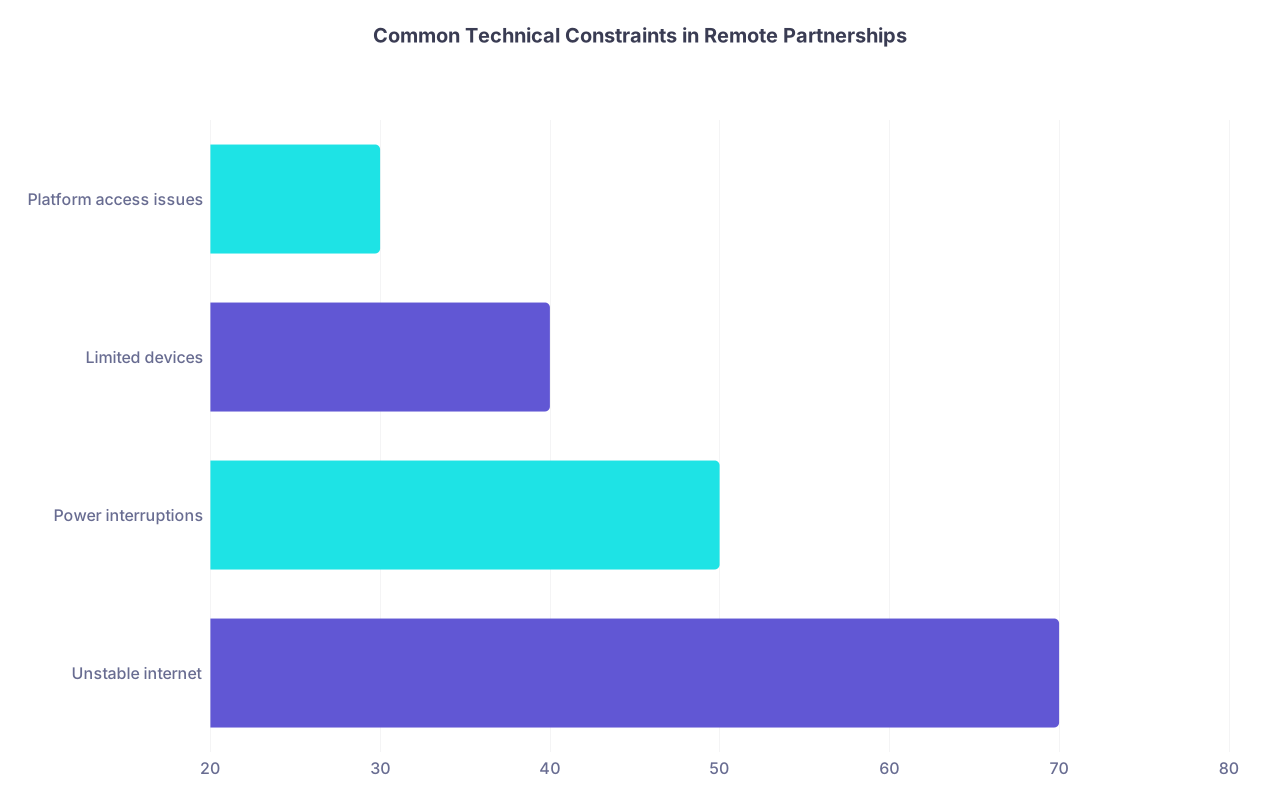
| Category | Value |
|---|---|
| Unstable internet | 70 |
| Power interruptions | 50 |
| Limited devices | 40 |
| Platform access issues | 30 |
If you ignore these realities, your “pipeline” will be a series of cancelled or half‑functional calls.
5.1 Minimal viable tech stack
Aim for minimal:
Synchronous platform:
- Zoom, Teams, or Meet—whichever both institutions already use legally.
- Get institutional accounts if possible to avoid security issues.
Asynchronous backup channel:
- Encrypted messaging group (WhatsApp, Signal) for logistics and “We lost power, reschedule?” messages.
- Shared folder (OneDrive, Google Drive, institutional share) for case templates, slides, and recorded learning points.
Recording policy:
- Default: No recording of live sessions unless absolutely required for internal education and cleared by ethics at both sites.
- If recording: strict access control and short retention.
Basic tech hygiene:
- Waiting room enabled.
- Password‑protected meeting links.
- No screenshots of patients or visible identifiers.
6. Keep the Power Balanced and the Learning Bidirectional
This is where the ethics and personal development bite. You are not setting up “Western experts teach local doctors how to be better.” That model is tired and condescending.
You design the pipeline so learning is clearly bidirectional.
6.1 Flip the script regularly
Concrete ways to avoid one‑way hierarchy:
Alternate who presents “primary” cases.
- 2 sessions from partner site, then 1 from your site.
- When your team presents, you are explicit: “We want your input on how you’d handle this with different resources / cultural context.”
Name expertise clearly.
- When someone from the partner site describes managing severe malaria with limited ICU beds, you call that what it is: high‑level expertise in resource‑limited critical care. Not “interesting curiosity.”
Highlight contextual brilliance, not just “guideline knowledge.”
- Example: The way a district hospital designs a TB contact‑tracing system with two nurses and a motorbike is a masterclass in systems thinking. Treat it that way.
6.2 Protect against quiet exploitation
Watch for warning signs:
- The cases are mostly from the partner site; your site uses them for teaching and then writes publications with minimal local authorship.
- Meetings are scheduled to please your faculty and repeatedly collide with your partner’s clinics or prayer times.
- Slides are branded with your institution’s logo only.
You fix this by:
- Shared leadership: joint program co‑directors, one from each site.
- Authorship rules in writing: any conference abstract or paper arising from these discussions must have meaningful partner authors in lead or senior spots where warranted.
- Rotating chairs: different moderators from both sides, including trainees.
7. Make It Sustainable: Scheduling, Staffing, and Scope
Most programs do well for 3–6 months, then die when one champion leaves. You design from day one so the pipeline survives leadership turnover.
7.1 Start smaller than you want
If you are tempted to do weekly 90‑minute calls across four time zones—stop.
Better:
- Start with once a month or every 2–3 weeks, 60 minutes max.
- Build a 6‑month calendar with:
- Date, time, tentative case theme, named presenter.
- Publish that calendar to all participants. Treat it like an operating room schedule: not optional.
7.2 Delegate and train successors
Make a simple “playbook” document that includes:
- How cases are proposed and approved.
- Case template.
- Session outline.
- Contacts and troubleshooting.
- Ethics/IRB reference numbers and constraints.
Then, actively:
- Identify one junior colleague on each side and say:
“You are my successor for this pipeline. Over the next 6 months you will co‑run everything with me.”
Without that, your pipeline is a pet project, not a program.
8. Build Personal and Professional Growth In, On Purpose
This is underused: your remote case‑discussion pipeline is a powerhouse for personal development and medical ethics education if you structure it that way.
8.1 Make ethics explicit, not accidental
In every case conference, you can include one short ethics segment:
At 40–50 minutes, ask explicitly:
- What was the main ethical tension here?
- Autonomy? Justice? Resource allocation? Cultural conflict?
- How would this be handled differently in each context?
Use a simple structure:
- State the ethical question in 1–2 sentences.
- List 2–3 realistic options the team faced.
- Discuss trade‑offs briefly.
Over time, participants learn to naturally integrate ethics into case formulation, not as an afterthought. That is real professional formation, not checkbox “ethics modules.”
8.2 Track growth for trainees
You can use this pipeline as a structured tool for trainee development. Examples:
- Presentation skills: residents present cases to a truly international audience—this is qualitatively different from local noon conference.
- Cultural humility: they confront their own resource assumptions. Hard to forget the first time you suggest MRI and hear, “That is a 2‑day bus ride plus 3 months’ wages.”
- Reflective practice: build a short post‑session reflection form:
- What did you learn clinically?
- What challenged your assumptions?
- What would you do differently next time?
You do not need pages. Three questions, 5 minutes. Done consistently, this changes how clinicians think.
9. Monitor, Evaluate, and Course‑Correct
If you do not measure anything, you will not notice the pipeline dying until it is already over.
Track a few simple metrics:
- Number of sessions held vs. scheduled.
- Attendance by site and cadre (trainee vs. faculty).
- Number and type of cases discussed.
- Simple post‑session rating (1–5) on educational value.
- Qualitative comments: “What should we change?”
Then do a joint 6‑ or 12‑month review:
- What is working well?
- What parts feel like a burden?
- Are we still within our ethical/IRB boundaries?
- Any unanticipated harms or concerns?
If needed, adjust:
- Frequency.
- Duration.
- Who moderates.
- How cases are selected.
You treat it like a clinical quality‑improvement project, because it is.
10. The Bottom Line: How to Actually Build This
Let us condense this into a bare‑bones action plan. If you follow this sequence, you will be ahead of 90% of “global case” projects:
Secure ethical clarity and oversight.
- Draft a 2–3 page project description.
- Get IRB/ethics review at both sites.
- Write down: no cross‑border clinical orders, educational/QI only.
Co‑design with your partner.
- Run 2–3 discovery calls.
- Agree on frequency, time, language, and case focus.
- Assign named roles on both sides.
Build the case pipeline.
- Create a simple case eligibility checklist and template.
- Establish de‑identification and consent process.
- Identify your first 3–4 cases in advance.
Lock in the session format.
- Use a predictable 60‑minute structure.
- Train presenters and moderators.
- Create and share ground rules slide.
Choose realistic tech and backup plans.
- Agree on a single platform everyone can actually use.
- Set up a WhatsApp/Signal group for logistics.
- Decide recording and data storage rules.
Protect power balance and ethics.
- Alternate presenters between sites.
- Make authorship and ownership decisions explicit.
- Name and discuss ethical tensions in each case.
Plan for sustainability from day one.
- Start monthly or every 2–3 weeks.
- Write a playbook.
- Train successors on both sides.
Do this, and you will not just have a Zoom link and some good intentions. You will have a functioning remote case‑discussion pipeline that grows clinicians, honours patients, and treats your overseas partners as what they are: colleagues, not props.


