

The way most global health electives are designed is backwards. They start with a student’s desire to “go abroad” instead of a partner’s clearly defined needs. That is how you end up with ethical messes, frustrated hosts, and electives that vanish after one year.
You can do better. And you can do it systematically.
What you need is a planning template that forces you to think in the right order: partner first, patients second, systems third, learners last. Here is a stepwise blueprint I use when I help schools and residents build sustainable global health electives that do not implode after the first enthusiastic cohort.
Step 1: Define the Purpose and Boundaries Before You Book a Flight
If you cannot clearly state why this elective exists and where its limits are, you are not ready to send anyone anywhere.
1.1 Write a one-sentence purpose statement
You want a sentence that could go on a Memorandum of Understanding and still make sense. For example:
- “This elective exists to support the outpatient HIV clinic in X District through longitudinal quality improvement, while providing supervised, competency‑appropriate learning for visiting residents.”
- “This elective strengthens emergency triage and basic ultrasound capacity at Y Hospital in partnership with local staff, with a focus on mutual training and system improvement.”
Your purpose should:
- Name the partner site.
- Identify the main service or system area (e.g., HIV clinic, emergency triage, maternity ward, primary care).
- Clarify that visiting learners are there to support, not lead.
If your sentence is more about learners (“expose students to resource-poor settings”) than about systems and patients, rewrite it.
1.2 Set non‑negotiable ethical boundaries
Before logistics, set the lines you will not cross. Examples:
- No independent clinical practice without local clinician supervision.
- No procedures learners are not credentialed to perform at home.
- No research or data collection without IRB/ethics approval and partner‑led questions.
- No distribution of medications or devices outside agreed systems (no “suitcase pharmacies”).
- Clear policy on photography and social media (patient consent, no poverty porn).
Write these as 5–10 bullet points and treat them as hard rules. You will reference them when pressure builds later (“But they really need us to…”)
Step 2: Start With the Partner, Not the Program
If your elective planning could happen without a specific partner’s input, it is already off track.
2.1 Map stakeholders and decision‑makers
At minimum, you need:
- A primary institutional partner (hospital, clinic, NGO, university, or ministry unit).
- A designated on‑site clinical supervisor for learners.
- A designated on‑site administrative/coordination contact.
- A home‑institution faculty lead with decision power.
Write the names, roles, and email/WhatsApp for each. No “TBD.”
| Role | Who They Must Be |
|---|---|
| Local clinical lead | Senior clinician with teaching authority |
| Local admin/coordination | Person who controls schedules/logistics |
| Home faculty lead | Faculty with time and institutional clout |
| Home global health office | Approver of risk, credit, and policy |
| Learner rep (optional) | Student/resident liaison |
If you cannot fill this table with actual names, you are not in “designing an elective” phase. You are in “relationship‑building” phase.
2.2 Conduct a structured needs and assets assessment
Do not guess what the site “needs.” Ask.
Schedule a remote call (or better, a short site visit by a senior faculty member) and work through five domains:
Clinical services and priorities
- What are the top clinical pressures right now? (e.g., high maternal mortality, uncontrolled diabetes, emergency overcrowding)
- Where are visiting learners most likely to help without creating chaos?
Human resources
- How many clinicians, nurses, and trainees are already in the system?
- Are there existing teaching programs? (local med school, nursing school, residency)
Training and supervision capacity
- Who can realistically supervise visiting learners?
- How many learners at a time can they handle without burning out?
Infrastructure and systems
- Language, EMR vs paper, call schedules, transport, housing, safety.
- Any existing partnerships with other foreign programs that might conflict?
Existing strengths
- What is this site already very good at? (The answer is never “nothing.”)
Document this in a concise 2–3 page site profile and share back with the partner to confirm accuracy.
Step 3: Co‑Design Learning Objectives That Do Not Undermine Care
Most electives fail here. They bolt US/European learning objectives onto a partner site like a sticker. Do the opposite: derive objectives from what the site can safely offer and what local supervisors can realistically teach.
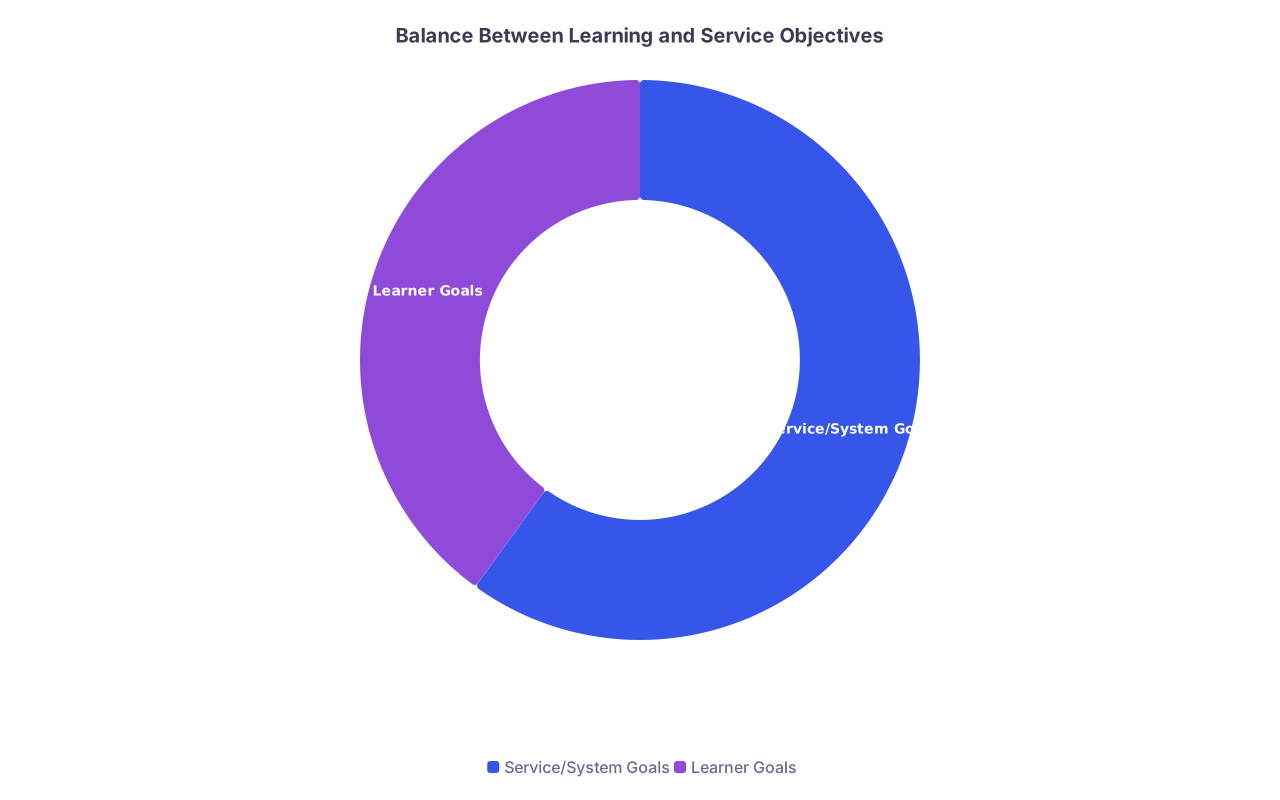
| Category | Value |
|---|---|
| Service/System Goals | 60 |
| Learner Goals | 40 |
3.1 Set three tiers of objectives
System‑level/service objectives
Examples:- Support implementation of a triage checklist in the emergency department.
- Contribute to weekly multidisciplinary TB case review meetings.
- Assist with updating locally relevant clinical protocols (under supervision).
Clinical competencies (context‑appropriate)
Specific, realistic, and always under supervision. Examples:- Safely perform and document focused adult physical exams with local standards.
- Recognize and escalate red‑flag presentations defined by local protocols.
- Participate in managing common conditions (e.g., malaria, pneumonia, preeclampsia) under supervision, respecting local guidelines.
Reflective / ethical development objectives
Examples:- Critically analyze at least two ethical dilemmas encountered (e.g., resource allocation, consent in low literacy contexts).
- Articulate differences between disease patterns and health systems at home vs partner site without making deficit assumptions.
- Demonstrate respectful collaboration with local trainees (not displacing them).
Put these in a one‑page “Learning Objectives and Expectations” document that both home and host supervisors approve.
3.2 Align tasks with existing roles, not above them
Rule of thumb: learners should not be doing anything abroad that would be prohibited or heavily supervised at home.
Concrete protocol:
- Make a matrix with rows as tasks (e.g., history + exam, order medications, perform C‑section, do lumbar puncture) and columns:
- “Permitted at home (yes/no)”
- “Expected supervision at home (direct/indirect/none)”
- “Permitted at partner site (per local policy)”
- “Required supervision at partner site”
- Any cell with “not permitted at home” but “permitted at partner site” should trigger a hard stop or explicit extra policy (usually: learner may observe only).
You will avoid 80% of ethical disasters just by enforcing that matrix honestly.
Step 4: Lock Down Supervision, Scope, and Safety
If you do not have a written supervision and scope‑of‑practice plan, you are inviting harm. Verbal “it will be fine” is not a system.
4.1 Build a supervision plan
For each clinical area where learners will rotate (e.g., outpatient clinic, maternity, emergency):
Define:
- Named supervising clinician(s). Not “the team,” but “Dr. X, Nurse Y.”
- Supervision level:
- Direct (supervisor in room).
- Indirect (supervisor immediately available).
- Oversight (chart review only) – usually not appropriate for short electives.
- Maximum learner‑to‑supervisor ratio (e.g., 1:1 or 2:1, never 5:1 where learners get ignored).
- How supervision is documented:
- Sign‑off on procedures.
- Co‑signature on notes (if relevant).
- End‑of‑week mini‑evaluation.
Put this in a two‑page “Supervision and Scope” addendum to your partnership agreement.
4.2 Define a hard scope‑of‑practice document
One page. Bulleted. No ambiguity.
Include categories:
- You must do:
- Always present cases to your local supervisor before major decisions.
- Use local formularies and protocols.
- You may do under direct supervision:
- e.g., suturing simple lacerations, placing peripheral IVs, assisting in uncomplicated deliveries.
- You may not do:
- Independently prescribe medications.
- Perform procedures you are not credentialed for at home (C‑sections, spinal anesthesia, etc.).
- Provide clinical care if no supervising clinician is present on site.
Every learner signs this before departure. Every local supervisor reviews it.
4.3 Risk management and emergency protocols
You need hard answers to:
- What happens if a learner is injured, assaulted, or becomes seriously ill?
- Who has authority to pull a learner out of a clinical situation?
- Who covers evacuation insurance, and how is it activated?
At minimum:
- Mandatory pre‑travel risk briefing (security, transport, personal conduct).
- Written escalation ladder:
- On‑site clinical supervisor → local program coordinator → home faculty lead → institutional risk office.
- 24/7 emergency contact on both sides.
Step 5: Design Pre‑Departure Preparation That Actually Prepares
Most “global health orientations” are fluff. A morning of travel vaccines and high‑level ethics lectures is not preparation. You need a structured curriculum with clear outputs.
5.1 Core pre‑departure curriculum (minimum package)
I recommend a 12–16 hour package over several weeks, covering:
- Context and history
- Political and health system overview of the partner country and region.
- History of the partnership and past projects (including failures).
- Ethics and power
- Sessions focused on:
- Role confusion (student vs doctor vs volunteer).
- “Saviorism” and how it shows up in clinical decisions and social media.
- Prioritizing patient safety over your learning.
- Sessions focused on:
- Clinical and systems orientation
- Local epidemiology (what you will actually see).
- Local standard treatment guidelines (summaries).
- Referral patterns and expected resource limitations.
- Communication and teamwork
- Working with interpreters.
- Collaborating with local trainees (not stepping over them).
- Giving and receiving feedback across hierarchies.
Require specific outputs:
- A short written reflection on an ethical case.
- A one‑page summary of local health system structure.
- A checklist signed off by the faculty lead confirming completion.
5.2 Skills tune‑up aligned with site needs
If the maternity ward is the primary placement, do NOT send someone who has never seen a vaginal delivery. Same for ED, ICU, or HIV care.
Set minimum clinical prerequisites:
- For example, “Must have completed core internal medicine and OB/GYN rotations” for a maternal health elective.
- Or “Must have completed at least 8 weeks of emergency medicine” for an ED‑heavy elective.
If they do not meet them, they do not go. That simple.
Step 6: Build a Longitudinal Service or QI Component
Sustainable means that each cohort contributes to something that outlives their four weeks.

| Step | Description |
|---|---|
| Step 1 | Pre departure |
| Step 2 | On site orientation |
| Step 3 | Clinical work and QI project |
| Step 4 | On site debrief |
| Step 5 | Post return reflection |
| Step 6 | Project handoff to next cohort |
6.1 Select one or two long‑term projects with the partner
Examples that work:
- Implementing and refining a triage tool in the ED.
- Improving hypertension follow‑up tracking in a primary clinic.
- Strengthening hand hygiene compliance in a ward.
- Developing and iterating local teaching materials (e.g., case‑based modules).
Key conditions:
- The project is chosen by the partner, not by visiting learners alone.
- It has a named local project owner.
- It fits within existing workflows (no parallel data systems).
6.2 Create a simple handover system between cohorts
Your project dies if every group starts over.
Set up:
- A one‑page “Project Brief” document:
- Aim, indicators, current status, next steps.
- A shared, secure folder (cloud or institutional platform) where:
- Each cohort uploads a short summary (2–3 pages max).
- Data are stored in a structured way (with backup).
Mandate that:
- Within 2 weeks of returning, each group must:
- Update the Project Brief.
- Record a 10–15 minute video or written handover for the next cohort.
The home faculty lead and local project owner review these.
Step 7: Plan for Bidirectional Benefits and Capacity Building
If your elective only moves people and resources in one direction (you to them), it is not sustainable. It is extractive with a nicer logo.
7.1 Budget for partner benefits, not just learner travel
A usable rule: at least as much money should go into partner capacity as you spend on sending your learners.
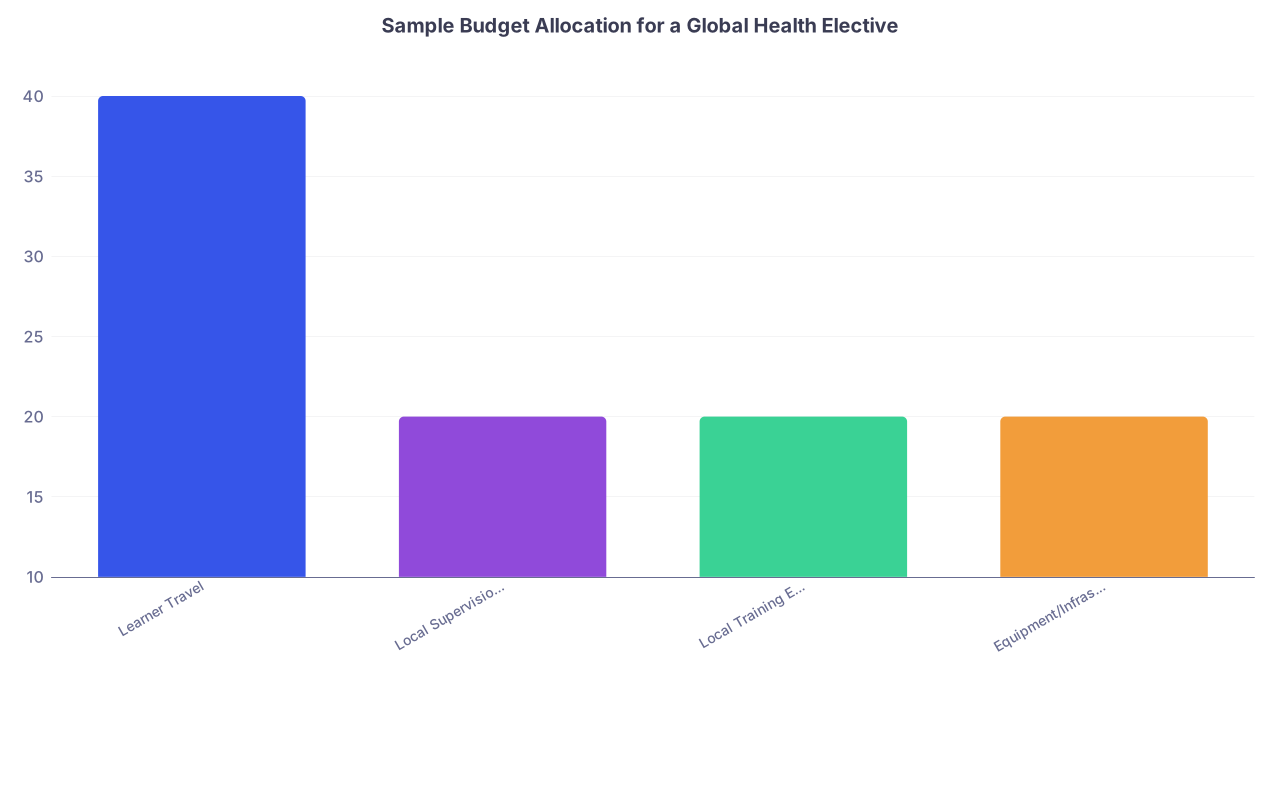
| Category | Value |
|---|---|
| Learner Travel | 40 |
| Local Supervision Stipends | 20 |
| Local Training Events | 20 |
| Equipment/Infrastructure | 20 |
This might include:
- Stipends or protected time for local supervisors.
- Funding for local trainee scholarships or conference participation.
- Teaching materials and equipment the site requested (not what looks good in photos).
Spell out these commitments in your MOU.
7.2 Create opportunities for local trainees and faculty
Concrete options:
- Virtual co‑learning
Regular case conferences or journal clubs with both sets of trainees. - Reciprocal visits (even if small scale)
Even one visiting local faculty or trainee every 1–2 years, supported by your institution, changes the power dynamic. - Co‑authorship and co‑presentation
If data or educational products come out of the elective:- Local collaborators are co‑authors.
- Presentations at conferences include local voices when possible (in person or virtual).
Put this in writing. Anything not budgeted and written down has a 90% chance of evaporating.
Step 8: Implement Structured On‑Site Orientation and Daily Practices
Dropping learners into a ward and hoping they “figure it out” is how you get unsafe behavior and angry partners.
8.1 First 48 hours: strict orientation and observation
Non‑negotiable:
- No independent clinical work in the first 1–2 days.
- Activities:
- Tour of facilities.
- Explicit review of local protocols and how to ask for help.
- Introductions to key staff and trainees.
- Shadowing only, with focus on observing workflow and hierarchy.
Give learners a printed “First 48 Hours” checklist to complete with their local supervisor.
8.2 Daily micro‑structure to keep things on track
Simple, low‑burden routines:
- 5–10 minute huddle at start of shift with supervising clinician:
- Today’s role.
- Cases where learner can be primary vs observer.
- Any limits (e.g., no procedures today).
- 5–10 minute debrief at end of shift:
- One thing learned.
- One question or ethical dilemma noted.
- Any issues with team dynamics.
This structure sounds trivial. It is not. It anchors expectations and keeps supervisors engaged without huge meetings.
Step 9: Debrief, Evaluate, and Adjust Every Single Cycle
Sustainability is not something you decide once; you earn it every year by being willing to change.
9.1 Multi‑source evaluation after each elective
You want data from:
- Local supervisors.
- Local trainees (if they shared spaces).
- Visiting learners.
- Home faculty lead.
Use short, focused tools:
- 10–15 question structured survey for each group.
- 1–2 group debriefs (one on site with local staff; one post‑return with learners).
Focus on:
- Patient safety events or near misses.
- Supervisory burden.
- Displacement of local learners (did it happen? where?).
- Contribution to the longitudinal project.
- Suggestions from local staff (they usually know exactly what needs fixing).
Score key items on a 1–5 scale and track over time.
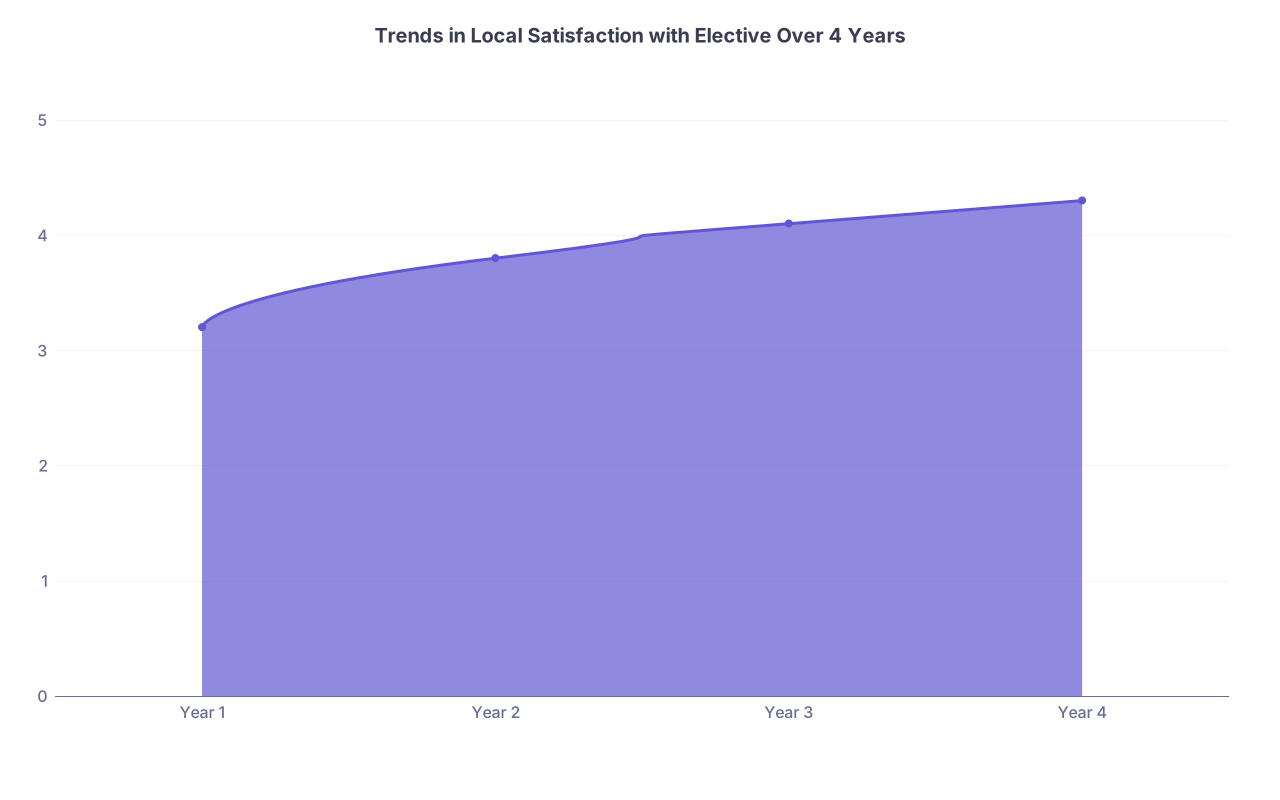
| Category | Value |
|---|---|
| Year 1 | 3.2 |
| Year 2 | 3.8 |
| Year 3 | 4.1 |
| Year 4 | 4.3 |
If local satisfaction starts dropping, you pause and redesign. Not negotiate it away.
9.2 Annual partnership review
Once a year, hold a joint meeting (virtual is fine) with:
- Local clinical lead and admin.
- Home faculty lead.
- Representative from global health office.
Agenda:
- Review safety incidents and responses.
- Review satisfaction trends.
- Review progress on longitudinal project(s).
- Confirm or change:
- Number of learners per year.
- Timing of rotations.
- Priority areas.
Document decisions in a short “Annual Review Note” and store alongside your MOU.
Step 10: Codify Everything in a Simple, Usable Template
You do not need a 70‑page policy manual nobody reads. You need a lean template you can reuse for every elective.
Here is a practical structure:
Partnership Overview (2 pages)
- Site description.
- Key contacts.
- History of collaboration.
Purpose and Boundaries (1 page)
- One‑sentence purpose.
- Non‑negotiable ethical boundaries.
Supervision and Scope (2–3 pages)
- Supervisors by clinical area.
- Scope‑of‑practice matrix.
- Emergency and risk protocol.
Learning Objectives and Curriculum (3–4 pages)
- System‑level, clinical, reflective objectives.
- Pre‑departure requirements.
- On‑site orientation plan.
Longitudinal Project Brief (1–2 pages)
- Aim, measures, roles, status.
Bidirectional Commitments and Budget (2 pages)
- Resource flows.
- Capacity‑building commitments.
Evaluation and Review Plan (1–2 pages)
- Surveys.
- Annual review process.
If the entire template runs more than ~15 pages, you are probably padding. Cut jargon, keep decisions.
A Sample Stepwise Planning Checklist (Condensed)
Use this as your “am I serious about sustainability or just doing voluntourism with better branding?” test.
Partner‑driven?
- Do you have a named local clinical and admin lead?
- Has the partner defined priority areas and approved your purpose statement?
Ethically bounded?
- Is there a written scope‑of‑practice signed by learners and supervisors?
- Are there explicit rules against unsupervised care and “above‑training” procedures?
Prepared learners?
- Completed structured pre‑departure curriculum?
- Met minimum clinical experience for the placement?
Supervision and safety?
- Documented supervision levels per site/department?
- Clear emergency and evacuation protocols?
Longitudinal and reciprocal?
- At least one ongoing project that spans cohorts?
- Budgeted benefits and capacity‑building for the partner?
Feedback loop?
- Multi‑source evaluation every cycle?
- Annual joint review with documented adjustments?
If you cannot honestly check most of these, pause. Fix the gaps before sending the next group.
Your Next Concrete Step
Do not start by drafting a brochure for students. That is the last step.
Today, do this instead:
Open a blank document and write your one‑sentence purpose statement and a first draft of your non‑negotiable ethical boundaries for the elective you are planning (or already running). Then email that one page to your local partner and ask one direct question:
“Does this reflect what you want this elective to be, and what would you change?”
If you build from that answer, you are finally designing a sustainable global health elective instead of just another short‑term trip.


