

It is July. You just got back from a two-week “global health” trip. You have a few hundred photos, some stories about the power going out in the OR, and a vague sense that what you did was… something. Helpful? Maybe. Maybe not.
The hard question hits you on the flight home: “Was that just volunteer tourism, or the start of something real?”
If you are serious about global health, you cannot afford another disconnected, feel-good trip. You need a plan. Specifically: a concrete, long-term partnership strategy that respects local leadership, avoids doing harm, and actually strengthens systems instead of your Instagram.
Let me walk you through how to turn that one-off trip—past or upcoming—into a structured long-term global health partnership plan.
1. First, Admit What the “One-Off Trip” Usually Gets Wrong
Before you build, you strip. You need to be brutally honest about what is broken in most short-term trips.
Patterns I see over and over:
- Teams show up with no clear ask from the local side.
- Students perform at the edge of, or beyond, their competence.
- No follow-up. No data. No continuity.
- The local clinic shifts its schedule around the visitors, then is left picking up the pieces afterward.
If you want a long-term partnership, you start by refusing to repeat the same mistakes.
Run your last (or planned) trip through this ethical checkpoint:
Who requested the trip?
- You? Your school? A local leader with defined needs?
If there is no explicit local request, you are starting on the wrong foot.
- You? Your school? A local leader with defined needs?
Who controlled the agenda?
- Did you mostly do what you planned from home, or what the site genuinely needed?
Who benefited the most?
- Be honest. Your CV? Your photos? Or patient outcomes and local capacity?
What changed a month later?
- If the honest answer is “almost nothing,” then you did a one-off service trip. Not a partnership.
Do not sugarcoat it. This is the baseline you are trying to fix.
2. Reframe the Goal: From “Trip” to “Partnership”
You are not planning more travel. You are planning a relationship. That sounds softer than it is. Real partnerships are structured, contractual, and sometimes uncomfortable.
Here is the mental pivot you need:
- A trip is an event.
- A partnership is an ongoing commitment with shared responsibility, shared agenda, and shared risk.
That affects everything:
- Time horizon: minimum 3–5 years, not 2 weeks.
- Metrics: not “how many patients we saw,” but “what changed for the local system over years.”
- Power: local partner leads. You follow.
Quick Partnership Reality Check
If you cannot answer “yes” to most of these, you are not ready to call it a partnership yet:
- Do you know the names, roles, and constraints of key local leaders?
- Can you state, in their words, their top 3 priorities for their health system?
- Do they know your constraints—time, training level, funding, institutional politics?
- Is there at least one concrete, ongoing project that both sides agreed to continue for 2+ years?
If not, do not panic. That is what we are going to build.
3. Map the Landscape: What You Actually Bring vs What They Actually Need
This is where most people get it wrong. They jump straight to “I’ll go back next summer and do more clinics.” That is lazy and usually misaligned.
You need two maps:
- A local needs and assets map
- A your skills and resources map
Then you overlap them and kill the rest.
3.1 Build a Local Needs & Assets Map (With Them, Not For Them)
Set up structured debrief calls with:
- The local medical director or clinic leader
- Nursing leadership
- Community health workers (CHWs) if they exist
- Ministry of Health / district health officials, if possible
Ask concrete questions:
- “What are your top 3 health system priorities for the next 3–5 years?”
- “Where are your biggest bottlenecks—staffing, training, supplies, data, referrals?”
- “What have past foreign teams done that was genuinely helpful? What was not?”
- “If you could have a committed partner for 5 years, what would you ask them to do?”
Do not argue. Do not pitch. Just document.
Then build a simple map:
| Category | Local Needs (From Partners) | Local Assets (Existing Strengths) |
|---|---|---|
| Clinical Services | Improve emergency care triage | Strong nursing staff, high case volume |
| Training/Education | Basic ultrasound skills | Motivated clinicians, teaching culture |
| Data & Quality | Better maternal outcomes tracking | Paper records, some Excel capacity |
| Infrastructure | Reliable cold chain for vaccines | Government-supplied vaccines |
| Community Engagement | Diabetes/HTN education | Existing CHW network |
Now you have something real to align with.
3.2 Map Your Skills and Resources (Without Pretending)
Make an honest inventory. If you are an MS3, you are not “bringing surgical expertise.” Stop.
List:
- Your true clinical competencies (basic procedures, not “assisting in nine C-sections once”)
- Non-clinical skills: QI, data analysis, teaching, curriculum design, implementation science, language, IT, logistics, grant writing
- Institutional resources: global health office, simulation lab, remote mentoring faculty, IRB, small grants
- Time you can commit over 12–24 months
Now overlay with their map and circle the few intersections where:
- There is a real need,
- You or your institution can meaningfully help,
- And you can do it ethically without displacing or undermining local staff.
Everything else? Off the table.
4. Design a Long-Term Partnership Structure: 3–5 Year Spine
Now you build a spine. Not a pile of random projects. A structured, time-bound partnership plan.
Think of it as a 3–5 year Gantt chart with clear lanes:
- Governance and communication
- Programmatic focus areas
- Training and capacity building
- Evaluation and feedback
- Funding and sustainability
4.1 Governance: Who Owns What
You want minimal bureaucracy but clear structure. At minimum:
- Local partnership lead: someone on-site with decision-making authority
- Home institution lead: faculty or senior resident who will outlast you
- Student/trainee coordinator: you, for now
Set up:
- A written Memorandum of Understanding (MOU) or at least a letter of agreement
- Quarterly virtual meetings with shared minutes
- A shared document (Google Docs, Notion, whatever they can access) that tracks projects, roles, timelines
Clarify explicitly:
- Who approves visiting teams
- Who sets clinical scope and supervision rules
- Who collects data and owns it
- Who decides when a project ends or shifts
5. Choose 1–2 Focus Areas, Not 10
Trying to “help with everything” is how you help with nothing.
Pick one or two primary themes, and commit hard. Examples:
- Emergency triage and referral improvement
- Maternal and neonatal care quality
- Noncommunicable disease (NCD) management (hypertension, diabetes)
- Surgical safety and perioperative care
- Mental health integration in primary care
Make sure they are:
- Explicitly requested by local partners
- Aligned with national or regional health strategies
- Feasible for your skills and institutional support
For example, say the joint decision is:
Focus area: Emergency care triage and early management at the district hospital.
Now everything revolves around that.
6. Build a Concrete Multi-Year Action Plan
This is where you stop talking about “long-term relationship” in the abstract and write a plan with dates and deliverables.
6.1 Example: 3-Year Partnership Plan Skeleton
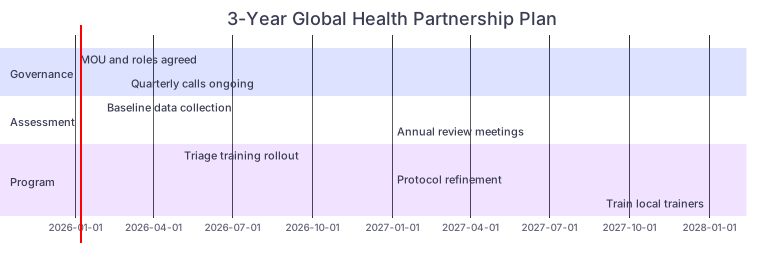
| Task | Details |
|---|---|
| Governance: MOU and roles agreed | a1, 2026-01, 2m |
| Governance: Quarterly calls ongoing | a2, 2026-03, 34m |
| Assessment: Baseline data collection | b1, 2026-02, 3m |
| Assessment: Annual review meetings | b2, 2027-01, 24m |
| Program: Triage training rollout | c1, 2026-05, 6m |
| Program: Protocol refinement | c2, 2027-01, 12m |
| Program: Train local trainers | c3, 2028-01, 6m |
Use a structure like:
Year 1 – Listening, Baseline, Pilot
- Finalize MOU
- Jointly define 1–2 measurable indicators (e.g., time-to-antibiotics in sepsis, triage-to-physician time)
- Collect baseline data
- Design and pilot one small, low-cost intervention that fits their workflow
- Identify 2–3 local “champions” for the theme (nurse, clinician, admin)
Year 2 – Scale and Strengthen
- Refine protocols or tools based on Year 1
- Expand to more wards/sites if it worked
- Develop and run a formal training or mentorship program with local trainers co-leading
- Start transitioning responsibilities firmly to local leadership
Year 3 – Consolidate and Transition
- Make sure all key tasks (training, data collection, protocol updates) are owned by local team
- Shift the home institution role to remote support, research collaboration, or advanced training on request
- Decide together whether to:
- Extend the same focus area,
- Hand it off fully, or
- Add a second focus area, if and only if the first is solid and stable.
7. Ethical Guardrails: How Not to Become the Problem
You can easily do harm with the best intentions. So build explicit guardrails.
7.1 Scope of Practice and Supervision
Non-negotiable rules:
- You only perform tasks you are allowed and competent to do at home.
- You are supervised at least as closely as you would be in your own setting.
- You do not “fill gaps” in ways that would never be acceptable at home (e.g., an MS2 doing solo deliveries).
Document this in your agreement. Get both institutions to sign off. If a site pressures you to exceed your scope, your pre-agreed line makes it easier to push back.
7.2 No Parallel Systems
One of the worst patterns: visitors set up cool new vertical programs that die the minute they leave.
So:
- Use existing documentation systems (paper, DHIS2, national EMR) rather than bringing shiny custom apps.
- Train local staff on skills that are usable without you (no reliance on your proprietary device or software).
- Align with national guidelines whenever possible, not your home-country favourite protocol.
8. Integrate Training and Capacity Building the Right Way
You are in the “personal development and medical ethics” phase. So yes, you will grow on these trips. But if the training is not primarily building local capacity, you are missing the point.
8.1 Design Training for Local Ownership
Instead of “we will run a workshop every time we visit,” think:
- Year 1: You co-facilitate with local staff.
- Year 2: Local staff lead. You support and provide materials.
- Year 3: Local staff fully own it. You maybe join remotely once a year.
Pick methods that actually work in busy, resource-limited settings:
- Short, repeated bedside teaching rather than marathon lectures
- Simple checklists or job aids laminated and posted
- Case-based teaching using local patients and local cases, not U.S. board questions
8.2 Use Remote Mentorship Intelligently
Everyone talks about “tele-mentoring” now. Few do it well.
Do it like this:
- Set a fixed monthly case or QI review call with a small, stable group.
- Use low-bandwidth tools (WhatsApp voice notes, email summaries) if video is unreliable.
- Focus each session on one theme (e.g., “3 recent sepsis cases”) rather than random scatter.
This keeps the partnership alive between trips without overwhelming anyone.
9. Data, Outcomes, and Not Lying to Yourself
A “long-term partnership” that never measures anything is just a long-term story.
You do not need a 50-page RCT. You do need 3–5 simple indicators you track together.
Examples for an emergency care partnership:
- Triage-to-physician median time
- Percentage of high-acuity patients correctly flagged
- In-hospital mortality for defined conditions (e.g., sepsis, trauma)
- Number of local staff trained and retrained
Turn it into a simple shared dashboard.
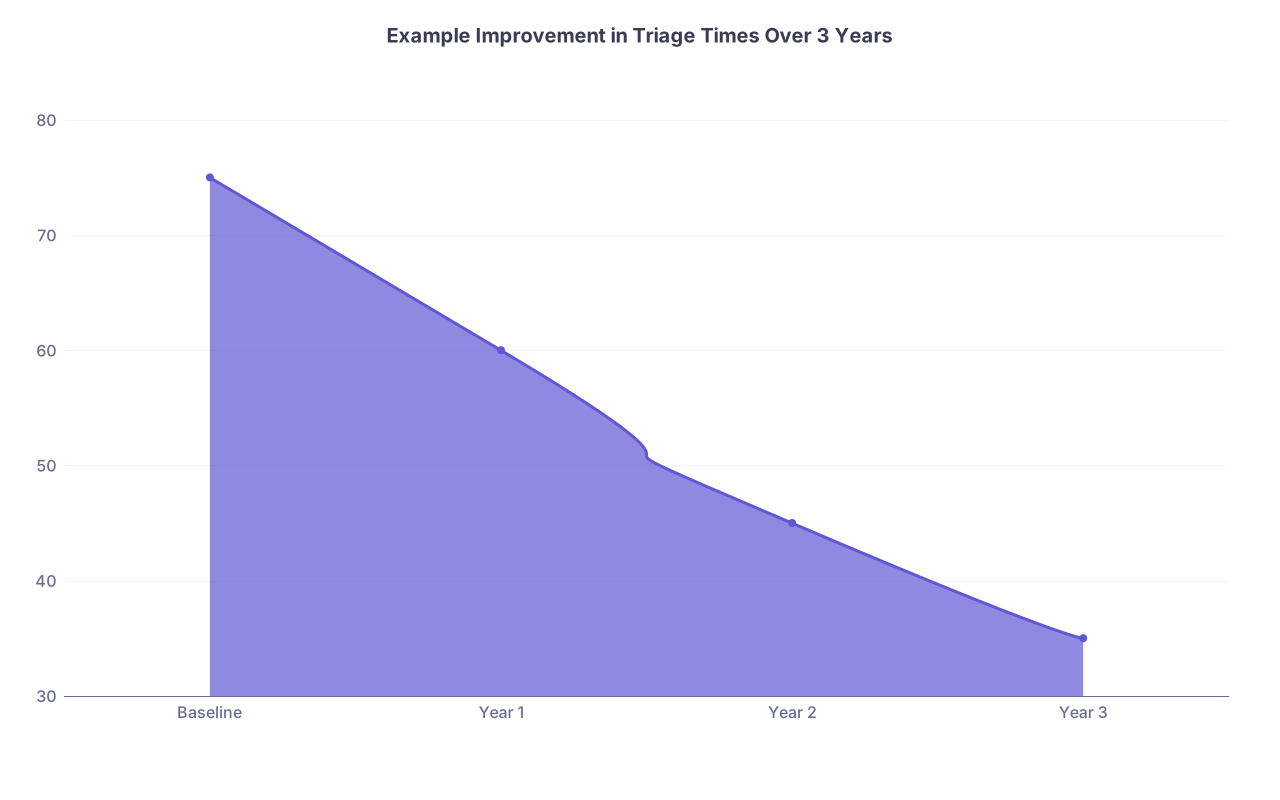
| Category | Value |
|---|---|
| Baseline | 75 |
| Year 1 | 60 |
| Year 2 | 45 |
| Year 3 | 35 |
Then:
- Present data together at local morbidity and mortality (M&M) or QI meetings.
- If things are not improving, change tactics or admit the project is not working. Do not fudge.
- If things are improving, aim to publish with local authors first, and you last.
10. Practical Logistics: Making Your Next Trip a “Partnership Trip”
You have the big picture. Now let us drill into your next visit.
Here is how to rebuild it from a one-off mission into a partnership-builder.
10.1 Pre-Trip (3–6 Months Out)
- Set a call with your local lead: ask what they want you to do this time in light of the multi-year plan.
- Draft a 1–2 page “Trip Objectives and Activities” document:
- Linked to specific partnership goals
- With named local counterparts for each activity
- Confirm:
- Housing, transport, safety plan
- Clinical supervision and scope
- Any teaching sessions they want you to prepare
Send this to your own institution so everyone knows this is part of a long-term plan, not a random elective.
10.2 On-Trip
Your job is not “do as much as possible.” Your job is “advance the long-term plan without causing damage.”
Daily checklist:
- What did we do today that a local person can continue without us?
- Did we displace any local staff? If yes, fix that tomorrow.
- Did we learn something that should change the partnership plan? Write it down.
Protect time for:
- Sitting down with local leadership for honest debriefs.
- Updating shared documents in real time.
- Adjusting next visit’s goals based on what you are actually seeing.
10.3 Post-Trip (First 1–2 Months)
This is where most people vanish. Do not.
Within 2 weeks:
- Send a concise trip report (2–3 pages max) to both sides:
- What was done
- What worked
- What did not
- Updated ideas for the next 12 months
- Propose dates for the next quarterly call.
Within 2 months:
- Analyze any data collected.
- Draft training or protocol revisions based on on-the-ground reality.
- Clarify your capacity for ongoing remote work (don’t promise daily support if you cannot do it).
11. Your Role Over Time: From “Visitor” to “Bridge”
You probably will not be in this exact role forever. You will graduate, change cities, change specialties. That is normal.
Your responsibility is to not make the partnership depend on you.
Your trajectory should look something like this:
Year 1–2:
- You do the bulk of the grunt work: notes, data cleaning, drafting documents, preparing teaching slides.
- You build relationships, but always introduce institutional leaders as the real anchors.
Year 3+:
- You shift toward:
- Mentorship of younger trainees joining the partnership
- Occasional visits or remote support
- Helping with publications and grant applications that elevate local voices.
If the partnership collapses when you leave, you built a fan club, not a system.
12. Common Failure Modes—and How to Avoid Them
I have seen the same problems repeat across programs in Kenya, Haiti, India, Guatemala, you name it.
Here are a few, along with direct fixes.
Failure 1: “Heroic” short trips that exhaust the system
- Fix: Cap daily patient volume. Share call with local staff. Always ask, “How can we make this easier for you after we leave?”
Failure 2: Uncoordinated teams from the same home institution
- Fix: Single point person/faculty who approves all travel. Central calendar. No rogue teams.
Failure 3: Massive projects nobody asked for
- Fix: Every major project must be explicitly requested and co-designed. If local leadership is lukewarm, walk away.
Failure 4: Ethics as a checkbox
- Fix: Treat ethical questions like clinical ones. If you would not do it under your home IRB and malpractice system, do not do it there.
13. A Simple 10-Step Checklist to Turn Your Trip Into a Partnership Plan
If you want something you can literally print and work through, use this.
- Identify and confirm a single local lead and a single home-institution lead.
- Schedule a 60–90 minute joint call to define 1–2 long-term focus areas.
- Build a written local needs and assets map, validated by local stakeholders.
- Map your actual skills and institutional resources honestly.
- Draft a 3–5 year spine: goals, roles, broad timeline.
- Choose 3–5 simple, trackable indicators you will monitor together.
- Create a one-page ethical framework: scope, supervision, no-parallel-systems rules.
- Redesign your next trip around specific partnership milestones, not random activity.
- Commit to quarterly virtual check-ins with brief, shared written minutes.
- Plan for your own succession: who takes over your role in 1–3 years?
If you work through those 10 steps properly, you are not doing “a trip” anymore. You are building a responsible, ethical, long-haul global health partnership.
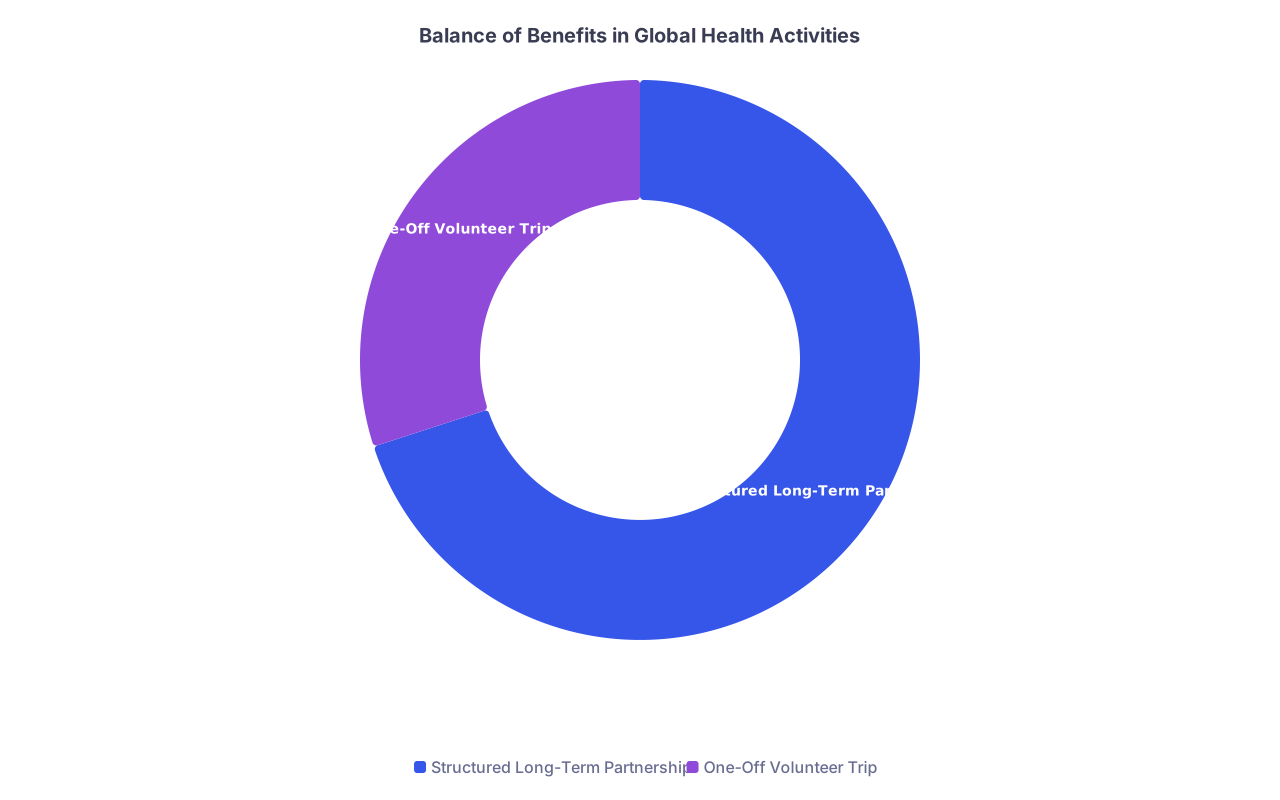
| Category | Value |
|---|---|
| Structured Long-Term Partnership | 70 |
| One-Off Volunteer Trip | 30 |


