

The most dangerous lie in global health is this: “You will always have backup.”
You will not. And if you are not prepared for that reality, you are a risk to your patients and to yourself.
This is about what you do when you are on mission, something serious lands in your lap, and there is no senior on site. No attending. No consultant. Maybe no reliable phone signal. Just you, a skeleton team, and a decision that actually matters.
You want a protocol for that. Not vibes. Not “trust your gut.” A protocol.
That is what I am going to give you.
1. Understand the Actual Problem You Are Facing
The ethical crisis is not “there is no senior around.”
The ethical crisis is: you have to make a high‑stakes decision with partial information, limited capacity, and no clear hierarchy.
That usually looks like:
- Two patients, one oxygen cylinder.
- A woman in obstructed labor and no surgical capability on site, transfer is risky.
- A child in septic shock, family wants traditional healer instead of IV antibiotics.
- Aggressive family demanding treatment that is not indicated (or not available).
- Local staff doing something you believe is dangerous or unethical, and you are the outsider.
If you treat each of these like unique, special snowflakes, you will drown.
You need a repeatable decision process that:
- Slows you down just enough not to do something reckless.
- Is simple enough to run under pressure.
- Protects patients first, but also protects you and your team legally and psychologically.
Here is the core rule:
When you are alone, your “senior” is the process. So build one and use it every single time.
2. Use a 6‑Step Emergency Ethics Protocol
I teach junior clinicians a stripped-down protocol they can remember at 3 a.m. after 18 hours on their feet.
Six steps. In order. No skipping.

| Step | Description |
|---|---|
| Step 1 | Recognize ethical red flag |
| Step 2 | Stabilize immediate threats |
| Step 3 | Clarify facts and context |
| Step 4 | Define options and constraints |
| Step 5 | Apply simple ethical test |
| Step 6 | Decide, act, and document |
| Step 7 | Debrief and escalate later |
Step 1: Name the Ethical Red Flag
If your stomach drops, say it out loud. To yourself or to your team.
- “We have a triage conflict.”
- “This might be against the patient’s wishes.”
- “We may be overstepping our scope.”
- “There is a serious consent issue here.”
Why? Because once you label it, you shift from panic mode to problem‑solving mode. You treat it as an ethics case, not just “bad feeling.”
Concrete move:
- Take 10 seconds and say: “OK, this is an ethical dilemma about X.”
That alone keeps you from sliding into autopilot.
Step 2: Stabilize First, Philosophize Later
Ethics does not trump airway.
Your first duty is to prevent immediate, preventable harm.
So before you start intellectualizing autonomy vs beneficence, do:
- Airway, breathing, circulation.
- Stop obvious bleeding.
- Simple analgesia if safe.
- Basic infection control (gloves, mask, hand hygiene).
You operate off one guiding principle here:
If an action is clearly life‑saving, low‑risk, and reversible, you are usually justified in acting first and sorting ethics after.
Examples:
- Start bag‑mask ventilation on an apneic child even if consent is unclear in the chaos.
- Give IV fluids for shock while you clarify family preferences.
Do not spend 15 minutes debating the philosophy of consent while someone bleeds out in front of you. That is cowardice dressed as ethics.
Step 3: Get the Facts — Not the Drama
Most “ethical crises” evaporate when you actually know what is going on.
You run a rapid fact‑check:
Clinical facts
- What is the diagnosis or top 2–3 differentials?
- What is the expected course without intervention? In hours, not in theories.
- What is your realistic treatment capacity here, right now?
Patient facts
- Is the patient conscious and capable of decision‑making?
- If not, who is the legitimate decision‑maker in this context? (Spouse? Eldest son? Village chief? Legal guardian?)
- What has the patient or family actually said, in their own words, not via rumor?
Contextual facts
- Local policy or protocol? (Ministry of Health, NGO, hospital rules.)
- Any written guidance relevant? (Triage policy, referral criteria, blood use policy.)
Do not assume. Ask. Explicitly.
Concrete script:
- “Tell me exactly what the patient said they want.”
- “Who is usually the person who decides for the family here?”
- “What is the hospital rule for this situation?”
If you have a translator, insist on first‑person quotes, not summaries.
“Please tell me the exact words they used.”
3. Map Your Options and Constraints
You are never choosing between “good” and “bad.” You are choosing between bad, worse, and unrealistic.
Write your options down if you can. On a prescription pad. On a glove. On your phone.
Example: One oxygen cylinder, two hypoxic patients.
Options might be:
- Give full oxygen to the most salvageable patient, none to the other.
- Split oxygen (jury‑rig a Y‑connector) and under‑treat both.
- Alternate use (15 minutes each).
- Use oxygen for transport only to a higher‑level facility.
- Palliative focus for one patient, full support for the other.
Now list constraints for each:
- Equipment available?
- Trained staff?
- Distance and safety of transfer?
- Local law or policy?
- Cultural non‑negotiables?
You aim for:
- Real options, not fantasies.
“Air‑evac to capital” is not an option if no one flies at night. - 2–4 options max. If you have 10, you’re just avoiding choosing.
4. Run Every Option Through a Simple Ethical Test
You do not have time for a 40‑page WHO ethics framework mid‑code. You need something compact.
Here is the 4‑question test I actually use in the field:
- Harm: Which option is most likely to prevent the most serious harm with the least added risk?
- Respect: Which option best respects the patient’s known or probable wishes and values?
- Fairness: Which option is least unfair to other patients who also need care?
- Accountability: Which option can I defend in writing to:
- The patient or family,
- The local medical director,
- A formal review or court,
and not be ashamed?
You will not get a perfect score. You are looking for the least unethical option that you can own.
To operationalize this, literally score each option 1–5 on each domain, fast:
| Option | Harm (1-5) | Respect (1-5) | Fairness (1-5) | Accountability (1-5) |
|---|---|---|---|---|
| Oxygen to most salvageable only | 4 | 3 | 4 | 4 |
| Split oxygen, under-treat both | 2 | 3 | 3 | 2 |
| Alternate use | 3 | 3 | 3 | 3 |
You do not need math. Your gut will land on one or two options that feel most defensible across all four.
If you are stuck, use the Accountability question as the tiebreaker.
If you would be embarrassed explaining your choice to a local colleague you respect, do not pick it.
5. Decide, Act, and Document Like a Professional
Indecision kills more patients than “wrong” decisions in these settings.
Once you have run the process:
Decide within a defined time box.
- For emergencies: 60–120 seconds.
- For urgent but not crashing situations: 10–20 minutes.
Act clearly.
- Give specific orders: “We will give oxygen to Patient A only. We will provide comfort measures to Patient B.”
- Assign roles: who does what, who talks to family, who monitors.
Explain in plain language.
- To the patient/family (through interpreter if needed).
- To the local nurse or clinical officer.
- Keep it short and direct.
Example script for scarce resources:
“We have only one working oxygen cylinder. Your father’s chance of surviving even with oxygen is very low. The child over there is very young and has a better chance if we give full oxygen. So I recommend we give oxygen to the child and focus on keeping your father comfortable. I am very sorry this is the situation. I will stay here and explain everything we do.”
You do not hide reality. You do not oversell what you can do.
Write (paper or electronic, whatever exists):
- Clinical situation in brief.
- The specific dilemma.
- The options considered.
- Who you discussed with (names and roles).
- The final decision and rationale.
- What the patient/family said, in quotes if possible.
- Any attempts made to contact seniors or referral centers.

Documentation is your safety net. Ethically and legally. It shows you did not wing it; you followed a reasoned process.
6. Use Remote Senior Support Without Paralyzing Yourself
“No senior is available” often means “no senior is physically present.”
There are still ways to pull in higher‑level input without pretending someone is going to make the decision for you.
Realistically, your options:
- Phone/WhatsApp call to on‑call consultant (if your NGO or hospital has one).
- Asynchronous messaging with photos, short videos, or case summaries.
- Guideline check (WHO, MSF, national protocols stored offline on your phone).
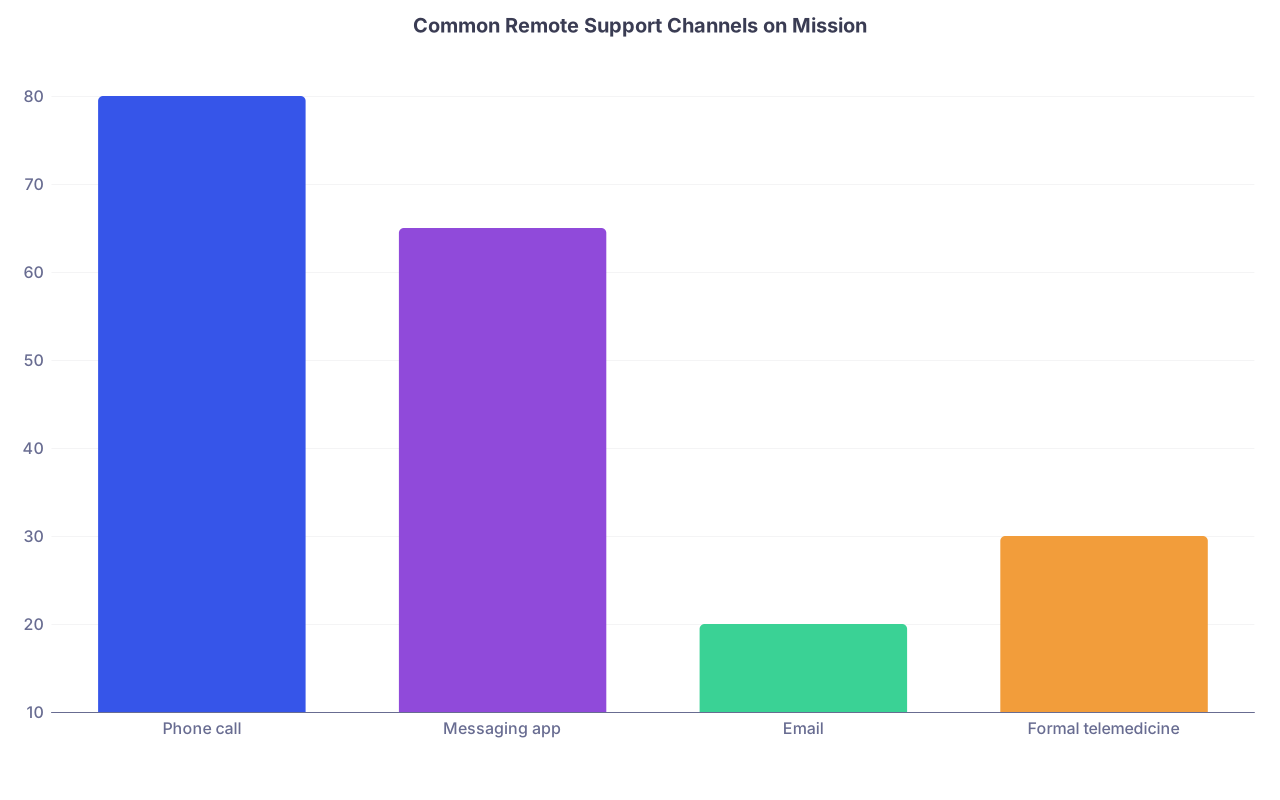
| Category | Value |
|---|---|
| Phone call | 80 |
| Messaging app | 65 |
| 20 | |
| Formal telemedicine | 30 |
Here is how to not waste that lifeline.
Prepare a tight case summary before calling:
- Age/sex, key problem, vitals, major comorbidities.
- What has been done already.
- What resources you actually have (drugs, oxygen, transport).
- The core ethical question: “We have X and Y; I need to choose between A and B.”
Ask for guidance, not permission.
- Good: “Given these limits, what would you prioritize, and what should I absolutely avoid?”
- Bad: “Tell me exactly what to do so I am not responsible.”
Accept that the final call is still yours. Remote seniors can help you see blind spots and avoid dangerous moves, but they are not there. You are. You own the decision.
If no one answers, you still have your protocol. Use it.
7. When Culture, Law, and Your Ethics Collide
Global health is full of ugly collisions: your training, local norms, and actual law pointing in three different directions.
Common flashpoints:
- Consent for women controlled by husbands or male relatives.
- Families insisting patients not be told their diagnosis (e.g., cancer, HIV).
- Local staff using treatments you consider harmful or non‑evidence‑based.
- Requests for bribes or “informal payments” to access services.
You do not fix a country’s culture in one night shift. But you do have lines you should not cross.
Here is a realistic way to handle this without turning into the self‑righteous foreigner who no one will work with.
7.1 Clarify the Local Standard Before You Judge It
Ask local colleagues or leaders:
- “In this hospital, who usually gives consent for X?”
- “Are patients usually told their diagnosis directly, or through family?”
- “Is it legal here for a woman to decide on her own care?”
You do not have to agree. But you need to know the baseline.
7.2 Draw Two Lines: “Deal With” and “No Go”
For yourself, define:
“Deal with” zone – Practices you dislike but can tolerate while you slowly advocate for better:
- Family‑mediated disclosure, as long as there is no outright lying by you.
- Use of some non‑harmful traditional remedies alongside proper treatment.
- Paternalistic communication style that is still broadly honest.
“No go” zone – Practices you will not participate in:
- Physical abuse or degrading treatment of patients.
- Denial of pain relief for punitive reasons.
- Performing procedures without any form of consent when consent is possible.
- Fraudulent documentation or falsifying results.
Concrete move:
- When pushed toward a “no go” item, say:
“I understand this may be usual here, but I am not able to do that. It goes against my professional code. I can help with [alternative] instead.”
Then you escalate to your organization or local leadership after the immediate situation is handled.
8. Scarce Resources and Triage: The Stuff That Sticks With You
Mission work forces you into triage decisions most clinicians never have to face at home. This is where people crack later.
Two rules that reduce moral damage:
- Triage by principle, not by feeling.
- Use a visible, shared system, not a secret mental algorithm.

If your mission or hospital does not already have a triage system, you adopt a simple one like START or a color‑coded severity scale, then you actually tell people you are using it.
Example: 3‑color system
- Red – immediate life‑threat, likely benefit from prompt intervention.
- Yellow – serious but stable for now.
- Green – walking wounded / minor.
- Black – expectant / palliative focus.
You then apply it consistently:
- The drunk, aggressive trauma patient who just lost half his blood volume and can be saved if you act? Red.
- The polite teacher with a month of back pain? Green.
Is this emotionally pleasant? No.
Is it ethically sounder than “treat whoever yells loudest or looks like you”? Yes.
And again: document.
“Patient categorized as ‘expectant’ due to [reasons]; focus shifted to comfort care.”
9. Protect Your Own Ethics Long Term: Debrief and Learn
The mission ends. The patients are gone. But your decisions follow you home.
If you do not process these dilemmas, you end up:
- Numb.
- Burnt out.
- Or convinced you are always right. Which is worse.
Two habits protect you.
9.1 Micro‑Debrief After Any Major Ethical Call
Same day, or within 48 hours, you do a 10–15 minute debrief with whoever is available (nurse, logistician, another clinician).
Template:
- “What actually happened, step by step?”
- “What were our options at the time?”
- “What would we do the same again?”
- “What, if anything, would we do differently with the same constraints?”
Keep it blame‑free. You dissect the decision, not the person.
If you are truly alone, write a short reflection for yourself. 5–10 lines.
9.2 Formal Debrief With Seniors After the Fact
Once you are somewhere with real internet and colleagues:
- Send 1–3 of the hardest cases to a trusted senior or ethics committee.
- Ask explicitly: “Given these constraints, how would you have approached this? What did I miss?”
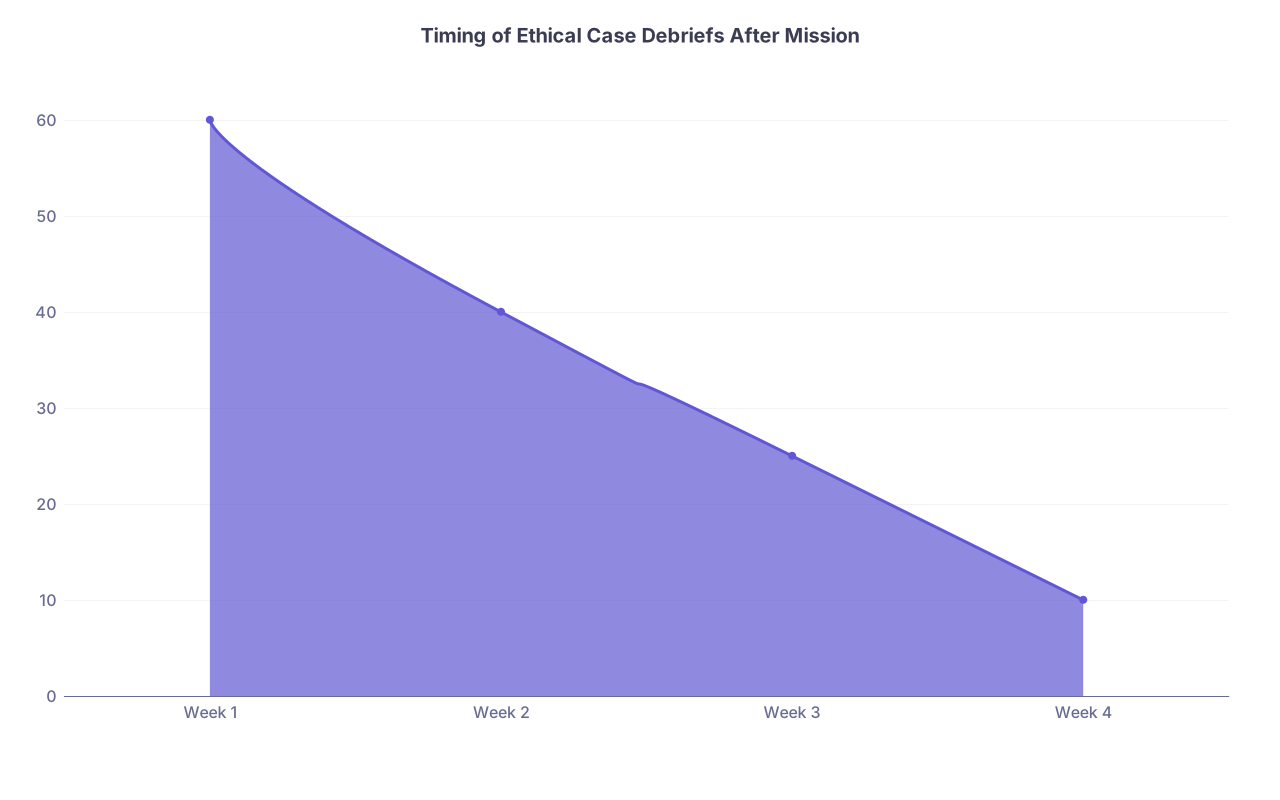
| Category | Value |
|---|---|
| Week 1 | 60 |
| Week 2 | 40 |
| Week 3 | 25 |
| Week 4 | 10 |
The point is not to beat yourself up. It is to upgrade your internal protocol so the next time you are alone, you are making slightly better bad choices.
10. Build an Ethics Toolkit Before You Go Back Out
If you are smart, you do not wait for the next crisis to “figure it out.” You pre‑load tools.
Here is a short list I have actually seen make a difference on the ground:
Offline guideline pack on your phone
- WHO Emergency Triage Assessment and Treatment (ETAT).
- WHO Surgical Care at the District Hospital (if relevant).
- Your NGO’s clinical and ethical guidelines. Save as PDFs. Test you can open them without internet.
One‑page personal decision checklist Meant to be printed and kept in your pocket. Example structure:
- Is there an immediate life‑threat I can safely treat now?
- What exactly is the ethical conflict (triage, consent, futility, cultural clash)?
- What are my realistic options?
- How do they score on harm, respect, fairness, accountability?
- What is my decision and why? (One sentence).
- Who did I inform? Who did I attempt to contact?
Pre‑identified “phone a friend” seniors
- 2–3 clinicians who agree you can message them if things get rough.
- Different time zones help.
- Not for every case. Only for the genuine “I will think about this for years” ones.
Local mentorship
- On arrival, identify one local senior nurse, clinical officer, or doctor whose judgment you respect.
- Explicitly say: “If I face a difficult decision when I am alone, can I ask your advice afterward so I do not repeat mistakes?”

You will still end up alone sometimes. But you will not be unarmed.
11. A Final Word on Fear and Responsibility
Let me be blunt.
If you are waiting for a world where:
- Resources are always enough,
- Seniors are always available,
- Cultural and ethical values never clash with yours,
you have chosen the wrong field. Global health runs on uncertainty and imperfection.
Your job is not to be flawless. Your job is to be consciously responsible:
- You notice the ethical problem instead of sliding past it.
- You follow a clear, repeatable process.
- You act in a way you can explain and defend.
- You learn from each case and upgrade your judgment.
Three points to carry with you:
- When no senior is available, your process is your senior. Use a structured approach: stabilize, gather facts, map options, test ethically, decide, document.
- Scarcity and cultural conflict are not excuses to abandon ethics. You will not get perfection, but you can consistently choose the least harmful, most respectful option you can stand behind.
- Debrief and preparation are part of being ethical. If you keep facing these cases alone and never build your toolkit or seek feedback, that is a choice. A bad one.
You will make decisions that hurt. Do the work so you can say, honestly:
“With what I knew, and what I had, I did the most responsible thing I could.”


