
You’re standing in the travel clinic, yellow card in hand, sleeves rolled up. The nurse is talking about hepatitis, typhoid, rabies, maybe even pre-exposure HIV prophylaxis, and all you can think is: “What if I catch something I can’t get rid of? What if this one trip changes my life… in a bad way?”
Everyone else on your global health team seems weirdly chill. They’re talking about food, safari weekends, “cultural immersion.” You’re busy Googling “healthcare worker HIV seroconversion risk” in the parking lot.
You’re not crazy. You’re not overreacting. You’re just the only one actually saying out loud what lots of people quietly worry about.
Let’s walk through this like someone who wants the truth, not the sugar-coated brochure version.
What infectious risks are actually on the table?
There’s the vague “tropical disease” fear, and then there’s the real list of what’s plausible for a health trainee on a short-term mission.
Here’s the unromantic, practical breakdown:
- Bloodborne stuff: HIV, hepatitis B and C
- Fecal-oral stuff: typhoid, E. coli, cholera, parasites
- Vector-borne: malaria, dengue, chikungunya, maybe Zika
- Respiratory: TB, influenza, COVID, other random viruses
- Contact/other: skin infections, scabies, fungal junk, rabies exposure
The thing that usually keeps people up at night: HIV and TB. Because they feel permanent and big and life-altering.
So let’s do the thing your brain doesn’t do naturally: put some numbers and structure to this instead of one big foggy “I’m going to catch everything.”
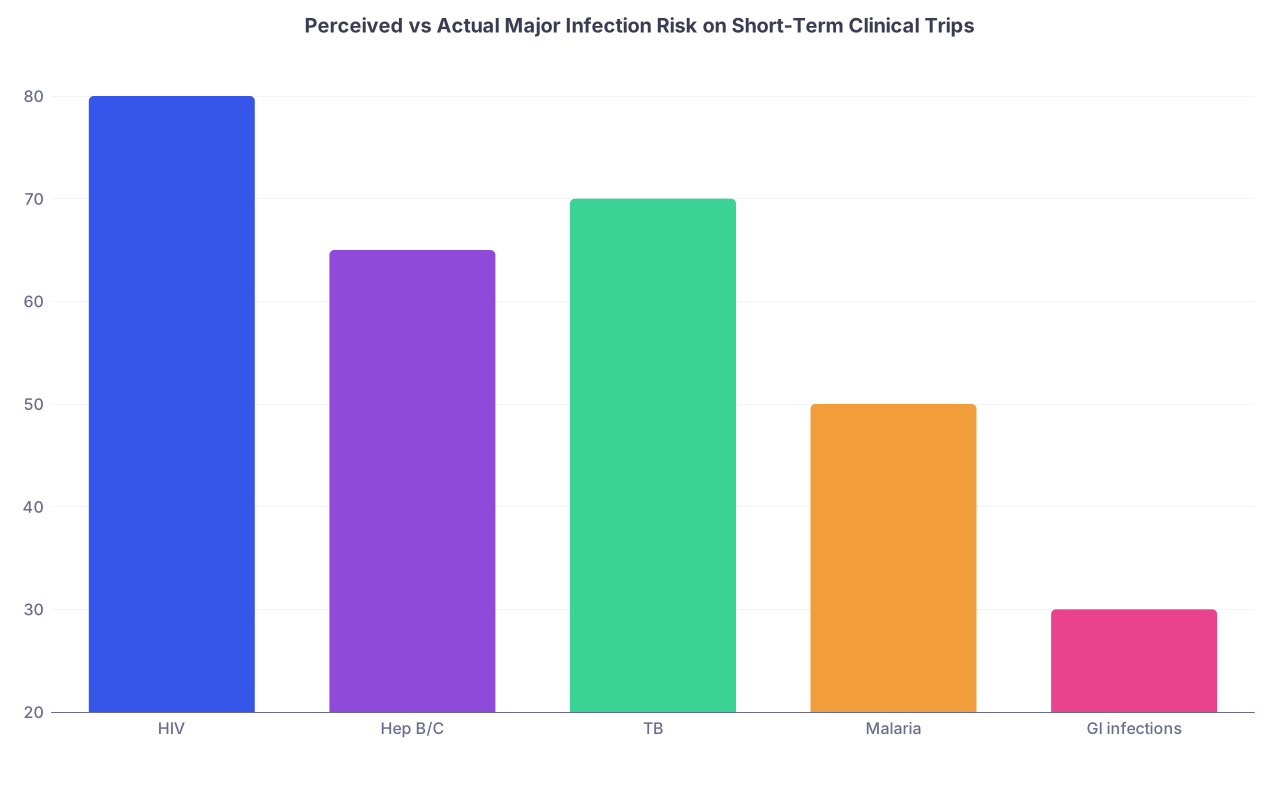
| Category | Value |
|---|---|
| HIV | 80 |
| Hep B/C | 65 |
| TB | 70 |
| Malaria | 50 |
| GI infections | 30 |
Think of that chart as “how big the fear feels,” not actual risk. The reality looks very different when you layer in protection.
How risky is HIV and hepatitis… really?
This is the nightmare scenario your brain keeps replaying: crowded ward, chaotic code, someone hands you a needle the wrong way, you get stuck. You go back to your room and stare at the tiny puncture mark thinking, “That’s it. My life just split into before and after.”
Let’s strip this down.
First: raw numbers for per-exposure risk
These are approximate, but good enough for sanity:
| Exposure Type | HIV Risk | Hep B Risk* | Hep C Risk |
|---|---|---|---|
| Needlestick (hollow bore, from infected source) | ~0.3% | up to 30% | ~1.8% |
| Mucosal splash (eye/mouth) | ~0.1% or less | lower than needle | low but not zero |
| Intact skin contact with blood | essentially 0 | essentially 0 | essentially 0 |
*Hep B risk is high if you’re not vaccinated. If you’re fully vaccinated with documented response, this goes down to “I would not lose sleep” territory.
Those numbers are without post-exposure prophylaxis (PEP), and without PPE. In a normal mission context, if risk is real, PEP is used. And PPE exists, even if it’s not ideal.
The question isn’t “Is there risk?” Yes, there is. The real question is: “Is the risk so big and unavoidable that going is reckless?” For most structured, medically supervised trips? No.
But that hinges on something most people don’t check: how seriously the program takes sharps safety and PEP access.
TB: the slow, quiet worry you can’t shake
Here’s the other one that eats at you: sitting in a packed clinic, no windows that open, coughing everywhere, your N95 slightly crooked because it’s day 9 and sweaty, and you’re thinking: “I’m absolutely inhaling TB right now.”
You might be right.
Short-term exposure to TB in high-burden settings can absolutely lead to latent TB infection. Plenty of people I know came back with a positive IGRA after a month in a crowded ward. Most never get sick. But it can mean months of prophylactic meds.
The risk depends heavily on:
- How intense the exposure is (inpatient TB wards vs outpatient clinic)
- Ventilation (open-air vs sealed concrete rooms)
- Mask use (real fit-tested respirators vs surgical masks vs nothing)
- Duration of stay
Your brain probably goes: “If it’s not zero, I’m doomed.” Reality: it’s not zero, but it’s usually manageable with good masking and smart role choice. And latent TB is treatable.
Still sucks. Still matters. But it’s not an automatic “don’t go” if you know how to minimize it.
The sneaky big risk that actually is common
It’s not HIV. It’s not TB.
It’s diarrhea. Fecal-oral infections. Parasites. And malaria in endemic areas.
Not glamorous. Not dramatic. But very real.
You’re way, way more likely to:
- Get traveler’s diarrhea
- Have a few days of fever from some viral thing
- Catch a respiratory infection (COVID, flu, whatever’s circulating)
- Get a mosquito-borne infection if you’re not careful
These don’t feel as existential as HIV, so your anxiety brain ignores them. But this is where your day-to-day misery and actual functional risk live.
How do I know if a missions program is actually safe vs just vibes?
This is where people screw up. They assume “big church,” “known NGO,” or “university-affiliated” automatically means “well thought out.” Sometimes true. Sometimes absolutely not.
You want to ask questions that make mediocre programs squirm a little.
Here’s what I’d look for and actually press on:
| Domain | Red Flag | Acceptable | Ideal |
|---|---|---|---|
| HIV PEP | “Hospital has meds” | Clear plan, local source | They carry PEP kit from home |
| Hep B | “Up to you” | Require proof of vaccine | Check titers if possible |
| TB | No mention | Suggest testing post-trip | Active masking + role limits |
| Sharps | You do procedures solo | Supervised only | Clear “no needles for students” policy |
| PPE | “We’ll see what’s there” | Basic masks/gloves | They bring extra PPE stash |
If, when you ask about PEP, they say: “Oh, we’ve never needed that,” that’s not reassuring. That’s either naïve or dishonest. A serious program assumes worst-case and plans for it.
Concrete protection plan: what you can control
This is where your anxiety can actually be useful. You’re the person who’ll actually follow through on precautions instead of just talking about “being careful.”
1. Vaccines and baseline labs
Non-negotiables (for most low- and middle-income countries with clinical work):
- Hepatitis B: full series, ideally with documented antibody response
- Tetanus/diphtheria/pertussis (Tdap) UTD
- MMR, varicella: immune or documented vaccination
- COVID: fully vaccinated and boosted as recommended
- Region-specific: typhoid, maybe hepatitis A, sometimes yellow fever
Strongly consider:
- Baseline HIV test
- Baseline IGRA (TB blood test) before departure
So if something happens, you actually know what’s new vs old.
2. Sharps: your personal non-negotiable line
You’re allowed to say no. I don’t care how “helpful” they say you’ll be.
Decide before you go:
- Will you do injections? If yes, only with:
- Supervision
- Adequate lighting
- Known sharps disposal
- Will you do fingersticks? Suture? Phlebotomy? If your gut clenches, that’s information.
If the local culture is very casual with sharps (“we recap needles,” “we throw them in a cardboard box”), your risk management is simple: you do not do procedures where you’re rushed or pressured.
You’re a trainee, not a savior.
3. HIV PEP: don’t outsource this to fate
If you’re going anywhere with:
- Significant HIV prevalence
- Limited systems
- Clinical exposure involving sharps or blood
…then you need a clear PEP plan.
At minimum, know:
- Where is PEP located?
- Who has authority to start it?
- Is it always available, including nights/weekends?
- What’s the timeline for reporting and first dose?
If that sounds vague or unreliable, I’d seriously consider bringing a starter PEP kit from your home institution if allowed. Many global health programs now provide exactly that.
Because this is what keeps you up at night: “What if the worst happens and there’s nothing we can do?” You fix that ahead of time.
4. TB: respirator, role, and reality
For TB-heavy areas:
- Bring proper respiratory protection (N95/FFP2 or better)
- Use it indoors in crowded clinical spaces without good ventilation
- Especially use it around coughing, undifferentiated respiratory patients, or TB wards
If your role has you:
- Doing prolonged inpatient rounding in TB wards
- Sitting in small, packed rooms all day with poor airflow
…then you’re in higher TB risk territory than most tourists.
Mitigation:
- Wear the mask even if no one else does
- Advocate for working in better-ventilated spaces where possible
- Limit time in high-risk areas if your role is flexible
Then when you get home:
- Repeat IGRA at ~8–10 weeks post-return
- If you convert, see ID/occupational health and treat latent TB
Annoying? Yes. Life-ending? No.
5. Malaria and mosquitoes: boring but big
If your site is in a malaria-endemic area, this is non-optional:
- Take malaria prophylaxis correctly and consistently
- Use repellents (DEET or picaridin)
- Sleep under treated bed nets when needed
- Long sleeves and pants in evenings
You worry about HIV at night, but malaria is more likely to actually land you in a hospital during the trip.
6. Food, water, and the unglamorous GI protection
This is where your daily misery comes from if you’re not smart.
Basic rules:
- Bottled or treated water only
- Peel-it-yourself fruit, thoroughly cooked food
- Avoid raw salads in sketchy places
- Hand hygiene like it’s your religion
I’m not saying “never try street food.” I’m saying make calculated risks, not random ones.
How to manage the anxiety without gaslighting yourself
You’re not going to “positive-think” your way out of worrying about this. Your brain is wired to scan for risk. Fine. Use it.
Here’s what I’ve seen help people like you:
Convert vague fear into specific scenarios.
Write them down:
“What if I get a needlestick?”
“What if I’m exposed to TB?”
“What if I get very sick and need to come home?”For each scenario, write the protocol.
If you don’t know it, that’s homework:- Who do I report to?
- Where do I get PEP?
- How do I get evacuated if needed?
- What insurance covers what?
Decide your personal red lines.
Examples:- “I won’t do unsupervised procedures.”
- “If there’s no PEP access, I don’t go.”
- “If they discourage PPE, I’m out.”
Get an external sanity check.
Global health faculty. Infectious disease doc. Occupational health. Someone who’s not trying to sell you the trip.
Your goal isn’t zero risk. That doesn’t exist. Your goal is:
- No reckless risk
- No preventable risk
- No “I had no idea what to do” risk
Ethics: are you being “selfish” to worry about your own safety?
People won’t say it out loud, but you’ll feel it. The subtle judgment: “If you’re that worried about yourself, maybe global health isn’t for you.”
That’s nonsense.
Protecting yourself:
- Protects future patients (you staying healthy, you not being out of the workforce)
- Sets a boundary that protects other trainees
- Forces programs to level up their safety standards
It’s actually unethical for programs to normalize unsafe behavior or hand-wave infection risk in the name of “service.”
Saying “I’m willing to help, but not willing to be reckless with my own health” is not selfish. It’s adult.
Trip selection: some are safer than others
Not all missions are created equal. A few quiet heuristics:
- University-affiliated, with an established global health office? Usually more structured, better PEP and protocol systems, more oversight.
- “Come for 2 weeks and perform surgeries / deliver babies as a student”? Hard no. That’s unsafe for patients and for you.
- Programs with formal pre-departure training that include:
- Occupational exposures
- Insurance/evacuation
- Cultural humility
…are usually safer overall.
You are allowed to walk away from a program that makes your stomach twist. That’s not fear winning—that’s your judgment winning.
Quick reality check: how bad is the risk if you do all this?
Let’s put it in perspective.
If you:
- Are fully vaccinated (especially for Hep B)
- Have access to HIV PEP and know the protocol
- Use N95-level protection in high-risk TB settings
- Use malaria prophylaxis and mosquito precautions where needed
- Are strict about sharps and PPE boundaries
Then your residual risk of:
- HIV seroconversion from a single short-term trip: extremely low
- Hep B infection: essentially zero if vaccinated with good response
- Hep C: very low with good sharps practice
- Active TB: real but still relatively low, and treatable if caught
- Malaria: substantially reduced with prophylaxis and precautions
Is it zero? No. Will your anxiety brain still whisper “what if” at 2 a.m.? Probably.
But now you’ll have a plan instead of just a feeling.

| Step | Description |
|---|---|
| Step 1 | Considering mission trip |
| Step 2 | Standard travel vaccines and precautions |
| Step 3 | Check program safety |
| Step 4 | Do not go or negotiate changes |
| Step 5 | Define personal boundaries |
| Step 6 | Pre-trip vaccines and baseline tests |
| Step 7 | On-site - follow safety plan |
| Step 8 | Post-trip testing and follow up |
| Step 9 | Clinical exposure? |
| Step 10 | PEP and PPE adequate? |
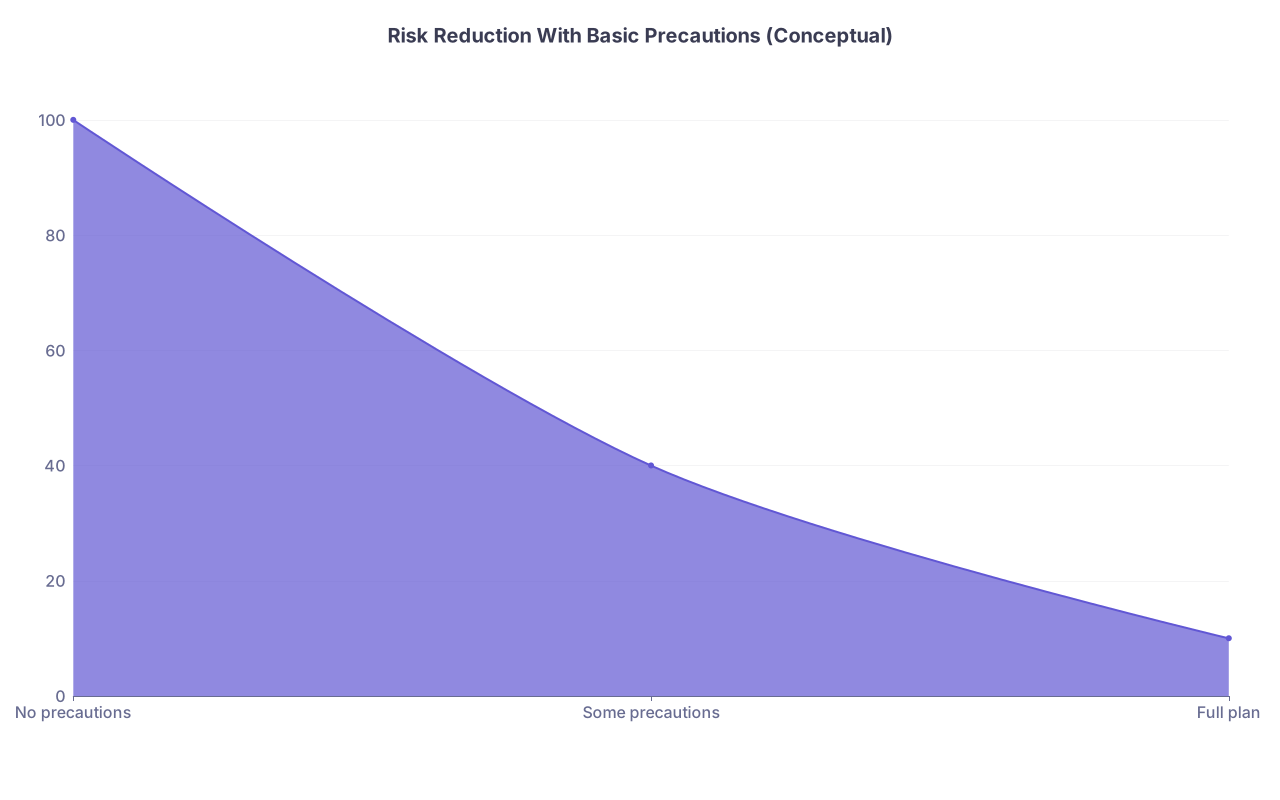
| Category | Value |
|---|---|
| No precautions | 100 |
| Some precautions | 40 |
| Full plan | 10 |
Think of that as mental: your risk doesn’t vanish, but it drops massively when you stop winging it.

FAQs (the things you’re probably still chewing on)
1. What if I get a needlestick from a patient with unknown HIV status?
You treat it as if they might be positive until proven otherwise.
- Immediately: wash the area with soap and water, don’t squeeze aggressively.
- Report it. Don’t downplay it. Don’t wait to “see how it looks.”
- Start HIV PEP as soon as possible, ideally within 1–2 hours.
- Follow whatever exposure protocol your home institution or program has, including follow-up testing.
You don’t wait for source testing if that will be slow. You start PEP, then adjust based on final results. Worst-case, you took a short course and didn’t need it. That beats the alternative.
2. Should I skip missions entirely if I’m terrified of HIV?
Not necessarily. But you should be very selective.
Ask yourself:
- Is my fear purely emotional, or is it pointing to real safety gaps in this specific trip?
- Does this program have:
- Clear exposure protocols
- Easy access to PEP
- A culture that respects safety?
If yes, then your fear is something you manage with planning, not avoidance. If no, then your fear is accurate and you should listen to it and choose a different program.
3. How do I explain my safety concerns without sounding “difficult”?
You frame it like a professional, not a fragile person.
Something like: “I’m excited about this opportunity, and I want to make sure I’m fully prepared. Could you walk me through your protocols for blood exposures, HIV PEP access, and TB precautions for trainees? I’d like to review them before committing.”
That’s not drama. That’s exactly how a responsible clinician talks. If they react badly to that question, that’s your answer about whether you should go.
4. Is a few weeks of exposure enough to give me TB or HIV?
For HIV: extremely unlikely in the absence of a clear high-risk exposure like a deep needlestick with a hollow-bore needle from an HIV-positive source. It doesn’t work like “I was in the same building so now I’m infected.”
For TB: yes, a few weeks in a high-burden, poorly ventilated setting can be enough to acquire latent TB infection. That’s why masking, ventilation awareness, and post-trip IGRA testing matter. It’s not about panicking—it’s about accepting the reality and planning around it.
5. What’s one thing almost everyone forgets to do?
They forget to plan the post-trip phase.
Before you leave, you should already have:
- A date on your calendar 8–10 weeks after return for:
- TB testing (IGRA)
- Any recommended follow-up HIV or hepatitis testing if there was any concerning exposure
- A list of who you’d contact at home (occupational health, student health, global health office) if you’re worried about a possible exposure—even if you’re “not sure it counted.”
People get home, get busy, and ghost their own follow-up. That’s how small, possibly manageable things turn into long-term anxiety.
Here’s your next step, today:
Open a blank document and title it “Mission Infectious Risk Plan – [Your Name].” Make four headings: Pre-trip, On-site, Exposure Protocol, Post-trip. Start filling in what you know now and highlight what’s blank. Every blank is a question you need to get answered before you say yes to any trip.


