
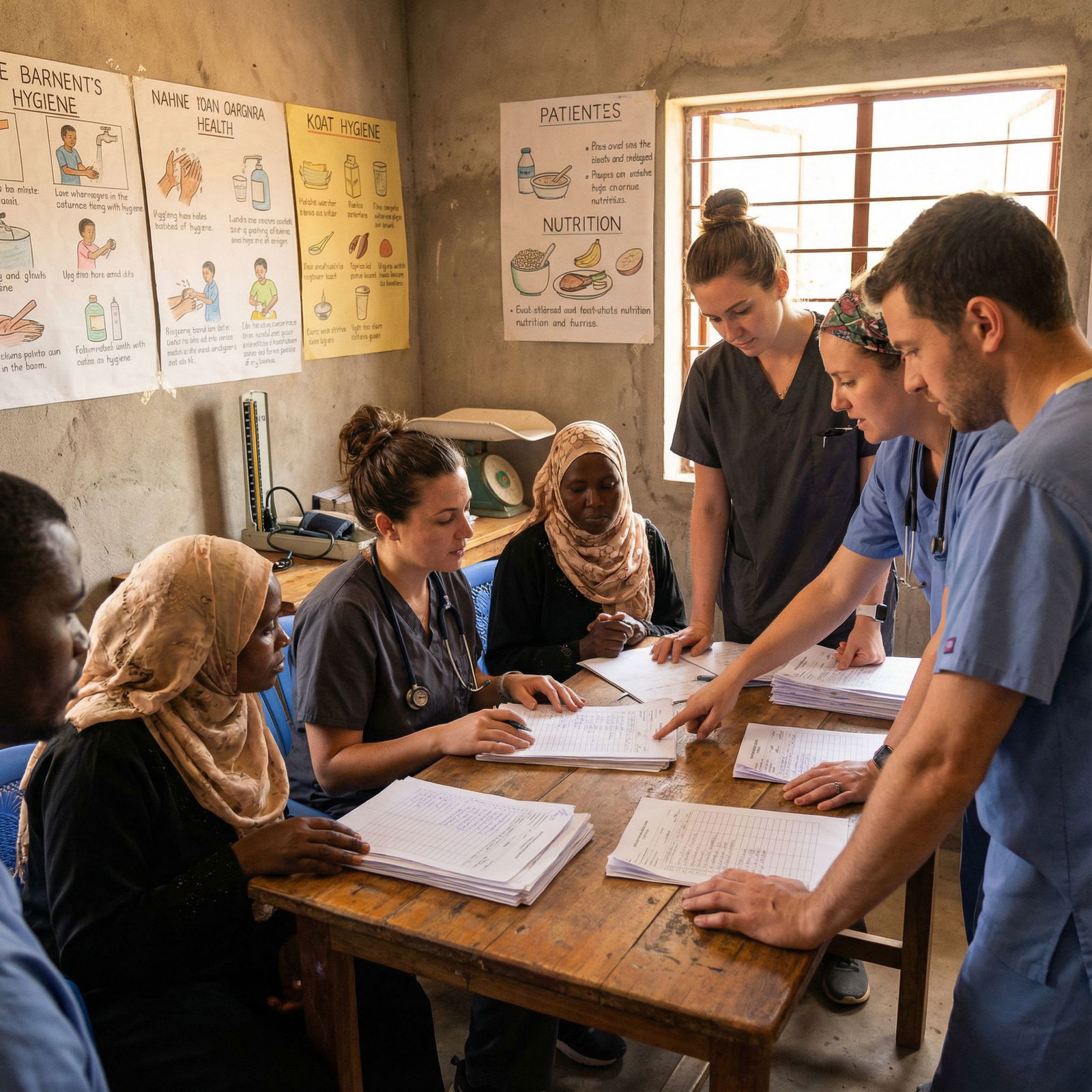
You’re sitting in the med school library after a long day, half-reading for tomorrow’s small group while doom-scrolling through other people’s CVs on LinkedIn and institutional bios.
Everyone seems to have a “Global Health Mentor.”
Someone did work in Malawi. Another has a “global surgery research mentor at Harvard.” A classmate just posted about getting connected to a tropical medicine doc through their school’s global health track.
You look at your own school’s website.
No global health center.
No formal “Global Health Pathway.”
Faculty list: hospitalists, cardiologists, orthopedists… but nobody with “global health” in their title. Your advisor is a very nice nephrologist who has never left the country for anything other than vacations.
And the thought hits you hard, in that pit-of-your-stomach way:
“Everyone else is getting mentored into these global opportunities and I’m… just here. At a school that doesn’t even have global health. Am I already behind? Like permanently behind?”
Let me be direct:
No, you’re not behind. But I know exactly why it feels like you are—and I also know how people at “non-global” schools quietly build very strong global health trajectories anyway.
Let’s unpack the actual problem you’re facing and then what you can realistically do about it.
The ugly fear underneath: “No mentor = no path”
The fear isn’t just “no mentor.” It’s what your brain does with that:
- “If I don’t have a mentor now, I won’t get into global health electives.”
- “If I don’t have formal global health at my school, residency programs will think I’m not serious.”
- “Everyone starting earlier will have better projects, better letters, better stories. I’ll always be the one who came late to the party.”
And if you’re even more catastrophically-minded (join the club):
- “This means I chose the wrong med school.”
- “I’ll never catch up to people from places like UCSF, Hopkins, or Harvard who have whole global health departments.”
- “I’m going to look like a tourist who did one random trip instead of someone genuinely committed.”
Here’s the part nobody says out loud: a lot of “global health” at big-name schools is branding. Some of it is excellent, long-term work. Some of it is a single 2‑week trip that somehow becomes “Global Health Scholar” on a CV.
I’ve watched people from tiny, no-name schools with zero formal infrastructure match into global EM, global surgery, ID with global health focus—because they built their own path instead of being passively fed one.
You’re not behind. You’re just not on rails. And yeah, being off rails feels like chaos.
What “being competitive” in global health actually looks like
You need to know what you’re aiming at before you panic about being behind.
Residency and fellowship folks looking at “global health interest” usually care about:
Pattern, not labels.
They care far less about whether your school had a “Global Health Track” and way more about whether your story and choices show a coherent interest over time.Substance over scenery.
Longitudinal work, even locally (refugee clinics, migrant health, health equity research), is often more compelling than a photo of you in scrubs next to a jeep in another country.Basic competence first.
You can’t be “behind” in global health if you don’t even know the basics of your future specialty. Programs would rather take a solid clinician with modest global experiences than a global health tourist who barely passed their boards.Letters from someone who knows your work.
Does the letter say “this person shows up, takes ownership, learns fast, collaborates well, and actually follows through”? That weighs more than “this person went on a trip to Ghana with me.”
Here’s a rough comparison that might help your anxiety brain calm down a bit:
| Profile | What It Looks Like | What Program Directors Actually See |
|---|---|---|
| Student A – Big GH School | Global Health Track, one short trip, fancy branding | Some exposure, but maybe surface-level |
| Student B – Your Situation | No formal track, but sustained work with refugees, remote research, thoughtful essays | Clear, authentic commitment with follow-through |
| Student C – CV Tourist | Multiple scattered short trips, no theme, no follow-up | Red flag for voluntourism, poor insight |
Who’s “behind” there?
It’s not automatically the person without the glossy label.
The mentor myth: what you actually need vs what you think you need
Your brain is probably saying: “Without a global health mentor at my school, I’m screwed.”
So let’s dissect “mentor” into what’s real and what’s fantasy.
You do NOT absolutely need:
- A single superstar “global health mentor” who guides you from MS1 to fellowship
- A formal title like “Director of Global Health” attached to someone in your institution
- Someone who does exactly your dream combo (e.g., “global pediatric neurosurgery in East Africa”) at your school
You DO need:
An anchor person at your own institution
They don’t have to be “global.” They have to:- Answer emails
- Care about your development
- Be willing to connect you outward
This could be a hospitalist, ID doc, primary care doc, ethics faculty, or even a dean. Their job is not to be your global health expert. Their job is to say, “Okay, let’s find you people,” and then vouch for you.
At least one content mentor (even if remote)
Someone who actually does some piece of what you’re interested in:- Works in TB/HIV
- Does migrant health or refugee care
- Runs research in LMICs
- Works in health systems strengthening or policy
This person can be at another institution. Virtual only is fine. That still counts.
A feedback loop
You need people who will:- Look at your project ideas and tell you what’s naive
- Tell you when something is exploitative or performative
- Help shape your CV story so it makes sense
None of these require your school to have a formal global health presence. They require you to be more intentional and a little scrappier. Which is unfair, yes. But it’s doable.
“But I don’t even know where to find a global health person…”
Okay, here’s the very un-fancy, non-magical way people actually do this.
Step 1: Ruthless stalking (the good kind)
You sit down and you search:
- Your city’s major academic centers (even if you’re at a community or smaller med school)
- Departments: Infectious Disease, Family Med, EM, Pediatrics, OB/GYN, Public Health
- Search terms on their faculty pages: “global”, “international”, “refugee”, “migrant”, “tropical”, “HIV”, “TB”, “humanitarian”, “global surgery”
You’ll start turning up random profiles like:
“Dr. X’s interests include HIV care in resource-limited settings.”
or
“Dr. Y previously worked in refugee camps in Jordan and continues to collaborate with partners abroad.”
These people are your targets.
Step 2: Email like a competent, not-clueless person
Not: “Hi, I’m interested in global health, can we chat?”
They get those. They delete those.
Better:
- 3–4 sentences max
- Specific, respectful, with a small ask
Example:
Dear Dr. X,
I’m a second-year medical student at [Your School], very interested in infectious diseases and global health, especially HIV care in resource-limited settings. I saw on your profile that you’ve worked in [Country/Program], which is exactly the type of work I’d love to learn more about.
Would you be open to a brief 20–30 minute Zoom sometime this month so I could ask a few questions about how you got started and how a student at a school without formal global health programs can get involved appropriately?
Best,
[Name], MS2, [School]
You will be shocked how many people say yes to something that specific and small.
“No rotations abroad = doomed?” No. Here’s what actually counts.
This is another persistent fear: “My school doesn’t have overseas electives. So I’ll never get real global experience.”
I’m going to be blunt: a lot of med student international rotations are more about the student than the community. Programs know this. A 4‑week trip does not make or break you.
Let’s break this into reality vs. fear.
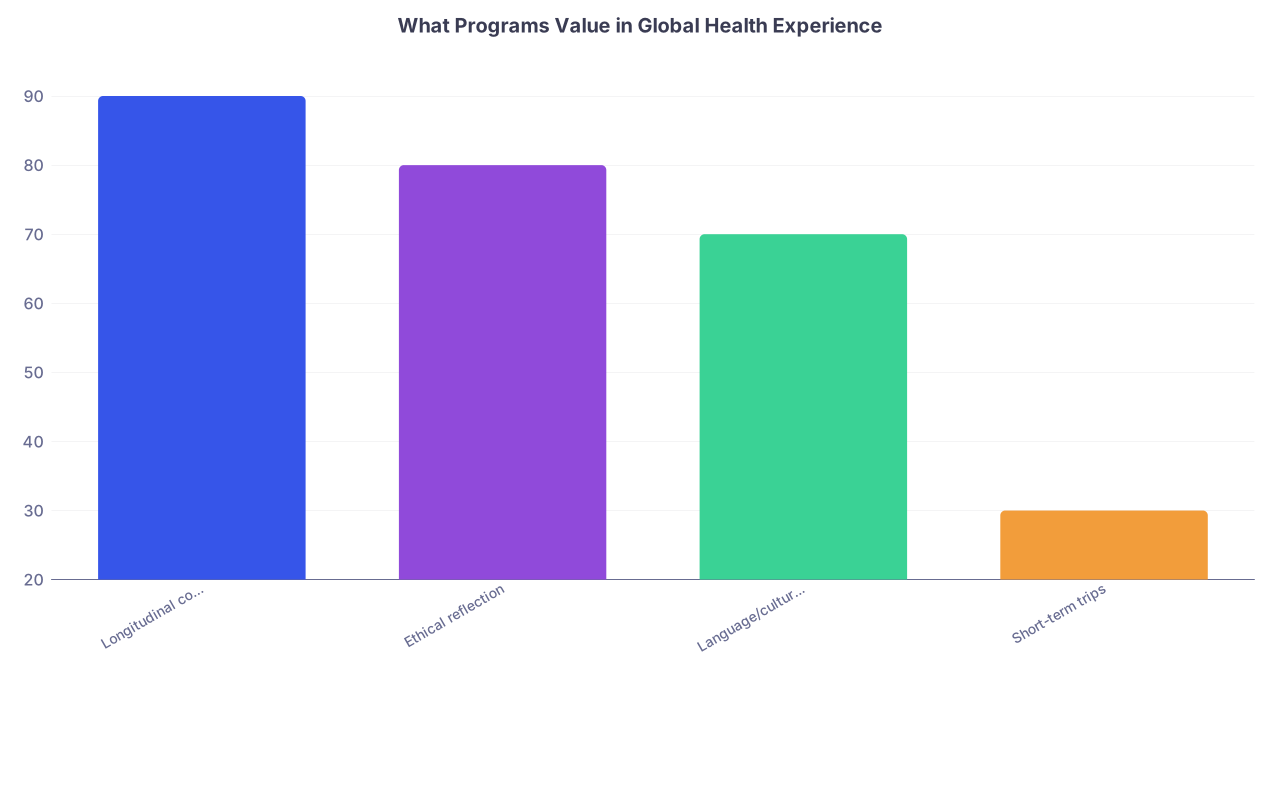
| Category | Value |
|---|---|
| Longitudinal commitment | 90 |
| Ethical reflection | 80 |
| Language/cultural skills | 70 |
| Short-term trips | 30 |
The numbers are illustrative, but the trend is real:
- Long-term involvement (even locally) > brief time abroad
- Deep reflection and understanding > passport stamps
- Working with marginalized/underserved communities at home absolutely counts as global health-adjacent
If you can’t go abroad (or you’re anxious you’re “missing the boat”), focus on what you can build:
- Longitudinal work in a refugee clinic or FQHC with immigrant populations
- Research on global disease patterns, access to care, health systems, or implementation science
- Remote collaborations with global partners through someone at another institution
- Language skills and cultural humility—very underrated, very relevant
Residency and fellowship reviewers are not sitting there with a checklist: “Did they do an international elective? No? Reject.”
They’re asking: “Does this person understand global health beyond voluntourism? Can they commit to something and follow through?”
The ethics piece: trying to do “global” without being clueless
Since your category here is global health + ethics, let’s be honest about the part that’s probably making you nervous too:
“What if I finally get an opportunity… and it’s actually exploitative or sketchy and I don’t know?”
The hard truth: a lot of student “global health” is poorly thought out ethically. You being worried about that is actually a good sign. It means you’re less likely to be the person posting smiling kid photos on Instagram without consent.
You’re not behind ethically because you don’t have a mentor. You’re actually at an advantage if you’re already questioning the power dynamics.
Things to anchor yourself in:
- You are a learner, not a savior
- Your primary responsibility is not to “do as much as possible,” but to avoid harm
- If you’re doing work about a community, they should have a say in what gets done and how it’s shared
This is another area where a remote mentor (ID, EM, family med, public health) can help you sanity-check opportunities: “Is this elective/program legit or is it just student tourism with a stethoscope?”
Okay but timeline-wise… am I late?
Let’s walk through phases, because anxiety loves vague panic and hates specifics.
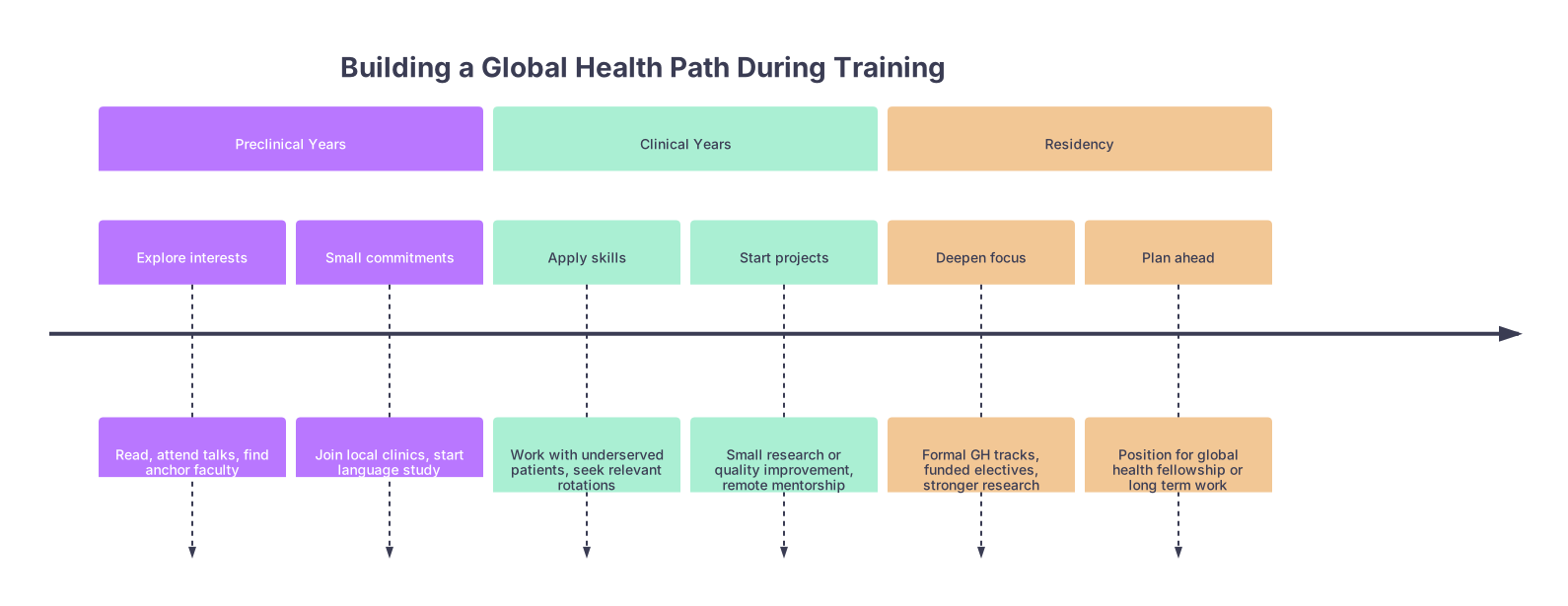
| Period | Event |
|---|---|
| Preclinical Years - Explore interests | Read, attend talks, find anchor faculty |
| Preclinical Years - Small commitments | Join local clinics, start language study |
| Clinical Years - Apply skills | Work with underserved patients, seek relevant rotations |
| Clinical Years - Start projects | Small research or quality improvement, remote mentorship |
| Residency - Deepen focus | Formal GH tracks, funded electives, stronger research |
| Residency - Plan ahead | Position for global health fellowship or long term work |
If you’re:
- MS1–MS2 and have no mentor: you’re fine. Most of your peers’ “global health” right now is vibes and Instagram, not substance.
- MS3 and feeling late: you still have time to build a coherent narrative—especially through clinical experiences with underserved communities, plus 1–2 focused projects.
- MS4 applying to residency: it’s more about how you frame what you’ve done than how many overseas stamps you have.
The actual disaster scenario is not “I started late.”
It’s “I scattered myself into five shallow things I can’t explain well.”
You can avoid that. Even starting today.
So what do you do today if you have zero mentor and a lot of anxiety?
Here’s a brutally practical, low-glamour starting point.
1. Define a direction, not a detailed plan
Write down 1–2 sentences:
- “I’m mostly interested in global health as it relates to [specialty] and [population/issue].”
Example: “EM and disaster response,” or “OB/GYN and maternal mortality,” or “pediatrics and refugee health.”
Doesn’t have to be perfect. You just need something more specific than “global health.”
2. Identify one anchor faculty at your school
Not global. Just human and responsive.
This could be:
- Your academic advisor
- A primary care doc you liked on rotation
- Someone involved in community medicine, ethics, or health equity
Email them: ask if they’d be willing to be a general career advisor for you and help you find someone in global or related fields externally.
3. Make a short list of 5–10 potential content mentors outside your school
Use the faculty search method from earlier. Make a list with:
- Name
- Institution
- What they do (1 line: “Global surgery in East Africa,” “Refugee health in [city]”)
Then send 2–3 carefully written reach-out emails. Not 20. Just a few good ones.
4. Start one local or remote thing that aligns with global health values
Pick one of these and commit:
- Volunteer once a month at a refugee/immigrant clinic or legal-medical partnership
- Join or start involvement in a local project on language barriers, access to care, or infectious disease in marginalized groups
- Take a remote course (e.g., global health ethics, humanitarian principles, health systems) and actually finish it
Over time, that “one local thing” becomes the backbone of your story—often more convincingly than a random 2‑week trip.
You’re not behind because your school doesn’t have “Global Health” in big letters on the website.
You feel behind because there’s no pre-built path, no obvious mentor, and a lot of noisy CVs out there making it seem like everyone else is effortlessly gliding into perfectly curated global careers.
They’re not. Most people are scrambling too. Some just have a shinier logo.
Here’s your specific, actionable next step for today:
Open a new document and write three headings:
- “Anchor faculty at my school”
- “Potential external mentors”
- “One local/remote commitment I can start in the next 2 months”
Under #1, list 2–3 names you could reasonably email this week.
Under #2, list at least 3 faculty from other institutions whose profiles mention global work.
Under #3, write down one realistic option.
Then send one email today—to either an anchor faculty or a potential external mentor. Just one.
You don’t need a global health office to get started. You just need to stop waiting for a formal mentor to magically appear and take the smallest possible step toward building your own network.


