

You’re at your desk, staring at an email that says, “We’re excited to welcome you to our global health elective.” And instead of excitement, your stomach drops because all you can think is: My language skills are garbage. I’m going to be useless. Or worse, dangerous.
You start doing the mental spiral:
“What if I misunderstand a symptom and miss something life-threatening?” “What if patients think I’m an ignorant foreigner?” “What if the local staff resent me because I can’t communicate?” “What if I’m just… unethical by being there at all?”
Yeah. I know that spiral. Let’s go straight at it.
The Fear Underneath: “Am I Going To Harm People?”
Let me be blunt: your fear isn’t ridiculous. The nightmare scenario here isn’t embarrassment. It’s harm.
You’re probably imagining:
- A patient trying to tell you “chest pain going to the left arm” and you hear “arm pain” and think musculoskeletal.
- A mom saying her kid’s been seizing and you misunderstand it as “fever episodes.”
- A situation where you nod and pretend you understood because you’re ashamed to ask again.
That’s not just social anxiety. That’s ethical anxiety. Which is actually good. It means your moral compass is working.
But here’s the key thing: you’re not wrong about the risks; you’re wrong if you go in pretending there aren’t any. The people who scare me overseas are not the ones fretting about language. It’s the confident “I’ll figure it out, I’ve got Google Translate” types.
You’re already ahead of them because you’re asking: Is my language good enough to do this safely and respectfully?
What “Enough Language” Actually Means (And What It Doesn’t)
Here’s where people mess up. They think “enough language” means “I can independently take a full history, counsel the patient, and crack jokes in the local language.”
No. That’s ideal. Not realistic for most short-term global health people.
For overseas clinical work, “enough” usually means something more like:
- You can handle basic greetings, build a little rapport, and show you’re trying.
- You know core medical phrases in the local language (pain, fever, diarrhea, days/weeks, pregnancy, medication, etc.).
- You understand the limits of your comprehension and stop when you’re outside them.
- You rely appropriately on interpreters, local staff, or bilingual colleagues for anything complex or high-stakes.
Most global health programs that aren’t garbage do not expect you to independently manage patients in a language you barely speak. They expect:
- You to work under supervision
- You to communicate honestly about what you can and cannot do
- You to prioritize patient safety and dignity over your ego or “learning experience”
If your current anxiety is, “But I can barely get past ‘hello’ and ‘how are you?’” then no, you’re not where you should be yet. But that’s a trainable problem, not a character flaw.
The Ethical Red Flags You’re Right To Worry About
Let’s call out the worst-case scenarios, because they’re driving your anxiety in the background.
You should be worried if your elective looks like this:
| Scenario | Why It’s A Problem |
|---|---|
| No consistent interpreters | High risk of misunderstanding and harm |
| Students seeing patients alone | Unsafe, especially with weak language skills |
| You’re expected to “run your own clinic” | Exploits patients as practice material |
| No orientation on culture or communication | Signals program isn’t serious about ethics |
| You’re encouraged to “just try” procedures way above your level | Clear ethical boundary violation |
If your language is weak and the structure is chaotic or exploitative, it’s not just, “Will I be awkward?” It’s, “Will this be unethical?”
I’ve seen students stuck in clinics where:
- There’s no interpreter, but they’re told to “just use body language.”
- They’re asked to “just prescribe something” for a patient they barely understood.
- They’re pressured to perform procedures because “the patients don’t mind.”
That combination—bad structure + weak language—is where real harm happens.
So your anxiety is pushing you to ask the right question:
Not “Am I good enough?”
But “Is this setup safe and ethical given my language level?”
Where Your Language Does Matter vs Where It Doesn’t
Let me separate out your fears into two piles: the ones that should change your plans, and the ones that mainly just need managing.
Pile 1: Fears that should affect your decision
You should seriously pause or adjust if:
- You’re expected to take full histories or manage patients without an interpreter or bilingual supervisor.
- The work is in acute or emergency settings where nuance and speed matter and no one can reliably interpret.
- You can’t even communicate basic safety-related questions (allergies, pregnancy, pain severity) and there’s no one to help.
- The only reason you’re going is “it’ll look good on my CV,” and you’re ignoring big communication gaps.
In those situations, your language skills really might not be enough. And backing out or changing to a more appropriate role is not cowardly. It’s ethical.
Pile 2: Fears that are real, but manageable
On the other hand, it’s normal and okay if:
- You’re anxious you’ll sound like a 3-year-old in the local language.
- You’re worried patients will laugh when you mispronounce things.
- You need interpreters for pretty much every encounter.
- You freeze in the first few days and struggle to get words out.
Those things are… just how learning works. They’re uncomfortable, not dangerous, if the clinical structure is sound.
What You Can Responsibly Do With Limited Language Skills
You might be imagining you’ll be dropped in a small rural clinic and expected to function like a local intern.
If that’s the model, run.
Here’s what more ethical setups often look like for students with limited language:
- You shadow local clinicians and ask questions in English (or your stronger language).
- You help with charting, vitals, organization, patient flow, while clinicians lead the communication.
- You participate in group rounds, where interpreters or bilingual staff help you understand.
- You interact with patients in tiny, safe ways: greetings, asking “how are you?”, basic comfort.
And later, as you get more comfortable and your language improves, maybe you:
- Ask a few simple history questions with a supervisor listening in.
- Take parts of the history with an interpreter and check your understanding with the team.
- Practice patient education with clear scripts and supervision.
That’s all meaningful. You don’t have to be hero of the ward to be useful.
Building A “Minimum Ethical Baseline” Before You Go
If you’re still early in this, you can absolutely do something about the “I know basically nothing” feeling.
Think of it as building a minimum ethical baseline rather than “fluency.”
Here’s a bare-bones structure for prep (and yes, this is me being bossy on purpose):

| Step | Description |
|---|---|
| Step 1 | Decide on elective |
| Step 2 | Assess current language level |
| Step 3 | Delay or pick English speaking site |
| Step 4 | Targeted language prep |
| Step 5 | Learn key clinical phrases |
| Step 6 | Practice with native speaker |
| Step 7 | Clarify role with host site |
| Step 8 | Adjust expectations before travel |
| Step 9 | Below basic? |
Your target before you go:
- Basic social survival: greetings, introductions, “I am a medical student,” “I am learning your language.”
- Symptom basics: pain, fever, cough, diarrhea, vomiting, shortness of breath, dizziness, pregnant, child, baby, old, days, weeks.
- Essential questions: “Where is the pain?”, “How long?”, “Is it better or worse?”, “Have you had this before?”, “Are you taking any medicines?”
- Safety questions: allergies, pregnancy, medication use, prior surgery.
You don’t need to be eloquent. You need to not be dangerous.
If you can’t honestly get that baseline after targeted prep and time is short, you might need to:
- Ask to adjust your role to more observational/educational.
- Or choose a setting where your working language is spoken (e.g., certain sites where English is an official or widely used clinical language).
That’s not failure. That’s being a professional.
How To Talk About Your Language Limitations Without Sounding Incompetent
This part freaks people out: admitting your limits to supervisors and patients.
You probably worry they’ll think: “Why did we even let you come?”
What they often actually think is: “Thank God, a student who understands boundaries.”
Some phrasing you can literally copy and use (adapt to language/setting):
To your supervisor (before you even go):
- “I want to be clear about my language level. I can [describe what you can do], but I absolutely need interpreter or bilingual support for full histories and counseling. Is that compatible with how students are involved there?”
On-site, with the team:
- “I’m still learning [language]. I can help with basic questions, but I’m not comfortable taking full histories without an interpreter. Can you let me know when it’s appropriate for me to step in versus step back?”
With patients (through interpreter, at first):
- “I am a medical student from [country]. I’m learning [language], but I’m not very good yet. I’ll speak slowly and check my words. Thank you for your patience.”
This sounds simple, but it does two crucial ethical things:
- It sets expectations.
- It makes it much harder for people to pressure you into working beyond your competence.
The Ugly Truth: Some Programs Don’t Care If Your Language Is Weak
You’re worried you’re not safe enough. Some programs are worried they’re not funded enough.
So they sell global health experiences to students who can’t communicate, then dump them into clinics that weren’t really prepared to host them anyway.
Red flags that you’re being plugged into one of these:
- They say “language is not a problem!” but offer no interpreters or formal support.
- They can’t clearly explain your role and supervision level.
- They talk a lot about “hands-on experience” and “impact” and not much about patient autonomy, safety, or consent.
- Former participants say things like, “They just let us do everything.”
In that context, your weak language is actually a symptom of a bigger ethical problem: students being used to fill staffing gaps or create the illusion of help.
Your worry then is exactly the right reaction. It’s your conscience screaming, “This feels off.”
You’re Allowed To Say “Not Yet”
Here’s what almost nobody tells anxious, overachieving med students:
You are allowed to say, “I’m not ready for this. Yet.”
Not as a dramatic career-ending admission. As a responsible decision.
You can:
- Choose a later elective after you’ve done more language coursework.
- Pick a site where your stronger language is used clinically.
- Go in a non-clinical role first (public health, data, education alongside locals) and return later for clinical work when you’re better prepared.
- Tell your school, honestly, “I don’t think I can participate in direct patient care in this setting without better language support.”
That’s not cowardly. That’s exactly the kind of judgment global health actually needs more of.
Okay, But Emotionally… I Just Feel Inadequate
Let’s separate ethics from ego for a second.
Ethically, you’re right to question whether your current skills plus the site’s structure = safe and respectful care.
Emotionally, you’re probably also thinking:
- “Everyone else doing global health speaks 3 languages and has worked in 5 countries.”
- “If I can’t handle this, maybe I’m not cut out for global work at all.”
- “Real doctors would just push through and figure it out.”
That’s nonsense, by the way. The best global health clinicians I’ve seen:
- Admit what they don’t know.
- Get translators.
- Switch into roles that match their skill set.
- Spend years learning language and culture instead of ticking experiences off a list.
Your anxiety is loud, but it’s not dumb. It’s just extreme. It’s saying, “If you’re not fluent, you’re a fraud.” Reality is more like, “If you’re honest about your limits and choose structure carefully, you can participate ethically even without fluency.”
Fluency is a journey. Ethics is a decision.
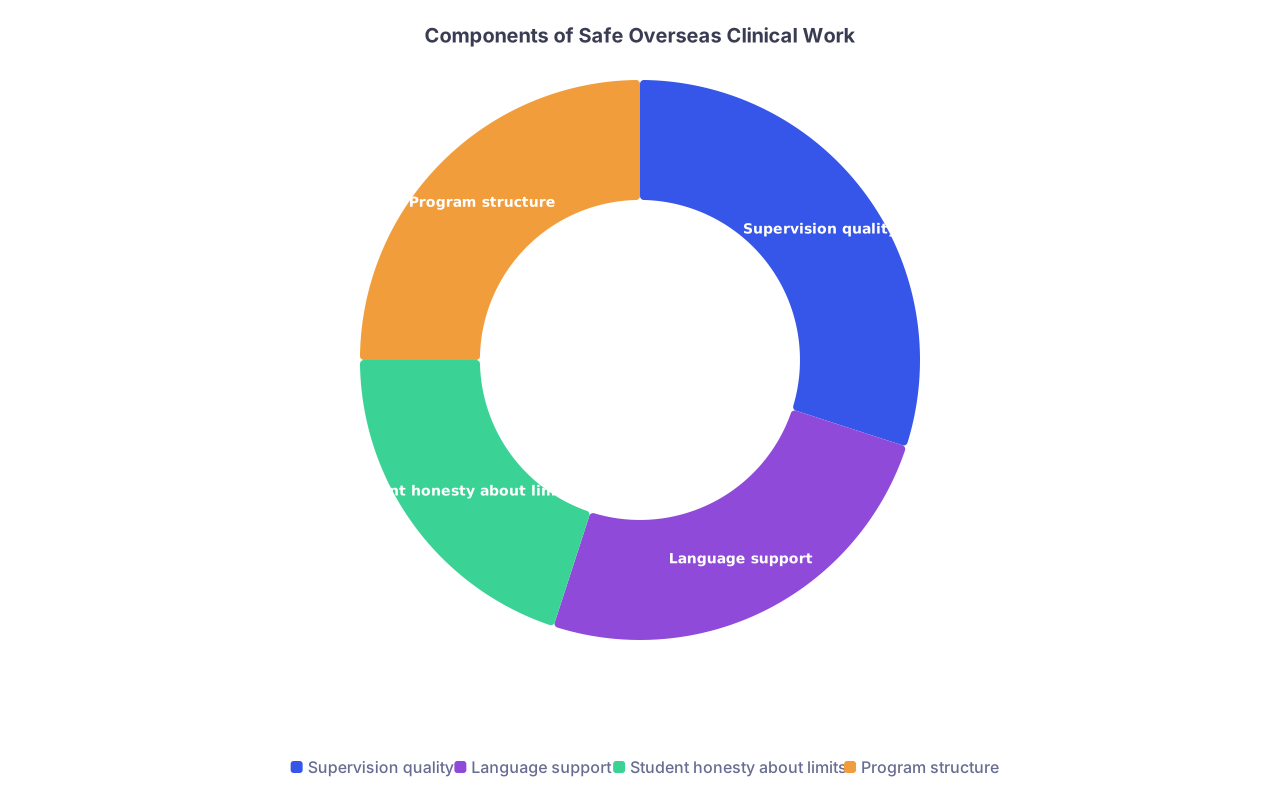
| Category | Value |
|---|---|
| Supervision quality | 30 |
| Language support | 25 |
| Student honesty about limits | 20 |
| Program structure | 25 |
What You Can Do Today (Concrete, Not Vague)
You’re probably tired of abstract reassurance, so here’s something you can actually act on today:
- Pull up the info for your planned (or ideal) overseas elective.
- Write down your real language level in one sentence. Example: “I can have basic conversations in Spanish but struggle with medical vocabulary and fast speech.”
- Send one email to the program coordinator or faculty lead that includes:
- Your honest language description.
- The question: “Given this level, what kind of patient contact and responsibilities do you envision for me? Will there be interpreters or bilingual supervisors available whenever I’m involved in direct care?”
Their answer will tell you a lot:
- If they give a vague, hand-wavy, “Oh, you’ll be fine, don’t worry about it,” that’s a bad sign.
- If they give a clear, specific outline and mention interpreter support and supervision, that’s much better.
That one email will do more to reduce your anxiety and protect patients than 10 hours of late-night spiraling.


| Step | Description |
|---|---|
| Step 1 | Interested in overseas clinical work |
| Step 2 | Assess language level |
| Step 3 | Focus on language study or non clinical role |
| Step 4 | Review program structure and support |
| Step 5 | Choose different site or role |
| Step 6 | Proceed with clear limits on responsibilities |
| Step 7 | Can handle basic clinical phrases with support? |
| Step 8 | Adequate supervision and interpreters? |
FAQ: Language Anxiety and Overseas Clinical Work
1. If I’m not fluent, is it unethical for me to have any patient contact overseas?
No. What’s unethical is unsupervised, high-stakes patient care without adequate language support. It’s fine—and often valuable—to interact with patients using interpreters, to do limited tasks within your competence, and to learn. The key is supervision, transparency, and not pretending your language is better than it is.
2. Is it “white savior”-ish to show up with weak language and try to help?
It can be, if your main driver is “helping” and you ignore your limits or the local context. But if you’re going with humility, working under local leadership, being honest about your skills, and recognizing you’re learning far more than you’re giving—that’s a different story. The posture matters as much as the passport.
3. Can I rely on Google Translate or apps for clinical communication?
As a supplement with supervision? Maybe. As your main tool for complex histories, consent, or counseling? Absolutely not. Machine translation misses nuance, slang, context, and can be dangerously wrong. You can use it to help learn vocabulary or check simple words, but not to replace an interpreter for real medical decision-making.
4. My school says language “isn’t required” for the elective. Should I be reassured or worried?
Depends. If they also say there’s strong interpreter support and close supervision, okay. If it’s more like, “You’ll pick it up as you go, students manage,” that’s a warning sign. Ask very specific questions: who interprets, how often, for what kinds of encounters, and what exactly previous students with no language did day to day.
5. What if I get there, realize my language truly isn’t enough, and I just freeze?
Then you do the uncomfortable-but-correct thing: you tell your supervisor. “I thought my language would be stronger in practice. I’m not comfortable taking independent histories or giving counseling. Can we adjust my role to observation/support and use interpreters when I’m involved?” That’s not a meltdown; that’s professionalism. And if they dismiss that, the problem is them, not you.
Action step for today:
Open your email, find the contact for your planned (or dream) overseas elective, and write a three-sentence message honestly describing your language ability and asking exactly what language support and supervision will be there. Don’t overthink it. Just send it.


