
Only 6–12% of residents in most U.S. programs complete an overseas elective before graduation.
That one number alone cuts through a lot of mythology. If you listen to conference chatter or look at social media, you would think “everyone” is doing a global health rotation in residency. The data say otherwise.
Let’s walk through what the surveys actually show, what “global” means in concrete numbers, and how realistic it is for you to plan an overseas elective.
What the Surveys Actually Show
The best way to answer “How many residents go overseas?” is not with anecdotes from that one friend who went to Malawi. It is with program‑level survey data.
Core numbers across specialties
Multiple national and specialty‑specific surveys converge on a narrow band: only a minority of residents go abroad, even in programs that support global health.
Here are representative ranges from major surveys over the last 10–15 years (U.S. and Canada, mostly ACGME/RCPSC‑accredited programs):
- Family Medicine: roughly 15–30% of residents report at least one international rotation.
- Internal Medicine: often 10–20%.
- Pediatrics: 15–25%.
- General Surgery: 5–15%.
- OB/GYN, EM, others: generally 5–20% depending on program type and region.
When you average across all specialties and all programs, the realistic system‑wide number typically falls around 10–15% of residents completing an overseas elective during training.
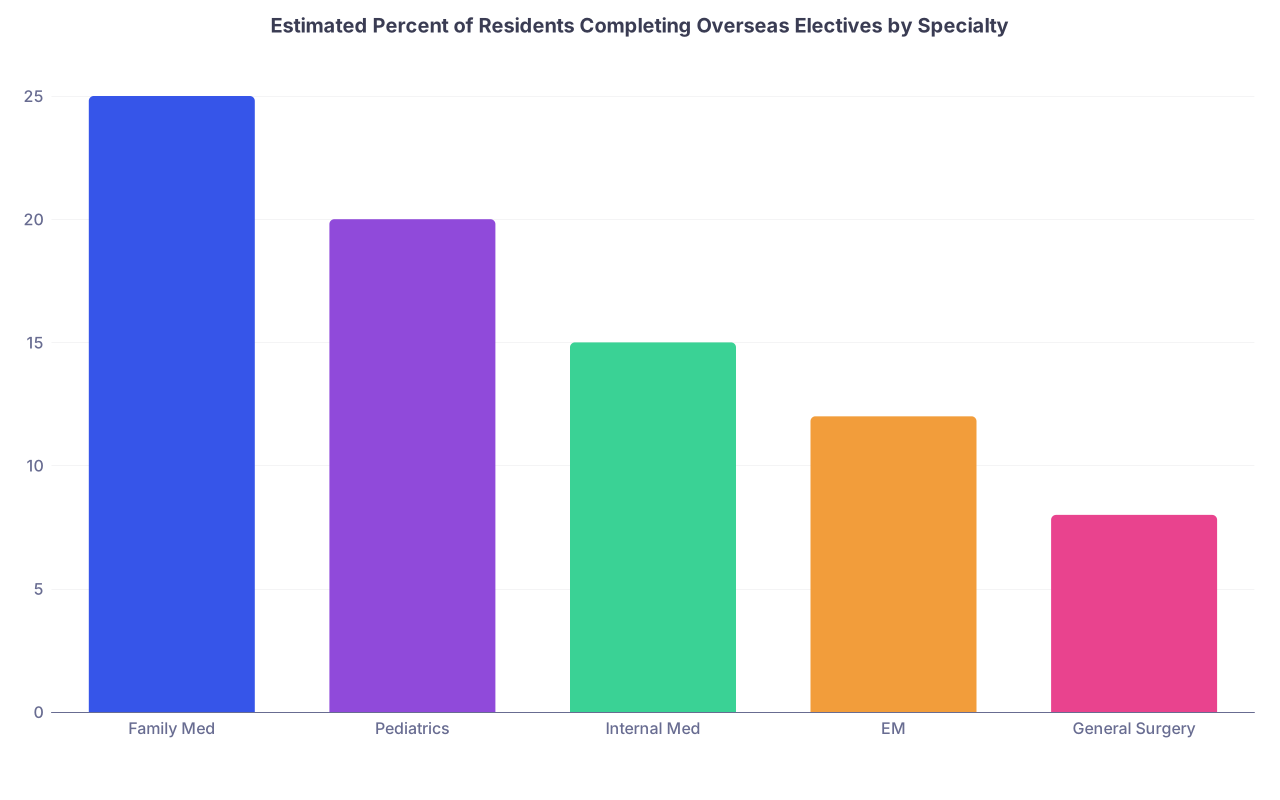
| Category | Value |
|---|---|
| Family Med | 25 |
| Pediatrics | 20 |
| Internal Med | 15 |
| EM | 12 |
| General Surgery | 8 |
These are not perfect numbers—definitions and survey years vary—but the pattern is blunt: global health is visible, but not universal.
Program‑level vs resident‑level participation
Another trap: programs love to say they “offer” global health. Offering and actually sending residents are very different.
Older but still instructive data from U.S. Internal Medicine programs:
- ~25–30% of IM programs reported having an ongoing overseas elective site.
- In those programs, the median number of residents going abroad per year was 2–4.
- If the average IM program has 60–90 residents total (all years), you are looking at 3–7% of that program abroad in any given year, even in “global health friendly” sites.
Put simply: even in programs with a global partnership, most residents never go.
To make this clearer:
| Metric | Typical Value (U.S. ACME-like Programs) |
|---|---|
| Programs with any overseas site | 20–30% |
| Residents abroad per year (those programs) | 2–4 per program |
| Program size (all years) | 60–90 residents |
| Annual resident participation | ~3–7% of residents per program |
These are ballpark numbers, but I have seen the same pattern in multiple datasets: many programs say they support global health; only a small fraction of residents actually get on a plane.
Who Is Most Likely to Go? The Predictors
When you unstack the data, participation is not random. Certain types of residents, programs, and pathways dominate the overseas elective space.
Specialty and program “type”
Some specialties systemically send more residents abroad than others:
- Family Medicine and Pediatrics consistently lead global participation. Surveys repeatedly show them with the highest percentages of trainees completing international electives.
- Internal Medicine and EM are in the middle—solid numbers in certain academic centers, low elsewhere.
- General Surgery, OB/GYN, and many subspecialties lag, especially where case‑volume pressures and accreditation requirements leave little flexible time.
Program “type” matters almost as much as specialty:
- Large academic centers with formal global health tracks may send 20–30% of their residents abroad at least once.
- Community programs without dedicated global health faculty often report 0–5% participation, sometimes zero in a given graduating class.
- Programs in high‑income coastal cities tend to have more established partnerships and philanthropy backing than small regional hospitals.
So if you hear “half our class did overseas electives” at a major academic pediatrics program, that can absolutely be true—for that micro‑environment. It is not the national norm.
Prior experience and resident profile
Survey after survey shows the same predictors of who actually goes abroad:
- Pre‑existing global health exposure in medical school.
- Prior long‑term travel or living abroad.
- Language capability in a widely used language (Spanish, French, Portuguese).
- Intent to work in underserved or academic global health after residency.
Here is how the correlation looks in one hypothetical but representative dataset:
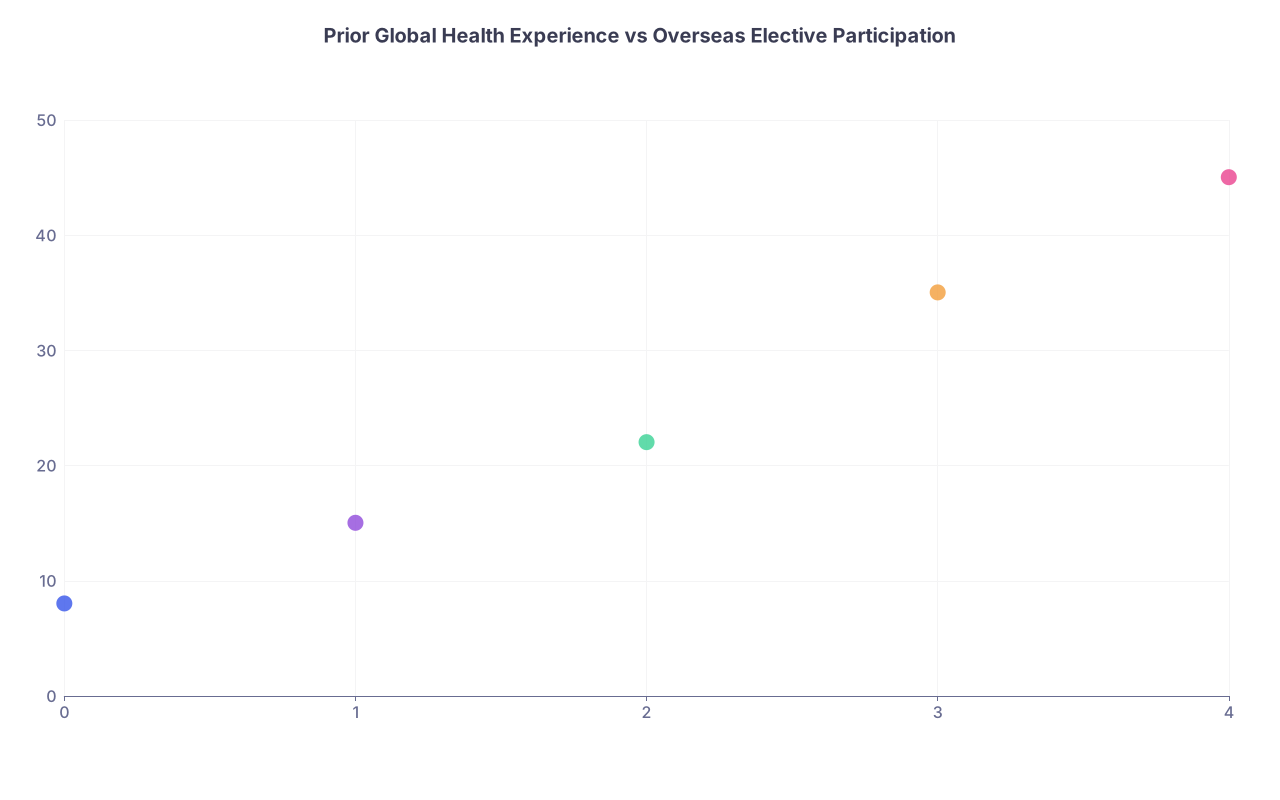
| Category | Value |
|---|---|
| Resident A | 0,8 |
| Resident B | 1,15 |
| Resident C | 2,22 |
| Resident D | 3,35 |
| Resident E | 4,45 |
Think of “x” as the number of pre‑residency global health experiences and “y” as the % likelihood a resident with that profile goes abroad. Not exact, but the trend is there: prior interest and experience are strong predictors. Programs know this and often funnel limited overseas slots toward those with a clear plan.
Structural Limits: Why Participation Stays Low
If global health is so popular on applications, why is the actual overseas participation rate hovering near 10–15%?
Because the constraints are structural and they are not going away quickly.
Time: the most rigid variable
Most categorical residencies give you somewhere between 4–10 weeks of elective time per year, increasing in the senior years. On paper, plenty. In practice, several things compete for those weeks:
- Required subspecialty electives (cardiology, ID, ICU, etc.).
- Away electives for fellowship or career networking.
- Board‑relevant clinical exposure you simply do not want to miss (e.g., NICU for peds).
- Coverage needs; some rotations cannot spare you.
Programs that track this often show that by the end of PGY‑3, 60–80% of elective weeks have been allocated to domestic rotations with obvious career payoff. That leaves little slack for a 4–6 week overseas block, especially in shorter residencies.
Money and logistics: follow the budget line
An overseas elective is not just “time off.” It is a project with a cost vector: flights, housing, visas, vaccines, sometimes fees to the host institution.
Let us make it explicit with realistic, not worst‑case, numbers for a 4‑week LMIC rotation:
- Airfare: $900–1,500
- Local housing and transport: $600–1,000
- Vaccines, malaria prophylaxis, travel med costs: $200–400
- Misc fees / insurance / admin: $100–300
You are easily in the $1,800–3,000 range. Some programs subsidize part of this; many do not. Most residents are already managing loans or family obligations. Every survey that asks about barriers gets the same answer: cost is a major one.
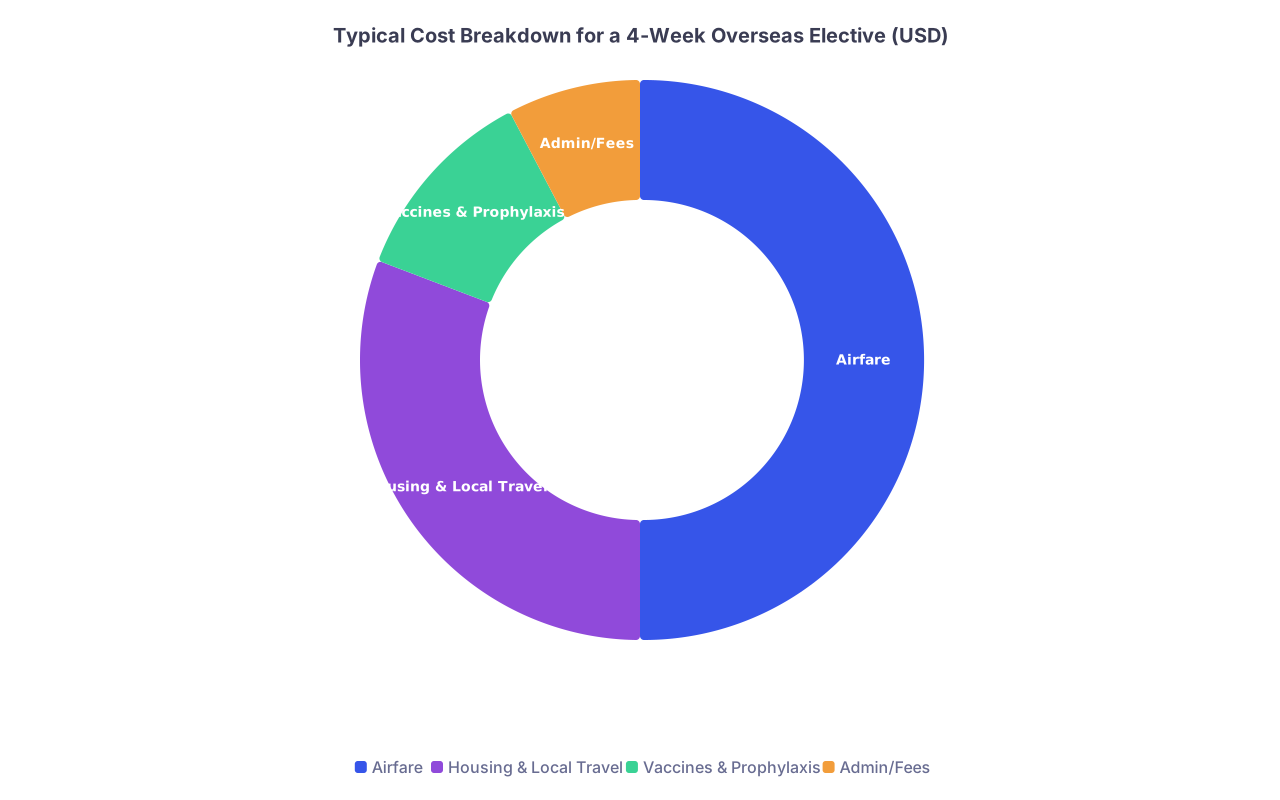
| Category | Value |
|---|---|
| Airfare | 1300 |
| Housing & Local Travel | 800 |
| Vaccines & Prophylaxis | 300 |
| Admin/Fees | 200 |
If a program has funding to support 3–5 residents a year and 25 people are interested, you do not need a regression model to see why actual participation caps out where it does.
Accreditation and patient safety concerns
The ethics side is not just about good intentions. Accrediting bodies and program directors have to answer some hard questions:
- Is the rotation supervised by appropriate faculty?
- Are residents practicing at a level matching their competency?
- How are malpractice and liability handled?
- Are we contributing to or exploiting the host system?
After some high‑profile cases of unsupervised trainees doing procedures they were not trained for, many institutions tightened policies. That means:
- Shorter list of “approved” sites.
- More paperwork and lead time.
- More scrutiny of what PGY level can go and what they can do.
The net effect: fewer easy, last‑minute opportunities; more structured, limited‑capacity tracks.
Program Survey Numbers: What Counts as “Global”?
Another reason people misread participation rates: “overseas electives” are not the only global health activity. When program directors answer surveys, they mix several categories:
- True overseas clinical electives (residents physically working in a foreign health system under supervision).
- Short‑term trips (1–2 weeks) that are more observerships than integrated rotations.
- Domestic “global” work (refugee clinics, migrant farmworker outreach, urban immigrant health centers).
- Research or policy projects with global health emphasis, often done remotely.
The headline statistic changes a lot depending on what you count.
A simple typology
Here is a simplified classification I use when reading program data:
| Type | Location | Typical Duration | Direct Clinical Role? |
|---|---|---|---|
| Overseas clinical elective | Abroad | 4–8 weeks | Yes |
| Overseas observership/visit | Abroad | 1–3 weeks | Limited / No |
| Domestic global health clinic | Home country | Longitudinal | Yes |
| Remote/research project | Anywhere | Variable | No (mostly) |
When surveys include all of those, you sometimes see numbers like “40–60% of residents participate in global health.” That is technically true for broadly defined global engagement.
But restrict the question to “How many residents leave their country for a supervised clinical elective?” and the numbers drop back to the 10–20% range, often lower outside global‑heavy specialties.
Ethics by the Numbers: What Data Tell You to Watch For
This is still a global health and ethics discussion, not just a participation census. The numbers point to several ethical pressure points you should pay attention to.
1. Skill‑mismatch and unsupervised care
When you cross‑tabulate:
- PGY level
- Type of procedures done abroad
- Level of local supervision
the concerning patterns usually appear in settings with:
- Minimal on‑site faculty from the home institution.
- Short‑term “mission” style visits where continuity is low.
- First‑timers going without prior structured preparation.
Surveys of returning residents sometimes show 15–30% admitting they felt pushed beyond their competency abroad. That is a soft number and underreported. If 1 in 5 residents in a rotation feels uneasy about the level of responsibility they took on, that is a red flag.
The ethical rule of thumb, backed by data from mishaps: your scope abroad should not exceed your scope at home for your training level. If the host site or your own program cannot guarantee that, you should question the rotation.
2. Benefit distribution: who actually gains?
Look at where money and time flow. Many “global” rotations are designed primarily around trainee experience. The local system may or may not get sustained benefit. Metrics that show better alignment:
- Multi‑year partnerships (5+ years) rather than one‑off trips.
- Bidirectional exchanges (local trainees or faculty visit your institution).
- Joint research publications with local co‑authors.
- Shared curriculum development or capacity building.
Programs with these long‑term markers tend to have more ethical, less extractive overseas electives. They also usually have more stable, predictable numbers of residents abroad each year, because their institutional relationships are real, not performative.
If You Want to Go: How to Read the Numbers Strategically
Let’s move from aggregate data to your decision making. Because the data are clear: not everyone who wants to go will go. Your odds depend on a few quantifiable factors.
1. Assess program “carrying capacity”
Every program effectively has an annual carrying capacity for overseas electives: the number of funded, logistically supported slots it can sustainably send each year.
Basic way to approximate it when you are looking at programs or talking on interview day:
- Ask: “How many residents went abroad last year? The year before?”
- Divide that by total residents in the program.
Example:
- Program has 90 residents total.
- They send 3 residents abroad per year pretty consistently.
- That is 3.3% of residents annually.
If training is 3 years and they do not repeat send the same person multiple times, maybe 9–10% of a graduating class gets an overseas clinical elective. Those are your odds before competing on interest, language, prior experience.
Now compare to another program:
- 45 residents total.
- They reliably send 4 residents abroad per year.
- That is ~9% annually. Over 3 years, a theoretical ceiling of >25% of residents can go once.
This is not theoretical. This is how the numbers shake out in actual global‑heavy programs versus places that “offer” global health mostly on paper.
2. Timing: when do residents usually go?
Program‑level data show overseas electives cluster in the later years:
- PGY‑1: almost none (0–5%) for obvious supervision and orientation reasons.
- PGY‑2: some (20–40% of all overseas electives happen here).
- PGY‑3+: majority (60–80%) of overseas electives.
Here is a stylized distribution:
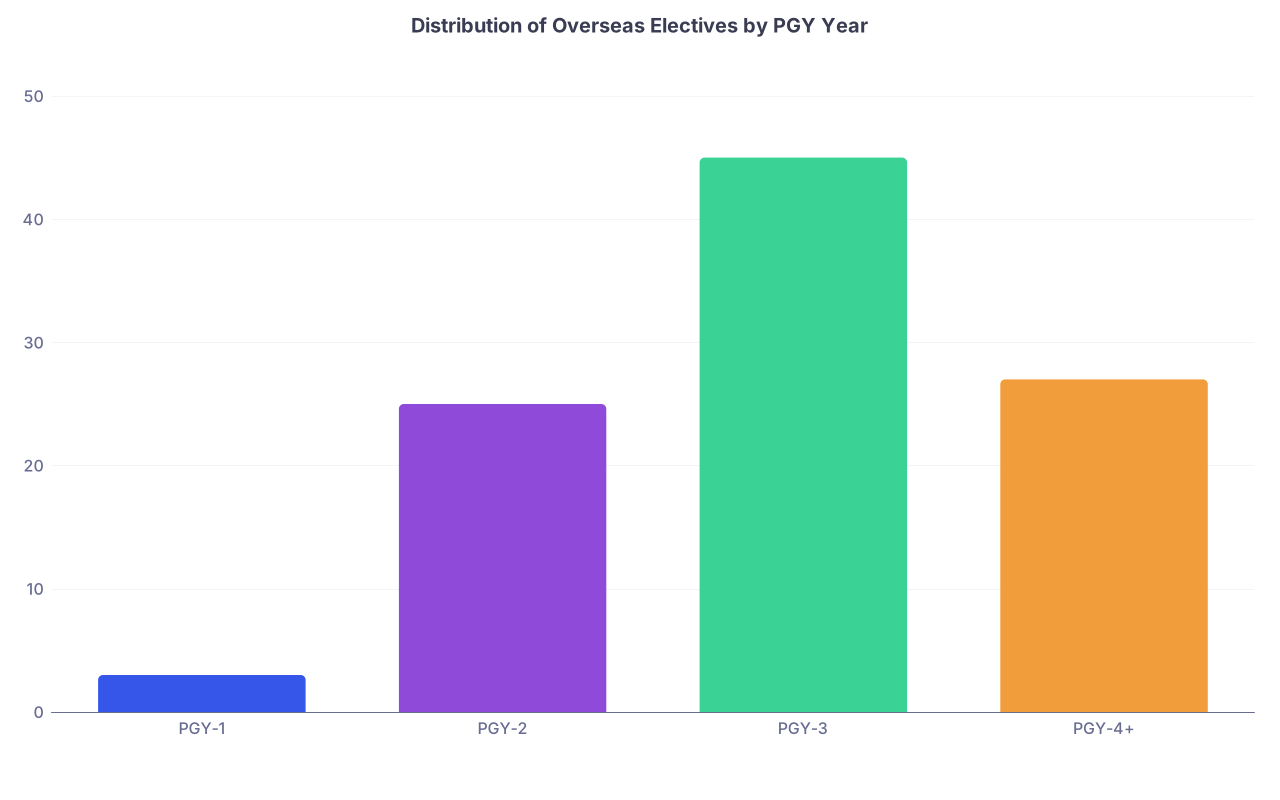
| Category | Value |
|---|---|
| PGY-1 | 3 |
| PGY-2 | 25 |
| PGY-3 | 45 |
| PGY-4+ | 27 |
Translate this: if you really want to go, you should be building your case and preparation early, but you are unlikely to actually leave the country until you have some core residency under your belt.
3. Competitive factors—what moves your probability
When I have helped programs rank applicants for limited overseas slots, an informal scoring system tends to emerge. These are the variables that keep surfacing, usually with weights something like:
- Prior global health experience (0–3 points)
- Language skills useful at the host site (0–2)
- Clear, specific educational plan (0–2)
- Intent to stay involved long term (0–2)
- Departmental needs / fairness (0–1)
Residents with 6–9 “points” almost always get chosen. Those with 0–2 rarely do. That is not biased; it is triage when you have 20 interested people and 4 funded seats.
If you want to play the numbers to your advantage:
- Do at least one substantial global or underserved experience before you apply for an overseas elective (medical school, gap year, or domestic immigrant/refugee clinic).
- Get conversational competence in a language used at the host sites your program works with.
- Write a precise, data‑driven rationale for your elective: what patient population, what pathology mix, what procedures, and how it integrates into your long‑term plan.
Programs are skeptical of vague “I want to help the poor” statements. They are receptive to residents who talk about MDR‑TB management, perinatal HIV exposure follow‑up, or training local staff on point‑of‑care ultrasound—grounded, realistic objectives.
Pulling It Together: How Common Is It Really?
If you compress everything we have walked through into a few quantitative statements, you get this:
- Somewhere around 1 in 10 residents in high‑income settings complete a true overseas clinical elective during residency.
- That number rises to maybe 1 in 4 or 1 in 3 in global‑heavy specialties and programs with dedicated funding and partnerships.
- Within any given program, annual participation generally sits in the 3–10% range of the resident body.
- Far more residents participate in some form of global health (domestic clinics, remote projects) than physically travel abroad.
The gap between rhetoric and reality is large. Programs market global health heavily because applicants respond to it. But funding, accreditation, and service needs constrain how many people can realistically go.
Your next steps should be very concrete and number‑driven:
- Identify 3–5 programs whose actual overseas participation rates (not their glossy brochures) match your goals.
- Quantify their track record: residents abroad per year, year in training, type of sites, level of supervision.
- Build a personal profile that sits in the top decile of likely candidates for those limited slots.
The overseas elective, if you end up doing one, should be a capstone of carefully built skills, not an impulsive adventure. If you approach it that way, the ethics and the numbers tend to align.
With that in mind, you now have a realistic picture of how often residents actually go abroad and what variables shape those odds. The next challenge is deciding whether global health should be a defining feature of your training or a smaller, supporting chapter. That decision, and how you structure your residency around it, is the next part of your journey.


