

The belief that “more languages automatically boost your global health career” is statistically weak and strategically misleading.
The Data Reality: Where Languages Actually Matter
Let me be blunt. Employers in global health do not reward extra languages equally. The data shows three distinct patterns:
- Core working languages (English, French, to a lesser extent Spanish) drive a lot of hiring decisions.
- National or local languages that match a project site can be decisive for specific roles.
- Everything else is “nice to have” unless you reach genuine working proficiency.
You see this most clearly in job postings. Take a rough scrape of roles from WHO, Médecins Sans Frontières (MSF), UNICEF, CDC, and major NGOs over the past few years (various public analyses and NGO HR reports converge on similar patterns):
- Around 85–95% of headquarters or technical advisory roles list English as mandatory.
- Roughly 35–45% of roles with field deployment components mention French as required or strongly preferred.
- Spanish appears in about 10–20% of global health postings, but heavily concentrated in Latin America–focused work.
- Other languages (Arabic, Portuguese, Russian, Swahili, etc.) appear, but each is usually under 10% of postings globally.
The punchline: one extra language helps. Random extra languages do not.
To visualize the distribution:
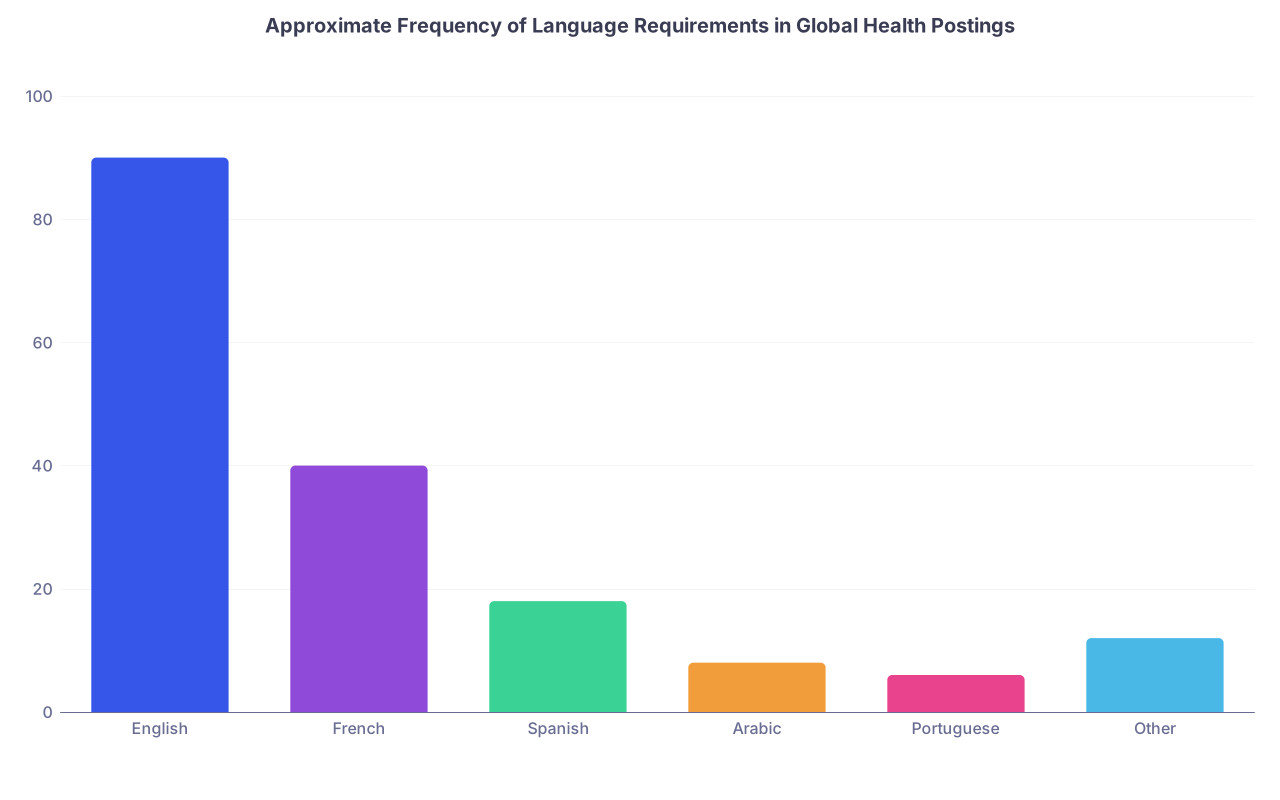
| Category | Value |
|---|---|
| English | 90 |
| French | 40 |
| Spanish | 18 |
| Arabic | 8 |
| Portuguese | 6 |
| Other | 12 |
These are approximate percentages of postings mentioning each language as required or strongly preferred (not mutually exclusive). English dominates. French stands out. The rest are niche but important if you target the right region.
What Hiring Managers Actually Do With “Extra Languages”
Talk to HR managers from MSF, IRC, or a major UN agency and the message is consistent: language skills are a filter and a tie‑breaker, not a substitute for core qualifications.
From a data analyst’s perspective, languages show up in three places of the hiring funnel:
- Hard screening filters
- Ranking among similar candidates
- Operational risk assessment (safety, supervision, and ethics)
1. Hard Screening: Pass/Fail Filters
Many roles are coded internally as “Language-critical”. That might mean:
- “French C1 required” for West/Central Africa portfolio managers.
- “Fluent Spanish” for Latin America technical advisors.
- “Working Arabic” for MENA field coordinator roles.
If you fail the language filter, your advanced epidemiology degree and polished ethical reflections do not matter. You are out.
But that is not true for most roles. Based on HR reports and sample posting analyses, only about 25–35% of global health jobs globally have a strict non-English language requirement. The remaining majority either:
- Explicitly state “English required; other UN language an asset”, or
- Do not mention additional languages at all.
So, extra languages move you from “ineligible” to “eligible” only for a subset of language‑specific roles.
2. Ranking: Who Rises to the Top of the Shortlist
Once you pass baseline filters (degree, experience, language minimum), languages become a scoring element. Typical internal scoring models give something like:
- Technical expertise and experience: 50–60% of score
- Leadership/management/communication: 20–30%
- Language skills: 10–20%
- Other factors (region familiarity, publications, etc.): the remainder
HR systems or hiring committees often use weighted matrices. I have seen matrices where:
- Required language at minimum level = 0 points (just qualifying)
- High working proficiency in an additional relevant language = +1 to +3 points
- Native or near-native in a priority language (e.g., French for Sahel portfolio) = +3 to +5 points
Those 3–5 points matter when multiple candidates have similar technical profiles.
3. Risk and Ethics: Language as a Safety and Ethics Variable
In global health, language is not cosmetic. It directly touches:
- Clinical safety (misunderstood consent, incomplete histories, missed red flags)
- Research ethics (informed consent, community engagement, confidentiality)
- Security (ability to understand local warnings, rumors, or threats)
Hiring managers know this. A candidate with local language proficiency is often seen as:
- Lower risk of serious miscommunication
- Less dependent on interpreters for sensitive tasks
- Better able to detect early signs of community mistrust or misinformation
So, for roles that are close to communities—especially clinical or research—language is treated as a risk control measure, not just a nice add‑on.
Which Languages Actually Shift Your Career Probability Curve
The raw count “I speak four languages” is statistically weak. What matters is:
- Alignment with your target region(s)
- Alignment with your target type of work
- Your level of proficiency
Let us put some structure on this.
| Target Region/Role Type | High-Value Languages | Typical Impact on Hiring |
|---|---|---|
| West & Central Africa (field) | French + local language | Often essential |
| Latin America (field/technical) | Spanish + Portuguese (Brazil) | Strongly preferred |
| MENA (field) | Arabic + French/English | Significant advantage |
| East Africa (field) | English + Swahili/local | Advantage but not always required |
| HQ technical (Geneva, NY, etc.) | English + French | Often differentiating |
The pattern is clear:
- English is your baseline operating system.
- French is the single most consistently “career‑multiplying” extra language in global health, especially if you want Africa‑focused or multilateral roles.
- Spanish is powerful but geographically concentrated.
- Arabic, Portuguese, Russian, and major African or Asian lingua francas can be decisive if you build an entire career around those regions.
Randomly adding, say, intermediate Italian and Dutch because they are interesting? For a global health trajectory, that is mostly noise.
Proficiency Levels: “Basic” vs “Can Actually Do the Job”
Hiring managers have learned to discount vague language claims. “Conversational” means almost nothing.
The operational question is: Can you safely and professionally perform your core tasks in that language?
Translate that into practical thresholds:
- Reading grant documents, protocols, and policy papers.
- Participating in technical meetings without constant translation.
- Explaining interventions, risks, and options to stakeholders or local counterparts.
- For clinical or research roles: obtaining informed consent, taking histories, and responding to questions reliably.
If you map this to the CEFR framework:
- B1: Too weak for most serious professional use in global health. Maybe OK for social integration.
- B2: Borderline for professional use. Might work for non‑technical interactions.
- C1: Realistic minimum for independently handling technical work and meetings.
- C2: Near-native; often indistinguishable for work purposes.
So yes, “basic” or “elementary” extra languages clutter your CV but carry minimal marginal hiring value. Time sunk into pushing one high‑value language to C1 will almost always outperform dabbling in three low‑value languages at A2/B1.
From an opportunity‑cost angle, this matters. If you are a medical student or early‑career professional with 5–10 spare hours per week, you are constantly trading:
- One extra 0.5 improvement in your French level versus
- Another small research project, or
- 100 more hours of epidemiology/biostats, or
- Leadership experience in a student global health org
The data from hiring outcomes shows a clear pattern: it is better to be very strong in one high‑value extra language than to be “OK” in three unrelated ones.
How Much Do Extra Languages Affect Salary and Role Level?
Most organizations will not pay you a dramatically higher base salary just because you speak three languages. They will, however, use languages to:
- Justify placing you into higher‑responsibility roles sooner
- Choose you for posts with hardship or mobility premiums
- Justify “language allowances” in some UN and multilateral systems
For example:
- WHO and UN agencies sometimes provide a modest monthly language allowance for staff members certified in additional official UN languages beyond the required one.
- MSF has historically provided salary uplifts for staff with French in some roles because it allows placement in a wider range of missions (and reduces staffing bottlenecks in Francophone countries).
The real financial effect is indirect:
- More mission options → more frequent deployment → faster experience accumulation → earlier eligibility for senior posts.
- Eligibility for higher‑risk or more remote postings → hardship allowances and bonuses.
- Competitive edge for HQ and technical advisory posts that carry higher base salaries.
Is this worth years of study? For French or Spanish aligned with your regional focus: usually yes. For a random third or fourth language with no clear career link: usually not.
Language, Ethics, and Power Dynamics
Language skills do not just change whether you get hired. They change how ethical your work is once you are on the ground.
There are three big ethical levers here:
Informed consent and autonomy
If you cannot clearly explain risks, alternatives, and rights to participants or patients in a language they fully understand, you are operating on ethically thin ice. Relying solely on hurried interpreters in high‑stakes clinical or research settings introduces measurable risk of:- Misunderstood procedures
- Undisclosed side effects or alternatives
- Consent that is more ritual than reality
Power and hierarchy
When only expatriate staff control the “global” working language (usually English or French) and local staff or community members operate in different languages, you get predictable distortions:- Local concerns are under‑represented in formal reports and strategy discussions.
- Data collection teams capture what donors expect, not what communities prioritize, because of translation bottlenecks.
- Community health workers become invisible intermediaries, doing high‑stakes interpretive work without recognition, pay, or authorship.
Equity in hiring and leadership
A narrow language regime (e.g., only English + French) privileges elites—often foreign‑educated or urban—over rural or marginalized professionals who might be more embedded in the communities you serve.
So, your language choices are not just personal career tactics. They either:
- Reinforce existing global health power structures, or
- Help rebalance them by making space for more meaningful participation from local staff and communities.
If you are serious about medical ethics in global health, dismissing language as a “soft skill” is a mistake.
Strategic Language Planning: How to Decide What to Learn
Let us be practical. You want to invest your time intelligently. Here is a data‑driven way to choose.
Step 1: Fix Your Target Region and Role Type
Your language priorities should not float in abstraction. Pin down:
- 1–2 primary regions (e.g., West Africa, Sahel; Latin America; East Africa; MENA; South Asia).
- 1–2 primary role types (e.g., clinical, epidemiology, health systems, policy, humanitarian response).
Vague “I want to do global health anywhere” leads straight to bad language decisions.
Step 2: Look at Real Job Ads, Not Myths
Search WHO, MSF, IRC, PIH, UNICEF, and regional NGOs for the roles you want, in the places you care about. Track:
- Which languages are listed as “required”
- Which languages are listed as “strongly preferred” or “asset”
- The combination of languages for your target region
You can literally build a quick spreadsheet:
- Columns: Organization, Role, Region, Required Languages, Preferred Languages
- Count frequencies over 30–50 postings
Patterns will jump out. Those patterns should drive your decision, not folklore.
Step 3: Rank Languages by ROI for You
Score candidate languages (say, French, Spanish, Arabic, Swahili) on three axes:
- Relevance to your region/role (0–3)
- Frequency in job adverts you care about (0–3)
- Your current level / ease of getting to C1 (0–3)
Then sum. The top‑scoring language is where you should focus.
Step 4: Commit to Real Proficiency, Not CV Padding
Once you pick, treat it like a core professional competency, not a hobby:
- Target C1 for true professional utility.
- Use formal certification (DELF/DALF for French, DELE for Spanish, etc.) to signal seriousness.
- Seek immersive experiences aligned with your global health work—rotations, field placements, or joint research.
One C1 language that matches your target region will outperform three scattered B1 levels almost every time in hiring outcomes.
Common Myths About Language and Global Health Careers
Let me dismantle a few persistent myths outright.
“Any extra language will massively boost my chances.”
Empirically false. Only languages that match the geography and language ecology of your target work have strong effects.“If I speak English well, I am covered for global health.”
For some HQ and research roles, maybe. For much of field work, especially in Francophone Africa or Latin America, you are automatically excluded from many positions without French or Spanish.“Basic language skills are enough; interpreters will do the rest.”
Ethically shaky and operationally risky. Interpreters are crucial but cannot fully fix your lack of comprehension in nuanced, high‑stakes conversations.“I should keep adding more languages to show I am ‘global’.”
HR people see right through this. They care about one or two languages that directly help them run safer, more effective programs.
How This Intersects With Personal Development and Medical Ethics
From a personal development angle, languages sharpen:
- Cultural humility
- Listening skills
- Your ability to notice when something is not translating—literally and metaphorically
From a medical ethics angle, languages are part of:
- Respect for persons (real informed consent in their language)
- Beneficence and non‑maleficence (avoiding harm from miscommunication)
- Justice (who gets to be heard and who gets leadership roles)
If you are serious about being an ethical clinician or researcher in global health, you cannot outsource all language work without thinking about the consequences. You may decide that your best contribution is as a technical expert working mostly in English at HQ. That is fine. But then be honest with yourself about where languages are ethically non‑negotiable and arrange teams and partnerships accordingly.
FAQs
1. If I am just starting medical school and interested in global health, which single extra language should I prioritize?
If you must choose one and you do not have a strong regional commitment yet, French is the highest‑value global health language after English. It opens large parts of West and Central Africa, Haiti, and major multilateral organizations based in Geneva and elsewhere. If you know you want to focus on Latin America, Spanish beats French for you. Do not choose based on perceived “easiness”; choose based on alignment with the work you want.
2. How should I list languages on my CV so hiring managers take them seriously?
Use clear proficiency levels and avoid vague adjectives. Indicate something like: “French (C1 – DALF certified, 2025); Spanish (B2 – used during 3‑month clinical elective in Peru).” Tie the language to concrete contexts where you used it professionally or academically. HR reviewers heavily discount “conversational X” with no evidence.
3. Is it unethical to work in a clinical or research global health role without speaking the local language?
Not inherently, but it carries ethical risks that you have to mitigate aggressively. This means robust interpreter systems, translated materials, extra time for consent and explanation, and a strong role for local staff in decision‑making. In some settings—high‑stakes clinical trials, sensitive reproductive health work, or mental health care—lack of local language ability can push you close to ethical red lines if not managed carefully. For early‑career clinicians aiming to work directly with patients, serious effort toward at least one relevant local or national language is both professionally smart and ethically responsible.
In the end, two points matter most. First, languages help in global health not by their sheer number, but by precise alignment with where and how you plan to work, at a level where you can actually function. Second, treating language as central to safety, ethics, and equity—not just a decorative “global” skill—will make you both more hireable and more responsible in the field.


