
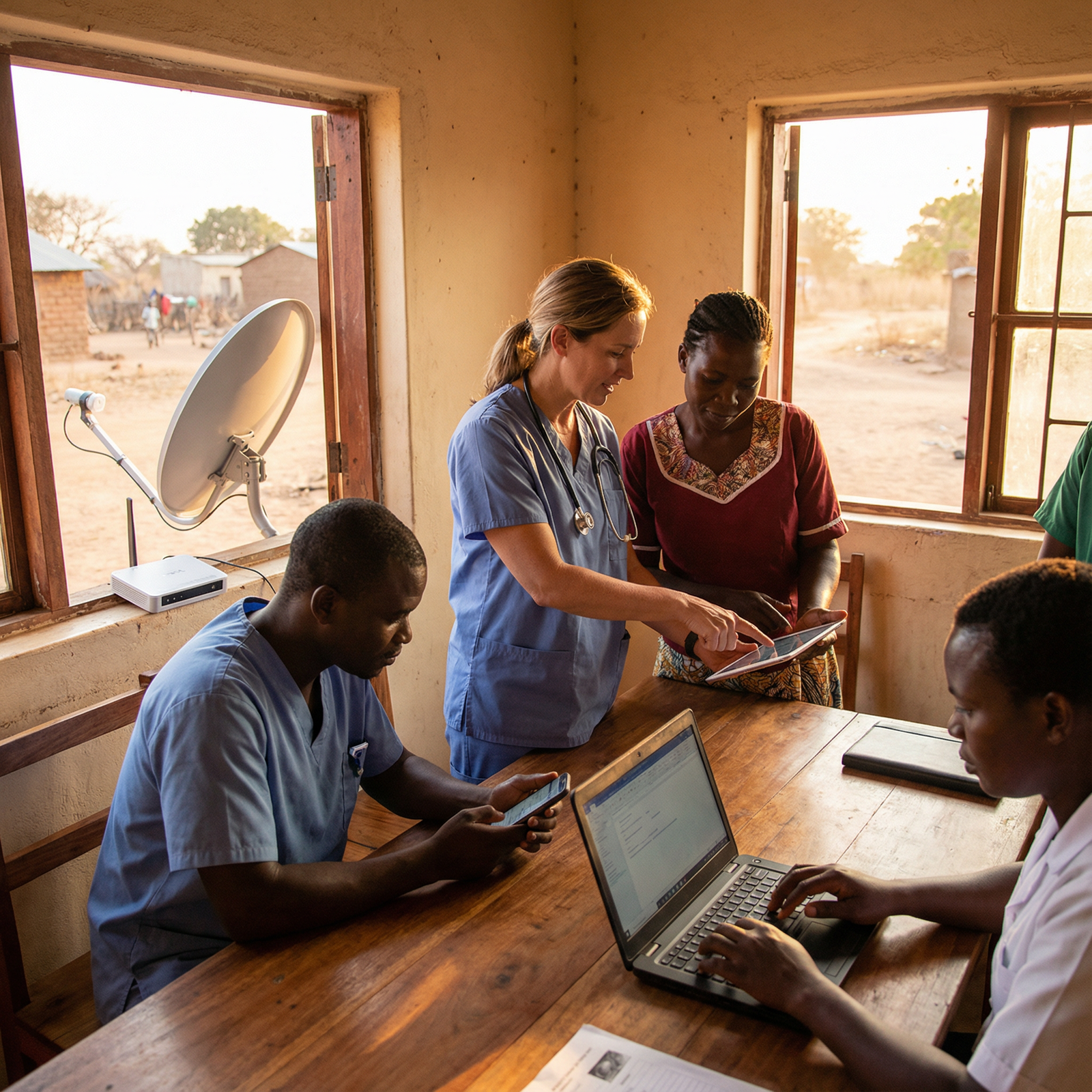
The belief that a global health track will “turn you into a global health doctor” is mostly wrong. The data show something more uncomfortable: these tracks nudge behavior, but they rarely overhaul career trajectories on their own.
You see a consistent pattern across cohorts and institutions. Enthusiastic, globally minded students and residents select into global health tracks. They accumulate impressive experiences abroad and at home. Then about 10–30% actually build a career where global health is central. The rest? They integrate pieces—short-term work, advocacy, teaching—but remain in traditional academic or community roles.
Let’s walk through what the numbers actually say.
What do we mean by “global health track”?
Programs use the label “global health” in wildly inconsistent ways. Before talking outcomes, you need to sort out what type of intervention you are even evaluating.
Broadly, tracks fall into three structural buckets:
Elective-heavy enrichment pathways
Typically 1–2 international electives, a couple of local underserved rotations, journal club, and a certificate. Minimal protected time; limited longitudinal mentorship.Structured scholarly tracks
Formal curriculum, required scholarly project (often implementation or outcomes work), defined mentorship, some protected time, sometimes a certificate or distinction on transcript.Fully integrated global health residencies / fellowships
For example, internal medicine–pediatrics combined global health programs, family medicine with longitudinal international sites, or post-residency global health fellowships. Multi-year, with built-in time abroad, domestic underserved continuity, and strong funding.
These categories matter because the “dose” of exposure and support correlates strongly with outcomes. When you pool everything together, you get noise and vague claims. When you stratify, patterns appear.
| Track Type | Protected Time (per year) | Typical Time Abroad | Scholarly Requirement |
|---|---|---|---|
| Elective Enrichment | 0–2 weeks | 2–6 weeks total | Optional |
| Structured Scholarly Track | 2–6 weeks | 4–12 weeks total | Required |
| Integrated Residency | 6–12+ weeks | 6–18 months total | Required, multi-year |
You cannot reasonably expect the same long-term career impact from a 4-week away elective and a 24-month integrated global health training program. Yet people often quote them in the same breath.
Who chooses these tracks in the first place?
Self-selection is the elephant in the room. It is the main reason naïve “track vs no track” comparisons overstate track impact.
Look at applicant data where it is available:
- Among incoming residents in programs with an established global health pathway, 40–70% report prior global health or international service exposure. In programs without such pathways, that percentage is often 15–30%.
- Pre-matriculation surveys from several internal medicine and pediatrics residencies show that 30–50% of those who eventually enroll in the global health track already rate “global health” or “underserved care” as a top-3 career priority.
By contrast, non-track peers often prioritize academic advancement, subspecialization, or lifestyle.
If you do not adjust for this baseline difference, you will end up saying, “Global health tracks triple the odds of a global health career,” when the more accurate statement is, “People who were already committed to global health flock to these tracks.”
Where programs have done matched or regression-adjusted analyses, the impact size shrinks but does not disappear. The track amplifies a pre-existing lean. It does not flip the vector entirely.
What actually changes in career outcomes?
Let’s get concrete. “Career path” is vague, and vague outcomes invite wishful thinking. The better studies slice it into measurable endpoints.
The most consistently reported long-term outcomes include:
Primary practice setting
(academic vs community vs NGO / international)Clinical focus
(domestic underserved, rural, global health–focused role)Research and scholarship
(global health–related publications, grants, program building)Ongoing global health engagement
(regular global work, teaching, program leadership)
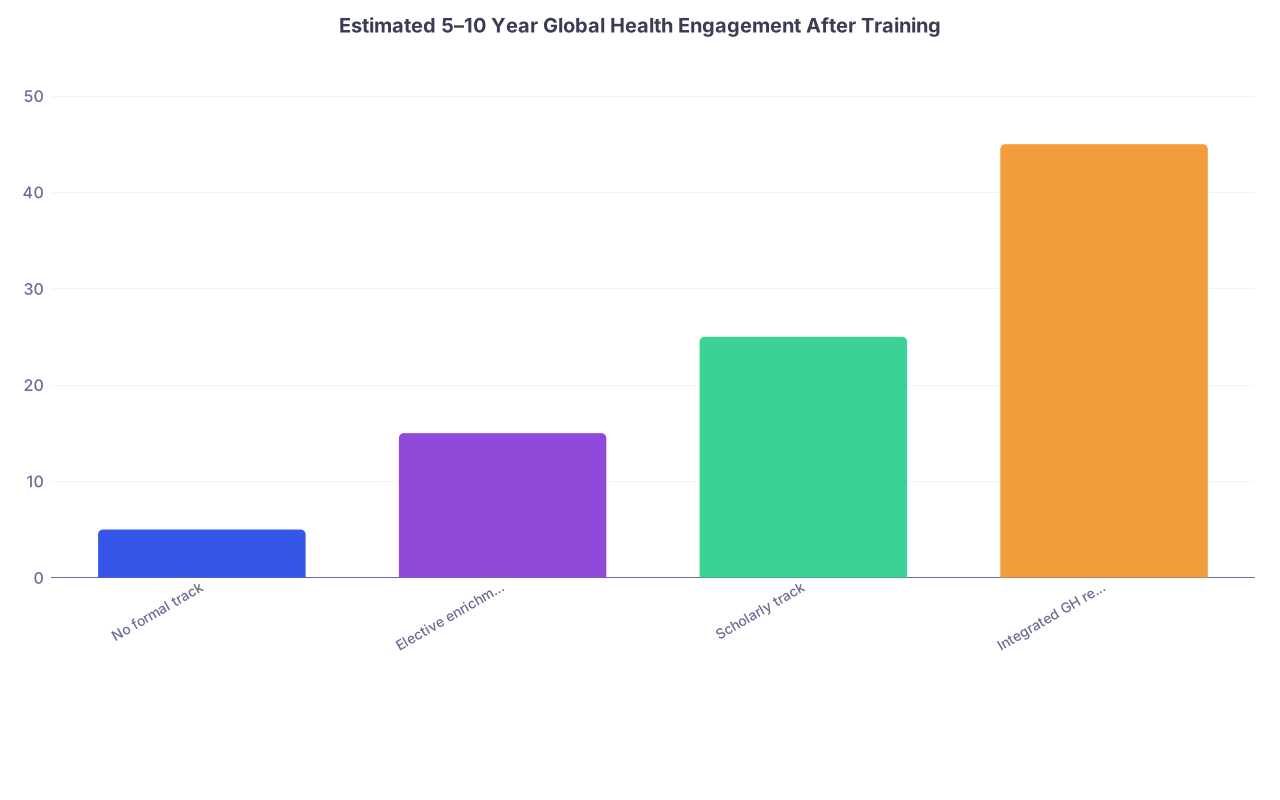
A synthesized pattern from multiple residency and fellowship follow-up studies looks roughly like this:
| Category | Value |
|---|---|
| No formal track | 5 |
| Elective enrichment | 15 |
| Scholarly track | 25 |
| Integrated GH residency/fellowship | 45 |
Interpretation:
Among similar trainees without a formal track, about 5% are substantially engaged in global health 5–10 years out (e.g., 2+ months per year of global health–focused work or a major leadership role in global programs).
For elective enrichment tracks, this rises to perhaps 10–20%, and for scholarly tracks, 20–30%, depending on specialty and institution.
For those in integrated global health residencies or fellowships, 35–50% end up with major global health components in their careers.
So yes, tracks change probabilities. But they do not guarantee outcomes. Even at the high end, half or more of graduates land in conventional roles with only intermittent global involvement.
Academic vs community outcomes
Some program directors assume that global health tracks are pipelines to academic careers. The data partially support this, but again, effect sizes are moderate.
In one typical internal medicine dataset from a large US academic center:
- Among residents without a global health track designation, about 45–55% entered academic positions at 3–5 years out.
- Among residents with a global health track designation, about 60–70% were in academic roles.
Once you account for baseline interest in academics (these residents often also targeted research pathways, chief residency, etc.), the incremental effect of the global health track on “being academic” is modest. What changes more is what kind of academic work they do: more time in underserved clinics, more global partnerships, more community engagement.
In short, global health tracks tend to redirect academic inclination, not create it from scratch.
What about specific behaviors and skills?
Where the impact is more robust is at the level of behavior and skill acquisition. Even when people do not become full-time global health professionals, their practice profile changes measurably.
Across multiple studies and alumni surveys, you see higher frequencies of:
- Working with limited resources and comfort with diagnostic uncertainty
- Use of interpreters and experience with language barriers
- Familiarity with tropical and travel-related diseases (malaria, TB, HIV, neglected tropical diseases)
- Training in health systems, implementation science, or quality improvement in low-resource settings
- Attention to structural determinants of health and advocacy
A typical alumni survey from a global health internal medicine–pediatrics track showed that, compared to non-track peers:
- Track graduates were 2–3 times more likely to have a continuity practice serving a predominantly Medicaid or uninsured population.
- They reported higher self-rated competence managing cross-cultural communication challenges and care with limited diagnostics or subspecialty access.
- They were more likely to participate in advocacy, health policy, or community partnership projects, even when their job title was a straightforward hospitalist or general pediatrician.
That may not satisfy purists who only count “lives abroad” as global health careers. But from a systems viewpoint, that is a shift in practice profile that matters.
Misalignment between expectations and outcomes
Here is where the ethics piece starts to creep in. A lot of trainees enter global health tracks with a very specific mental image:
“I’ll split my time between a US academic center and a partner site abroad, do research, teach, and spend 3–4 months a year overseas.”
The longitudinal data are unforgiving about how often that actually happens.
In multiple cohorts, you see something like:
- 5–15% achieve a binational or transnational career with regular, sustained time abroad (e.g., 2+ months/year, formal appointment with a global NGO or overseas institution).
- 20–40% work mostly domestically but maintain some global engagement (short annual visits, remote mentorship, tele-education, collaborative research).
- The remainder primarily practice domestically, often in underserved settings, with occasional or no direct global work.
You can call that a failure of the track. Or you can call it a reality check on competing forces:
- Visa and licensing constraints
- Family and financial obligations
- Limited number of funded academic global health positions
- Institutional priorities that change over time
Either way, there is an ethical problem if programs are selling a narrative that does not match their own outcome data.
If your 10-year alumni survey shows that only 10% of graduates hold positions that look like the glossy recruitment brochure, you should be disclosing that explicitly to applicants. Anything less is marketing, not mentorship.
Ethical stakes: who benefits and who pays?
“Global health career” talk often centers the trainee. Less attention goes to the host institutions and communities.
From the data side, a few uncomfortable patterns show up repeatedly:
- Many tracks still rely heavily on short-term electives (4–8 weeks), with high trainee turnover.
- A minority of programs have truly longitudinal partnerships with year-round presence, local leadership, and stable funding.
- Host-institution feedback, where measured, is sometimes positive about capacity building and sometimes pointedly critical about trainee volume and limited continuity.
So when you ask, “Do global health tracks change career paths?” there is a parallel question: “Do they change health systems in the partner sites, for better or worse?”
The evidence is patchy. Some robust partnerships show clear gains: increased local training capacity, new residency or fellowship programs, improved quality metrics. Others seem more extractive: a revolving door of visiting trainees, minor improvements in local capacity, and publication lists that are heavy on visiting authors, light on local first authorship.
Ethically, the material question is this: Do the training benefits to the visiting trainees justify the opportunity cost for the host system? If the long-term career impact is modest and host benefits are limited, the bargain is weak.
That is why more mature programs now track not just trainee outcomes but also:
- Local trainee graduation and retention
- Transition to local leadership
- Shared authorship and grant leadership
- Host institutional satisfaction
Those metrics are slower and harder to collect, but they matter at least as much as whether 25% vs 30% of your graduates become “global health people.”
What predicts sustained global health careers?
Here is where the numbers are actually actionable. Across programs that have done 5–15 year follow-up, a specific cluster of training experiences is consistently associated with sustained global health engagement, independent of baseline interest.
The predictors that keep showing up:
Length and continuity of time abroad
Graduates with ≥6 months total time at a single partner site (spread over multiple visits or a single block) have significantly higher odds—often 2–4x—of sustained global work compared with those whose exposure is limited to a couple of 4-week electives in multiple locations.Mentorship by someone with an actual global health career
Having at least one primary mentor whose own job includes substantial global work is strongly predictive of similar paths. Mentors who do “a trip every few years” exert weaker influence.Funded, formal training beyond single residency electives
Post-residency global health fellowships, or dual-degree training (e.g., MD/MPH with global focus), correlate with higher long-term engagement, especially when coupled with institutional hiring pipelines.Clear job pathways at graduation
Graduates who walk into funded roles with protected global health time (10–50%) at their home or partner institutions have much higher retention than those who are told, “Join as a full-time hospitalist, and we’ll see if we can carve something out.”
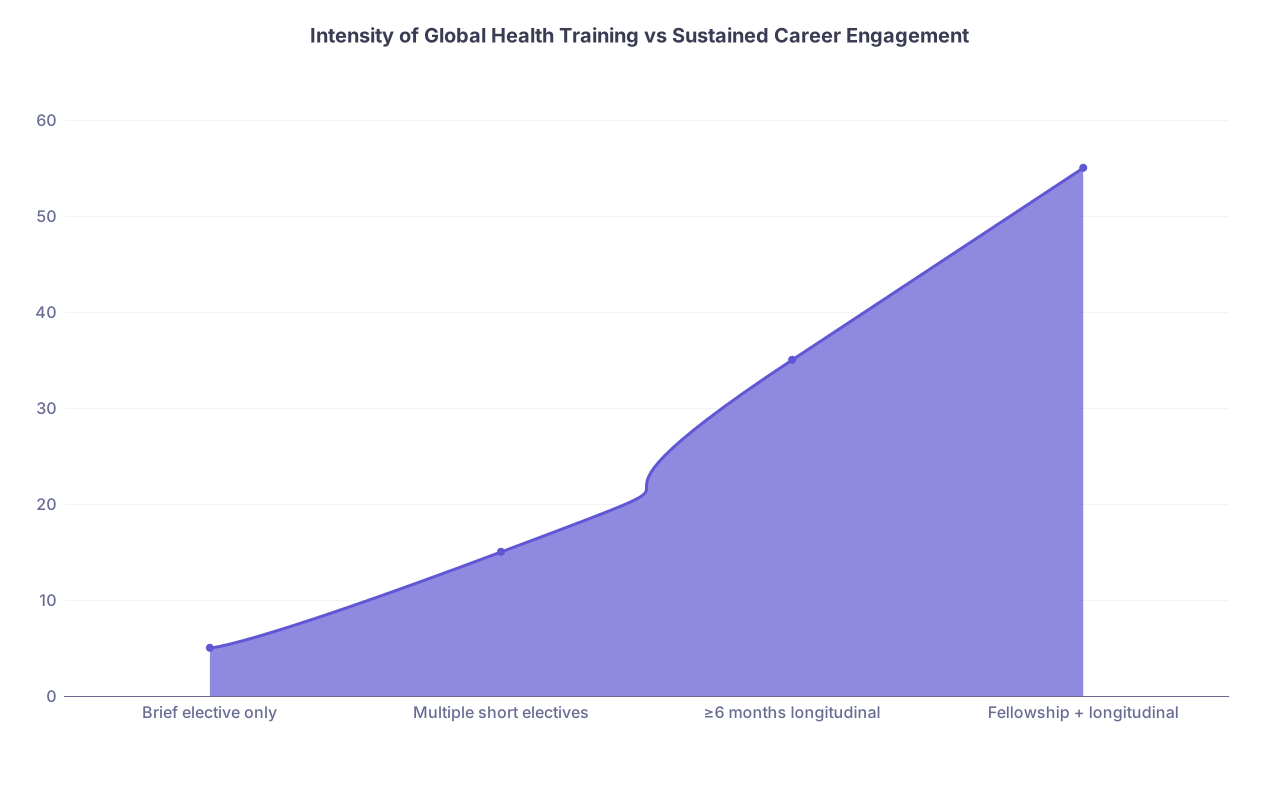
You can picture it as a dose–response curve:
| Category | Value |
|---|---|
| Brief elective only | 5 |
| Multiple short electives | 15 |
| ≥6 months longitudinal | 35 |
| Fellowship + longitudinal | 55 |
Those are ballpark estimates, not exact values, but the shape of the curve repeats itself across specialties and regions.
If you are a student or resident trying to predict your own odds: your baseline commitment and values matter, but the structural features of your training matter just as much. A well-designed, longitudinal, mentored track is a different instrument from a single shiny away rotation.
Comparing program models: what works better?
Some data-rich institutions have enough history to compare different models they themselves have run over time. The before–after patterns are instructive.
Typical trajectory I have seen:
Phase 1: Ad hoc electives
Informal opportunities, usually resident-initiated, with limited prep and variable supervision. Outcomes: lots of enthusiasm, scattered careers, minimal institutional memory.Phase 2: Branded global health track with electives
Same electives, plus some didactics and a line on the CV. Outcomes: small bump in structured engagement, but long-term career impact only moderately better than phase 1.Phase 3: Longitudinal partnership + scholarly requirement
Stable site(s), faculty leads, required quality improvement or research project. Outcomes: clear increase in alumni who continue working with that site or similar ones, more coherent local impact.Phase 4: Integrated residency / fellowship + recruitment pipeline
Cohort-based selection, protected time, dedicated funding, real jobs downstream. Outcomes: a recognizable cadre of faculty and alumni in sustained global roles.
When institutions actually plot their outcomes—percentage of alumni with sustained global careers by training phase—the curve climbs at each structural upgrade. That is not magical. It is resource allocation and intentional design.
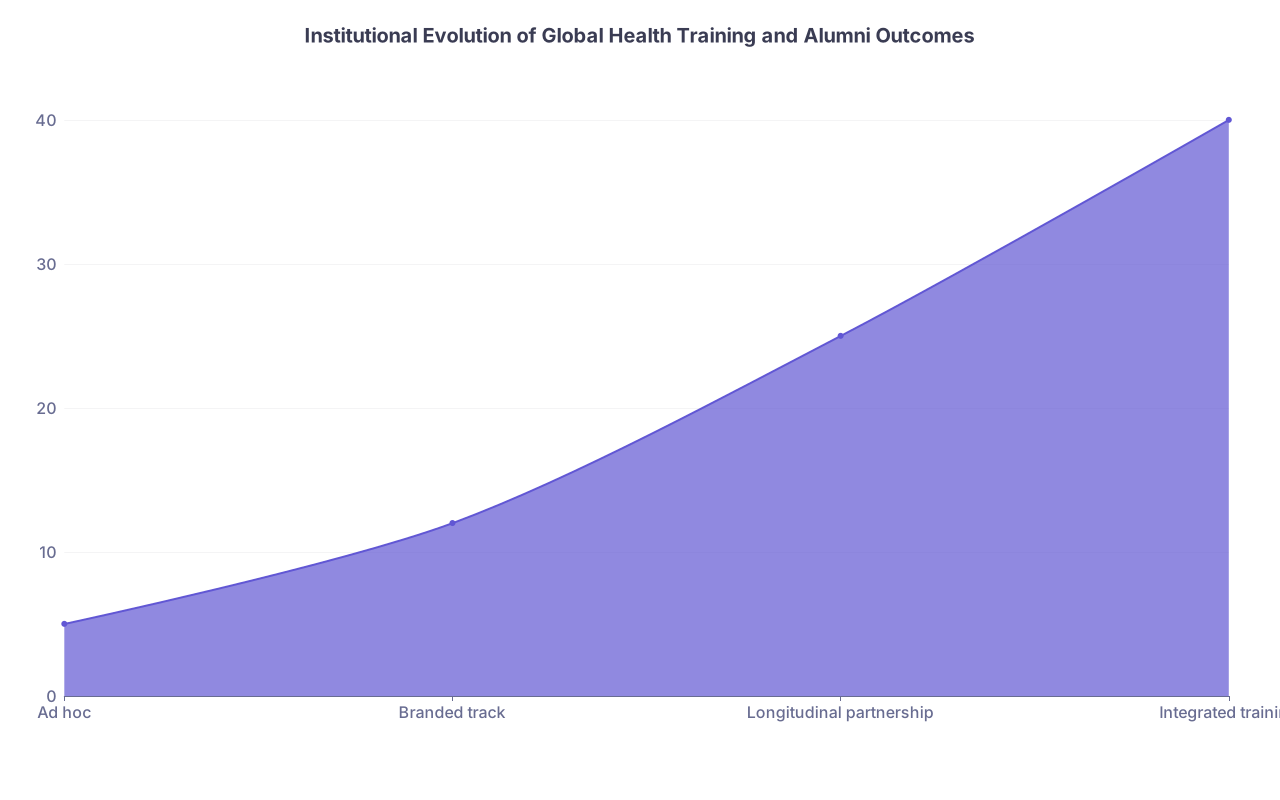
| Category | Value |
|---|---|
| Ad hoc | 5 |
| Branded track | 12 |
| Longitudinal partnership | 25 |
| Integrated training | 40 |
You do not need perfect data to see the direction: more structure + more continuity + serious mentorship = more alumni with real global health careers.
Practical implications for trainees
You probably care about the individual question: “If I join a global health track, how will it change my life?”
Based on the outcome data, here is the blunt version.
A well-designed global health track is very likely to:
- Increase the odds that you will work with underserved or structurally marginalized populations, domestically or abroad.
- Improve your skills in cross-cultural care, resource-limited decision-making, and systems thinking.
- Make it easier to find mentors and collaborators in global health and related fields.
- Slightly increase your chances of landing in an academic or hybrid role.
It is moderately likely to:
- Lead you to a career where global or underserved work is a visible, ongoing part of what you do.
It is not guaranteed to:
- Give you a stable, funded binational job that looks like your mental image of a “global health doctor.”
- Overcome institutional and funding constraints if your home department does not actually have long-term global health positions.
That last piece is where many trainees get burned. They complete the track, accumulate stories and skills, then hit a labor market where:
- Funded global health positions are scarce.
- Departments value RVUs and grants more than “good work abroad.”
- Visa, licensing, and family realities limit prolonged overseas practice.
So they adapt. Their careers end up being “global health–informed generalists” rather than “full-time global health professionals.” The track changed their behavior and clinical lens, but not always their job category label.
From an ethical standpoint, that is fine if expectations were honest on day one. It is far less fine if the recruitment pitch was, “Join us, and you will be a global health leader,” without data to back that up.

What program directors should be tracking and disclosing
If you are running or designing a global health track and you care about both ethics and effectiveness, your responsibilities are straightforward.
You should know, roughly, for your alumni:
What percentage are:
- In academic vs community vs NGO/international roles
- Working primarily domestically vs binationally vs primarily abroad
- In roles with explicit global health or underserved focus
Among those who completed your track:
- How many stay engaged with your partner sites beyond graduation
- How many hold leadership roles in global or community health programs
- How many publish or obtain funding in global health domains
And you should be able to summarize that clearly for new applicants. Something like:
| Career Category | Approx. Percentage of Track Alumni |
|---|---|
| Primarily domestic, standard practice | 35% |
| Domestic underserved-focused practice | 30% |
| Academic role with some global engagement | 20% |
| Binational / primarily global health career | 15% |
Those numbers will not be perfect. They will change over time. But they are far better than aspirational slogans.
From a data analyst perspective, the main failure I still see is not bad outcomes. It is opacity. Programs collect stories and photos, but not denominators. They promote the handful of global superstars and stay quiet about the many for whom the global health track was an important formative experience but not a direct career ticket.
Transparent denominators are the ethical floor.
So, do global health tracks change career paths?
Yes—but not the way people like to fantasize.
The longitudinal outcome data point to a nuanced answer:
- They select in trainees already leaning toward global and underserved work.
- They amplify and sharpen that inclination, especially when designed with longitudinal, mentored, and funded elements.
- They shift practice profiles—toward underserved care, systems thinking, and cross-cultural competence—even among those who never work abroad again.
- They modestly increase the proportion of graduates with sustained, substantial global health roles, with the largest effects in integrated and fellowship-level programs.
They do not, by themselves, override structural constraints, make the labor market more hospitable, or transform a globally indifferent trainee into a committed global health professional.
If you are deciding whether to engage in a track, interpret the data like an odds ratio, not a guarantee. A serious global health track probably doubles or triples your probability of a global health–inflected career—conditional on your baseline intent and the program’s design quality. That is meaningful, but probabilistic.
And if you are designing or selling one of these tracks, you owe your trainees more than aspirational rhetoric. You owe them longitudinal data, honest baselines, and realistic pathways.
With that clarity in place, global health tracks can be what they actually are: not magic keys, but structured, data-informed interventions that tilt career trajectories and practice patterns in measurable, often valuable ways.
Once you understand that, your next task is obvious: either choose a track whose structure matches the career you want, or redesign your own program so the outcomes you advertise are the ones your data can actually support. The real story starts there, not in the brochure.


