
How Safe Are Conflict-Zone Missions for Physicians in Training?
How much personal risk is actually involved when a medical student or resident signs up for a “short-term mission” in or near a conflict zone?
Here’s the blunt answer: for trainees, true conflict‑zone work is usually far more dangerous, more ethically complicated, and less controlled than the glossy brochures suggest. And most of the time, it’s not appropriate for you to be there at all.
That does not mean you can never work in high‑need, unstable settings. It does mean you need a clear framework for judging safety, ethics, and your actual role before you ever get on a plane.
Let’s walk through that.
1. The real risk profile: what “safety” actually means
When people ask, “How safe is it?” they usually hear answers like “reasonable precautions,” “our organization has many years of experience,” or “we haven’t had any serious incidents.” That’s marketing, not risk assessment.
In a conflict or post‑conflict zone, you’re looking at layered risk:
- Direct violence: shelling, shootings, kidnappings, landmines, carjackings.
- Indirect violence: being near targets (hospitals, checkpoints, convoys, government buildings).
- Systemic breakdown: weak hospitals, no ICU backup, bad blood supply, limited evacuation routes.
- Legal/political: shifting front lines, sudden border closures, detention, accusations of spying.
- Health hazards: infectious disease, poor water/sanitation, limited medications, no reliable PPE.
For a physician in training, the key question isn’t “Is it safe?” but “Is the risk controlled enough, and my role defined enough, that this is an ethically defensible learning and service environment?”
Often, the answer is no.
Most responsible global health and humanitarian organizations do not place trainees in active combat settings. They may allow them in:
- Post‑conflict settings with some residual insecurity.
- Neighboring countries hosting refugees/IDPs.
- Stable regions of unstable countries, under tight security protocols.
- Large, well‑protected referral centers with strong local leadership.
If you’re being pitched a mission “near the front line” and you’re a student or PGY‑1, that’s a red flag. A huge one.
2. Ethical red lines for trainees in conflict zones
Before you ask “Is it safe for me?”, you should ask “Is it ethical for me?” because in conflict‑affected settings, ethical and safety issues are usually tangled together.
Here are the lines that should not be crossed:
Practicing beyond your competence because “there’s no one else.”
- You as a PGY‑1 doing unsupervised C‑sections in a bomb‑damaged hospital? Wrong.
- You leading a trauma code without appropriate backup? Wrong.
- “It’s an emergency, you just do what you can” is not a blanket ethical excuse for systematic under‑supervision.
Displacing local staff or undermining local systems.
- If your presence pushes out local clinicians or reinforces dependence on foreign volunteers, that’s not ethical aid.
- If the hospital empties out when your team leaves, that’s a problem, not a success.
Being used as “cheap labor” or PR.
- If the program is plastering your photos in their fundraising materials and you’re basically free staff without robust training or mentorship, rethink it.
- “Student brigades” that fly in for 1–2 weeks, do dramatic photos, and leave, often contribute little and consume a lot of local bandwidth.
No real safety or evacuation plan.
- If your only “evacuation” plan is “we’ll figure it out with local drivers,” that is not a plan.
- If there’s no discussion of what happens if someone is injured, kidnapped, or detained, walk away.
No attention to your psychological safety.
- Conflict settings mean mass trauma, death of children, repeated ethical tradeoffs.
- If nobody is talking to you about moral injury, debriefing, or post‑deployment support, they’re not taking your well‑being seriously.
If any of those five are present, the mission is not ethically compatible with your status as a trainee, no matter how “safe” they claim it is.
3. How to evaluate an organization’s safety and ethics – concretely
You need a checklist. Too many trainees go in on vibes and good intentions. Here’s a more clinical approach.
Ask these questions directly. Write down the answers. If they are vague, evasive, or dismissive, that in itself is your answer.
| Domain | Key Question |
|---|---|
| Security | Who is responsible for daily security decisions on the ground? |
| Evacuation | What is the written medical and security evacuation plan? |
| Supervision | Who is my direct supervisor and what is their training level? |
| Scope of Practice | What exactly will I be allowed and not allowed to do clinically? |
| Legal | How am I credentialed and insured for this specific setting? |
Then push deeper in each area.
Security
- Is there a dedicated security focal person, or is it “everyone’s responsibility” (translation: nobody’s responsibility)?
- How often are security briefings conducted?
- Who decides if a day’s activities are canceled due to risk? And does that person ever actually say no?
Reasonable answer: There is a named security lead, standard operating procedures, daily or frequent briefings, and a clear “go/no‑go” structure that does not depend on your comfort level.
Evacuation and medical backup
- If I’m seriously injured, where will I go first? Second? Who pays?
- Do you have prior experience executing actual evacuations from this area?
- Is there any ICU‑level care available within realistic reach?
If the answer is “we’ve never needed to do it, but we have contacts” — that’s not good enough.
Supervision and scope of practice
- Who signs off on my clinical work?
- Will I always be supervised when practicing at the edge of my competence?
- Are there clear written limits on what I can and cannot do?
If what they want you to do would be illegal or completely unacceptable back home, and the only justification is “this is a low‑resource setting,” that’s a major warning sign.
4. Common setups trainees encounter – and how safe they actually are
Let’s ground this in the kinds of opportunities people bring me to ask about.
Scenario 1: Short‑term “mission trip” near an active conflict
Example: 10‑day trip to a border region, seeing refugees “from the war zone,” run by a small faith‑based NGO with limited long‑term presence.
Risk profile: High relative risk, low control, often poor continuity of care. These trips tend to under‑invest in security and over‑rely on ad‑hoc local networks.
Ethical/safety verdict: Generally not appropriate for medical students or early residents. If they have no in‑country medical director with years of experience, no formal local partnerships, and no clear supervision structure, pass.
Scenario 2: Rotating with a large humanitarian agency (e.g., MSF, ICRC) in a conflict‑affected country
Example: Four‑week elective in a regional referral hospital in a country with ongoing conflict, but your site is in a relatively stable city, with a large international NGO presence.
Risk profile: Moderate. These agencies typically have strong security frameworks, strict rules about where you can go, and high thresholds for accepting trainees.
Ethical/safety verdict: Potentially appropriate for senior residents or fellows with relevant skills, under tight supervision and with institutional approval. Still usually not offered to medical students in truly insecure contexts.
Scenario 3: Academic global health rotation in a post‑conflict setting
Example: University‑approved rotation in Rwanda, Sierra Leone, or northern Uganda. Past conflict, but currently politically stable, with some residual tensions.
Risk profile: Low to moderate. Main issues are health system limitations, occasional political unrest, and resource constraints, not active combat.
Ethical/safety verdict: Often appropriate for trainees, if the rotation is well‑structured, supervised, and based on a long‑term academic partnership.
5. The hidden safety issue: moral injury and psychological impact
People focus on bullets and bombs. They under‑estimate what it does to your mind to work in or near war as a trainee.
Here’s what I’ve seen:
- A student who watched a child die on a bare mattress because there were no ventilators… and then flew home to OSCEs two days later.
- A PGY‑2 who participated in triage after a bombing, then felt “weak” for months because she couldn’t stop replaying the choices.
- Residents trying to explain on residency or fellowship interviews why they “checked out” for half a year after their big “global health trip.”
You’re at a vulnerable developmental stage professionally. Your clinical identity is still forming. Throwing yourself into a high‑trauma environment without preparation and support is not brave; it’s reckless.
Before going, demand clear answers to:
- Will I have structured pre‑departure training that addresses trauma exposure and coping, not just vaccines and packing lists?
- Is there planned debriefing afterward — not a 20‑minute Zoom, but real processing time?
- Does my home institution recognize this risk and back me up if I need time or support on return?
If the answer across the board is “not really, we haven’t had issues before,” don’t be their first case study.
6. Building toward conflict‑zone work the right way
If you’re serious about eventually working in conflict zones — and some of you are — then treat it like a specialty, not a hobby.
You don’t start your surgical career by walking into a mass‑casualty OR on day one. Same logic here.
A sane progression looks something like this:
- Solid clinical foundation at home.
- Be competent, not barely functioning. Your future colleagues under fire need you to be good, not just idealistic.
- Experience in resource‑limited but stable settings.
- Rural hospitals, safety‑net clinics, or international rotations in stable LMICs.
- Mentor‑guided global health exposure.
- Work under someone who has actually done conflict work. Learn what it really involves.
- Focused skill development.
- Emergency medicine, surgery, OB, anesthesia, ICU, infectious disease — these are high‑value skills in crisis zones.
- Gradual exposure to higher‑risk settings with robust support.
- Shorter rotations with large, reputable organizations that are known for strong security and structural support.
In other words: if your first exposure to global health is “volunteering in a war zone for 3 weeks,” you’ve skipped a lot of essential steps.
7. A hard truth: saying no is often the ethical choice
You will get offers that sound heroic. “We’re the only doctors willing to go.” “The need is massive.” “God will protect us.” “You’ll learn so much.”
You need a filter that isn’t based on flattery or guilt.
Here’s the framework I use when advising trainees:
- If the mission has weak security and weak supervision → do not go.
- If your scope of practice would be wildly outside what’s acceptable back home → do not go.
- If your presence mainly benefits you (experience, CV, photos) and not the local system → do not go.
- If your home institution does not formally approve and support the trip → do not go.
You are not a bad person for declining. You’re a professional making a sound judgment about when you are — and are not — the right person to be there.
8. So, how safe are conflict‑zone missions for physicians in training?
Summed up in plain language:
- Truly active conflict‑zone work is rarely safe enough — or ethically appropriate — for medical students and early residents.
- Well‑structured placements in conflict‑affected countries (not front lines) can be relatively safe for trainees when run by large, experienced organizations with clear supervision, security, and evacuation plans.
- The biggest hazard isn’t just physical safety. It’s being pushed beyond your competence, practicing unethically, or sustaining psychological harm without support.
- If the organization cannot answer specific, detailed questions about your safety, role, supervision, and backup, treat that as your answer: you should not go.
You’re allowed to want this work. You’re also responsible for doing it when you’re ready, in the right way, with the right partners.
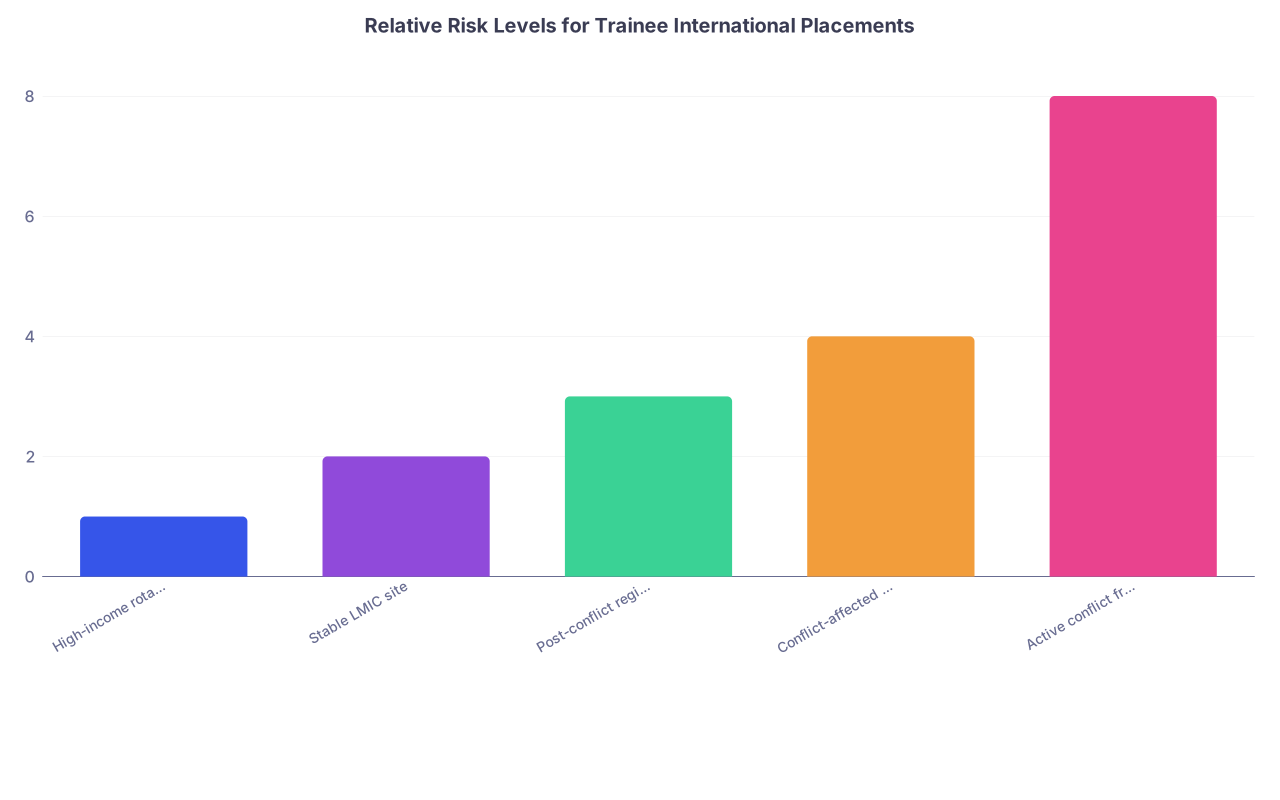
| Category | Value |
|---|---|
| High-income rotation | 1 |
| Stable LMIC site | 2 |
| Post-conflict region | 3 |
| Conflict-affected country (stable city) | 4 |
| Active conflict front-line | 8 |

| Step | Description |
|---|---|
| Step 1 | Offered conflict zone mission |
| Step 2 | Do not go |
| Step 3 | Consider going with mentor guidance |
| Step 4 | Large experienced org? |
| Step 5 | Clear supervision and scope? |
| Step 6 | Written security and evac plan? |
| Step 7 | Home institution approves? |
Your next step today
Open the email or flyer for the mission you’re considering and do one concrete thing: write back and ask for their written security plan and your exact scope of practice as a trainee. If they cannot or will not send that, you’ve just gotten your answer.


