

The uncomfortable truth: most students doing procedures abroad they “can’t” do at home are crossing ethical lines. Often with good intentions. But still crossing them.
Here’s the answer you’re looking for: it is only ethical to perform procedures abroad that you are not allowed to do at home if your role, training, supervision, and local standards all align with how you’d ethically practice anywhere else. The second you’re doing something because it’s abroad and you’d never be allowed or trusted to do it at your home institution, you’re in dangerous territory.
Let’s unpack that in a way you can actually use when you’re on the ground, not just in a classroom ethics discussion.
The Core Principle: “Would This Be Acceptable at Home If Context Were the Same?”
Strip away the passports and the feel‑good photos. The key ethical test is simple:
If the exact same patient, with the same resources, same supervision, and same acuity walked into your home institution, would your participation be acceptable there?
Notice what this test does not care about:
- That you flew 16 hours and paid a program fee
- That the patients are poor or “have no other option”
- That you “want to learn so you can help more in the future”
Those are about you. Ethics in global health is about the patient.
So if something would be considered:
- Unsafe
- Outside your scope of training
- Outside supervision norms
- Below the standard of informed consent
at home, then doing it abroad is usually unethical. Full stop.
Why This Feels So Tempting (And Why That’s a Problem)
You know the vibe:
- “You’ll get to do a lot more over here.”
- “We need you to help with these procedures.”
- “This is a great chance to get hands-on skills you can’t get in the US/UK/Canada yet.”
I’ve heard faculty and students say these exact things on short‑term trips. Nobody thinks they’re the villain. But here’s what’s baked into that logic:
- Different standard of care for poor patients – They become your practice material.
- Training goals prioritized over patient safety – You’re there to “get experience.”
- Power and gratitude silence patients – They’re unlikely to refuse the foreign team.
That’s not “global health.” That’s exploitation with nicer branding.
The Ethical Framework You Actually Need
Use these five filters every time you’re offered a procedure abroad.
| Filter | Question to Ask Yourself |
|---|---|
| Role Alignment | Is this consistent with my role at home? |
| Training Level | Am I adequately trained to do this safely? |
| Supervision | Is supervision at least as strong as at home? |
| Patient Benefit | Would I do this if I gained nothing from it? |
| Transparency | Would I be comfortable documenting this honestly? |
If you cannot confidently answer “yes” to all five, you should not be doing the procedure.
Let’s go through them briefly with concrete examples.
1. Role Alignment
Ask: “Is this something a trainee at my level would reasonably do at my home institution, in a similar resource setting?”
Examples:
You’re a 3rd-year med student. At home you can: do IVs, blood draws, Foley insertion, simple suturing under supervision.
Abroad? Doing those same tasks under similar supervision is fine. That is your role.You’re a 2nd-year med student with no formal procedural competence. At home you mostly observe, maybe practice on models.
Abroad? Being primary operator for C-sections, lumbar punctures, or intubations is not your role. You are being turned into an underpaid, undertrained provider.
Global health does not magically promote you to “junior resident” status.
2. Training Level
Ask: “Have I been properly trained and assessed on this skill anywhere?”
- Practiced once on a mannequin does not equal competency.
- Watching a YouTube video does not equal competency.
- “The local doctor will stand nearby” does not equal competency.
You should NOT be learning a procedure the first time on a patient abroad that you have never practiced in a supervised, structured way at home (or equivalent teaching environment).
3. Supervision
Ask: “Is my supervision here at least as good as I’d have at home, given my level?”
Supervision fails ethically when:
- The “supervisor” is too busy and not actually watching you
- You’re doing things alone because “the doctor trusts you” after a day
- The supervising clinician is unfamiliar with your level or training system
- You’re asked to make independent decisions well outside your skill set
On the flip side, performing a procedure you haven’t yet done at home, but:
- You’ve been fully trained on the theory and steps
- You have robust, direct supervision
- A similar-level trainee would get that opportunity at home in a comparable low-resource setting
can be fair. The key is: would a reasonable ethics committee see this as training under supervision, or as using vulnerable patients as practice materials?
4. Patient Benefit vs Learner Benefit
This one is brutally clarifying:
If you personally got zero educational benefit from this procedure, would doing it in exactly this way still be the best option for this patient?
If the honest answer is no, you’re using the patient.
Common red flags:
- “We could have the attending do this in 5 minutes, but it would be a great learning opportunity for you to take 30.”
- “There is a skilled nurse who normally places these lines, but let’s have you try.”
- “We’d usually do X, but let’s try Y so you can see how it’s done.”
Any time the care is altered because you are there to learn, the ethical bar shoots way up.
5. Transparency and Documentation
Ask: “Would I be comfortable if this went in the chart exactly as it happened, and the patient or their family read it later?”
- “Procedure performed by visiting foreign medical student/trainee, first time on a live patient, under intermittent supervision.”
- “Local clinician delegated procedure due to visiting trainee wanting experience.”
If that phrasing makes you physically uncomfortable, good. That’s the point.
If your presence and role are not being clearly explained to the patient in a language and style they understand, informed consent is already compromised.
Specific Scenarios: What’s Clearly OK, Grey, and Not OK
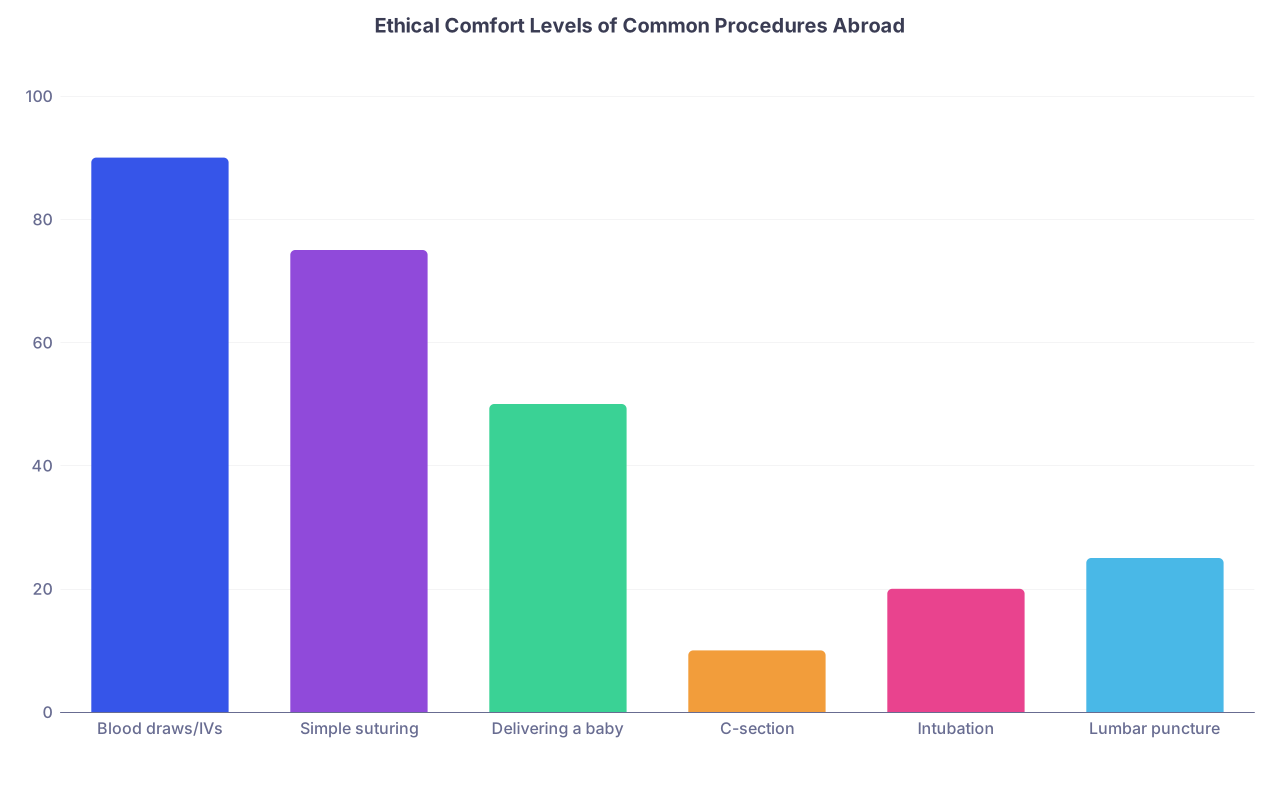
Let’s map it more concretely.
| Category | Value |
|---|---|
| Blood draws/IVs | 90 |
| Simple suturing | 75 |
| Delivering a baby | 50 |
| C-section | 10 |
| Intubation | 20 |
| Lumbar puncture | 25 |
Think of these percentages as rough “percent of typical short-term contexts where this is ethically appropriate for a student.” Rough. But you get the idea.
Clearly Acceptable (When Supervised)
- IV placement, blood draws
- Checking blood pressure, vitals, basic exams
- Foley catheter placement if trained
- Simple wound suturing you’ve done in skills lab and/or at home under supervision
These are low-risk, generally in-scope for students, and nicely teachable with close supervision.
Grey Zone
- First-time suturing on a live patient (but with strong supervision)
- Assisting in deliveries when you’ve had relevant OB training and supervision
- Doing a procedure you would soon be credentialed for at home, with excellent supervision and clear consent
Grey means: context really matters. Supervision level, patient condition, local norms, and whether this looks like actual training vs an “opportunity safari.”
Clearly Not Acceptable for Most Students
- Being primary operator for major surgery (C-section, laparotomy)
- Independent intubation in an unstable patient with no backup ready
- Lumbar puncture on a critically ill child as your first attempt
- Handling obstetric emergencies solo or as lead
If you are a medical student or early trainee and you’re doing something abroad that would be reserved for senior residents or attendings at home, ask yourself who is taking the extra risk. It’s not you.
What About “They Have No One Else”?
This is the emotional trump card programs love to play.
“They have no one else to do it. If we do not do it, no one will.”
Sometimes that’s true. Often it’s exaggerated. Either way, it still does not justify unsafe care.
A few hard truths:
- “Lower standard than ideal” in a low-resource setting is not the same as “no standard at all.”
- Patients in poor countries are not obligated to bear extra risk for your training.
- A system that only functions if undertrained foreigners show up occasionally is a system that needs structural solutions, not student improvisation.
If you are literally the only human between a patient and certain death, yes, ethics becomes more flexible. But that fantasy scenario (“I alone can save this child with an emergency cricothyrotomy I saw once on YouTube”) is not what’s happening 99.9% of the time.
How to Say No Without Being the “Difficult” Volunteer
You need language ready before you’re put on the spot.
Try variants of:
- “At my current level of training, I am not competent to do this safely as the primary operator. I’m happy to assist and observe.”
- “In my home institution this procedure is reserved for higher-level trainees, so I’m not comfortable taking the lead.”
- “For patient safety, I think it’s better if the most experienced person available does this, and I can help in other ways.”
If someone pushes back with “This is how we do things here,” you can respect local practice while still owning your limits:
- “I understand the constraints here, and I want to respect your system. Within that, I still have to practice within my competency for patient safety.”
You are not there to import your country’s system. But you also do not abandon basic ethical and safety standards.
What You Can Ethically Focus On Abroad
If this all sounds like “Don’t touch anything,” it isn’t. It’s “Do the right work for your level.”
High-value, ethical activities:
- History-taking, physical exams, formulation, documentation
- Patient education and counseling (with language support)
- Quality improvement projects, workflow fixes, checklists
- Helping with data systems, registries, follow-up tracking
- Teaching local students anything you actually know well (not things you barely learned last week)
Global health is not valuable because you do more procedures. It’s valuable because you learn to practice medicine with humility, systems-awareness, and cultural intelligence.

| Step | Description |
|---|---|
| Step 1 | Offered a procedure abroad |
| Step 2 | Politely decline |
| Step 3 | Proceed ethically |
| Step 4 | Aligned with home role? |
| Step 5 | Trained and practiced? |
| Step 6 | Strong supervision? |
| Step 7 | Best for patient even if you gain nothing? |
| Step 8 | Full transparency and consent? |
Print that logic into your brain before your next trip.
FAQ: Six Questions You’re Probably Still Asking
1. Is it ever OK to do a procedure abroad that I truly have never done at home?
Yes, but only under very specific conditions: you’ve been didactically trained, the procedure is appropriate for your level (e.g., suturing for a clinical-year student), supervision is direct and hands-on, and the same-level trainee would get that opportunity at home in a similar resource setting. First-time live attempts at high-risk procedures (LPs in unstable kids, intubations in emergencies, C-sections) are not appropriate just because you’re abroad.
2. What if the local clinician explicitly asks me to do it and seems comfortable?
Their comfort doesn’t automatically make it ethical. They may overestimate your skill because of your foreign training, may be overworked, or may be used to improvising with limited staff. Your ethical duty is to your patient and to your own scope of practice. You can still say, “I’m not trained enough to safely be the primary, but I’d be happy to assist.”
3. Do different resource settings mean different ethical standards?
Yes and no. Standards of what’s possible change with resources; standards of respect, transparency, non-maleficence, and honesty about your role do not. It may be ethically acceptable to provide care that’s less technologically advanced than at home. It is not acceptable to provide care that is less honest, less transparent, or more risky simply to give you experience.
4. How should programs be designed to avoid these ethical problems?
Good programs define trainee roles before you arrive, limit procedures to what matches your level, prioritize long-term local partnerships, and put supervision and patient benefit above student “exposure.” If your program markets itself mainly on “hands-on” procedural experience you can’t get at home, that’s a red flag.
5. What should I document about procedures I do abroad when I apply for residency?
Be honest and specific. “Assisted with” is different from “performed independently.” If you did something under circumstances that would be hard to defend in front of a residency director or ethics committee, reflect on that. Do not inflate your role. And do not present ethically dubious experiences as selling points.
6. What’s one concrete rule of thumb I can follow on the ground?
Use this sentence: “If my dean, my future program director, and this patient’s family all watched a video of this procedure with full context—my level, my training, my supervision—would I be proud of what they saw?” If the answer is no, step back.
Open whatever email, brochure, or website described your global health trip. Find the part that talks about “hands-on” experience or “procedures you can’t do at home.” Read it again, slowly, and ask yourself: Would I still want to go if all of that disappeared and all that remained was safe, supervised, appropriately scoped work? If the answer is no, your next step is not buying a plane ticket. It’s rethinking why you’re going at all.


