

What actually makes more sense: flying abroad as an M2 to “do global health”… or waiting until you’re a resident who can actually manage a crashing patient?
Let me be direct:
Most students try to do too much, too early, and for the wrong reasons.
You can absolutely start in med school. But the type of global health you do as a student should look very different from what you’ll do as a resident or attending.
Here’s how to decide where you fit right now—and how not to become the cliché “white coat with an iPhone” taking photos in an overcrowded ward.
The Core Question: What Are You Actually Qualified To Do?
Strip away the romance and Instagram:
As a medical student, you’re not licensed. You can’t independently diagnose, prescribe, or perform procedures. You are, by definition, a learner.
That doesn’t mean you’re useless. It means global health in med school should be:
- Education-focused
- Systems- or research-oriented
- Strictly supervised clinically
- Designed by the local site, not you
As a resident, things shift:
- You’re actually part of the clinical workforce
- You can take call, manage common emergencies, do procedures
- You can be trusted with more responsibility—if you’re still practicing within a local system, not freelancing cowboy medicine
So the question isn’t “med school vs residency.” The real question is:
What’s the most ethical, useful, and developmentally appropriate role for you at your current level of training?
Short answer:
- Med school = dip your feet in, build foundations, learn humbly
- Residency = deeper, longer, more clinically meaningful engagement
If you try to flip that—doing advanced clinical work as an M2 or just “medical tourism” electives as a PGY-3—you’re doing it backwards.
The Case for Doing Global Health in Med School
You can start in med school. In fact, if you think you might build a career in this area, I’d argue you should.
But it has to be structured, ethical, and realistic.
What med students can do well
Here’s where students can be genuinely valuable and not just “extra bodies on ward rounds”:
Long-term, faculty-led partnerships
Programs that have existed for years, with local ownership and clear scopes for students. Examples:- A university partnership with a district hospital where students join existing teams
- A recurring primary care / public health project with local NGOs
Public health and systems-oriented work
Things like:- Helping evaluate a vaccination campaign (under supervision)
- Contributing to quality improvement projects (e.g., antenatal care documentation, TB screening pathways)
- Assisting with patient education initiatives designed by local staff
Research and data work
You might be:- Abstracting charts for a maternal mortality study
- Helping validate a survey tool
- Supporting analysis of program outcomes
Not glamorous, but high-impact when plugged into local priorities.
Clinical exposure with strict boundaries
Observerships or tightly supervised elective rotations where:- You do not exceed the scope you’d have at home
- You are never the only person available to make decisions
- The local team actually wants students and has capacity to teach
If the program can’t articulate your role beyond “you’ll get great exposure,” that’s a red flag.
When You Should Not Do Global Health as a Med Student
Here’s where I get blunt.
If any of this is true, you should seriously reconsider going abroad in med school:
- You’re mainly interested in photos and stories for interviews
- You want to “practice procedures you can’t do at home”
- The trip is 2–3 weeks, high-cost, with vague objectives and lots of “you’ll help where needed”
- There’s no longitudinal relationship with the site—your school “found a contact” last year
- There is no pre-departure training on ethics, local health system, or cultural context
- You’re being told you’ll be “the only provider in the clinic two days a week”
Those are classic “voluntourism” signals. People get harmed in these setups. Sometimes obviously (wrong medication, botched procedures). Sometimes quietly (undermined local trust, disrupted workflows, or simply exhausting local staff who have to babysit rotating foreigners).
If your gut feels weird about how much “clinical responsibility” you’re being promised as an MS2, trust that feeling.
Why Residency Is Often Better for Heavy Clinical Global Health
Residency is where global health actually starts to feel like work, not a field trip.
What changes in residency
Three big things:
You have real clinical skills
You can:- Manage common conditions reasonably independently
- Do basic procedures properly
- Handle nights, wards, ICU, or OB triage depending on your specialty
You can contribute to service, not just learning
If the partnership is designed well, your presence can actually:- Lighten the clinical load (not just add to it)
- Transfer skills to local trainees by bedside teaching
- Help staff cover busier rotations or new services
Your questions become more useful
You’re no longer asking, “What’s the differential for cough?”
You’re asking, “How does this district hospital manage severe sepsis without available vasopressors and limited labs?”
That’s where systems thinking and global health actually live.
So if your goal is to do serious clinical global health work, residency is usually the better time to start longer and higher-responsibility engagements.
How the Decision Actually Breaks Down
Let me put this in a simple framework: Timing vs Role vs Depth.
| Factor | Med School | Residency |
|---|---|---|
| Main Role | Learner / junior contributor | Clinician / educator |
| Best Focus | Exposure, ethics, systems, research | Clinical service, capacity building |
| Typical Duration | 2–8 weeks | 1–6 months (or repeated blocks) |
| Ideal Activities | Structured electives, research | Longitudinal partnerships |
| Risk of Harm | High if unsupervised clinically | High if unsupervised or solo |
The sweet spot looks like this:
- Med school: 1–2 well-run experiences that help you decide if this is part of your future
- Residency: committed, repeated, relationship-based work where you go back to the same place or same system over time
You do not need four different “global” trips on your CV from four countries. That just screams scattered.
Ethical Ground Rules (That Apply at Any Stage)
Whether you go now or later, these are non-negotiable if you care about doing this right.
1. Do not do what you’re not allowed to do at home
If you can’t do unsupervised procedures in your US/UK/Canadian hospital, you don’t turn into an attending just because you crossed an ocean.
Red flag phrases I’ve actually heard:
- “You’ll get to do C-sections because they need help.”
- “Our students usually manage the ward when the local doctor is busy.”
No. If you’re substituting for local clinicians instead of supporting them, you’re part of the problem.
2. The local partner defines the needs
Good programs start with: “What does the local team want help with?”
Bad ones start with: “What do our students want to experience?”
If the hospital director or local NGO isn’t designing the project and setting priorities, it’s probably extractive.
3. Short-term work must plug into long-term systems
Two-week trips can be ethical if they feed into a continuous program:
- Same site, multiple trainee groups per year
- Shared protocols, data, and goals
- Continuity through local staff and in-country leadership
Random isolated electives where you show up, “help,” then disappear—those mostly serve you, not the patients.
How to Use Med School Wisely If You’re Serious About Global Health
If you’re leaning toward “I want this to be part of my career,” then here’s how to use med school productively.
Step 1: Learn the language of global health
And no, I don’t mean Spanish or Swahili (though that helps).
I mean the conceptual language:
- Health systems and financing
- Social determinants of health
- Task-shifting and primary care models
- Ethics of short-term medical work
- Decolonizing global health
Take the global health selective. Go to the boring-sounding evening lecture from the guy who worked 10 years at a district hospital in Malawi. Read a few actual policy or WHO documents rather than just blog posts.
Step 2: Do one solid, well-supervised experience
Aim for:
- 4–8 weeks at a site your school has partnered with for years
- Real pre-departure prep (not just “bring bug spray”)
- Clear learning objectives that aren’t just “see lots of disease”
- A defined role that doesn’t exceed what you’d do at home
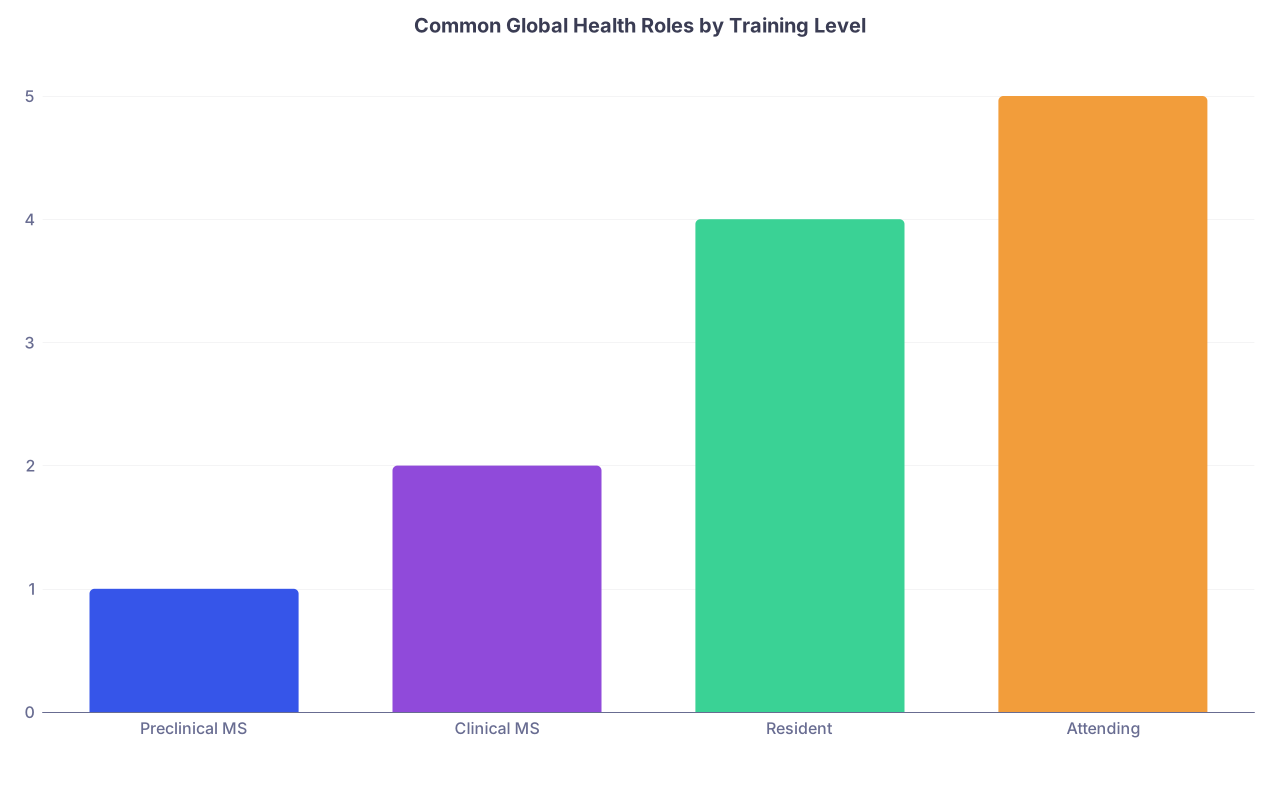
| Category | Value |
|---|---|
| Preclinical MS | 1 |
| Clinical MS | 2 |
| Resident | 4 |
| Attending | 5 |
(Think of that “value” scale as how much clinical responsibility you should realistically have. Preclinical students? Very little.)
Step 3: Attach yourself to mentors who are in this for the long haul
Ask faculty:
- “Where have you been going for more than 5 years?”
- “Who are your local partners there?”
- “What projects actually started from their side, not ours?”
Get involved in what they’re already doing. Don’t reinvent programs to get your name first on an abstract.
Step 4: Build transferable skills
The fancy way to say this: focus on things that will still matter in 10 years.
Examples:
- Getting really good at evidence-based primary care
- Learning quality improvement properly
- Building language skills in one region you might actually return to
- Understanding how to work in resource-limited settings at home (FQHCs, refugee clinics, rural sites)
If your med school global health is just a disconnected string of one-off experiences, you’ll feel good, but you won’t necessarily be useful later.
How to Decide: Med School Now, Residency Later, or Both?
Here’s a simple decision flow.

| Step | Description |
|---|---|
| Step 1 | Interested in global health? |
| Step 2 | Focus on local underserved care |
| Step 3 | Career or just exposure? |
| Step 4 | Do 1 structured med school elective |
| Step 5 | Seek mentor and long term program |
| Step 6 | Reassess interest in residency |
| Step 7 | Plan both med school and residency work |
If you’re just curious:
Do one well-structured med school experience. Learn. Reflect. Move on if it’s not for you.
If you’re seriously considering a career in global health:
Start in med school with:
- Coursework
- One meaningful elective
- Maybe research with a real team
Then plan for more sustained, clinically heavier work in residency and beyond.
Quick Reality Check Before You Book a Flight
Ask yourself:
- If this exact same clinical opportunity were offered in a poor rural area of my own country, would I be as excited?
- If I couldn’t post a single photo or talk about it in interviews, would I still go?
- Do I know the name of at least one local partner or institution—not just the US/European sponsor?
- Could I explain clearly what I’m not going to do there (procedures, unsupervised prescribing, etc.)?
If you can’t answer those well, you’re not ready. That’s not a moral failure. It just means your next step should be preparation, not plane tickets.
FAQ: Global Health in Med School vs Residency
1. Will doing global health in med school help me match into residency?
Yes, but only if it looks thoughtful and sustained. One 2-week trip with dramatic stories doesn’t impress serious programs anymore. What matters: evidence of reflection, understanding of ethics, maybe some research or QI work, and mentors who can vouch for how you behaved in a very different environment.
2. Is it unethical to go abroad as a med student at all?
No. What’s unethical is exceeding your competence, creating extra work for local staff, or using patients as a learning playground. Structured, supervised programs designed by long-term partners are ethical and can be excellent for your development. Unsupervised, short, high-responsibility trips are where things go wrong.
3. How long should a med school global health trip be?
Less than 2 weeks is almost never useful for anyone but you. Four to eight weeks is the usual sweet spot for students: long enough to learn something real, short enough that you’re not pretending to be key staff. In residency, one to six months (often in repeated blocks) is where your presence can actually matter.
4. Do I need to go abroad to “do global health”?
No. That’s one of the big myths. Working with refugee populations, migrant farmworkers, Native communities, or under-resourced urban clinics in your own country absolutely counts. The same questions about power, access, and systems apply. If you’re only interested when there are palm trees and new stamps in your passport, that’s a red flag.
5. How do I find an ethical global health elective in med school?
Start with your school’s global health office or well-known faculty, not random online organizations. Look for: long-standing partnerships, clear learning objectives, pre-departure training, explicit supervision structure, and honest conversations about what you will and will not be allowed to do. If you’re paying a third-party group thousands of dollars to “place” you, be very skeptical.
6. If I skip global health in med school, is it too late to start in residency?
Not at all. Plenty of strong global health clinicians never left their home country until residency or even attending life. You might even be better off starting later, with solid clinical skills. Use med school to become an excellent, thoughtful doctor and to learn the basics of health systems, ethics, and cultural humility. That foundation is what makes global work in residency actually useful rather than performative.
Key points:
- Med school is for exposure, ethics, systems thinking, and humble learning—not acting like an attending in a different time zone.
- Residency is usually the right time for heavier clinical global health work, especially if you can commit to long-term partnerships.
- Whatever stage you’re in, the work should be locally led, ethically structured, and firmly within your actual level of training.


