
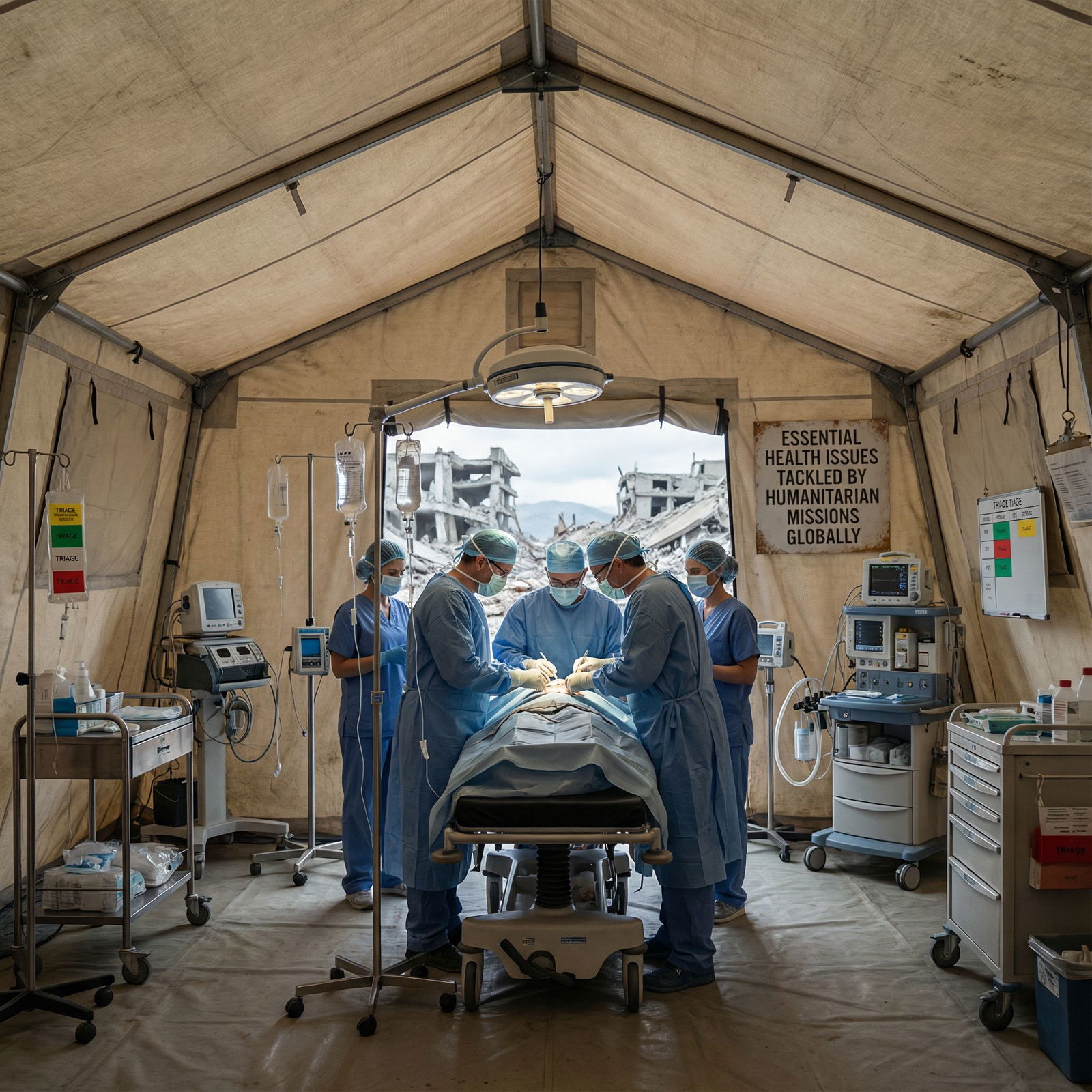
What actually matters more for a serious career in global health: a formal global health fellowship…or years of on-the-ground experience?
Here’s the blunt version: you can absolutely build a meaningful global health career without a formal fellowship. But you cannot do it without serious, structured field experience and real mentorship. The fellowship is just one (sometimes expensive, sometimes necessary) way to get those.
Let’s break this down so you can make a smart decision instead of just collecting another line on your CV.
First: What Are You Actually Aiming For?
Before you obsess about “fellowship vs. experience,” you need to answer a more basic question: What kind of global health work do you actually want to do?
Roughly, people fall into a few buckets:
The “clinician who likes to go abroad sometimes”
You want to practice mainly at home, maybe do 2–8 weeks per year in Haiti, Uganda, Guatemala, etc. Clinical, mostly non-research, maybe teaching.The “hybrid academic + global health person”
You want a faculty position, build long-term partnerships, write grants, publish, maybe run programs with NGOs or ministries of health.The “full-time global health career”
You see yourself working long-term in-country, with NGOs, WHO, MSF, PIH-style organizations, or in health policy / implementation.The “I’m not sure, but I’m pulled to this work”
You’ve had a couple short trips, you care about justice and equity, and you’re trying to figure out if this should be central to your career or more of a focused side commitment.
Your answer matters, because the value of a global health fellowship changes drastically between these groups.
When a Global Health Fellowship Actually Makes Sense
Let me be clear: global health fellowships are not inherently magical. Some are fantastic. Some are glorified medical tourism with a nicer logo.
They tend to add the most value in a few specific situations.
1. You Want an Academic or Leadership Career in Global Health
If you’re aiming to be “Dr. X, Director of Global Health at [university/NGO],” a fellowship is often a strong move.
Why?
Because good fellowships give you:
- Structured mentorship from people who’ve already built the career you want
- Protected time for research, implementation projects, or health systems work
- Access to grant-writing, program design, and serious evaluation projects
- Name recognition and networks that open doors (RWJ Clinical Scholars, HEAL, Duke, UCSF, Harvard, etc.)
Without that, you can still get there, but it’s slower and messier. You’ll be inventing your own structure and begging for mentorship time from people already overscheduled.
2. You Need Skills Beyond Pure Clinical Work
If what you want to do requires skills like:
- Implementation science
- Program evaluation
- Health systems strengthening
- Policy and advocacy at scale
- Advanced research methods (beyond a basic retrospective chart review)
A strong 1–2-year fellowship can give you that training in a concentrated, mentored way. Often bundled with an MPH or similar.
You can learn this stuff “on the job,” but that often looks like reinventing the wheel, doing mediocre analysis, and writing clumsy grants for the first five years.
3. You Want Longitudinal, Responsible Engagement but Have No Entry Point
Some residents finish training with:
- No strong institutional global health program
- No existing partnership with a site they trust
- No senior mentors truly working in global health beyond a week-long trip
In that case, a fellowship at an institution with deep, long-term partnerships can plug you into:
- Stable sites with real, local leadership
- Existing projects that need sustained work
- Infrastructure for visas, housing, credentialing, safety
That beats wandering into random “mission opportunities” you found via a Google search and hoping they’re ethical.
When Field Experience Alone Is Enough (And Often Better)
Now the other side. There are plenty of scenarios where you do not need another 1–2 years of training.
1. Your Main Career is Domestic Clinical Practice
If your plan is:
- 0.8–1.0 FTE in your home country
- A few weeks per year in one or two partner sites
- Teaching, some direct clinical work, maybe helping with QI projects
You do not need a formal global health fellowship for this. What you need:
- A stable, responsible partner site with local leadership
- Explicit agreements about your role, scope, and continuity
- Ongoing mentorship in ethics, equity, and systems issues
- Commitment to going back to the same place over and over
I’ve seen hospitalists with no fellowship become invaluable partners because they showed up to the same Rwandan hospital every year for a decade, listened more than they talked, and mentored local residents remotely in between trips.
No fellowship. Just seriousness and consistency.
2. You Already Have Deep, Longitudinal In-Country Experience
If you’ve spent:
- 1+ years cumulatively working in one system or country
- Built strong relationships with local colleagues
- Taken part in actual projects (not just “I saw 50 patients a day”)
- Gained mentorship and structured reflection along the way
A fellowship may add diminishing returns. You may be better off:
- Formalizing your role with your current partners
- Doing a targeted degree (MPH, MSc) if you lack specific methods
- Seeking selective short courses (e.g., implementation science, monitoring & evaluation) rather than a whole fellowship
A fellowship is not a sacraments-of-global-health ceremony. If you already have the substance, don’t chase the label.
3. You’re Mid-Career and Switching into Global Health
For attendings 5–15 years out, giving up salary and family stability for a 1–2 year fellowship can be a bad trade.
Alternative paths can work:
- Join established NGOs or academic partnerships in part-time roles
- Take focused training (online MPH, short in-person methods courses)
- Build a portfolio of 1–2 serious projects with measured impact
- Use sabbaticals, unpaid leave, or 0.8 FTE schedules to free time
You won’t have the “global health fellow” title. Nobody actually cares. People care whether you show up, do careful work, respect local leadership, and stay longer than a photo-op.
What Actually Matters More Than “Fellowship vs Experience”
Let’s zoom out. Because this is where people get distracted.
The distinction that matters is not:
“Do I have a global health fellowship line on my CV?”
It is:
“Do I have the competencies, track record, and relationships needed to do ethical, impactful work over time?”
Those core elements look like:
Ethical grounding
Understanding power, colonialism, local leadership, and humility. If your mindset is “I’m going to save them,” you’re already off track. A good fellowship can challenge this. So can good mentors and honest reflection in the field.Serious, not token, field experience
Not three disconnected 1-week trips. We’re talking months to years of engagement, ideally in the same place(s), under local supervision.Mentorship and community
People who will tell you, “That’s a bad idea,” or “You’re repeating the same failed model from 10 years ago.” This is huge. It can come from fellowships, strong institutional programs, or long-term NGO colleagues.Technical skills
Depends on your path: trauma surgery + systems building, HIV program design, maternal health implementation, cost-effectiveness analysis, etc. Fellowship is one route; targeted coursework and experience can be another.Alignment with local priorities
You’re not driving the agenda alone. You work within frameworks and visions set by local partners, governments, or communities.
Fellowship can accelerate this. It is not the only way to get there.
How to Decide: A Simple Framework
Here’s a practical decision tool. Be honest with yourself.

| Step | Description |
|---|---|
| Step 1 | Want long term global health career |
| Step 2 | Strongly consider fellowship |
| Step 3 | Field work plus targeted training |
| Step 4 | Build experience without fellowship |
| Step 5 | Use fellowship to get structure and mentors |
| Step 6 | Academic or leadership focus |
| Step 7 | Already have deep field experience |
| Step 8 | Have mentors and stable partners |
Now translate that to concrete questions:
- Do you want global health to be central to your career, or an important side component?
- Are you aiming for academic promotion, grant funding, or program directorships?
- Do you already have long-term partners, mentors, and in-country experience?
- Are you missing key skills (methods, systems, leadership) that a fellowship would realistically provide?
- Can you afford the opportunity cost (salary, geography, family disruptions) of 1–2 years of fellowship?
If your answers are:
- “Central,” “yes,” “no,” “yes,” and “yes” → A well-chosen fellowship probably makes sense.
- “Side component,” “no,” “some,” “I can get skills other ways,” and “not really” → You’re probably fine focusing on field experience + targeted training.
Types of Global Health Paths and What Helps Most
Here’s a quick comparison so you see how this plays out.
| Path | Fellowship Priority | Field Experience Priority | Extra Training Common |
|---|---|---|---|
| Domestic clinician + trips | Low | High | Short courses |
| Academic global health | High | High | Often MPH/MSc |
| NGO / implementation career | Medium | Very High | Implementation courses |
| Policy / multilateral orgs | Medium | Medium | Strong MPH/MPP |
| Long-term in-country work | Medium | Very High | Language, systems |
The pattern is consistent: field experience is always high or very high. Fellowship is situational.
Red Flags: When a Fellowship Is Not Worth It
I’ve seen people waste time and money on “global health fellowships” that were basically poorly supervised volunteer gigs with some Zoom lectures.
Be wary if:
- There’s no clear senior mentor with real global health credibility
- The “partnerships” are short-term, rotating sites with minimal local ownership
- Your role is just “extra hands on the wards” with no professional development
- No structured curriculum on ethics, equity, or systems
- It’s primarily marketed as “see the world” instead of “build skills and relationships”
If the fellowship can’t tell you:
- Who your main mentor is
- What skills you’ll leave with
- What local partners get out of it
- What prior fellows are doing now
Walk away.
How to Build Strong Field Experience (With or Without Fellowship)
Let’s say you decide not to do a fellowship, or you’re not there yet. You want your field work to actually mean something.
Focus on this:
Depth over breadth
Better to spend 6–12 months at one or two sites than 2 weeks at ten different ones.Responsible partners
Work with programs that have local leadership, transparent agreements, and long-term presence. Avoid pop-up “mission trips” whose main output is social media photos.Clear, appropriate role
Your scope must match your training and the local system. If you’re a PGY2 pretending to be the only intensivist in a district hospital, that’s not “heroic,” it’s dangerous.Reflection and feedback
Keep a journal. Debrief with mentors. Ask local colleagues what was actually helpful and what was a burden. Be ready to hear uncomfortable answers.Skills you can bring back and build on
Are you learning how to train others? Build protocols? Evaluate programs? Or just managing a huge census with no change in the system? Aim for the former.
Quick Reality Check: Ethics and Ego
We’re in the “personal development and medical ethics” lane here, so let’s say the quiet part out loud.
A global health fellowship will not fix:
- Savior complexes
- Poor listening skills
- Disrespect for local expertise
- Desire for CV lines more than actual impact
You need to do that work yourself. Through reading, reflection, being called out, and staying in relationship long enough for people to tell you the truth.
On the other hand, purely “field experience” without structure can turn into:
- Repeating harmful models
- Burning out without understanding why
- Reinforcing inequities while thinking you’re helping
That’s where serious mentorship and some formal learning (whether in fellowship or not) become non-negotiable.
Frequently Asked Questions (Exactly 7)
1. Will not doing a global health fellowship hurt my chances at an academic job in global health?
It can, but only if you also lack the core ingredients: sustained field experience, some scholarly output (quality improvement, implementation, or research), and strong references from people known in the field. A fellowship often bundles these things. If you can get them another way—through an MPH, serious in-country work, and mentorship—many departments will care more about what you’ve done than what your title was.
2. Should I do an MPH instead of a global health fellowship?
Different tools. An MPH gives you public health and research skills; it doesn’t automatically give you field mentorship, a stable site, or project ownership. Some fellowships include an MPH or similar degree, which is ideal for an academic track. If you already have rich field experience and just lack methods, a stand-alone MPH or targeted certificate can be better than a full fellowship.
3. How much field time is “enough” to be taken seriously in global health?
There’s no magic number, but under 2–3 scattered months total doesn’t count as much, frankly. People start paying attention around 6–12 months of cumulative, focused work, especially if it’s in one setting with growing responsibility and concrete outcomes. Multiple years of repeated engagement with the same partners is where you really stop being “visiting help” and start being a colleague.
4. Is it ethical to work abroad without a global health fellowship or formal training?
It can be, if you’re well supervised, working within your scope, invited by and accountable to local partners, and plugged into a responsible program. It’s unethical when people exceed their training, ignore local expertise, or join short-term trips that mainly serve visiting clinicians’ needs. Fellowship is not the ethical stamp; responsible structures and humility are.
5. I’m a resident with only 1–2 elective blocks. How should I use them if I’m considering a fellowship later?
Pick one strong site with long-term partnerships, not three scattered “interesting” places. Go there, work hard, listen, and then stay in contact after you leave. Use that experience to clarify what you actually liked: teaching? Systems work? Research? That clarity will help you pick (or skip) a fellowship intelligently instead of just “doing one because others are.”
6. How do I evaluate if a global health fellowship is actually good?
Talk to former fellows (not just the ones they parade on the website). Ask what concrete skills they gained, how often they met mentors, what local partners gained, and what their current jobs are. Look for longitudinal partnerships, real local leadership, a serious curriculum in ethics and systems, and clear protected time for your professional growth—not just cheap labor for their projects.
7. What should I do this year if I’m still unsure about fellowship vs. field-only?
Do one substantial thing that increases your options: a longer in-country elective, a structured global health course, an MPH class, or a research/implementation project with a global focus. You want something that both clarifies what you like and builds your credibility. Then revisit the fellowship question with real data about how you felt and what you’re missing.
Open a blank page and write down, in one sentence, the kind of global health work you want to be doing 5–10 years from now. Then list the three biggest skills or experiences you’re missing. Use that list—not fear of missing out—to decide whether a fellowship, focused field work, or both should be your next move.


