

Global health work is massively oversold as a match strategy.
If you think one trip to Tanzania is your golden ticket to dermatology, someone’s been selling you a story.
Let’s pull this out of the realm of vibes and into data, program director surveys, and actual match outcomes. Because right now, global health is treated like some magical checkbox—morally pure, professionally impressive, and strategically brilliant. In reality, the picture is messier, and frankly, more boring.
What Program Directors Actually Care About (Spoiler: Not Your Selfie in Scrubs Abroad)
Step scores. Clerkship grades. Class rank. Letters. That is still the spine of the residency selection ecosystem.
Global health? It lives in the “nice to have” bucket, and sometimes not even that.
The NRMP’s Program Director Survey is the closest thing we have to a scoreboard for what matters. Programs are asked which factors they consider and how important each is. You see the usual suspects near the top: USMLE scores, MSPE, clinical grades, specialty letters, AOA, class rank, audition rotations.
Global health experience doesn’t even appear as a distinct factor.
It gets buried under broad, vague buckets like “volunteer/extracurricular activities” or “evidence of professionalism and ethics.” That’s what your time in Haiti is competing with: free clinics at home, medical school leadership, quality improvement projects, tutoring, you name it.
Here’s the rough hierarchy most applicants don’t want to hear:
| Factor Category | Typical Importance Tier |
|---|---|
| USMLE/COMLEX Scores | Very High |
| Clinical Grades / Class Rank | Very High |
| Letters of Recommendation | Very High |
| Research Output (for some fields) | High |
| Sub-I / Audition Performance | High |
| Leadership & Volunteering (incl. global health) | Medium to Low |
Global health lives in that last row. Which means this:
If your scores or clinical performance are weak, a global health line on your CV does not rescue you. At all.
You don’t “offset” a 215 Step 2 with a month in Guatemala. Programs have said this explicitly in Q&A panels: interesting? Yes. Compensatory? No.
Does Global Health Predict a Better Match? The Data Says: Not Really.
There’s no high-quality, multi-school, controlled dataset showing that students who do global health are more likely to match, or match “better,” once you account for the real drivers: scores, grades, research, and school reputation.
You see three types of “evidence” people wave around:
Single-institution descriptions: “Our global health track graduates often match into competitive specialties!”
Translation: motivated, high-achieving students self-select into the track. They were strong before they got on a plane.Anecdotes: “My friend did a global health fellowship and matched plastics!”
You’ll also find a dozen people who did the same and matched family medicine because that’s what their overall profile supported.Correlations with zero control: “Students with global health experiences are more likely to… [insert success metric].”
Yes, because the type of student who chases global health—organized, driven, well-networked—also does other high-yield things.
This is classic selection bias.
Programs that advertise “we love global health” often attract a certain type of applicant and often sit at well-funded academic centers with strong reputations. So of course their graduates do fine. That’s not a causal effect of global health. That’s the school, the network, the baseline applicant quality.
Here’s the type of pattern you usually see when someone actually checks outcomes by track:
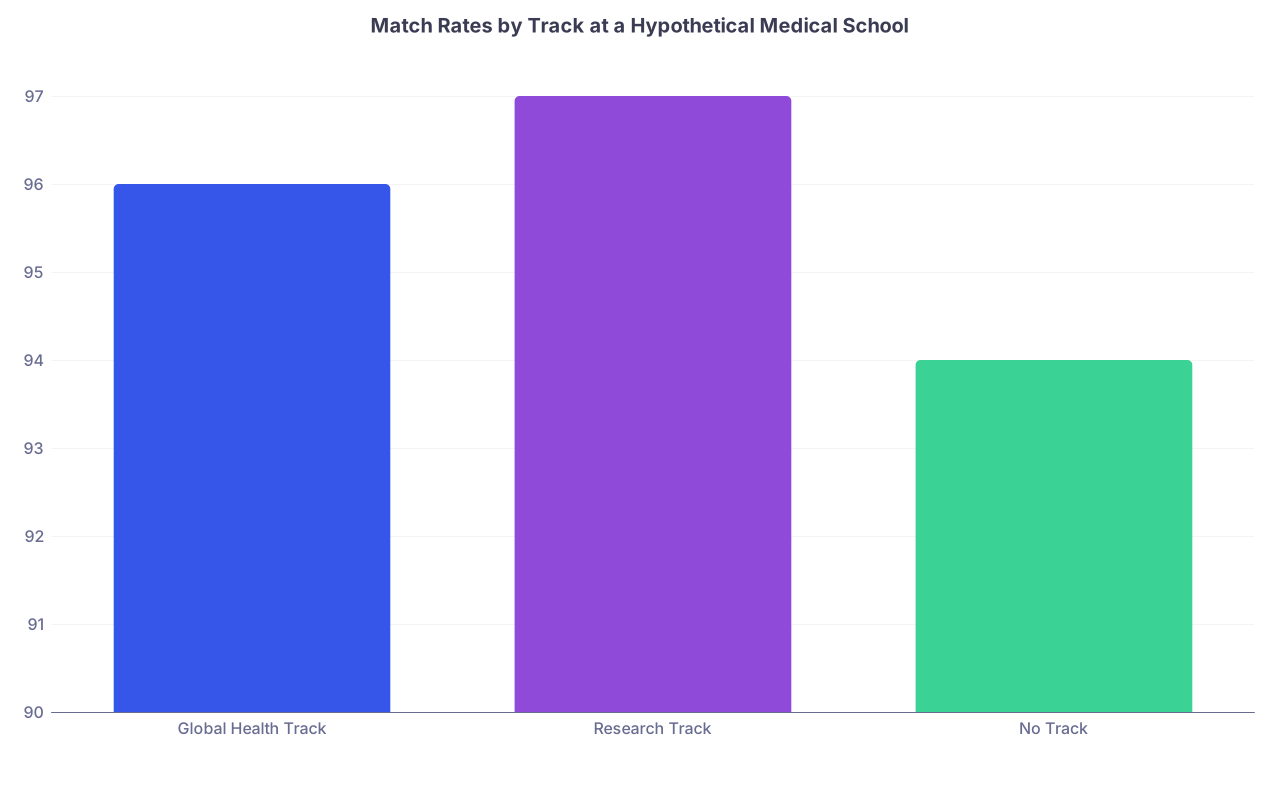
| Category | Value |
|---|---|
| Global Health Track | 96 |
| Research Track | 97 |
| No Track | 94 |
Looks impressive at first glance—until you realize those are tiny differences well within noise and self-selection. When you adjust for Step scores and class rank, the “track” effect usually fades.
So no, the data does not support “global health = higher match odds” as a general rule.
Where Global Health Actually Helps (And Where It Flat-Out Doesn’t)
Global health is not useless. It’s just not the blunt instrument people think it is.
There are a few specific cases where it can move the needle:
1. When It Aligns Directly With a Program’s Identity
Some programs genuinely care about this stuff because it’s woven into their mission and funding.
Think of places like:
- Family medicine programs with longitudinal work in migrant health or overseas partner clinics
- EM residencies that run global emergency medicine fellowships
- IM programs with long-standing partnerships in sub-Saharan Africa or South Asia
At those places, serious, coherent global health engagement—over years, not weeks—can do three things:
- Signal alignment with their mission
- Give you a narrative that makes sense to them
- Provide faculty sponsors who already know the faculty there
That is not the same as “any global health trip helps everywhere.” It’s “if you’re applying to a program that clearly advertises global health as core, and your experience is deep and sustained, that’s a plus.”
If all you did was a two-week surgical “mission trip” once in M2 because your school pushed it, don’t pretend this is a defining alignment point. Program directors can smell padding from a mile away.
2. When It Leads to Real Scholarly Output
This is the one genuinely high-yield angle.
Global health that becomes:
- First-author papers
- Posters at major conferences
- Quality improvement projects with hard data
- Grant-funded work
…is just research with a global label. Programs do value that.
You want global health to help you? Turn it into measurable scholarship. A well-designed outcomes project on TB treatment adherence in a partner clinic will look better than ten “I held babies for the camera” trips.
3. When It Shapes a Compelling, Credible Narrative
Most personal statements about global health are unusable. They wander into savior fantasy, trauma tourism, or generic “I want to help the underserved” clichés that could be written without ever leaving your home country.
The minority that stand out do three things:
- Acknowledge power imbalances and ethics
- Reflect on system-level problems, not just individual suffering
- Show how the experience changed your actual choices: research focus, language learning, advocacy, career path
Program directors don’t care that you “found your calling” in rural Peru. They care whether that experience turned you into someone who:
- Takes resource constraints seriously
- Works well in unfamiliar environments
- Understands health systems, not just diseases
When it does that—and you articulate it cleanly—that can differentiate you from the pile. Not override your scores, but sharpen your story.
The Ugly Side: When Global Health Hurts You
This rarely gets said out loud, but I’ve heard it behind closed doors more than once.
Global health experience can actually be a negative in three situations.
1. When It Looks Like Ethical Tourism
You know the photos. You’ve probably cringed at them yourself.
Students doing procedures they’re not trained for. Clinics with no continuity of care. No local ownership. Lots of emotion, not a lot of outcomes. That “I went there to save them” undertone.
Some faculty hate this. Intensely.
If your application reads as “short-term, unstructured, ethically sloppy volunteerism,” a subset of attendings will question your judgment. Especially in fields that prize systems thinking and long-term follow-up.
If your experience involved any of the following and you brag about it, that’s a problem:
- Doing procedures without proper supervision or credentialing
- Writing prescriptions when you wouldn’t be allowed to at home
- Going with no meaningful preparation or follow-up plan
You may think you’re showing initiative. They may see a safety hazard with a passport.
2. When It Crowds Out Core Competence
There’s a pattern I’ve seen at more than one school: the “global health keener” who’s constantly abroad, constantly in meetings, constantly starting another project—and underprepared clinically.
Program directors don’t want someone who can design a lovely outreach program but can’t manage DKA on night float.
If your transcript and comments suggest marginal clinical performance, and your CV screams “I was always gone doing global health,” some reviewers will connect those dots. Fair or not.
A brutal but honest quote I’ve heard:
“I don’t need an international health policy expert who can’t read an EKG.”
Make sure your global work looks like an extension of your competence, not a distraction from it.
3. When It Feels Performative or Overplayed
If every part of your application is global-this, global-that, global-everything, and you’re applying to a community IM program that mostly serves a local, low-income, urban US population, reviewers may get skeptical.
They’ll wonder:
- Are you actually going to stay here and do the work we do?
- Or is this just a stepping stone before you jet off to NGOs and conferences?
If your stated long-term goal clearly has nothing to do with the program’s actual patient population, they might pass in favor of someone who’s a better fit.
Global health is not universally admired. For some reviewers—especially those burned by flimsy overseas projects in the past—it triggers eye-roll, not admiration.
The Time Trade-Off Problem: What Are You Not Doing?
Every week you spend abroad is a week you’re not:
- Strengthening core research with local mentors
- Doing high-yield home institution projects
- Building relationships with people who will actually write your letters
- Studying for Step or crushing your clerkships
If you’re already strong across the board, you have room to explore. If you’re marginal on scores or clinical comments, I’ve seen global health become a very expensive distraction.
Think about it this way:
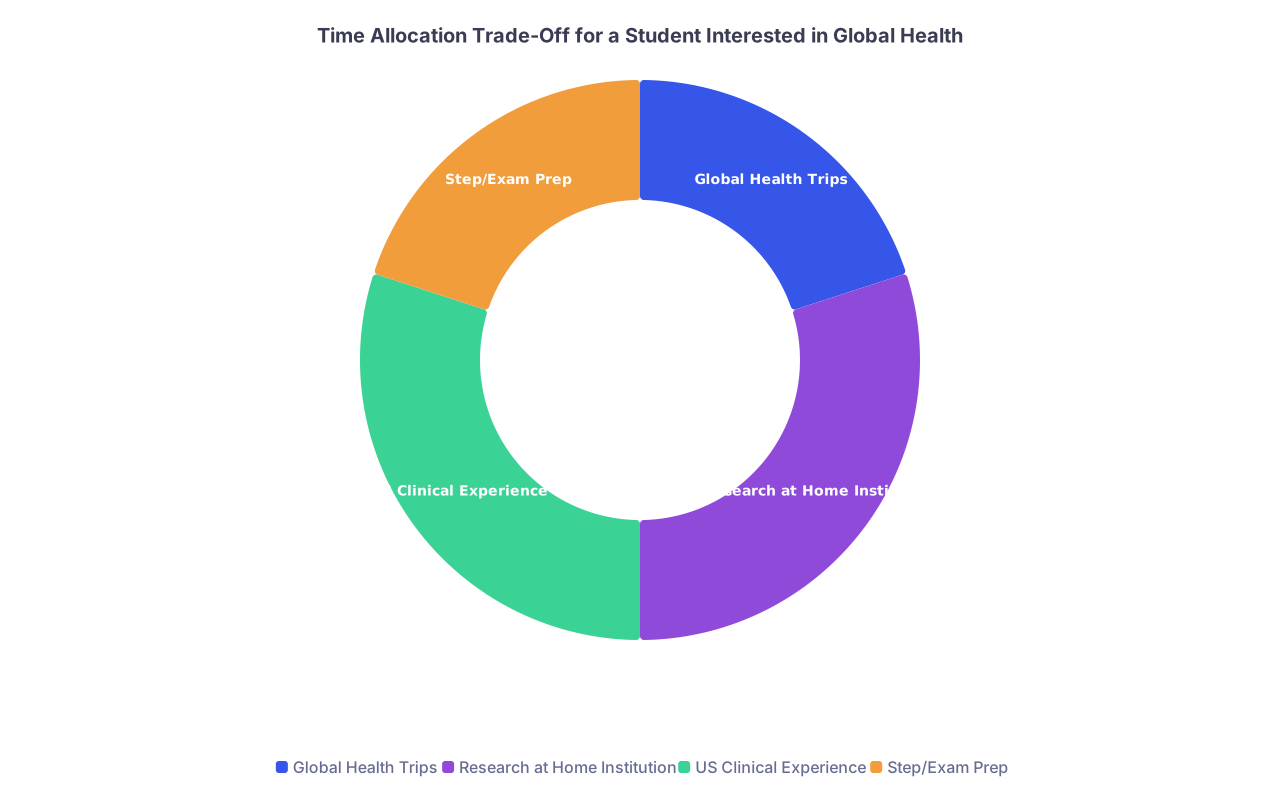
| Category | Value |
|---|---|
| Global Health Trips | 20 |
| Research at Home Institution | 30 |
| US Clinical Experience | 30 |
| Step/Exam Prep | 20 |
Shift that 20% “Global Health Trips” slice around. If moving even half of it into “research at home” or “exam prep” could bump your Step 2 or your publication list, the cold-blooded match strategy might be to stay home.
Romantic? No. Effective? Usually.
The Ethical Piece: Are You Actually Helping Anyone?
We’re in the “medical ethics” bucket, so let’s not ignore the obvious.
The global health literature is now full of critiques of:
- Short-term electives with minimal local benefit
- Projects that collapse when the foreign students leave
- Local trainees sidelined so visiting students can “get experience”
- Power dynamics where institutions in high-income countries dictate terms
Many faculty now expect you to demonstrate actual ethical reflection, not just emotion. When you talk about your global work, are you asking questions like:
- Who asked for this project?
- Who owns the data?
- Who benefits once I leave?
- What capacity-building actually occurred?
If your global health story shows humility, partnership, and continuity, it helps your credibility. If it reads as colonial-lite, it doesn’t just fail to help—it undermines you.
So Should You Do Global Health or Not?
Here’s the blunt answer:
Do global health because you care about it and you’re willing to do it well. Not because you think it will rescue your application.
If you are genuinely drawn to it, here’s how to make it actually contribute to your career rather than just your photo album:
- Embed yourself in one site or partner for years, not weeks.
- Seek projects with measurable outcomes and local leadership.
- Turn at least part of your work into real scholarship.
- Keep your clinical skills and exam performance non-negotiably strong.
- Talk about your experience with nuance: ethics, systems, limitations, and what you learned, not how much you “gave.”
And if your only reason for considering it is “I heard it helps you match”? Do something else. You will get more match mileage out of one excellent letter from a US attending who watched you crush a sub-I than from three glossy global health trips.
To wrap this up simply:
- Global health work, by itself, does not reliably boost match odds once you control for scores, grades, and research.
- It helps when it leads to real scholarship, deep alignment with certain programs, and a mature, ethical narrative—not when it’s shallow or performative.
- If you care about global health, commit to doing it well over time; if you only care about matching, fix your scores, your clinical performance, and your letters first.


