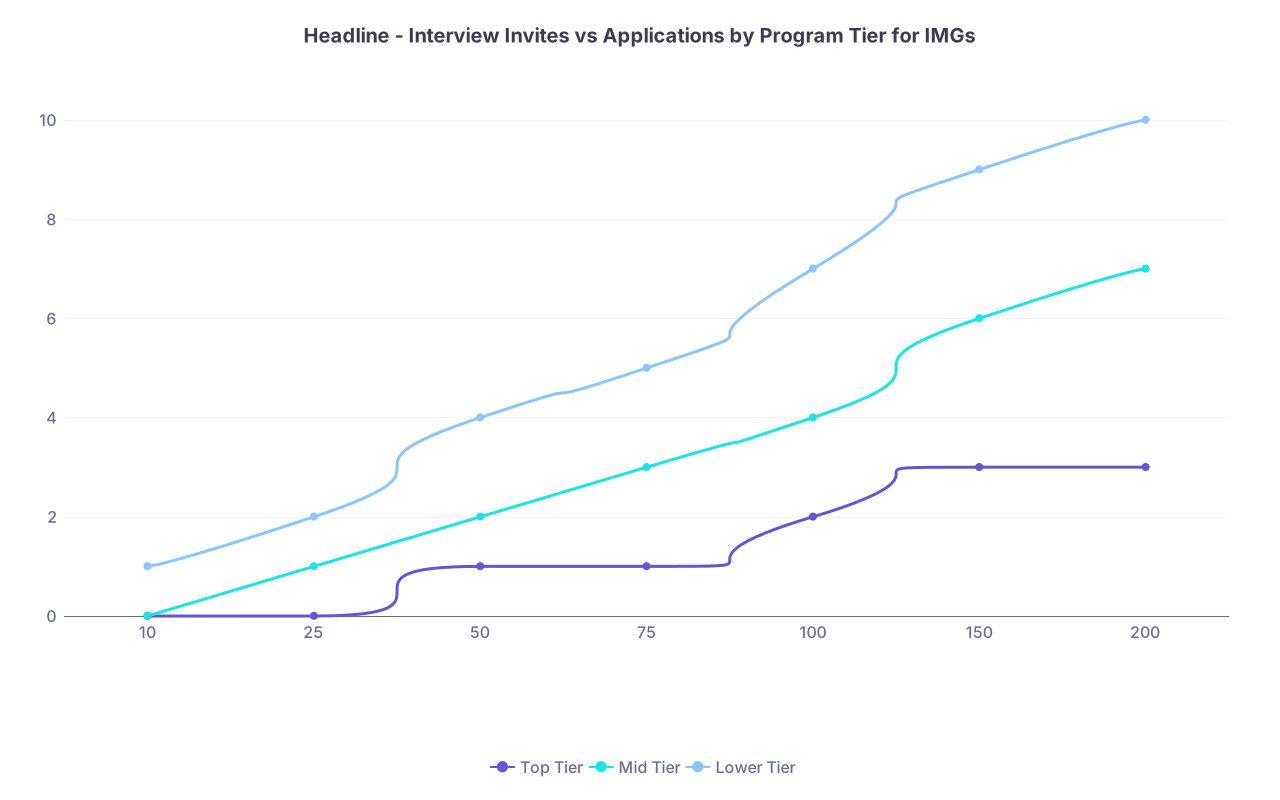
ERAS does not care about the prestige of your international medical school. It cares about machine readability. When an International Medical Graduate (IMG) uploads a foreign transcript, the ERAS system runs it through an automated Optical Character Recognition (OCR) parser. If the parser fails to read the document structure, your application stalls. I have watched brilliant candidates miss the entire September interview invite wave because a clerk in their home country scanned a document at 72 DPI or used a non-standard font.
The ECFMG and ERAS automated parsing software expects standard US formatting. It looks for clear headers, standard credit-hour equivalents, and legible English text. When the system encounters a densely packed, non-standard foreign grading matrix, it throws a flag. The hidden cost of this formatting discrepancy is brutal. A flagged transcript places an administrative hold on your ECFMG Status Report. Program coordinators see an incomplete application status. They move to the next candidate. You lose weeks of prime interview season waiting for a manual review that could have been avoided with basic operational foresight.
Proper preparation of these files is critical, much like handling Why ERAS Document Mismatches Get You Skipped during the application cycle.
Anatomy of a Flagged Transcript: 4 Common Structural Failures
You must understand exactly how your document fails before you can fix it. The ERAS system rejects foreign transcripts for four specific structural reasons.
1. Non-Standard Grading Scales and Missing Credit-Hour Conversions Your medical school might use a 1-10 scale, a percentage system, or a descriptive grading matrix. ERAS expects a 4.0 GPA or standard letter grades. I have seen transcripts from Eastern Europe using a 5-point scale where a 3 is passing and a 5 is excellent. The ERAS parser reads a "3" and assumes a failing grade in the US system. Without an official, merged conversion key, the system rejects the document outright.
2. Language Mismatch Issues You upload a translated document, but the institutional stamp is in Cyrillic, Arabic, or Mandarin. The translation ignores the physical seal, or the translator fails to explicitly account for the stamped text. The parser flags a discrepancy between the original document and the English translation.
3. Improper Document Resolution and Compression Artifacts Taking a photograph of your transcript with your smartphone is professional suicide. I watch candidates do this every single year. They stand under fluorescent lights, cast a shadow over their own name, and upload a blurry JPEG. The compression artifacts blur the text. The OCR reads a "B" as an "8". The system fails.
4. Institutional Header and Registrar Signature Omissions A transcript without the official university letterhead or the registrar's physical (or verified digital) signature is just a piece of paper. Helpful clerks often print grades directly from a database onto plain white paper. This triggers an immediate manual review hold.
The Step-by-Step Protocol to Format and Convert Your Foreign Transcript
Fixing this requires a rigid, phased approach. Do not skip steps. Do not assume your medical school's administrative staff understands US residency requirements. They do not. You must manage this process yourself.

Actionable Phase One: Requesting the Official Registrar-Sealed Document
Demand a digitally signed PDF or a physically sealed envelope from your medical school registrar. Do not accept a plain printout. If they provide a physical document, scan it yourself. Use a flatbed scanner. Set the resolution to exactly 300 DPI. Save the file as a PDF. Do not use a mobile scanning app. Mobile apps introduce perspective distortion that destroys OCR readability. Ensure the scan includes the full page, capturing all four corners and the official institutional letterhead at the top.
Actionable Phase Two: Standardizing Grading System Explanations
Do not rely on general internet conversions or third-party credential evaluators for the document itself. You need an official letter from your Dean or Registrar on university letterhead. This letter must explicitly outline the institutional grading scale and its exact US equivalent. The letter should state: "A grade of X on our scale is equivalent to a US grade of Y." Merge this grading scale explanation directly behind your transcript in a single PDF file. The ERAS parser reads the first few pages to establish context. If the conversion key is on page one, the parser applies it to the grades on page two.
Actionable Phase Three: Partnering with Certified Translators
If your document is not in English, you must use a certified translation service that understands ECFMG compliance standards. Do not use a family member. Do not use a standard online translation tool. The translator must provide a signed certification page. They must translate the text, the institutional stamps, and the seals. Merge the original language document, the certified English translation, and the translator's certification page into one single, continuous PDF. The original document must always come first, followed by the translation.
Actionable Phase Four: The Pre-Flight Checklist
Before you hit submit on the ERAS portal, run this exact checklist:
- File Size: Ensure the PDF is under 1 MB. Use a PDF compressor if necessary, but do not drop the resolution below 150 DPI.
- OCR Verification: Open the PDF in Adobe Acrobat or a standard browser. Press
Ctrl+A(orCmd+A). If the text highlights, the OCR works. If it selects the page as a single image, your document will fail. You must run OCR on the PDF before uploading. - Merge Order: Verify the page order. Grading scale letter first, transcript second, translation third (if applicable).
- Naming Convention: Name the file clearly. Use
LastName_FirstName_Transcript_ECFMG.pdf. Do not use special characters or spaces in the file name.
Emergency Fixes: What to Do If Your Transcript is Already Flagged
You missed the proactive window. Your transcript is flagged. Your ECFMG Status Report shows a hold. You are losing time. Here is how you execute an emergency recovery.
Contacting ECFMG Applicant Services Do not send a generic email through the web portal and wait. Call them. Call at 7:00 AM EST to bypass the midday queue. Have your USMLE ID and ERAS token ready. State clearly: "I am calling regarding an urgent transcript formatting correction for the residency match. My document was flagged for [specific reason], and I have the corrected file ready to upload." Be polite, but be firm. You need them to clear the hold so your new upload does not get stuck behind the old one.
Drafting a High-Impact Addendum Letter Program coordinators need to know why your application is incomplete. Draft a concise, professional email to the coordinators at your top-choice programs. Keep it under fifty words. Example: "My ECFMG Status Report currently shows a pending transcript verification due to an administrative formatting hold. The corrected document was submitted on [Date] and is processing. My application is otherwise complete and ready for review." Do not over-explain. Do not complain about your medical school. State the facts and move on.
Re-Upload Protocols
Do not just upload the exact same file with a new name. Fix the actual error. Once corrected, rename the file to include the word "CORRECTED" (e.g., LastName_FirstName_Transcript_CORRECTED.pdf). This signals to the manual reviewer that this is a revised submission, prompting them to replace the old file rather than review both.
Immediate Action Steps
Stop waiting for your medical school to fix their administrative errors. Take control of your documentation today.
- Audit your current transcript. Open it on your computer. Highlight the text. If it does not highlight, scan it again at 300 DPI and run OCR.
- Secure the grading key. Email your Dean or Registrar today. Request an official, stamped letter explaining your grading scale in US equivalents.
- Merge your documents. Combine the grading key, the transcript, and any translations into a single, optimized PDF.
- Verify the translation. Ensure your certified translator explicitly translated all institutional stamps and seals.
- Upload before August. Submit your finalized, pre-flighted document to ERAS well before the September rush to guarantee processing.
Key Takeaways
- ERAS flags transcripts primarily due to OCR readability issues, missing credit conversions, and non-standard grading scale explanations.
- Always include an official grading scale conversion key directly endorsed by your medical school's registrar, merged into the same PDF.
- Proactive formatting prevents automated system rejections that can cost you precious interview invites during the critical September application rush.